It has been a time of small coincidences in the Petersfield Oxfam bookshop.
(I’m no believer in fate, or things that were meant to be, but I like a nice coincidence as much as the next woman.)
One day recently, I was sorting through a small avalanche of donations and my mind began to wander to the catering for our annual winter lunch.
Feeding 30 plus people is not in itself hard as long as you chose your menu wisely.
Individual soufflés anyone?
Last year I made pies and I am, though I say it myself, a reasonable shortcrust pastry maker but pastry does require a bit of faff and multiply that by 30 people’s worth of faff and I shan’t do that again this year.
One year I made a chicken something or another which I got from inside my head rather than any recipe book and that was all very well until I learned a well-know chef had decided to come.
My lodestar for deciding what to cook is a farmer friend who likes his food, is always very appreciative and – because he can’t do with eating standing up – he leads the way to our outdoor table and others follow, thus easing the elbow-to-elbow crush in the house.
So, there I am thinking about what he would like, his exacting palate – and praying it doesn’t rain.
And I am still book-sorting away when I came across this little foodie delight.
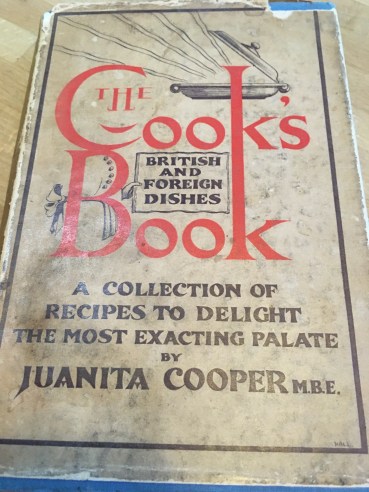
Usually, we have out winter lunch two weeks before Christmas which means it would be on December 16th but because of pressure on that end of the month, we decided to have it on the 9th.
So imagine my pleasure at finding that inside the book was this:
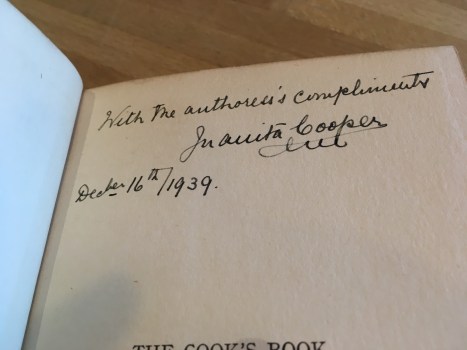
Of course that doesn’t quite fit into the perfect coincidence, but it was nice non the less.
So, I thought I would have a read and see if there was any recipe I could use……..
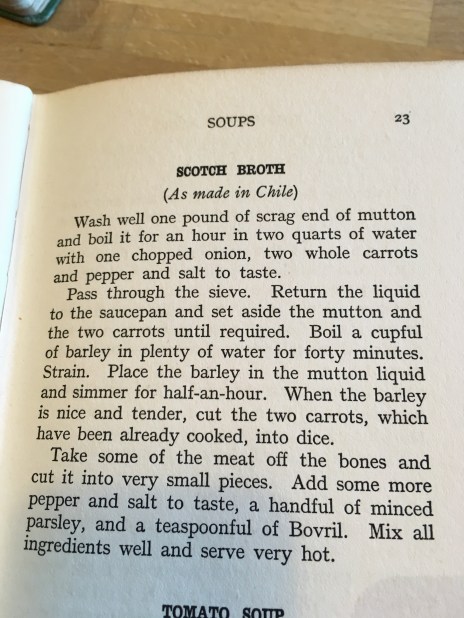
I am still not entirely clear what gets passed through a sieve…. and who would have thought Bovril was an essential ingredient in 1930s Chile?
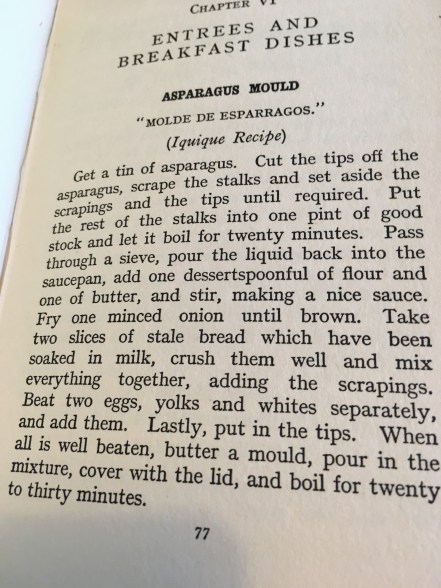
There is no doubt, none at all, that that asparagus would be well and truly cooked through….

Chicken meringue – I am not sure my farmer friend would go for that.
And finally,
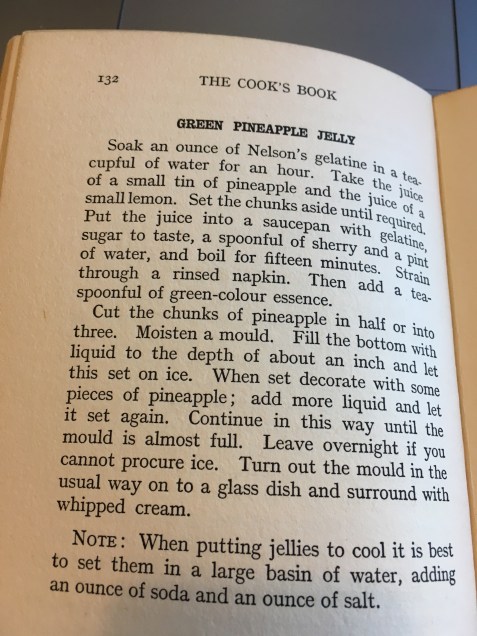
It was interesting to gather that not everyone who bought this book would have had access to ice – no fridges.
Call me a lax cook if you will, but I decided against trying to source Nelson’s gelatine and boiling tins of pineapple, straining them through rinsed napkins and then adding green food colour.
Leaving recipes behind, I turned my attention to natural history. It is hard to be sure any patterns when it comes to what is donated to the shop.
Just as you lament the lack of paperback fiction, the shelves are nearly bare and you think, this at last must be the Kindle effect, a tonne of novels arrive.
So, I am hesitant to share my theory on natural history books but here goes anyway.
We used to get lots and lots of books about natural history – from birdwatching to fossils to geology to, and given where we are this is not surprising, a lot of copies of Gilbert White’s Natural History of Selbourne.
( I always saved a particularly good version of this to see at Christmas – it makes a good present.)
Recently though, we have had very little and when I say recently, I mean perhaps the last year or so.
My theory is that people no longer look at the small and local and want to see Blue Planet or programmes about lions of the Kalahari.
But we do occasionally get copies of books from the New Naturalist Series – they have marvellous covers and sell very well.

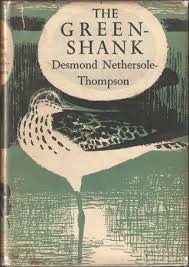
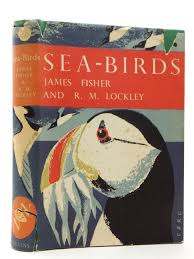

(I could bore you with the background information on why some are worth much more than others but I am guessing you don’t really, in your heart of hearts, want to know.)
Anyway, we have had some in recently so I put together a table display of them and some other stragglers of natural history.
It sold so well that instead of lasting a week, I had to re-think the table three days later.
We also get some books in the Wayside and Woodland series published by Frederick Warne.
And, just after I had re-done the table, I’m sorting some books, and this came in.
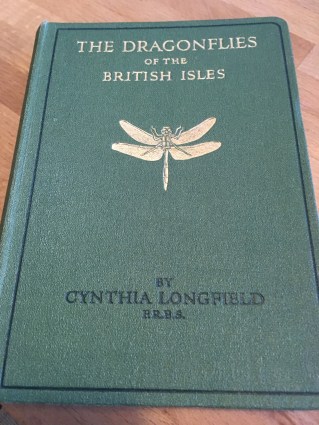
How interesting I thought, it is by a woman. I wonder who she was.
And inside I found this:
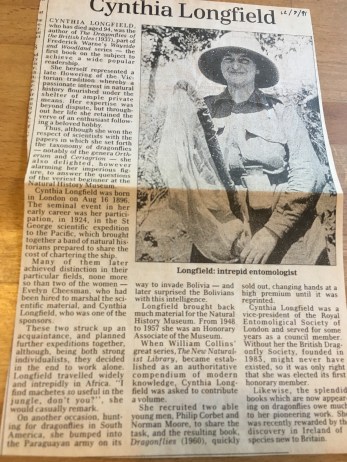
It says that her book, this book I am holding in my hand, was the first book on dragonflies to ‘achieve wide popular readership.’ ( Now apparently worth about £25.)
It also says that Cynthia Longfield used some of her ‘ample private means’ to part sponsor the chartering of a ship containing ‘a band of natural historians’ who went on a exploratory trip to the Pacific.
She travelled widely in Africa:’ I find machetes so useful in the jungle.’
And guess what else it says about the Cynthia – she was asked to contribute a volume to the New Naturalist Series which ‘ quickly sold out, changing hands at a high premium until it was re-printed.’
Indeed the 1960 first edition is now worth about £90.
We have a copy. It came in with the other New Naturalists and my colleague who collects them valued them for me, so I didn’t notice her name. It is in our cabinet of valuable books.

Satisfying coincidences all round.
 thereluctanthousewife