I don’t want to harp on about my holiday in Italy and visiting churches, but hey ho you need to know about the pink priests.
A warning though, the pink priests come at the end.
As I mentioned before, I do like visiting a church.
So, on a recent trip to Italy, (I may have mentioned that before too) there was one church which had a lot of confessional booths.
When I say a lot, I don’t mean a few, I mean about 20.
Yes really.


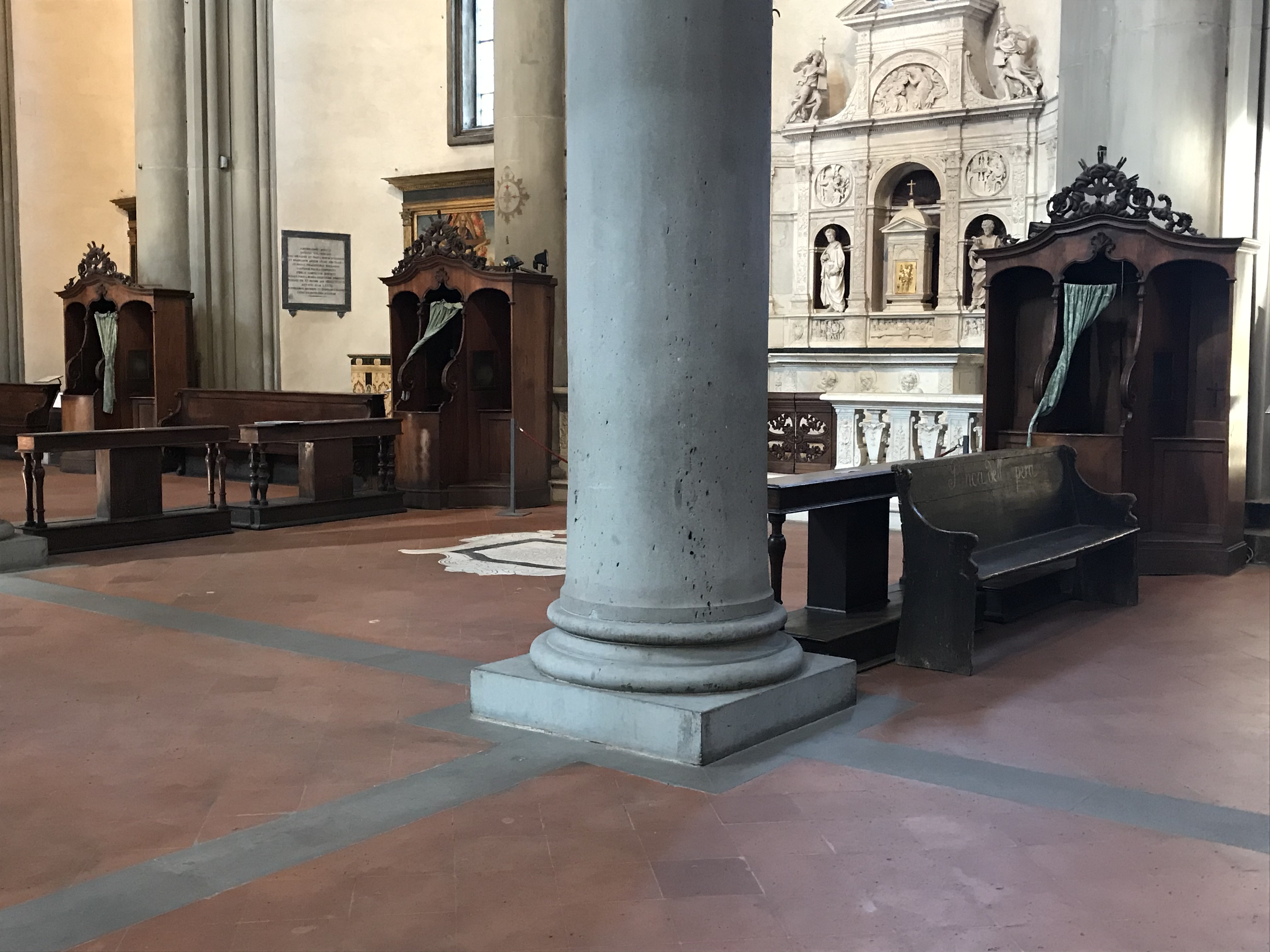
The comedian Zoe Lyons recently said of confession, ‘ You were locked in a wardrobe with a priest, and then you had to tell him what you had done wrong. The irony.’
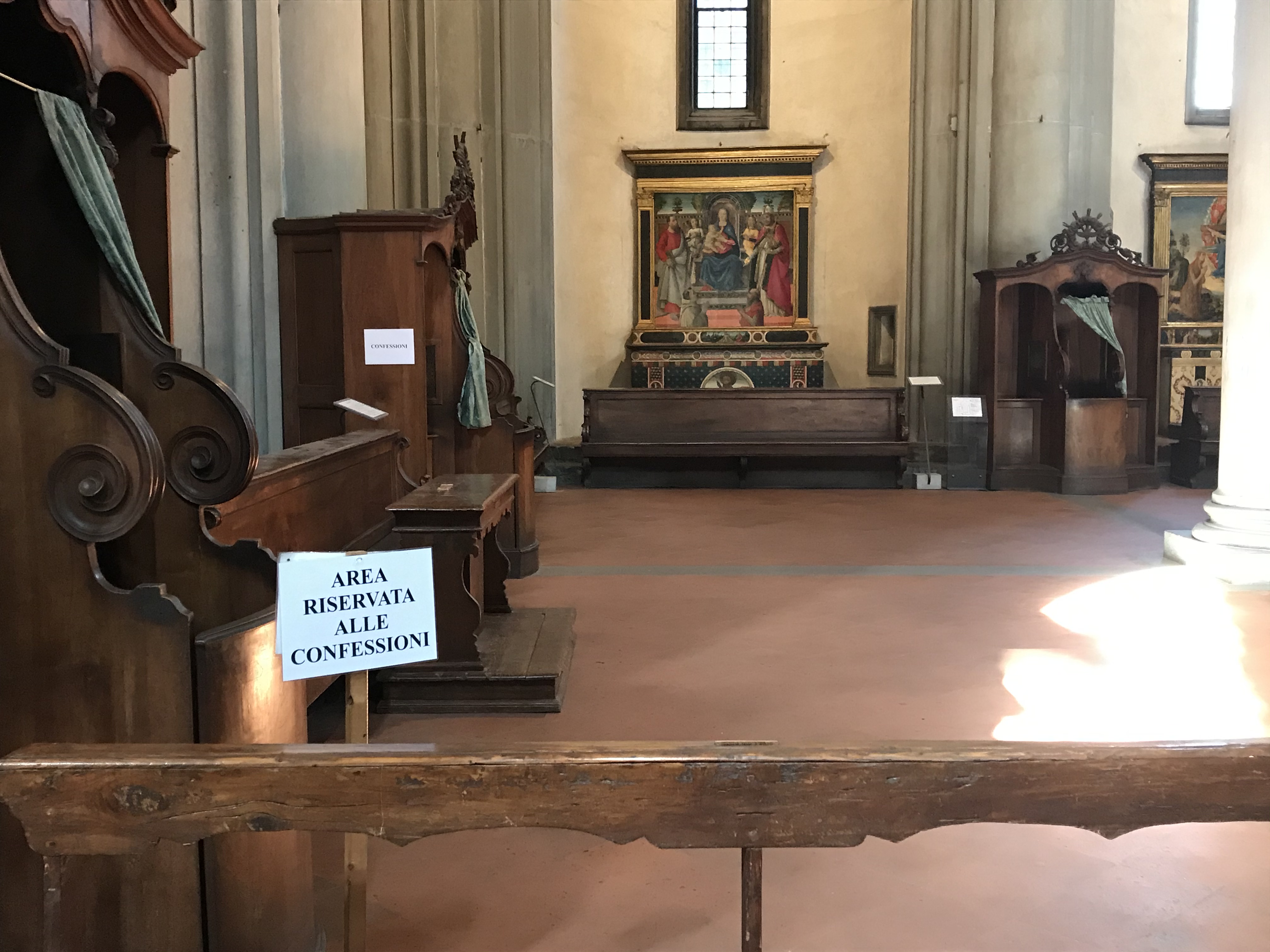
Well, the people of Lucca had clearly got a lot to talk about and they didn’t have the privacy of a locked in wardrobe. No, you had to kneel so that everyone else could see you.
Mind you, you did have a choice of venue booths, as it were.
That same church had a lot of plaques on the ground (I am sure there is a technical church term for them) which had once shown the likeness of the dead person but had been worn smooth.


I’d just like to say at this point that they may have been worn smooth as much by tourists as penitents but when I was there, I was one of the few visitors. ( Yes, I know I shouldn’t have boasted.)
But hey ho.
Anyway, so what was there about the people of Lucca which was so reprehensible that they need so many confessionals?
Well, I don’t know, but I did Google ‘Lucca scandals’ to find out if there had been anything which would have swept the populace into the confessional and came up with something on the Daily Mail online (of course).
“The Italian city of Lucca was today accused of ‘culinary racism’ after it banned new foreign eateries from opening in its historic centre.”
Further ( much further) down the article, there was this comment from the town’s authorities
“A spokesman for Lucca’s town hall defended the new rules, saying they were meant to safeguard the city’s traditional and cultural identity and that it also applied to sex shops, fast food restaurants and take-away pizza parlours.
‘The ban targets McDonald’s as much as kebab restaurants,’ he said.
The town council is also urging foreign restaurants to include on their menus at least one course typical of Lucca, prepared exclusively with local ingredients.”
I am not sure if the confessionals need to be used by people who are not offering sex with a traditional Luccan menu, but you never know.
Looking further back, (courtesy of Wikipedia) it turns out that Lucca had a busy time in history and within that plenty of scope for people to do things they might later regret:
‘In 1408, Lucca hosted the convocation intended to end the schism in the papacy. Occupied by the troops of Louis of Bavaria, the city was sold to a rich Genoese, Gherardino Spinola, then seized by John, king of Bohemia. Pawned to the Rossi of Parma, by them it was ceded to Mastino II della Scala of Verona, sold to the Florentines, surrendered to the Pisans, and then nominally liberated by the emperor Charles IV and governed by his vicar. Lucca managed, at first as a democracy, and after 1628 as an oligarchy, to maintain its independence alongside of Venice and Genoa, and painted the word Libertas on its banner until the French Revolution in 1789.’
Now, you could confess to being one of the people who sold your city to the Genoese, helping John of Bohemia to seize it, being involved in pawning it, selling it to the Florentines and as I am not sure of the dates of all this, your family could have done all of the above.
If you surrendered to the Pisans, you might feel a bit guilty, and if you helped Charles IV you might feel you needed to show to his vicar that you were someone who knew their way into a confessional.
So, who knows why there are so many confessionals but leaving aside food racism and everything from selling your city to wresting it from democracy to oligarchy, there must have been a few adultery, theft, gluttony, sloth, pride ‘issues’ to bring along – and maybe that was just the priests.
Talking of priests, we have finally dear reader, got to the pink ones.
So, yet another church but this time acting as a gallery for photographic images of the Volto Santo procession.
(The Holy Face of Lucca (Volto Santo di Lucca) is an eight-foot-tall (2.4 m), ancient wooden carving of Christ crucified in Lucca.)
According to medieval legend, Nicodemus, a figure often referred to as a Pharisee and is rumoured have met with Christ, carved from memory the face of Jesus. However, he hesitated to complete his carving for fear of not doing it justice. Exhausted from the work, he fell asleep. When he awoke, he found the face was finished and claimed it to be the work of an angel. The story then tells us that the Crucifix of the “Holy Face” was buried in a cave for safekeeping, where it remained for centuries. So you may be wondering if it was buried in a cave then how did it get to Lucca?
It was rediscovered by Bishop Gualfredo, who was on a pilgrimage to the Holy Land when its location was revealed to him in a dream. To allow God to decide where the Crucifix should be kept, the bishop set it adrift on an unmanned boat in the Mediterranean Sea. The Volto Santo arrived on the shores of northern Italy, where the Bishop of Lucca, also prompted by a dream, put it into a wagon with no driver to determine its final location. The two oxen pulling the wagon stopped of their own accord at Lucca in 782.
The story doesn’t stop there, it is also said that the Volto Santo was placed in the Church of San Frediano, but the next morning, it was found miraculously in another church, that of San Martino. Therefore, San Martino was designated the cathedral of Lucca and the wooden statue was left in a special chapel within the church.) Wikipedia.
So, that is the background story, and the festival is all about people from their districts of Lucca and their priests walking to the meeting point with the populace watching, and there are lots of candles and people crossing themselves and celebrations etc etc.
Now, just before I show you a photo of one ‘set’ of priests setting out on their walk with the Volto Santo, and you might think pink and lace on men might just, just, be thought a little bit gay, and you might want to ponder on the Catechism of the Catholic Church which says:
Basing itself on Sacred Scripture, which presents homosexual acts as acts of grave depravity (Cf. Genesis 19:1-29; Romans 1:24-27; 1 Corinthians 6:10; 1 Timothy 1:10), tradition has always declared that “homosexual acts are intrinsically disordered.” (Congregation for the Doctrine of the Faith, Persona humana, 8). They are contrary to the natural law. They close the sexual act to the gift of life. They do not proceed from a genuine affective and sexual complementarity. Under no circumstances can they be approved.

 thereluctanthousewife