Peter Pan and Wendy

So even back in the day there were lots of Peter Pan books published and he still keeps going, and lots of a print run means less value, so what is this one worth?

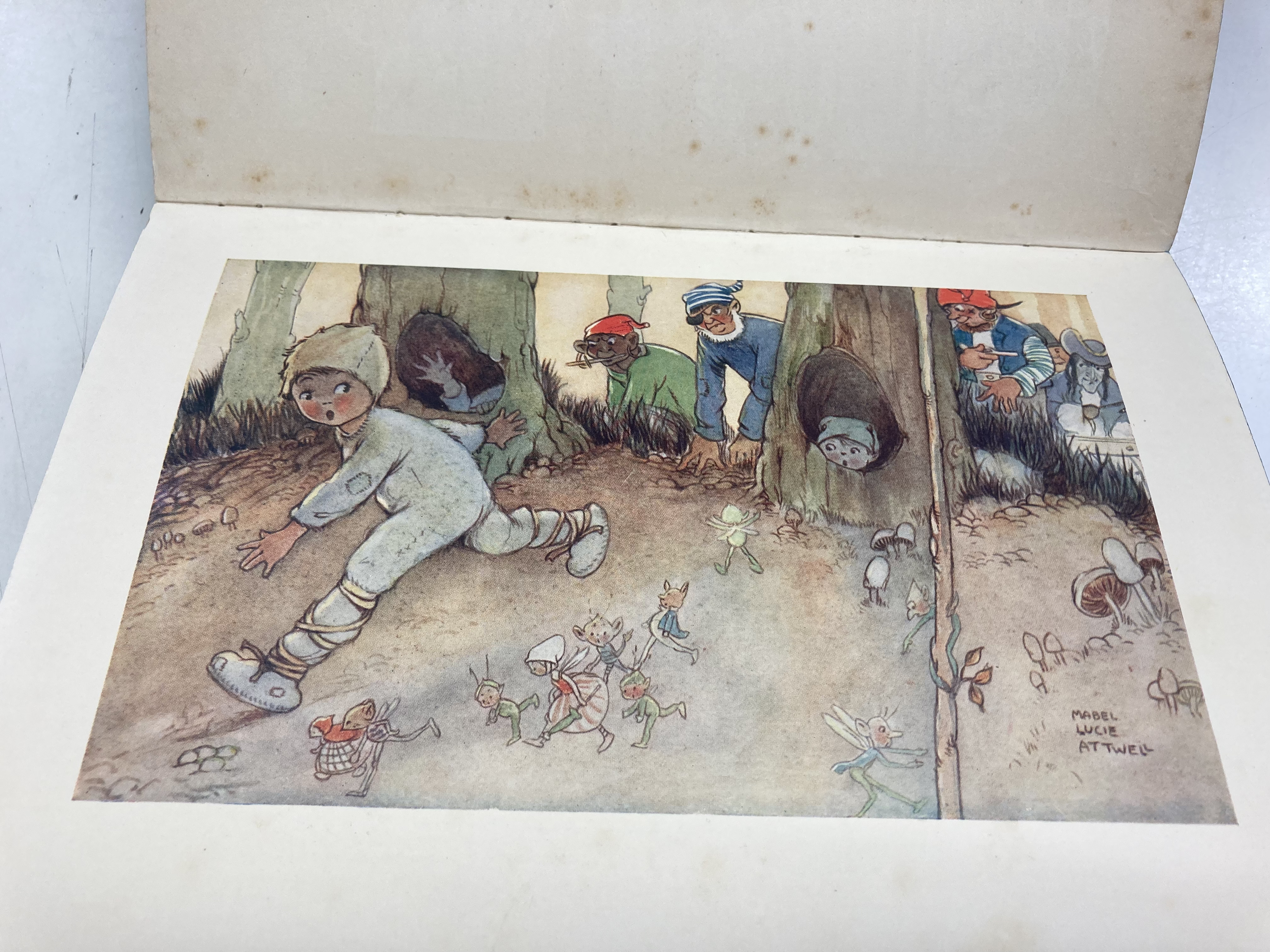
This lovely book came in and I set about working out what it might be worth.

Well there were lots of versions but none of them were exactly like ours – I called in our expert and here are the things we needed to think about.

There is no publication date in the book.
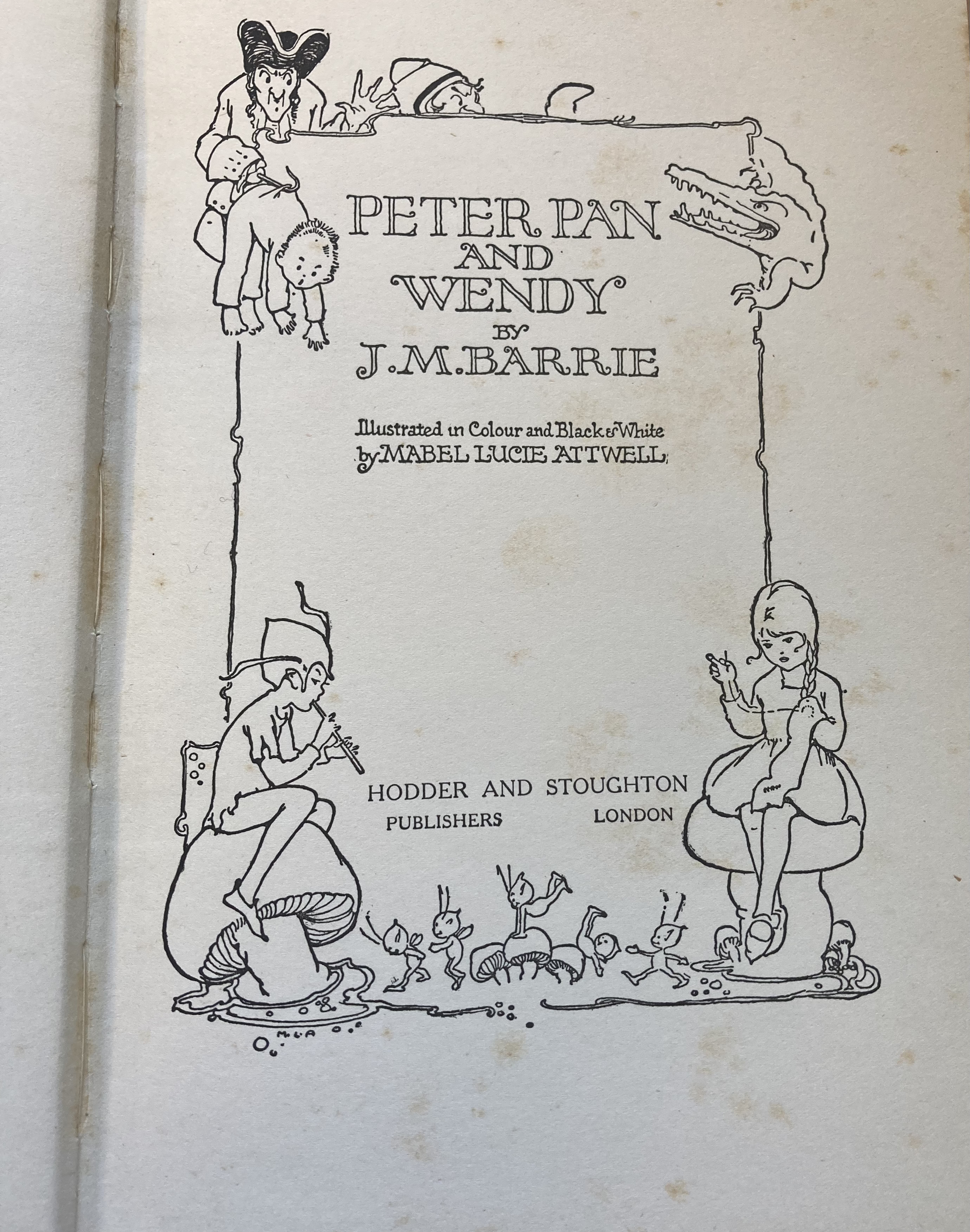
So is it a first edition of this version of the book? Well, we are going with that and that means I need to describe it in the listing as ‘first edition thus.’

It certainly isn’t the first edition ever published ( I wish) but it is ( we think) the first edition of this version of this book.

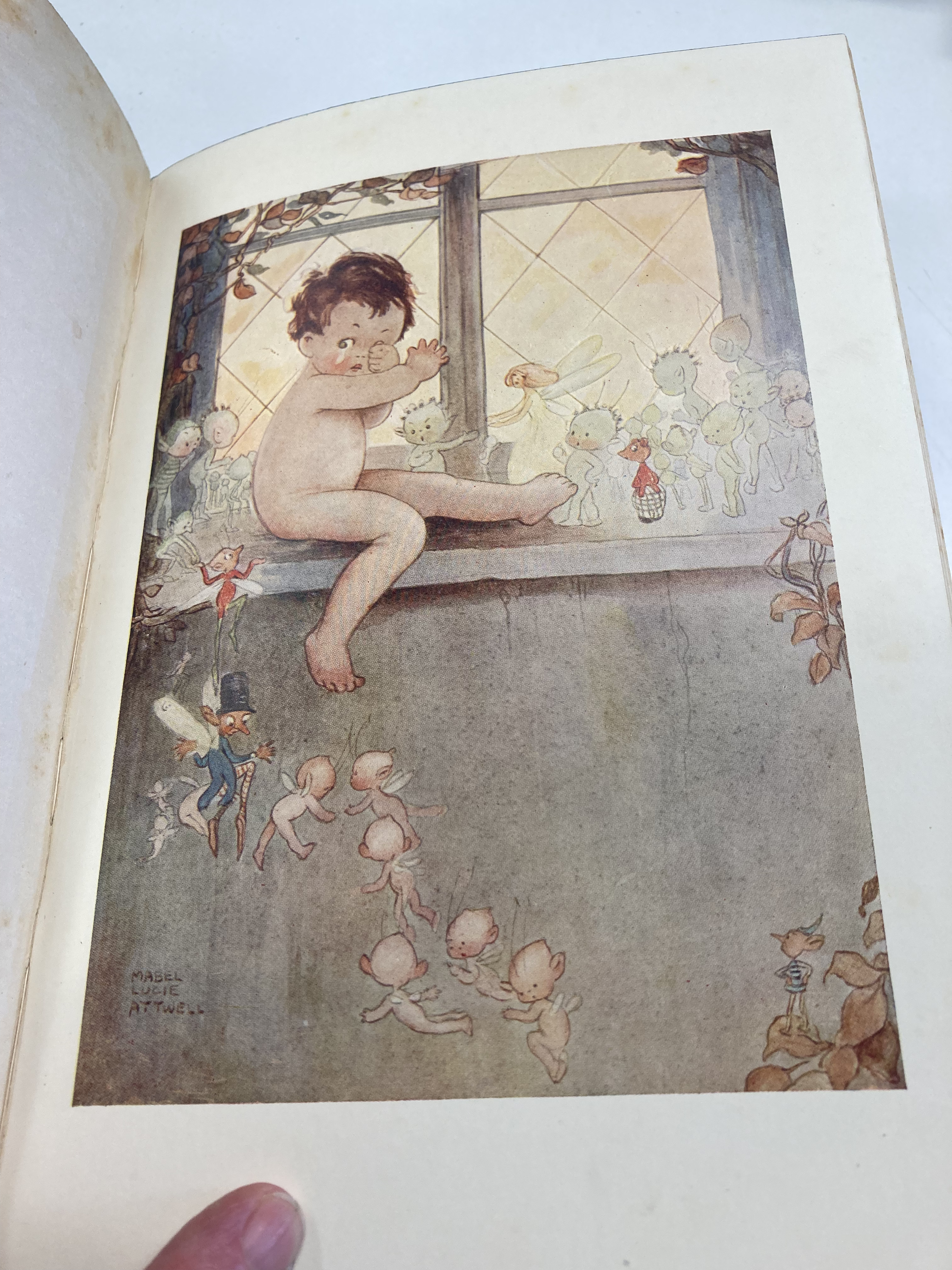
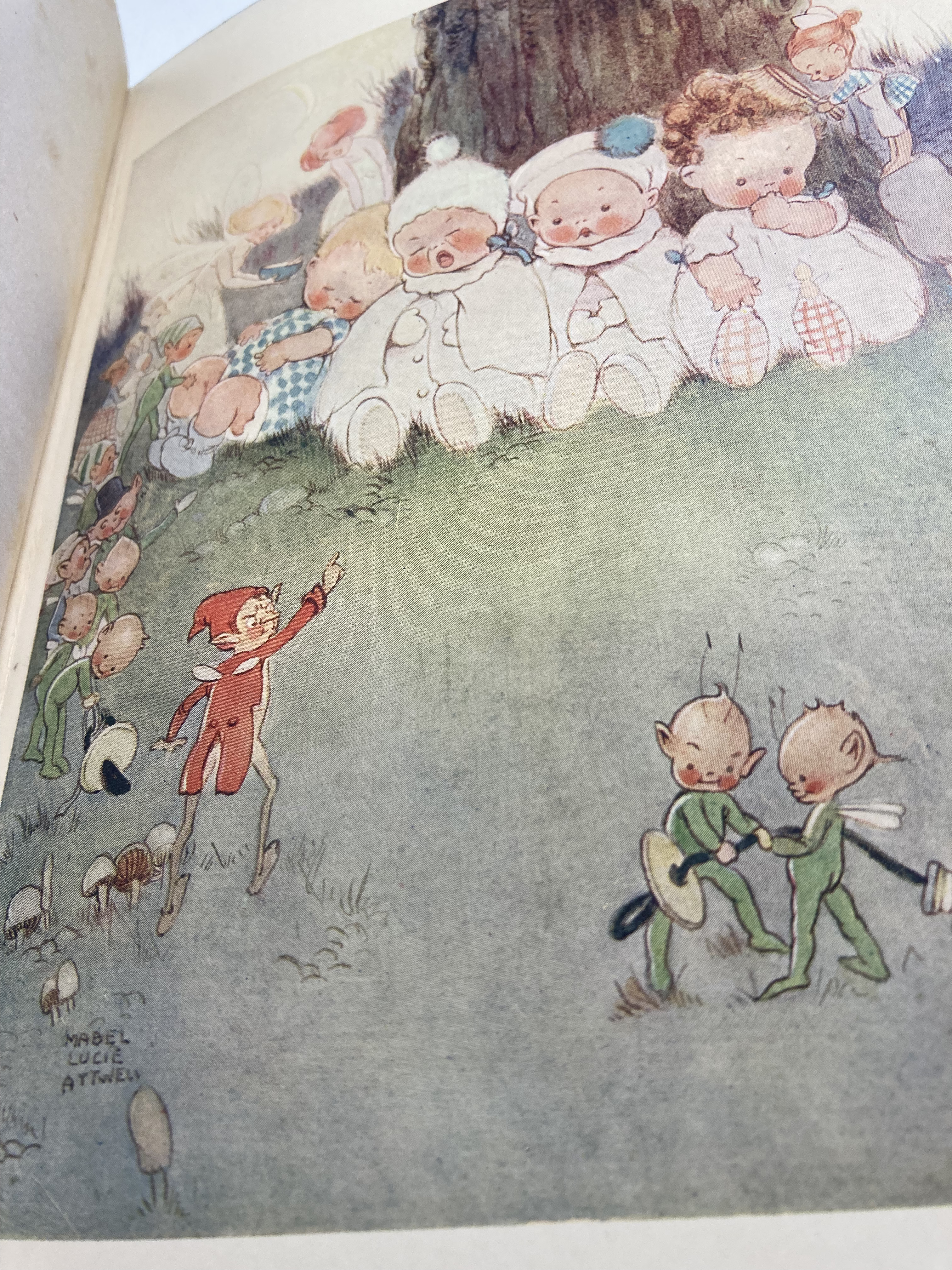
Mabel Lucie Attwell is the illustrator and she is still very popular in a rather charming/kitsch/of her era way.
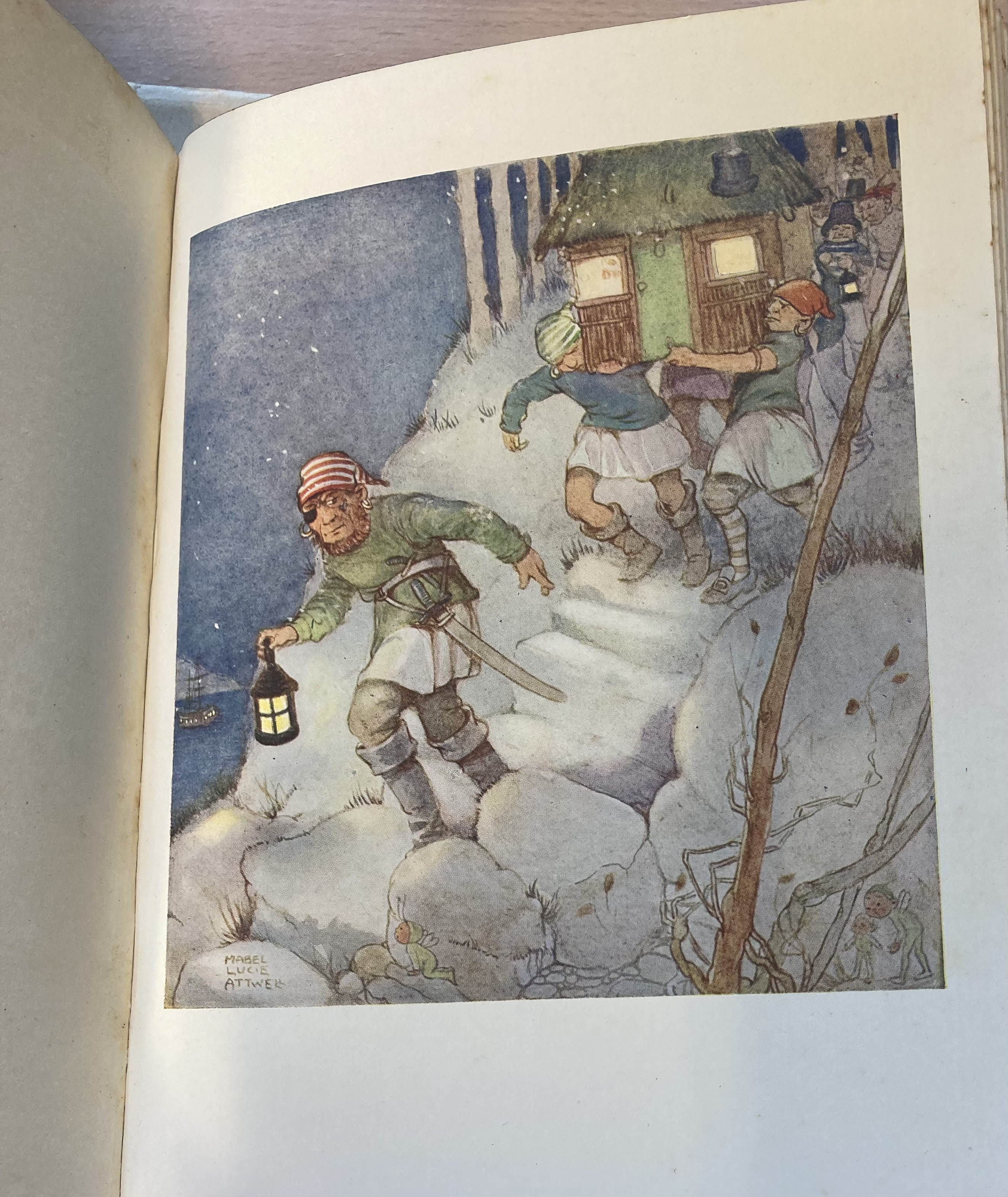
So, she adds value and though the book is somewhat ‘foxed’ (I’ll explain) that doesn’t affect the plates (the pictures.)

We think, given a bit of research that she did this book in the 1920s but not enough research to find out the exact year……

More of MB Attwell later.

Foxing is the reddish-brown spots or splodges on pages and are apparently caused by age and contaminants.
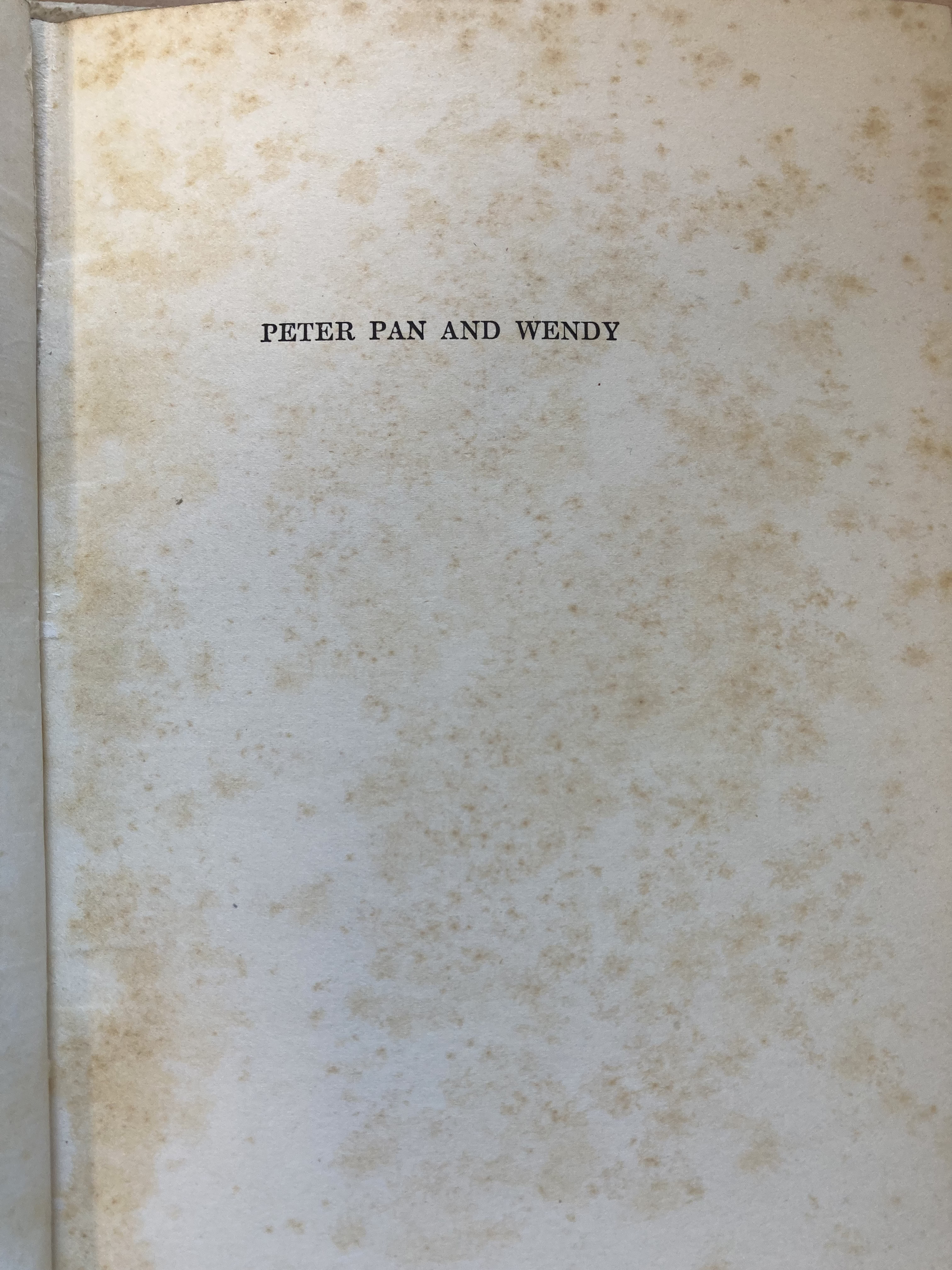
Infact, did you know and I am pretty sure you didn’t, that there is no foxing in incunabula which (just in case you were not entirely sure) are books printed/created before 1500.

Anyway, back to the book.

It has a cover/dust jacket and that makes a huge difference.

A dust jacket makes the value of the book much more interesting.

Now I don’t want to assume you are not a dust jacket expert, but just in case:

It is the paper cover which has the nice pictures on it and ‘covers’ the ‘boards’ which are the main covers.

They get damaged and some people – including an Oxfam volunteer who was promptly and firmly put right on the matter – think that a scrappy dust jacket should be thrown away and you are left with the rather cleaner board covers of the book. 

Never – just saying.

Another thing that matters is whether it is priced clipped. In case you are not 100 per cent sure what that means, it is whether or not the price always printed on the bottom left hand corner of the dust jacket’s fold into the front inside cover – got that image in your mind?

Who would have thought that mattered, but indeed it does.

So, not where are we up to deciding what this book is worth?

Well, the dust jacket is really important as I said, and it is in pretty good condition.

That means: it has small tears where it has been handled and put in and out of shelves. 

It does not have major tears, rips, scribbled on it, bits missing….

The other thing which is an issue, especially with children’s books is ‘internal markings’ which is anything from polite underlining of words or passages to energetic scribbles across pages.

We have none – except a lovely inscription ‘To Elizabeth with all Mummie’s and Daddy’s love’

Now, back to Mable Lucie Attwell.

She was ‘known for her cute, nostalgic drawings of children.’ 

So, no surprise when she was called on to illustrate a famous children’s story.

‘From1914 onwards, she developed her trademark style of sentimental rotund cuddly infants, which became ubiquitous across a wide range of markets: cards, calendars, nursery equipment and pictures, crockery and dolls.’

‘Attwell’s illustrations caught the attention of Queen Marie of Romania, who wrote children’s books and short stories in English. Attwell was invited to spend several weeks at the royal palace in Bucharest in 1922. She also illustrated two long stories of the queen’s, which were published by Hodder & Stoughton.

So with all that, what have we got to sell – after all, we are raising money for a good cause.

Here is how I will list the book on Oxfam online:

Date unknown but thought to be first edition thus. Circa 1920s. Rare and very good condition dust jacket. Not price clipped. Significant, but relatively light, foxing throughout not affecting 12 colour plates. Many black/white other illustrations. 

Clean with no internal markings except a small ink previous owner’s name on front endpaper/

All in all, a very nice edition of this children’s classic.

£95.00
One Morning

As you may have gathered by now, I spend most of my time these days (though in my Oxfam ‘youth’ things were different) looking at what we call the Old and Interesting books donated to the shop.

And, as you may have gathered over the years, many of the books I look at might be old but not necessarily very interesting, but there are enough to make my Oxfam life fascinating (sometimes.)

And I’d really like to tell you about some of the more interesting. But some other time.

I could tell you of the work of many another volunteer – from those who sort, wash, iron and put online the clothes we have had donated ( yes, in despite of being a bookshop), those who then pack them up and send them off, the classical music expert already sorting out special stuff to keep back for Christmas ( yes that word is already being mentioned), the sorting out of Oxfam cards into their allotted slots in the spinner, and so much/many more.

But I don’t know what they do as well as I know what I do, so here is my Monday just as an example of what happens behind the scenes :

I arrived at 8am, wrote and distributed the weekly volunteer update – what we took last week in the shop, counting up the online sales of books, jewellery, music and the odd stuff – a pair of gold, fur-lined gloves ( in July?), the treen boot-jack with integrated boot tools which has been on sale for six months and has finally sold etc etc.

I left to do my pilates class – yes I am a Sussex housewife – and got back at about 10.15 by which time everyone had worked up their questions about what felt like a million things, queries about what to do, : 

What was happening with the table and the window, plans for the front-facer books (in case you have forgotten, these are books displayed so you can see their front covers and therefore and really, are more attractive and sell better), where to put the latest donations, and was this book especially interesting, could we have tea and coffee, and by the way did you buy some milk? etc etc.

And could I find a few very small jewellery donations which weren’t yet listed online to fill the miniature pirate cask in the window?

By the way, the window looked great thanks to someone who does a great job at making it so – with the help of the manager’s mother who has knitted rats for the pirates display….

But I needed to put not for sale stickers on the inflatable seagulls (yes seagulls and pirates of course) belonging to another volunteer and clear up some of the window display ‘leftovers’.

I found some jewellery.

Could I find some theme of books for the corner display and clear off the previous display –  in case you want to know – books about Japan and a few Japanese artefacts.

So, no I couldn’t think of anything on a theme so just brought down (from the semi-organised chaos upstairs) some lovely-looking, interesting books. 

(They sold really well and that means there were gaps, and our smart, great manager said she stood and looked at the gaps in the display the next day and tried to work out what the theme was……  today, we re-filled it with great books we had been wondering where to show them off.)

In the meantime, back in Monday, I had asked someone I knew to come in an PAT test ( proving the items are electrically safe) some model railway stuff which we have had buried behind the boxes of vinyl ( yes they have been there for, well, some months.)

(He needed coffee, space, a conversation, thanks and time to be acknowledged.)

So, I have no idea what these things are but apparently they are worth some £20 each. I also have no idea how to describe them but I will wait until next Monday when a volunteer who knows a bit about this stuff, tells me how to write them up for an Oxfam online listing.

Then two other volunteers came in and they had questions, something just to mention, tea requirements, change for the till because there were two ten pound notes – no good if someone buys a £2.49 book with (yet) another.

So, that was a trip to the bank.

And in between all that, there were donations.

Now, we have an amazing volunteer who cuts through donations like a knife through butter – everything sorted into those that need to go to ‘another’ place ( yes that is a euphemism) and those which will sell, are first editions, signed, unusual.

But there is a rule that says five minutes after he leaves, there is another arrival of donations – and they needed to be dealt with.

Suffice it to say, I was a bit tired at the end of my (extended) shift on Monday.

But in all that I found a book which has been a dandy of a research project and might be worth a good deal. 

More of that another time.

Escape

There is something about an interesting map donation to the Oxfam bookshop which seems to get all sorts of volunteers interested.

And recently we have had some more than usually volunteer-captivating ones.

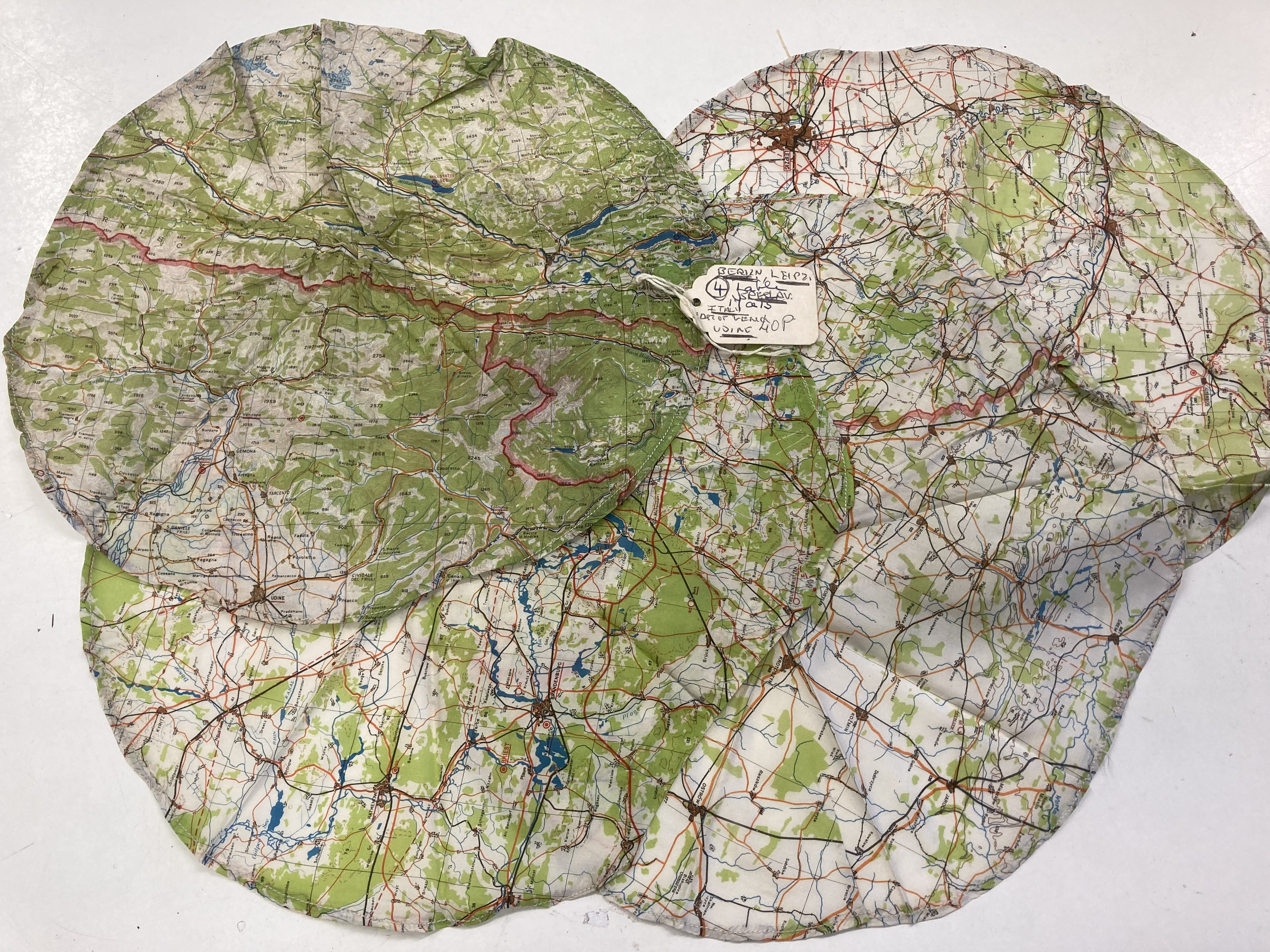
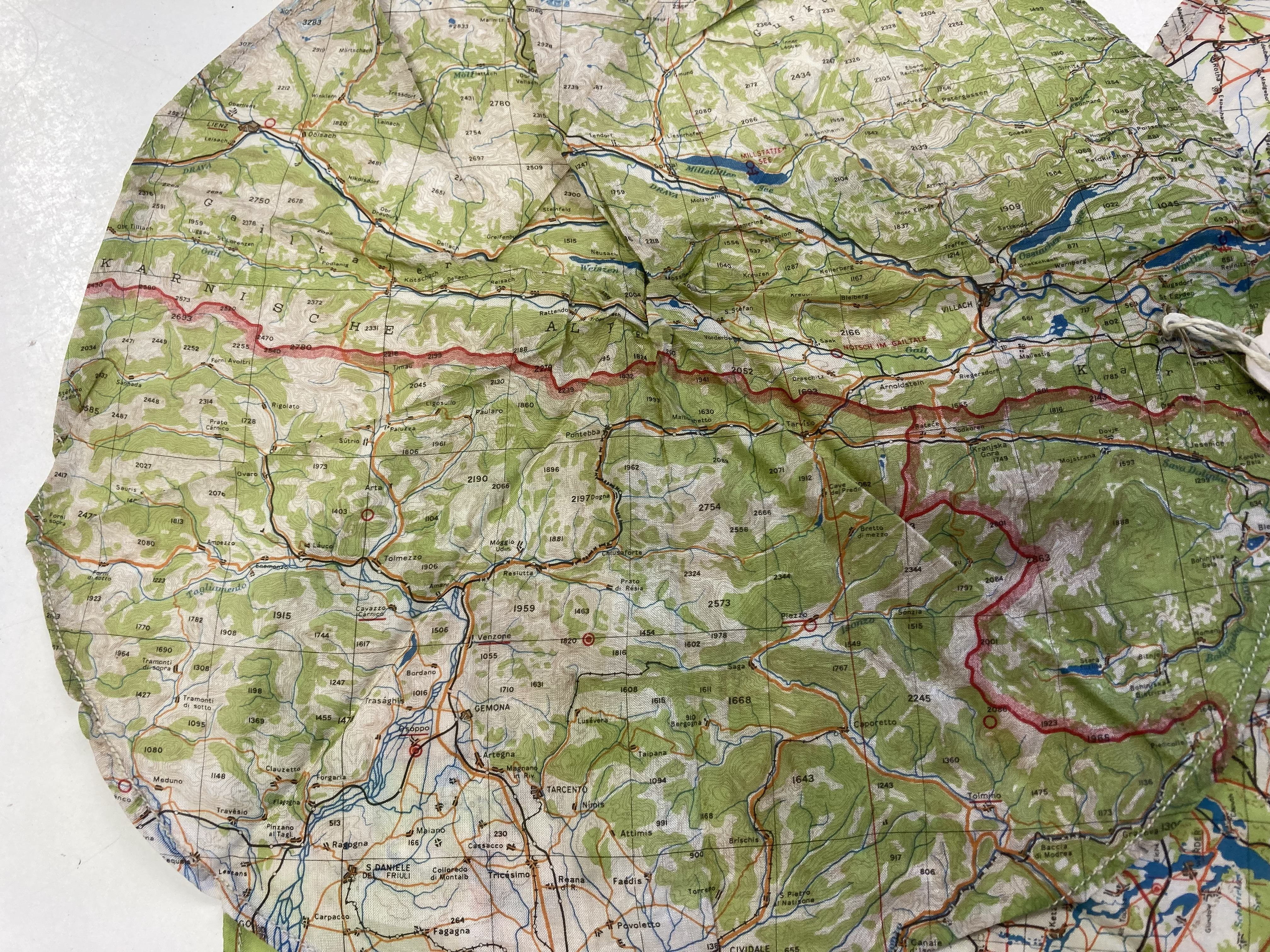
In an envelope in the back of the book, a colleague found these.

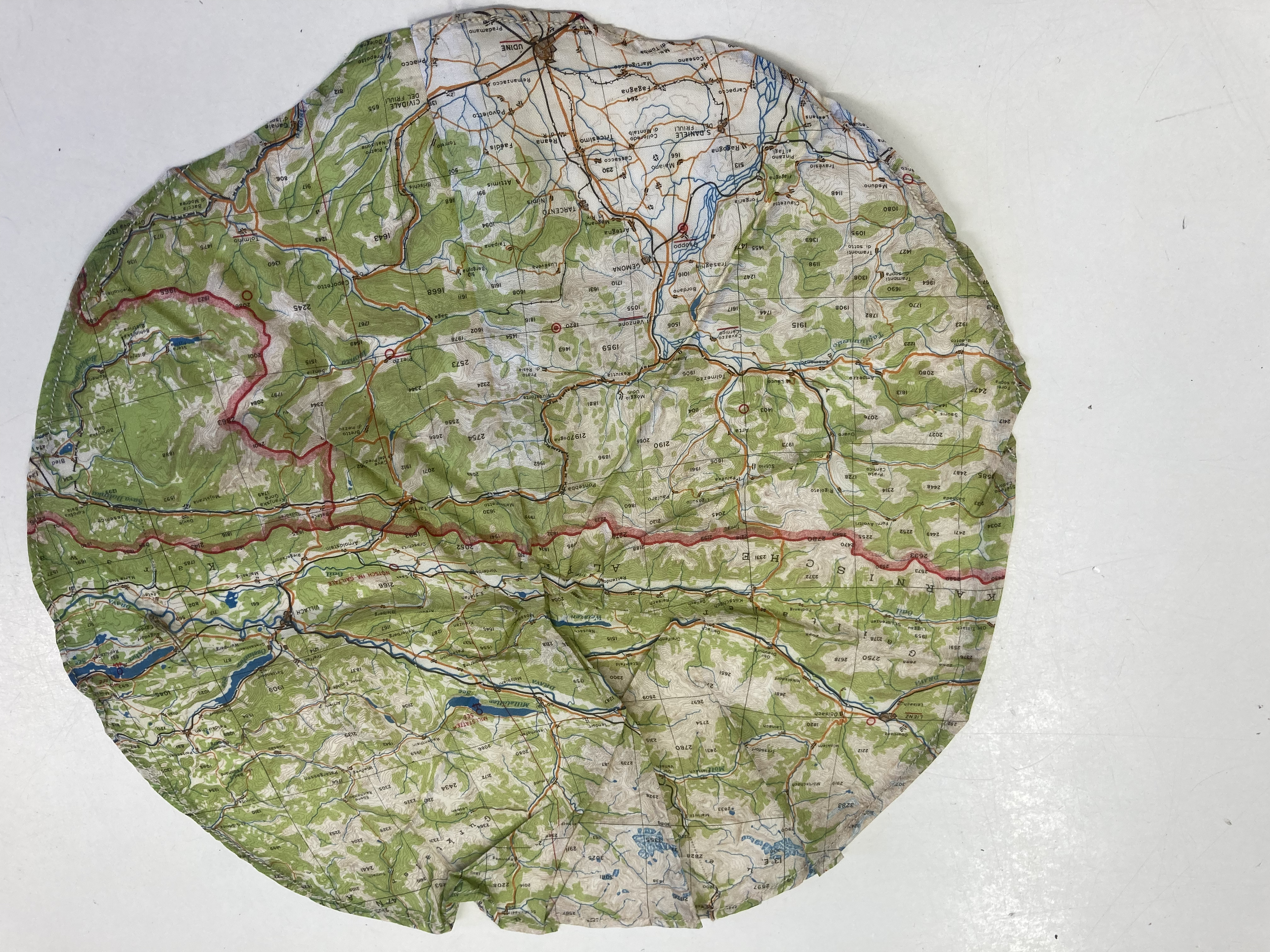
They are the remnants of escape maps.

One of them includes Berlin – so a brave person who went in there.

In case you don’t know, and we didn’t, maps were printed on parachute silk and/or rayon fabric and given to people making their way into ( and hopefully out of ) enemy territory in WW II.

(And if you will excuse me being rather clumsy, they are a nice escape from someone’s house clearance of less than riveting books. Of course, we love all the books donated but you know, now and then……)

Originally, they would have been larger and square and the fact that someone has cut them down to make, what? A small place mat? has rendered them a lot less valuable than they would have been.

The printing is amazingly clear and of course the fabric meant you could scrunch it up to nothing, hide it in your pocket, make into a hatband when in disguise, put into a slit in the lining of a jacket…. ( both true apparently.)

And there was none of that difficult, time-consuming folding and unfolding of a linen or paper map with which anyone whose been on a long walk in familiar territory, leave alone enemy territory, is all too familiar.

Courtesy, as ever, from Wikipedia:

During World War I Australians produced an escape map for use in July 1918 by prisoners in the German Holzminden POW Camp, sections of map were sewn into the clothing of prisoners who escaped via a tunnel to Allied territory.”

Some American intelligence offices visited the UK in 1942 to be briefed on the British efforts in escape and evasion techniques and equipment. 

The British MI9 gave the Americans a book or manual called “Per Ardua Libertas” to take back to the US. Published in this manual were examples of each cloth escape and tissue escape map that the British had produced. 

After this meeting with the British, the United States began to produce its own escape maps. Most of the American maps supplied by the Army Map Service from World War II were actually printed on rayonacetate materials, and not silk.

However, because of the silky texture of the materials, they were referred to by the more familiar textile name.

During WWII hundreds of thousands of maps were produced by the British on thin cloth and tissue paper. The idea was that a serviceman captured or shot down behind enemy lines should have a map to help him find his way to safety if he escaped or, better still, evade capture in the first place.

Many of these maps were also used in clandestine wartime activities.

Apparently,  35,000 servicemen and men and women on secret missions escaped safely during WW II and it is estimated half of them used some form of escape or evasion map to do it.

But it wasn’t just servicemen ( and maybe women on secret missions) who had these maps.

And they weren’t all made of silk or rayon:

The cloth maps were sometimes hidden in special editions of the Monopoly board game sets sent to the prisoners of war camps. The marked game sets also included foreign currency (French and German, for example), compasses and other items needed for escaping Allied prisoners of war.Escape maps were also printed on playing cards distributed to Prisoners of War which could be soaked and peeled apart revealing the escape map. Other maps were hidden inside spools of cotton thread in sewing kits. “Due to the inherent strength and extremely compact nature of the MI9mulberry leaf tissue maps, they could be wound into twine and then rolled into the core of cotton reels.

I have disappeared down a bit of an WW II escape rabbit hole so do feel free to leave if you don’t need to know anymore. 

But before you go, we will put our unfortunately-mangled maps for sale online and I will wonder whose were they? What was the story of if and how they were used, why were they cut down….

For anyone still with me, I was wondering what MI9 was.

It was:

MI9, the BritishDirectorate of Military Intelligence Section 9, was a highly secret department of the War Office between 1939 and 1945. 

During World War II it had two principal tasks: (1) assisting in the escape of Alliedprisoners of war (POWs) held by the Axis countries, especially Nazi Germany; and (2) helping Allied military personnel, especially downed airmen, evade capture after they were shot down or trapped behind enemy lines in Axis-occupied countries.

During World War II, about 35,000 Allied military personnel, many helped by MI9, escaped POW camps or evaded capture and made their way to Allied or neutral countries after being trapped behind enemy lines.

The best-known activity of MI9 was creating and supporting escape and evasion lines, especially in France and Belgium, which helped 5,000 downed British, American and other Allied airmen evade capture and return to duty. 

The usual routes of escape from occupied Europe were either south to Switzerland or to southern France and then over the Pyrenees to neutral Spain and Portugal.

MI9 trained Allied soldiers and airmen in tactics for evading and escaping and helped prisoners of war to escape by establishing clandestine communications and providing escape devices to them.

The person credited with creating the various ways to make, give and send escape and evasion maps was Christopher Hutton:

a British soldier, airman, journalist and inventor, best known for his work with MI9

And, just so you know, MI9 no longer exists but whilst it did, it had a section:

“Q,” staffed by Christopher Hutton and Charles Fraser-Smith, was charged with inventing devices to aid soldiers to evade or escape capture. “Q” was made famous in fiction by the James Bond movies.

Accidental Conversations 3

Next to our holiday balcony, there was another one used by a woman on her own.

I used to spend holidays on my own and I know there is pleasure, and less pleasure, about being on your own.

So, I asked her if she would like to share some wine with us one evening.

She was there to spend time with her son and his girlfriend, working all the hours god sent in the summer to make money.

She waited up to eat with them at the end of their evening shifts.

Meantime, we talked about her life as a single parent, changing her job because of the Greek financial crisis, learning massage as a calming therapy, how her ex-husband was a  good father but a rubbish financial provider, her new job, her real wish to retire but there is not enough money in her life…..

Then we got onto immigrants and she said, We all have to understand the new world. 

People are just trying to escape, to make a better life, to live their lives to way we do.

Climate change, wars, poverty – they all make people want to move and who can blame them?

We have to learn about how to accept that – all of us.

I have tried to show my son what it means to have a good heart.

She said a lot more, but I think you get the picture

It was a very good way to spend an evening with a stranger.

Greek Take-Aways

Some food just tastes better in its original surroundings.

A good greek salad tastes better when you are sitting at a table overlooking the sea, that it ever does at home in Deepest Sussex – even if you have the ripest homegrown tomatoes and cucumbers, the posh feta you have splurged on, really good olive oil.

(Though it has to be said not every Greek salad in Greece is brilliant – just saying.)

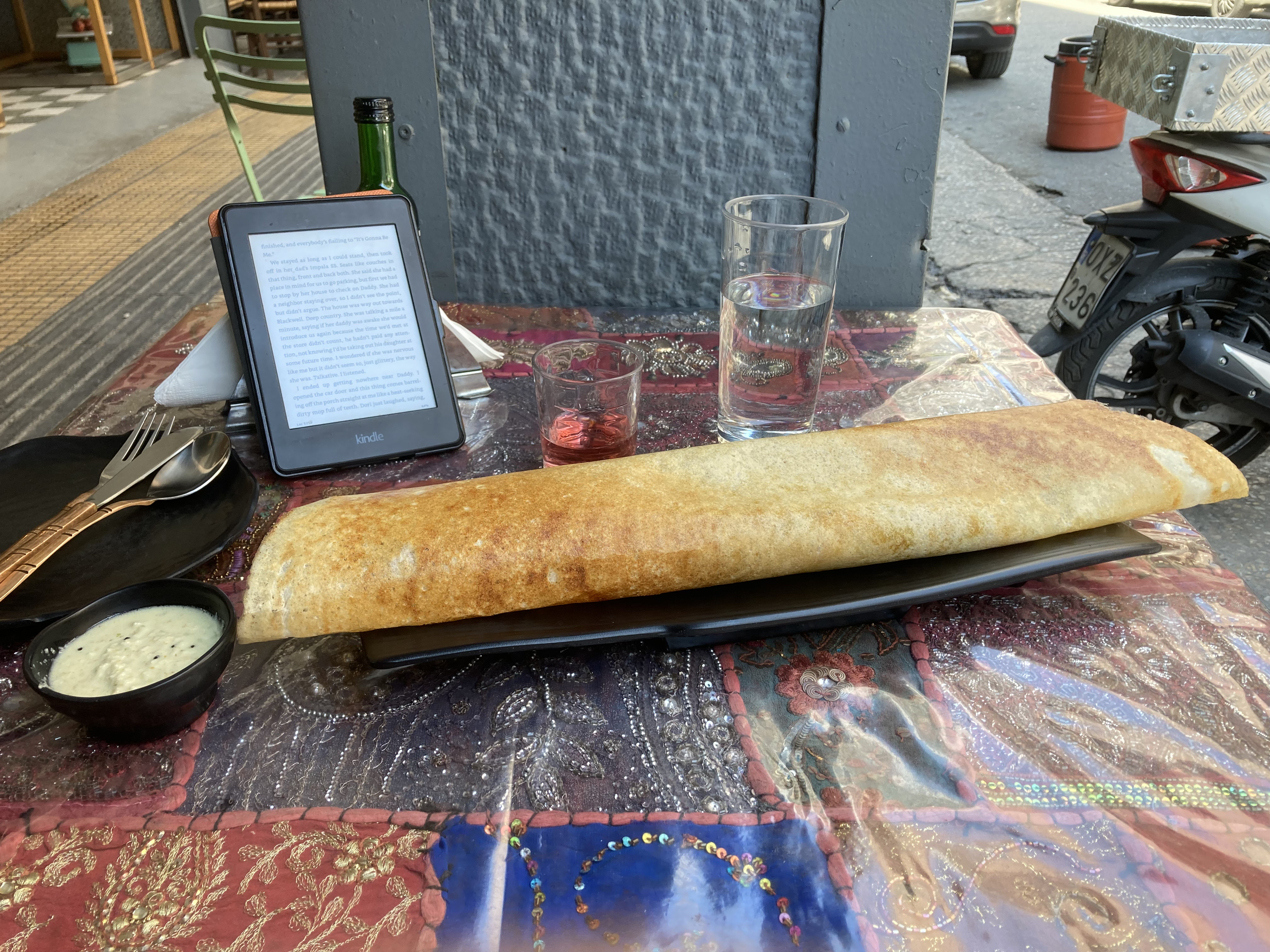
But though I am on about Greek food in Greece, can I just add I had one of the best dosas I have had in a long time in a tiny south Indian street place in Athens – see below.

But back to where I was, and apparently, and not entirely surprisingly, the Greek salad as we know it had only been around since the 60s or early 70s.

‘Everything started at the end of the 19th century when the Greeks were still ‘counting the wounds’ from their bankruptcy of 1893 and the Greek-Turkish war of 1897.

The main meal then consisted of vegetables – cucumber, olives, onions and (later) tomatoes and just sometimes cheese, with bread.

If you lived in the countryside, you took your vegetables whole, wrapped in a cloth, to the fields.

If you lived in Athens, you cut them up, put them in a dish and added olive oil, salt and oregano – that’s posh city folk for you.

Apparently, there was some tax which limited what you could charge for a basic salad to locals, and the growing number of tourists arriving in the 60s and 70s.

Folklore has it that an enterprising restauranteur in the Plaka area of Athens dropped a slice of feta on top and that meant it was no longer a basic salad – and he could charge what he liked. 

My take aways ( as it were) from this year’s Greek holiday (want a photo – well here you go) were Fava, chickpea stew and lamb baked with thyme ( and no doubt, time.)

Fava, just in case you don’t know, is basically yellow split peas cooked to a creamy mush with added flavourings.

It is a popular appetiser but beware, in the wrong hands it can turnout bland and, occasionally and unforgivably, lumpy.

If you get the flavourings right you can eat it by the spoonful all on its own. If you don’t you need all kinds of additions to make it tasty.

We had a very good version on the day we met our new friends, and the Best Beloved and I had another lovely and delicious lunch with them ( see previous blog about picking up friends on holidays).

It was Sunday lunch.

Unlike in Deepest Sussex , chickpea stew is a local Sunday lunch tradition, cooked for a long time on the stove and in the oven.

It had a dark, almost gravy-ish sauce, was unctuous and generally very good. I am pretty sure it was started Friday and left to its own cooking devices for a good long time and then kept to let the flavours all steep in.

I had the tavern’s speciality of lamb with thyme and though I am sure this is a speciality of eating places across Greece, it was very good indeed.

We left our dog with long-suffering neighbours whilst we went on this jaunt to sun-kissed shores (want another photo? well if you insist.)

And as this island has very little in the way of shopping-for-a-thank-you-present to offer, I decided to bring Greece to them and cook a Greek meal.

So by the time you read this, I will have made a chickpea stew with lamb and thyme and maybe Fava to start.

I will let you know if it was a satisfactory thank you.

If not, the dog gets it…..

Accidental Conversations 4

The island we were staying on is small so it was not entirely a surprise to bump into the gay couple we had struck up an intersting conversation with in a coffee place the day before.

We kicked ourselves for not arranging to meet them for another coffee, or even lunch.

And despite keeping our eyes peeled, we didn’t catch them again.

That was last year, and there were just the vaguest of hopes that we might see them again this year – but we didn’t.

So, when we were on a beach and I saw a nice looking gay couple I, well basically, picked them up.

Had a chat, and suggested coffee in the nearby restaurant in half an hour.

Coffee morphed into a (delicious) lunch and conversation.

One of the couple was a professor of early renaissance Italian philosophy and history and the other was a family lawyer.

The Best Beloved complained about the way philosophy was taught in Oxford (mind you that was a very long time ago) and the professor explained his way of teaching was to put the ideas in a historical context.

We talked about art (and its context), we talked about what lockdown was like in Rome – not too bad given they have a large airy apartment with a balcony and could eventually escape to their house in the Umbrian countryside.

We talked about the merits of various Greek islands, where to go in Southern Italy, how it was lonely doing all your legal work on Zoom and missing the chat with fellow lawyers and even divorcing clients.

To save the BB from writing holiday suggestions on the back of his hand, gave his email and suffice it to say, the next day he had a lot of holiday suggestions and we made an arrangement to meet for lunch on Sunday.

We get on fine on holiday but there is something good about conversations about things you don’t know with people you don’t know at all.

Picking up gay couples could well be a holiday habit from now on.

Accidental Conversations 2

Apparently, the right way to talk to strangers is with caution and humility according to Malcolm Gladwell – a man who gets a lot of things right.

Sometimes it works brilliantly and sometimes it doesn’t.

Especially on holiday, I don’t exercise the cautionary principle much. 

We got talking to one taxi driver and as a result, he  spent quite a lot of time slowly driving so he could dictate into Google Translate what he wanted to tell us about basketball – did you know that there was a Greek basketball player in a top league in America? No, nor did we.

Despite the BB’s grandson being a school and weekend basketball player, we soon ran out of conversation to dictate back into Google.

So, to change the subject I said, So what is this part of Athens?

It is toxic, he said.

And then there was, not bothering with Google, a one-sided ‘conversation’ about ‘toxic’ Bangladeshis and other immigrants.

Now, there is no denying that Greece has taken more than its European fair share of refugees and immigrants.

But this was not an easy listen.

The next day, I went out from our hotel and bought some water. From, it turns out, a Bangladeshi man.

He asked where I was from.

England.

You are so very lucky, he said.

Greece? I asked.

Not England, he said. Not so good. Not so good. 

There are a hundred things to unpack from these ‘conversations’.

Pickles – well just a few

I do like making a pickle, preserves, chutney – but it has to be said, we are not great eaters of any of these.

There are a few exceptions – homemade pickled red cabbage is a must with a cottage pie – meat or vegetarian.

Now, I am sure I have mentioned this before, and I know people (maybe you, dear reader) may sneer at that suggestion but bear with me again and give it a try – not the bought stuff though because it is too vinegary.

And I do like a Kilner jar of confit tomatoes in the fridge – lush and sweet and great with all sorts when you need a taste of summer in the winter.

If you make it to the end of this, there will be recipes.

Having said that, I still have a freezer drawer with cooked down crabapples waiting to go through the faff of turning them into crabapple jelly – its a two day operation and involves hanging muslin bags on broom handles, enough said.

But I have just found a book in the shop which makes me think of more pickle, preserves activity – making things we should but probably won’t eat, and will give to (hopefully) more appreciative friends, family and neighbours.

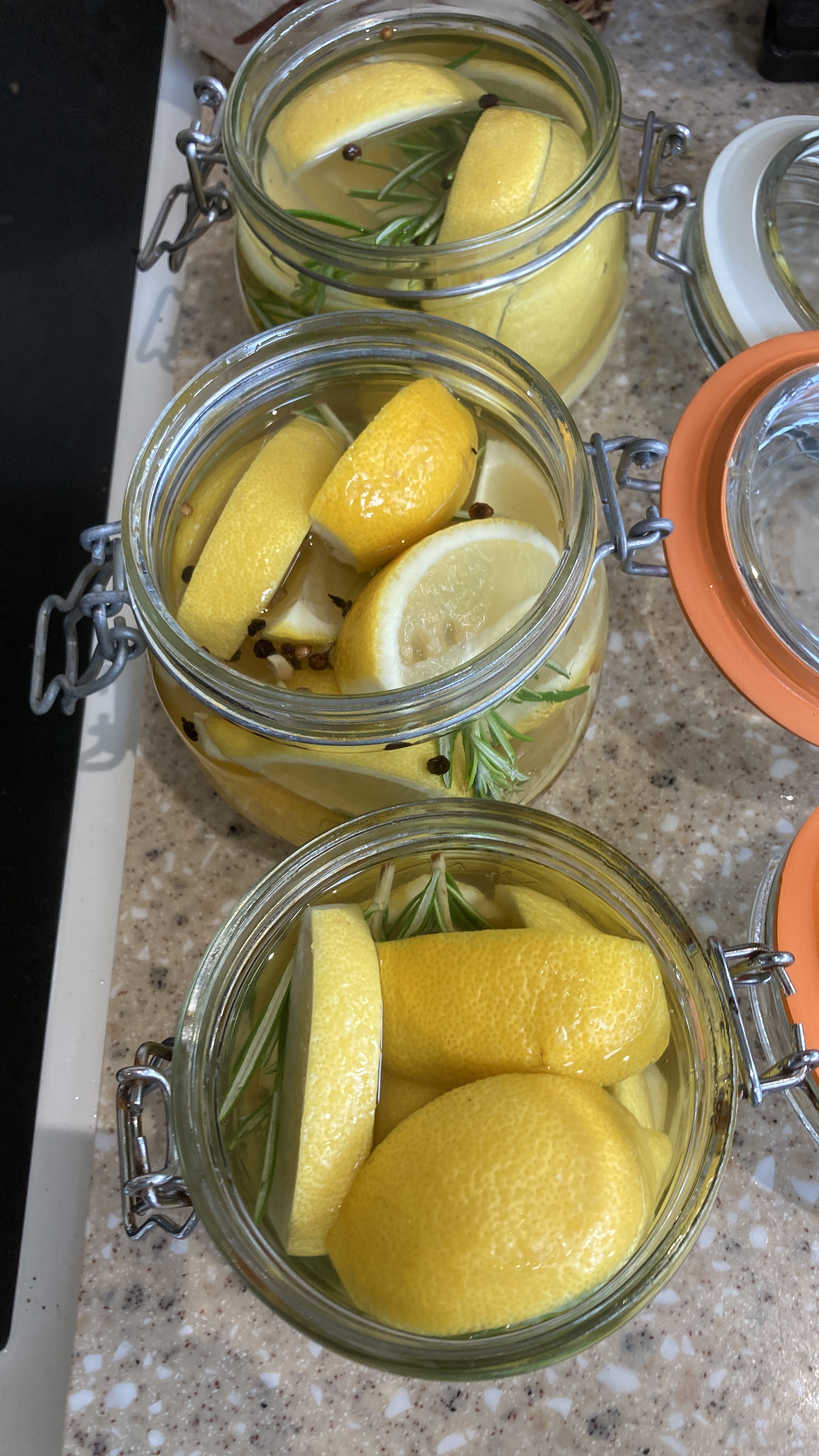
Today, I have made preserved lemons not least because we both have some covid-like lurgy and so are in a mini-lockdown – afternoon television beckons but a few things have to be done first, hence the lemons.

( And a roast chicken with tarragon sauce because I feel like making it but probably not so much eating it….. we shall see.)

So recipes;

Preserved lemons from this:

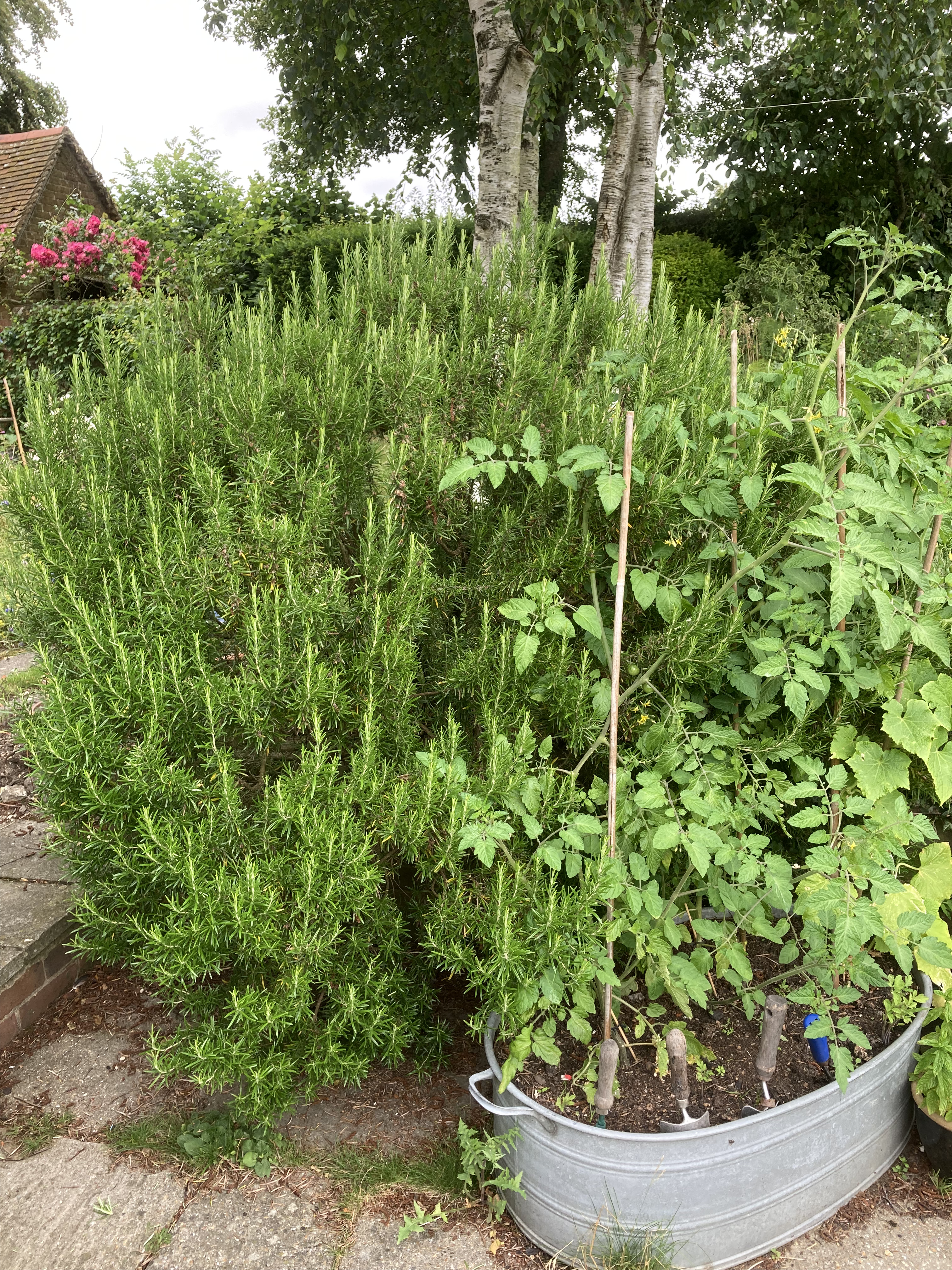
We have a great rosemary bush.

And you will notice tomato plants growing along side and they are earmarked for some confit assuming they are prolific – and given they are grafted plants they should be.(Gardening advice here, always buy a grafted tomato plant to ensure lots of fruit.)

So, you need a Japanese rice vinegar. ( I have to say that Waitrose in Petersfield only had Chinese rice vinegar so that is what I used, hey ho.)

I used less sugar – about 250g – just saying.

Cut up lemons, add your rosemary and you are done – about two weeks later admittedly.

Pickled red cabbage:

So, you shred ( don’t worry you don’t have to do it too finely and I rather prefer to cut with a knife not shredding in a food processor) a red cabbage. Not the hard stem – just the leaves.

Put it in a bowl and sprinkle salt over it and leave it in the fridge overnight.

Also, put a litre of distilled vinegar in a pan, add 200g ( or less if you prefer) of sugar, a teaspoon each of cloves, peppercorns, coriander seeds or juniper seeds ( I do like a lot of flavour but you can be more minimalist if you like) and a couple of cinnamon sticks. Warm up until sugar has dissolved – a bit of stirring here.

Cool and put in the fridge.

Next day, take the cabbage out of the fridge and rinse the salt off. Leave to dry, or pat dry with kitchen paper – though beware, you don’t want bits of kitchen paper in your pickle.

Put in sterilised jars – see here how to do it 

https://www.greatbritishchefs.com/how-to-cook/how-to-sterilise-jars

And pour over the liquid.

And this will keep happily for a year or two if you don’t eat that much cottage pie.

Meanwhile, confit means basically slow cooking in a lot of olive oil.

So, take some tomatoes – small ones I would recommend. Don’t both with cutting up or pricking the skins, or taking them off their stalks.

Put them heaped if necessary as they will cook down, into a roasting tin with whatever herbs or spices you fancy – garlic, oregano, thyme, chilli flakes, rosemary – a good grinding of salt and pepper, and enough olive oil to come at least half way up small tomatoes.

Put in the oven at a low temperature – say 100 in a fan oven for a couple of hours, or if you are a lucky Sussex housewife, in the bottom Aga oven – but do check if you are using  fan oven which can dry things out more quickly.

You want them well-cooked.

Cool, then squash into jars and use leftover olive oil to top them up.

They will keep in the fridge for a year or two and ignore the rules which say you can only keep for a week after they are opened.

They will make a good ‘sauce’ for spaghetti, or a quick supper, serve well if warmed under fish, in fact anything you like with tomatoes will work with these.

Off now to feed my tomato plants and then a relapse on the sofa.

Niche Ships

Another bit on niche books – attractive to my only Vice Admiral (and Sir) reader, I would guess.

So, if you are not into ships/boats/history/niche books, now is the time to walk away.

And after this, I maybe off to a blog on pickles – I bet you can hardly wait.

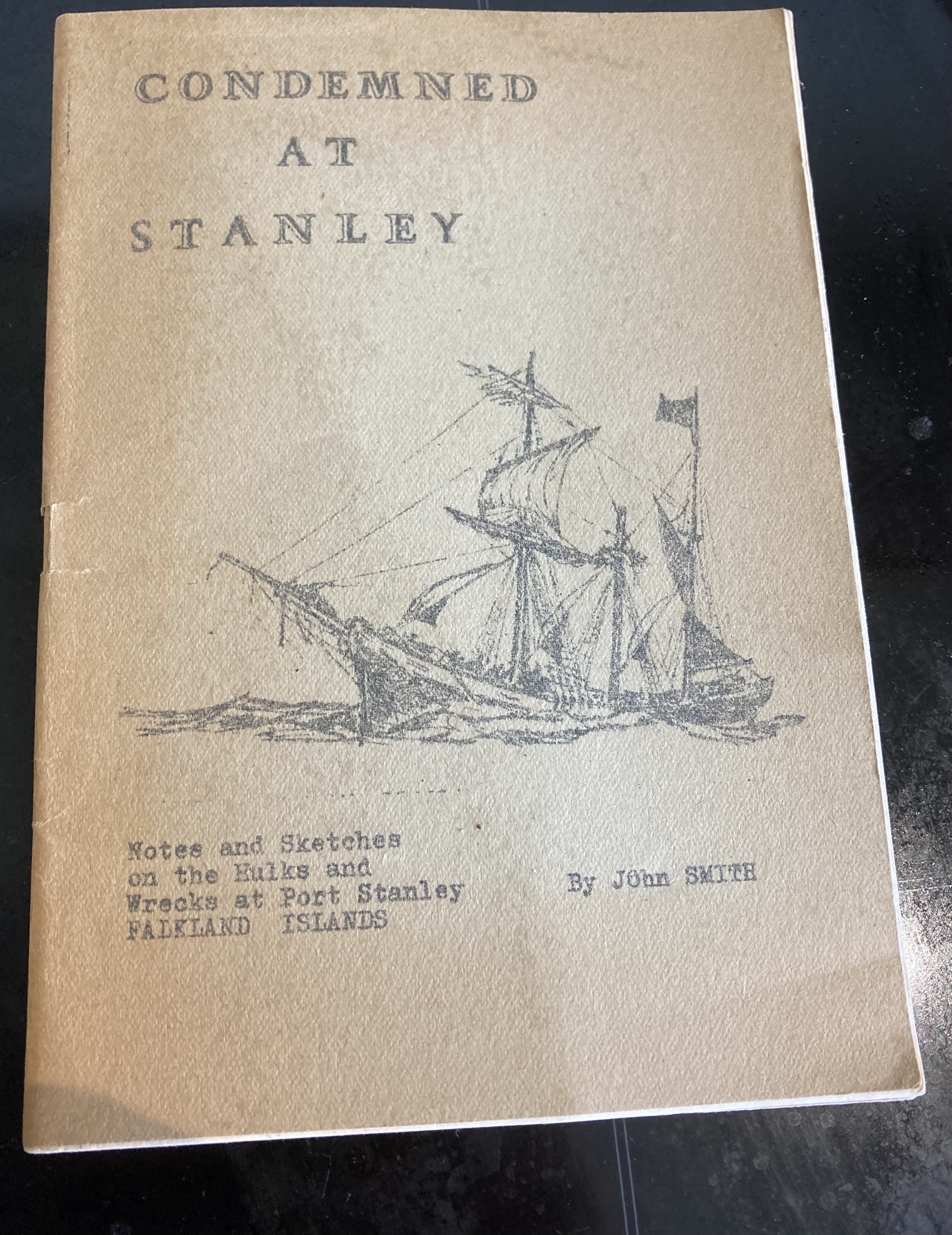
Right, now we are off to the Falklands.(Or Malvinas if you prefer.)

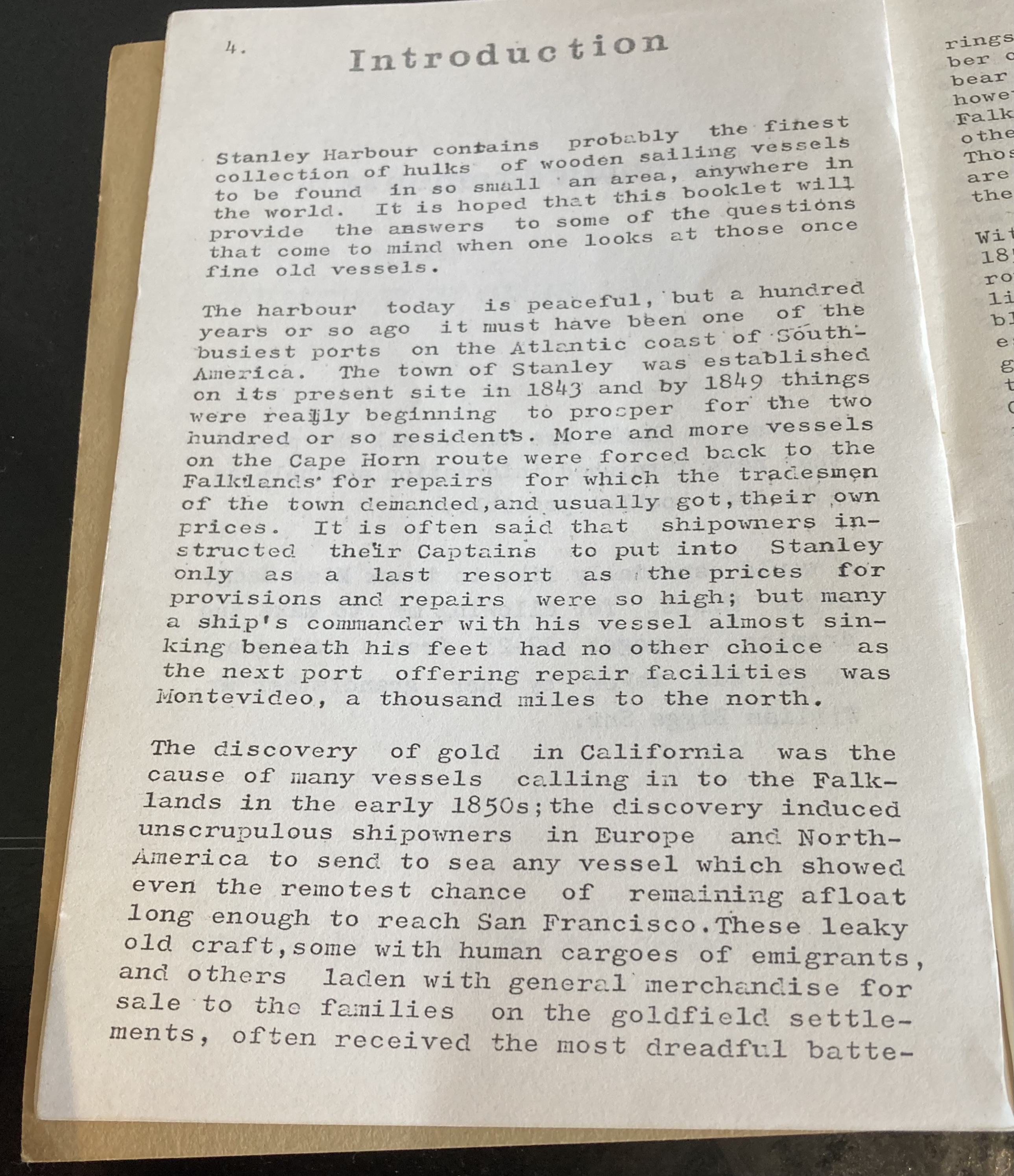
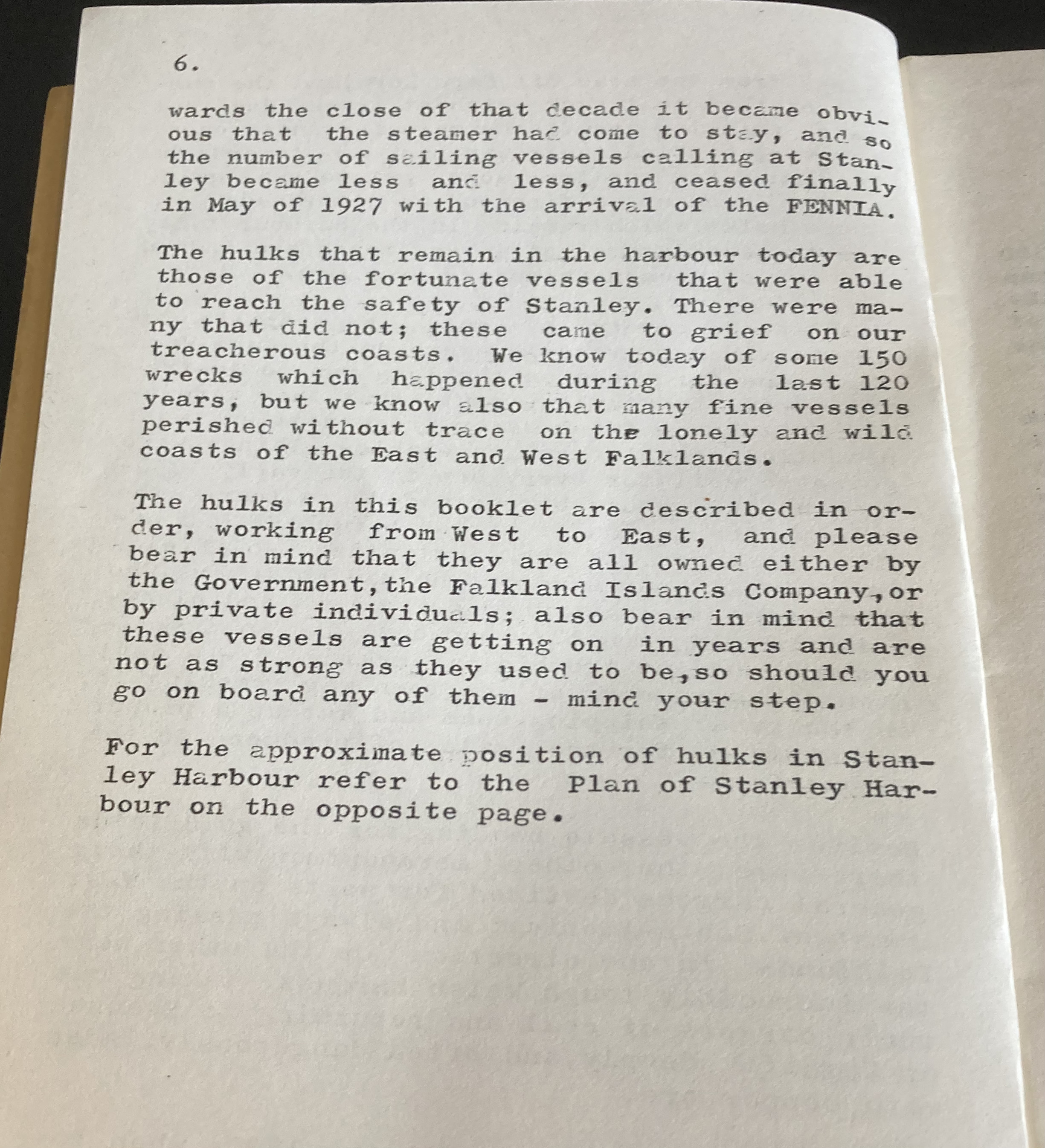
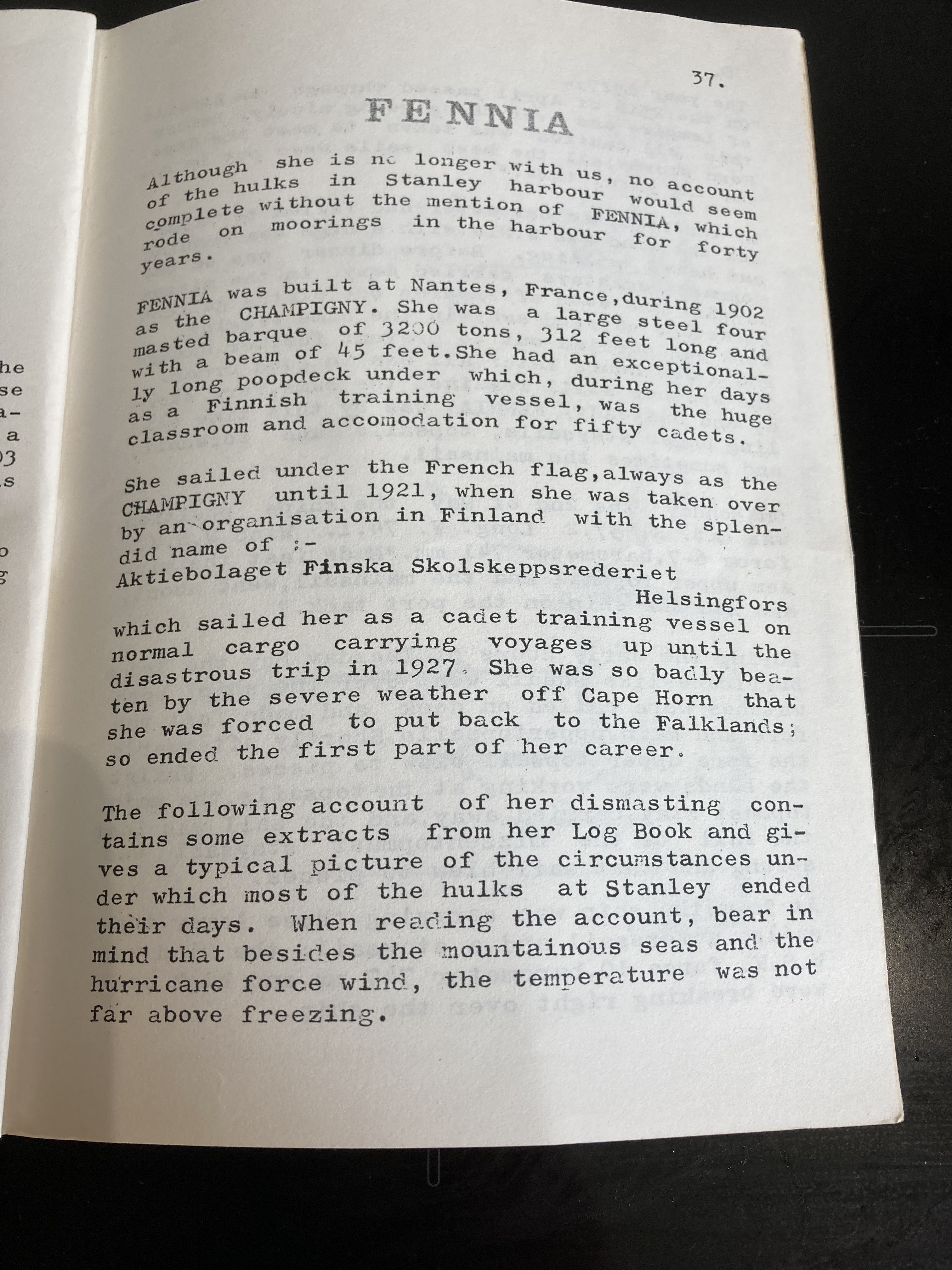
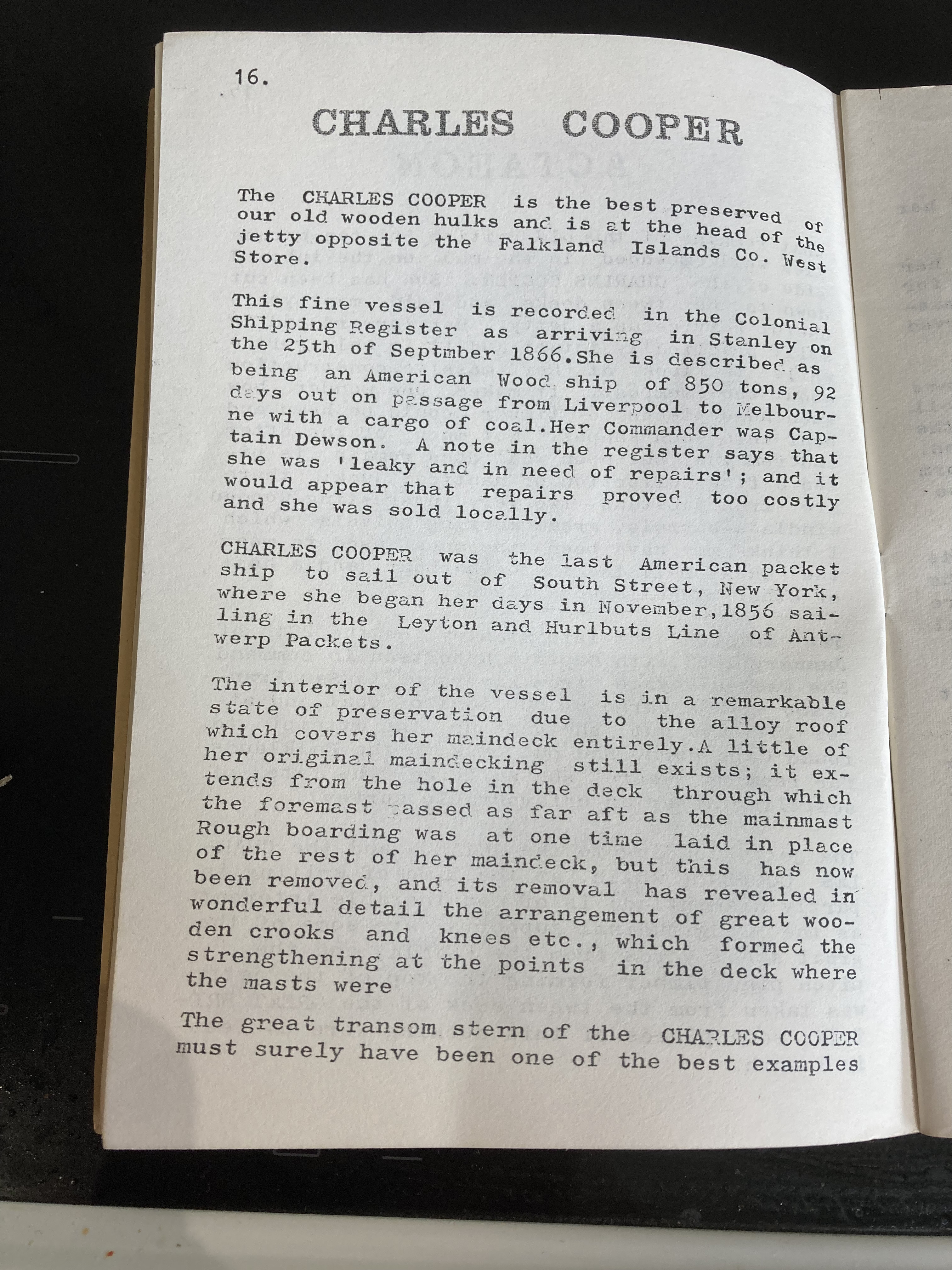
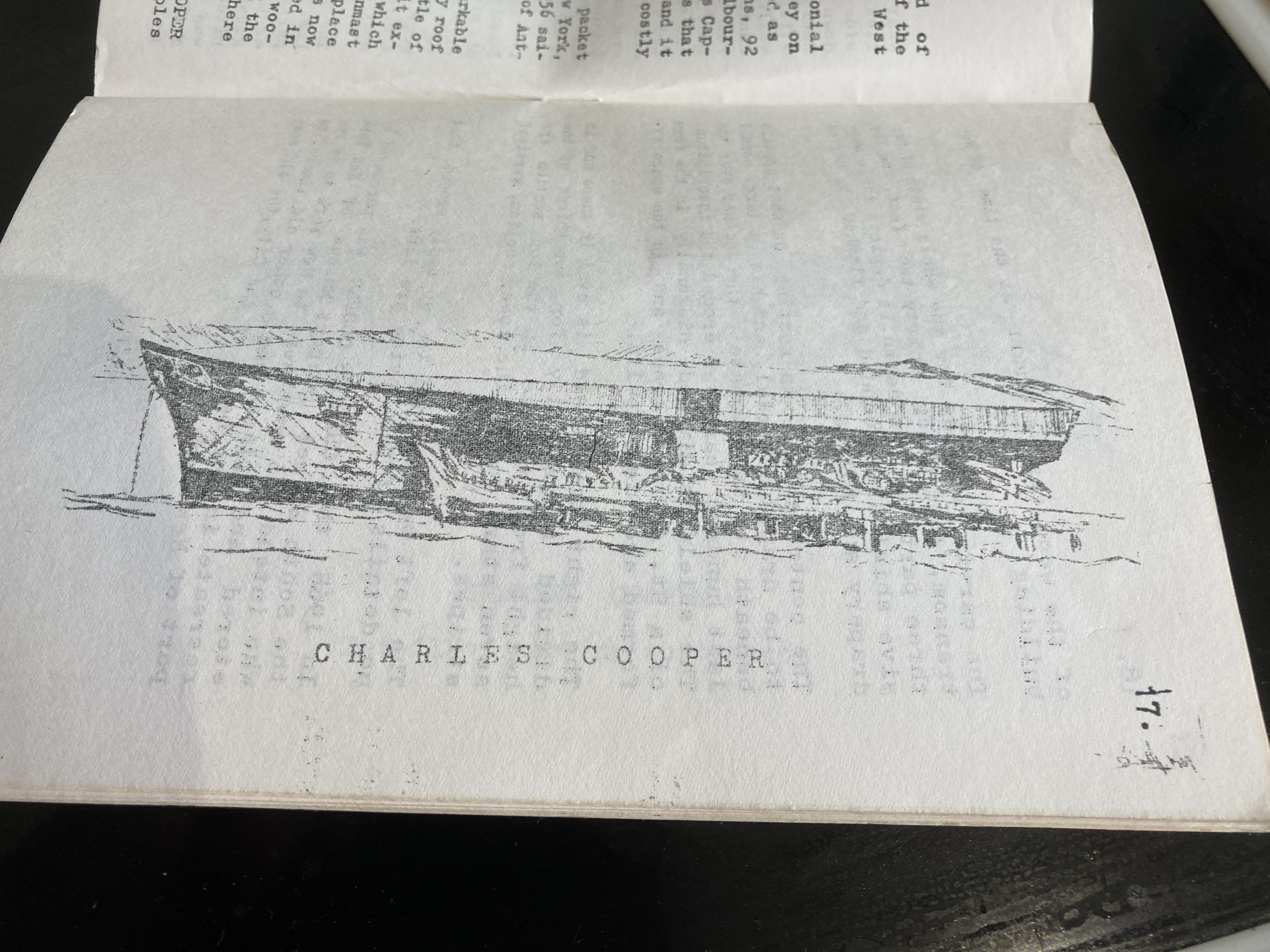
(Before we get onto the content, for those of us who remember bashing away on a typewriter, this little pamphlet was a trip down memory lane – obviously typeset from a typewritten ‘manuscript’ with added sketches – done by the author.

I do like a real, original typewriter typeface.

And presumably he did not print so many that he couldn’t bear the thought of changing the odd mistake by hand – see subsequent photos.)

I am guessing the author was the same John Smith who wrote a memoir called : 74 Days: An Islander’s Diary of the Falklands Occupation. ( No, that has not been donated.)

We have had got two of these pamphlets and one is signed and other has an interesting dedication but more on that later.

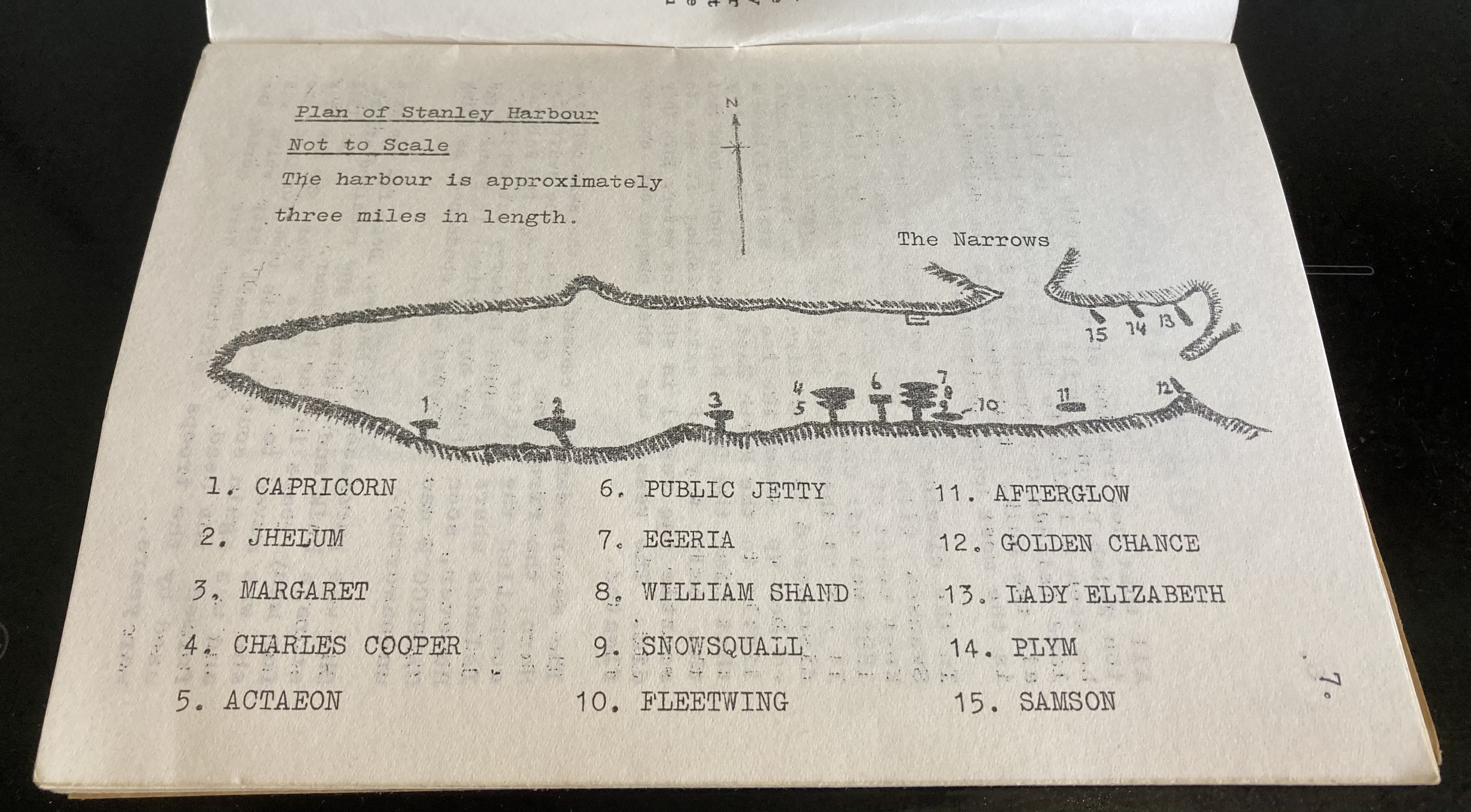
So, there are notes and sketches on 14 wrecks in the Falklands harbour – from Capricorn to Fennia.

And indeed the 3-mile long harbour does seem to have an abundance of wrecks.

There is a bit of history – and I have to say, well-written interesting stuff which is not inevitably the case with self-published/locally-published books…..

Back to the ships:

Here they are:

Apparently, it is indeed in the museum and …….

The Charles Cooper was built in Black Rock, Connecticut in 1856 and is the only surviving American ship of its kind in the world. It is the best surviving wooden square-rigged American merchant ship.  Built for New York’s South Street packet trade, the vessel voyaged around the world during the golden age of sail, and when it could sail no longer, became a floating warehouse for nearly a hundred years on an island off South America. The ship sailed for a decade from 1856 to 1866. It carried cotton to England, salt to India, gunpowder ingredients to the North during the Civil War, and brought European immigrants seeking economic opportunity and freedom in America. The Charles Cooper began with regular fixed schedules between New York and Antwerp. Then, with the outbreak of the Civil War, it no longer had set published departure times and instead voyaged based on spot demands from America to Europe and Asia.

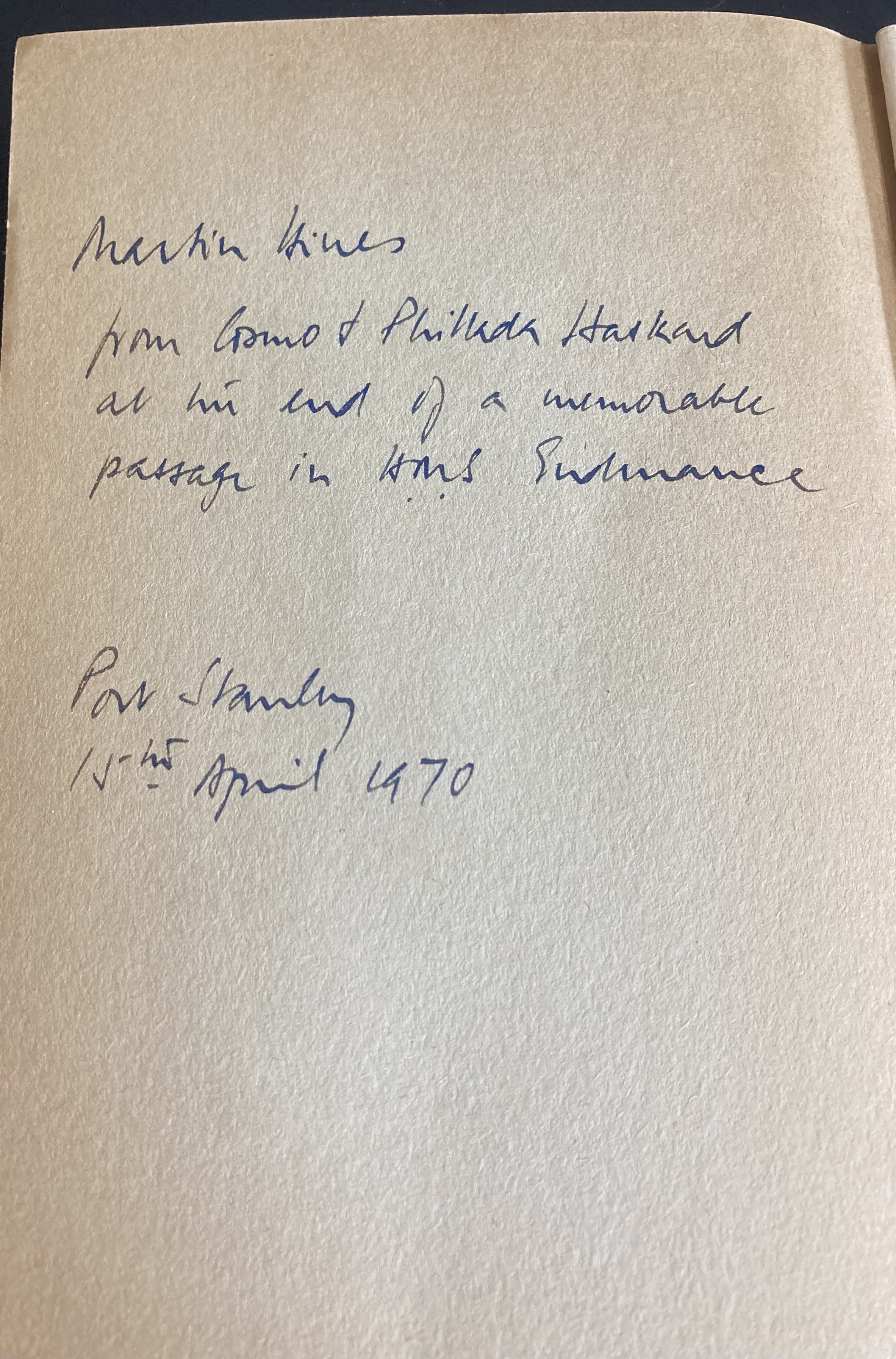
So, finally to the inscription:

So, it turns out that this pamphlet was given to Martin Kine by Cosmo and Phillida Haskand. Haskard was the Governor General of the Falklands (1964-1970) and who ‘played a key role in defeating plans by Harold Wilson‘s Labour government to cede the sovereignty of the islands to Argentina. ‘

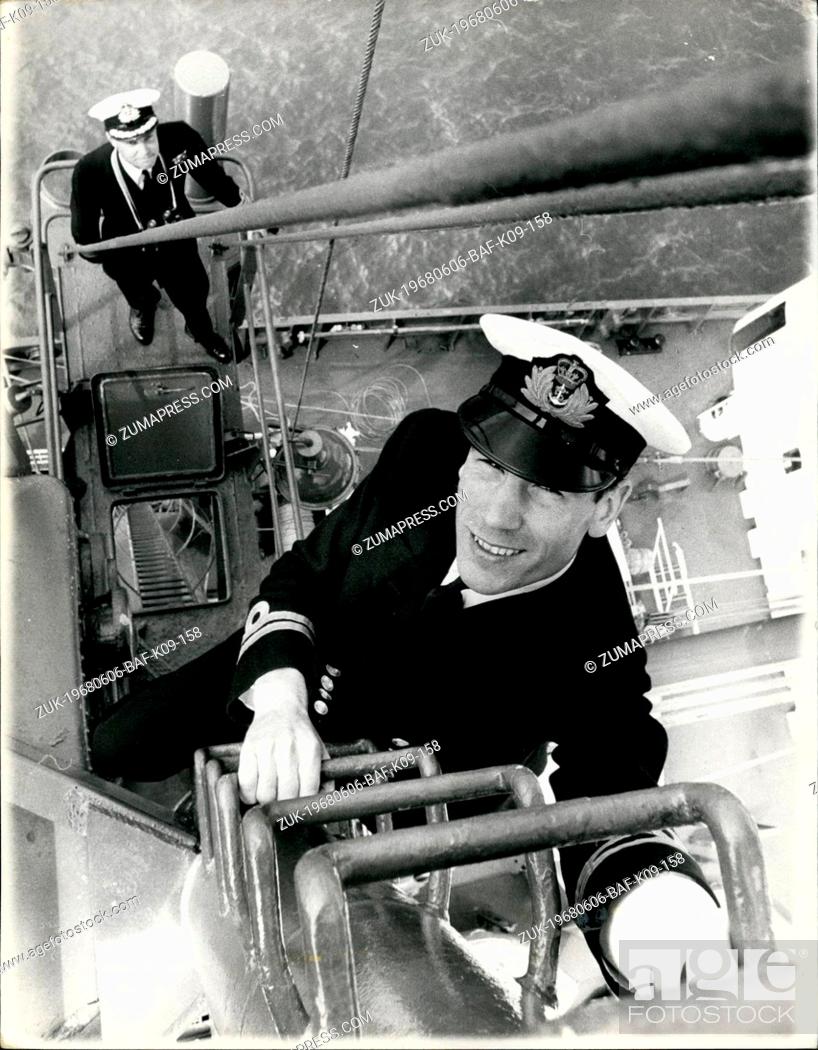
Martin was the HMS Endurance navigator, and dashing he looks too.

Jun. 06, 1968 – Press visit to H.M.S. Endurance: There was a Press visit to HMS Endurance, the Royal Navy’s new ice patrol ship, at Portsmouth Dockyard today. H.M.S. Endurance is expected to sail for the Antarctic later in the year. She will normally be deployed in the Antarctic, returning each year to the United Kingdom for maintenance and leave. In addition to providing a British naval presence in the area, she will assist the British Antarctic Survey in carrying out its scientific research programmes, and help support the permanent British stations there. HMS Endurance was recently converted for her new role at Harland and Wolff’s yard. Previously known as the Anita Dan. Her conversion has included the installation of special scientific and hydrographic equipment for her work in the Antarctic. One of the features of the ship is that it can be controlled from the crow’s next so as to give her officers view of channels through the ice.Photo shows the Navigating Officer, Lt. Martin Hines (nearest camera) and the Commanding officer, Captain Peter Buchanan seen making their way up to the crow’s nest from where the ship can be controlled. (Credit Image: © Keystone Press Agency/Keystone USA via ZUMAPRESS.com)   

Of course, of course, this was not the original HMS Endurance but a later version – originally a German ship bought by the British navy and used as an ice-breaker among other things.

But she had her place in history – she was the ship on which ‘the final surrender of the war, in the South Sandwich Islands, took place.’

Apparently she was known by her sailors as HMS Encumbrance towards the end of her life ‘due to unreliability problems.’

I have no idea why the Haskards had ‘such a memorable passage ‘ on her but it has been a memorable little find in Oxfam.

Accidental Conversations 1

There is something special about accidental conversations.

We are on holiday in Greece – so if that makes you curl your lip, please don’t read on as there will be mention of food, sea, sunshine, wine, relaxation and all those other privileged things – though mostly in the next installments.

So, one of the Sundays we were on holiday, the Greeks went to the polls again – it was a foregone conclusion that the New Democracy centre right party would win.

According to an accidental conversation with a taxi driver we learned what the canny Greeks do – and apparently there are a lot of canny Greeks

It appears they can choose to keep their voting rights in the area where they grew up.

So, you can legitimately say to your boss, you need one day to get there, one day to vote, take one or even two days off, and then you come back. Long weekend all round then.

Not sure that was what Joseph and Mary had in mind when they had to go to Nazareth to pay their taxes but I am pretty sure they didn’t go to make a long weekend of it.

Anyway, that leads me on to the next conversation.

Staying in Athens in the same hotel we stayed last year, I was set on re-visiting a small, rather dilapidated church which was apparently one of the first built when the Greeks shucked off the Ottoman ‘yoke’. 

Allegedly, the first ‘free’ cathedral in Athens. 

Of course, there is a much bigger, posher ‘proper’ cathedral built later.

(By the way a German aristocrat was made king and not by the Greeks, so not entirely free then…)

In St Demetrios’s the frescos are blackened by years of incense burning and swinging about the place, there are water damage marks, the icons are overlaid in (possibly) tin not silver. 

There are upstairs galleries where the women used to sit in the old days but apparently are not now needed on a usual Sunday as everyone sits together, and they only get a dusting off at Easter.

But still, it is a gem of a place

When we went in, an unmistakable Greek Orthodox priest was sitting at a desk by the door.

We have a look round and the Best Beloved sighs as I say, I am going to have a chat.

It turns out Father Nickolaus was a real font (excuse the pun) of information.

He told us that as part of the rejection of Ottoman/Turkish style, the artwork and icons were Western style – more realistic faces than the more abstract Eastern style. 

And as one of the first such churches in Athens, it was Western frescos all the way until there was a swing back to the abstract, which he preferred.

He said, no-one knew what these saints looked like so why pretend, just a beautiful artistic symbol was much better in relation to how you thought about saints.

There are now some Eastern icons.

So, in an Orthodox church there is a wood-carved and icon-covered wall with a door and the priest operates in the space beyond with his back to the congregation for much of the service.

Apparently the wall is relatively new innovation, by Orthodox standards, – a place to show off your icons and carvings.

There is an interesting theological difference of views about the priest having his ( well maybe her, but not in the Orthodox persuasion) back to or facing the congregation.

The Orthodox view is that having his back to the filled pews and facing the cross means he is with the congregation looking to God. 

He is part of the people, not God’s intermediary to the people.

At this point, I mentioned the Pope who is, so I gather, God’s intermediary on earth and infallible and so on.

Father Nickolaus was beautifully diplomatic –  smiled, and pointed out something else of interest in the church.

As a special treat, he opened the door in the carved wall and let us see inside where he performed his duties as the priest. (But to take a photo would have seemed rude, so I didn’t.)

And he told us that the bread and wine ritual is also part of the Orthodox communion but instead of wafers and a slurp, they have proper home-made bread brought in by local women and marked with a special square stamp.

It is cut up and into squares and I think, but maybe I misinterpreted or you dip it into the wine.

As if on cue, a local woman brought a loaf to the church so we could see it – but of course until it is blessed, it is not the body of christ.

Father Nickolaus told us, he had spent time with a friend who was an Orthodox priest in London, and St Albans.

It turns out that St Albans – a protestant cathedral is on a bit of an ecumenical mission.

It has services not only Orthodox, but German Lutheran ( who knew), Catholic ( well not that surprising) and the Free Church ( which is not that free if you are a gay, or a woman who needs an abortion, or a divorce.)

But anyway, good on St Albans.

(I looked up St Demetrius and it turns out he was run through with spears in 306 CE as part of the emperor Galerius’ persecution of christians.

Presumably, he got martyr status pretty rapidly as a result of that, but he made it into sainthood by, though dead, intervening against Barbarian barbarities in his city of Thessaloniki.

Now, Demetruis was the son of a senatorial family and in his time was proconsul of the district, so it was surprising to learn he was patron saint of agriculture, peasants and shepherds.

But on closer inspection of Wikipedia, it turns out that he was doing that familiar christian thing of adopting ‘pagan’ practices.

Apparently Demeter, the greek goddess and handily with a similar name, had a local cult going on.

She was the Olympian goddess of the harvest, the earth’s fertility, crops, etc.

As her cult died out, St Demetrius stepped into the breach and took over her responsibilities.

(All sorted then.)

Needless to say, Father Nickolaus’s English was great and I could have spent much longer listening to him.

But he kept getting mobile phone calls and so we left him to his (in his own words) small flock, but not as small as they are in England.

I think he had a pretty good idea that we were not practising christians of any sort, but  he liked to talk to people who asked questions, and maybe he was a bit bored of re-arranging the candles.

As I left, he said, I will give you an icon of St Demetrius, and I thought wow! But actually I got a card with an icon image of said saint.

Still it will be a nice reminder.