So, who knew there were so many mutinies in the Navy? Well I didn’t. Apart from Mutiny on the Bounty, I had heard of not much of the (seemingly) many others.
I am (still) on my research of a book about Admiral Duncan and the letter tucked inside, so if you haven’t read the relevant previous blog, you might find it a bit strange that I am writing about mutinies – don’t feel obliged to go back, after all you might just be interested in Navy ill-discipline.
But just in case you are in for the long haul – and it will be a long one, here is what I found which started this search.

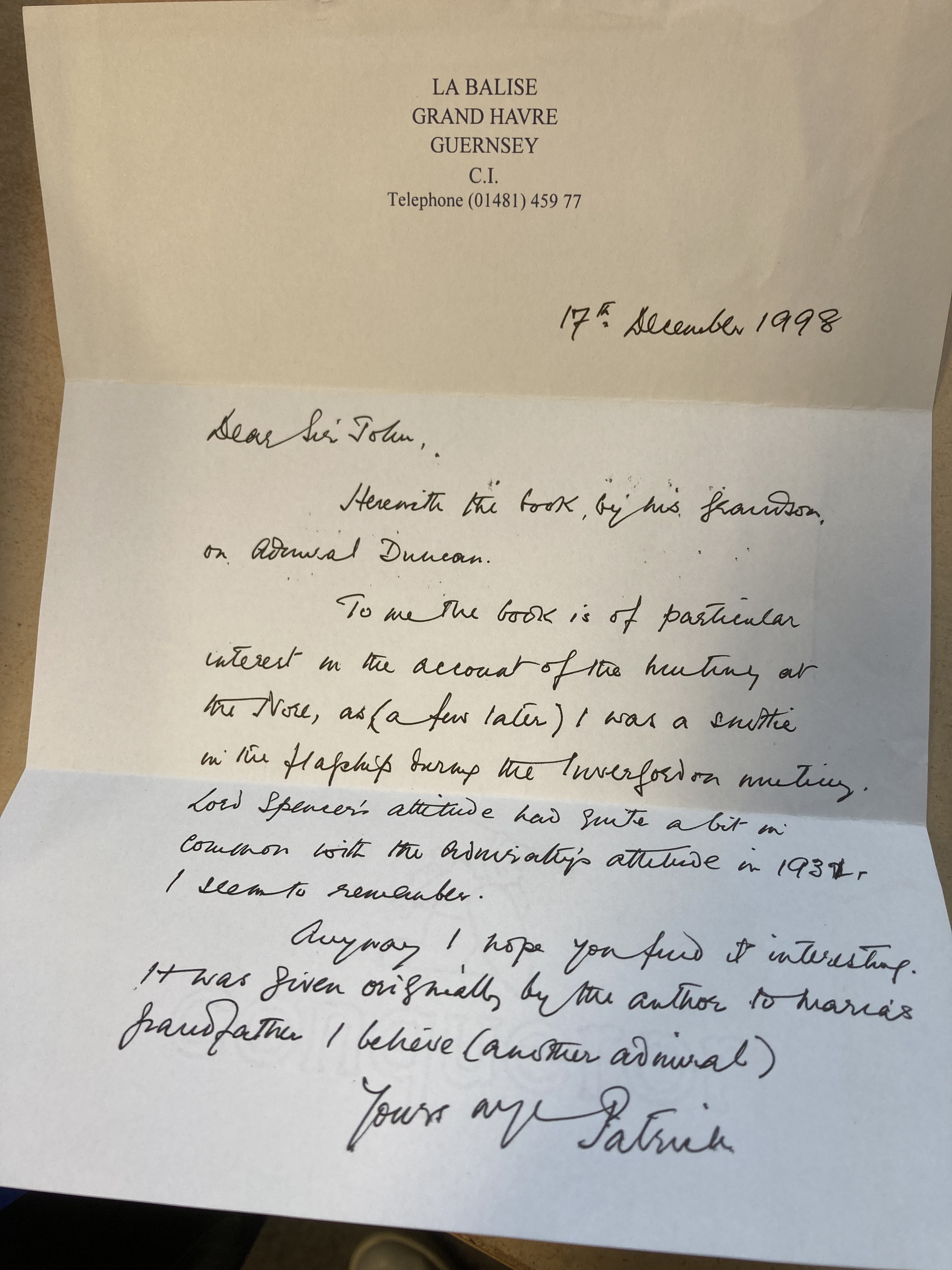
I need to find out about Patrick, his wife Maria, her grandfather and one day perhaps, Sir John.
Meanwhile back to mutinies.
My kind friend who does know about these things sent me this:
‘There were quite a few mutinies over the centuries, usually involving more than one ship when the fleet was at anchor (often for extended periods), and were due to government pay cuts or the state of the victuals as a result of corruption in the Victualling Board or yards – so pesky civilians at fault.
The more concerning ones from the Admiralty viewpoint were those on individual ships far from home – hence the Naval Discipline Act which unlike the other services allowed captains to award up to 2 years imprisonment.
Incidentally, WRNs were never subject to that act, and could just walk away.
The Captain’s safe used to have a confidential reference book on how to deal with mutinies. The only bit I remember was not to try to re-establish order while only wearing underpants.
Needless to say, we now have a joint Armed Forces Discipline Act and anything serious is handed over to civilian lawyers.’
I have two mutinies I want to investigate – the Nore mutiny for Admiral Duncan and the one Patrick was involved in – Invergordon.
But first some background to mutinies in 1797 – a big year for mutinies:
‘In September 1797, the crew of Hermione mutinied in the West Indies, killing almost all the officers in revenge for a number of grievances, including throwing into the sea without proper burial, the bodies of three men killed by falling from the rigging in a desperate attempt not to be the last men on deck, which was punishable by flogging.The Hermione was taken by the crew to the Spanish port of La Guaira.
On 27 December, the crew of Marie Antoinette murdered their officers and took their ship into a French port in the West Indies. Other mutinies took place off the coast of Ireland and at the Cape of Good Hope and spread to the fleet under Admiral Jervis off the coast of Spain. ‘ Wikipedia
So, if you are up for this, help yourself to a tot of rum and settle down.
(But given that this series of blogs is all about wandering about the Navy, books and history, here is a digression, and as a digression on a digression, who’d have thought the rum ration was still in action in 1970, and who’d thought it was not available in 1797 when the mutinies in this blog were in action?..)
‘The rum ration, or “tot”, from 1850 to 1970 consisted of one-eighth of an imperial pint (71 ml) of rum at 95.5 proof, given out at midday.
Senior ratings (petty officers and above) received their rum neat, whilst for junior ratings it was diluted with two parts of water to make three-eighths of an imperial pint (213 ml) of grog.
Rum, due to its highly flammable nature, was stored in large barrels in a special rum store in the bowels of the ship. The rum ration was served from one particular barrel, known as the “Rum Tub”.
Not all sailors necessarily drew their rum: each had the option to be marked in the ship’s books as “G” (for Grog) or “T” (for Temperance).
Sailors who opted to be “T” were given threepence (3d) a day instead of the rum ration, although most preferred the rum.
Sailors under 20 were not permitted a rum ration, and were marked on the ship’s books as “UA” (Under Age).’ Wikipedia
So back to mutinies.
In 1797 two mutinies broke out.
One in Portsmouth, the Spithead mutiny, and one in Nore in the Thames Estuary.
Apparently, the Spithead mutiny was more a kind of strike for better conditions whilst the Nore mutiny had more political overtones – and that is the one which involves Admiral Duncan.
When I say ‘apparently’ I am relying on a Wikipedia entry on these mutinies.
Now, I am a big fan of Wikipedia, rely on it frequently and yes, do send money to keep it going.
And all the entries are anonymous but sometimes you get the feel of the person behind what they are writing, and this entry has the whiff of a chap who is rather formal, has a Naval background and is not a fan of leftie politics. ( Of course I could be wrong.)
So, he (I’m assuming) writes (comments in italics are mine):
‘Seamen’s pay rates had been established in 1658, and because of the stability of wages and prices, they were still reasonable as recently as the 1756–1763 Seven Years’ War; however, high inflation during the last decades of the 18th century had severely eroded the real value of the pay. In recent years, pay raises had also been granted to the army, militia, and naval officers.
You can rather imagine that for people seeing their bosses getting a pay rise when they were told they shouldn’t grumble about the reasonableness of their own more meagre pay, set about 100 years before, during a period of high inflation, might just be just a bit annoying. Nothing like our own times of course.
And, ‘until 19th-century reforms improved conditions, the Royal Navy was additionally known to pay wages up to two years in arrears.
The Navy always withheld six months’ pay as a standard policy, in order to discourage desertion.
At the same time, the practice of coppering the submerged part of hulls, which had started in 1761, meant that British warships no longer had to return to port frequently to have their hulls scraped, and the additional time at sea greatly altered the rhythm and difficulty of seamen’s work.
The Royal Navy had not made adjustments for any of these changes, and was slow to understand their effects on its crews.
If you are still with me when I get onto the Invergordon mutiny (1931 rather than 1797 ) you might well see that little in the way of attitude had changed.
Impressment (a common practice) meant that some of the seamen were onboard ship against their wills.
That, is press gangs and meant that men between 18 and 55 years old and capable of being seafaring were ‘taken into naval force with, or without, notice.’
The army tried it for two years from 1778 to 1780 and then gave it up. The Navy held onto it for a long time: 1664-1815.
The new wartime quota system meant that crews had many landsmen from inshore (including some convicted criminals sent in lieu of punishment) who did not mix well with the career seamen, leading to discontented ships’ companies.’ Wikipedia
So, you as a well practised sailor, knowing your stuff, your colleagues/mates etc etc then find you are alongside men who know nothing about sailing and have a criminal past. It may be that that criminal past mattered less than the fact those men didn’t know how to hoist a sail….
The Nore mutiny 1797, as promised earlier:
The crew of Sandwich at anchor at Nore, seized control of their ship and several other crews did likewise. Because they were scattered, they set up their own elected delegates to make demands on the Admiralty – or indeed anyone who might listen.
The crews elected Richard Parker as President of Delegates of The Fleet and drew up demands which included pardons, a pay rise and modifications to The Articles Of War.
I will leave you to read them all
https://en.wikipedia.org/wiki/Articles_of_War
But just to mention article XIX
Mutinous assembly. Uttering words of sedition and mutiny. Contempt to superior officers. If any person in or belonging to the fleet shall make or endeavor to make any mutinous assembly upon any pretence whatsoever, every person offending herein, and being convicted thereof by the sentence of the court martial, shall suffer death: and if any person in or belonging to the fleet shall utter any words of sedition or mutiny, he shall suffer death, or such other punishment as a court martial shall deem him to deserve: and if any officer, mariner, or soldier on or belonging to the fleet, shall behave himself with contempt to his superior officer, being in the execution of his office, he shall be punished according to the nature of his offence by the judgement of a court martial.
Richard Parker became known as the President of the Floating Republic – and this was the time that the French Revolution was stretching its influence.
Imagine the effort the English establishment were harnessing so they they could ‘manage the disturbance.’
The mutineers extended their demands and partially blockaded London but they couldn’t make it work and the mutiny failed.
Parker was convicted of treason and piracy and hanged from the yardarm of Sandwich, the vessel where the mutiny had started.
In the reprisals that followed, 29 were hanged, 29 were imprisoned, and nine were flogged, while others were sentenced to transportation to Australia.
If you have made it here, thank you and yet, and yet, there is more……
 thereluctanthousewife