Botanical Mystery

You may recall that we had a book donated to the shop called The First Book of Indian Botany.

Well, it was interesting because it was a first edition but mind you, the spine had come away from the block of pages. 

They were all holding together very well but just not attached to the spine.

Now, before you think ho hum, there is a mystery.

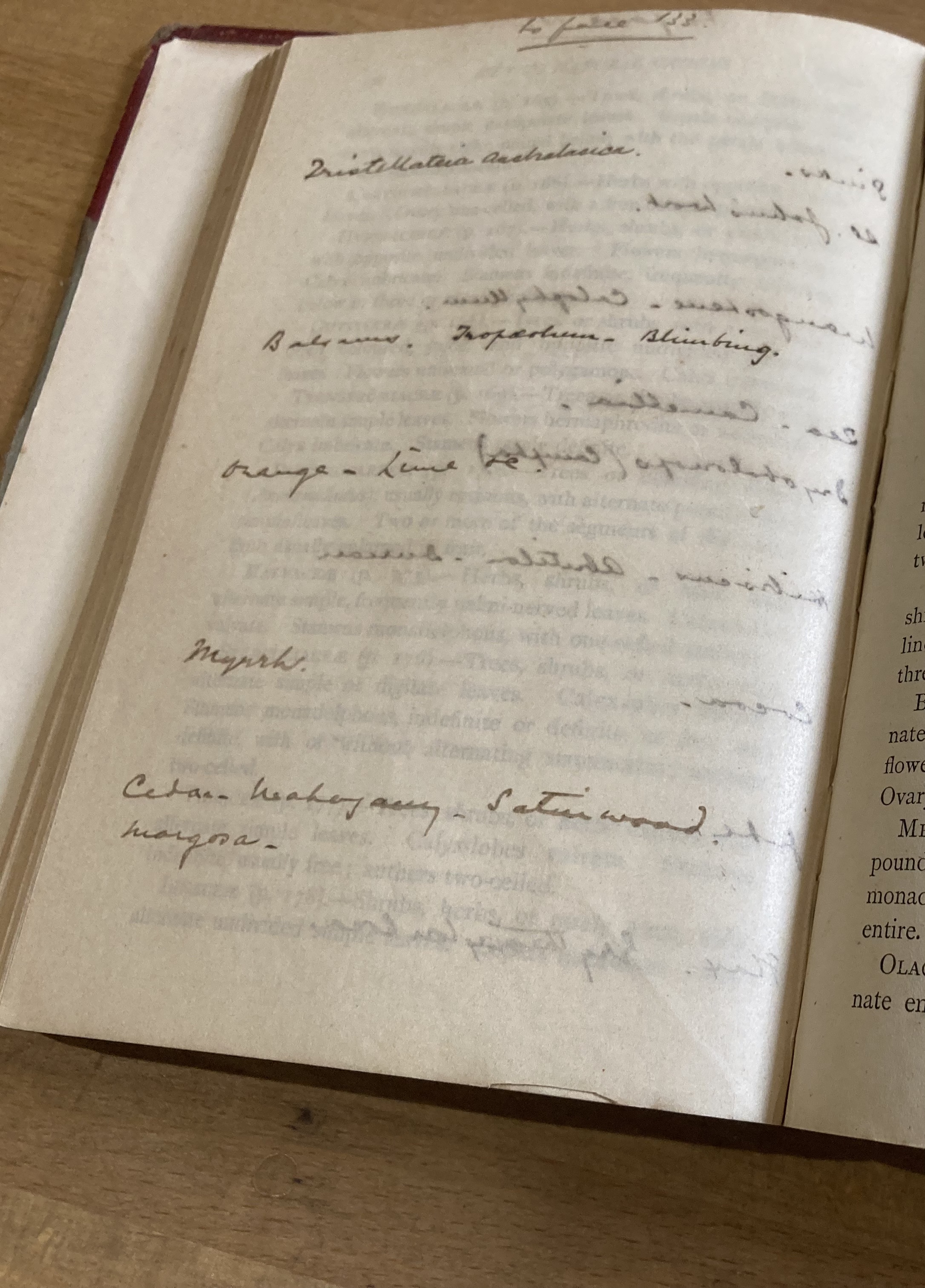
So, the pages are, of course, printed but bound in with them are some handwritten notes.
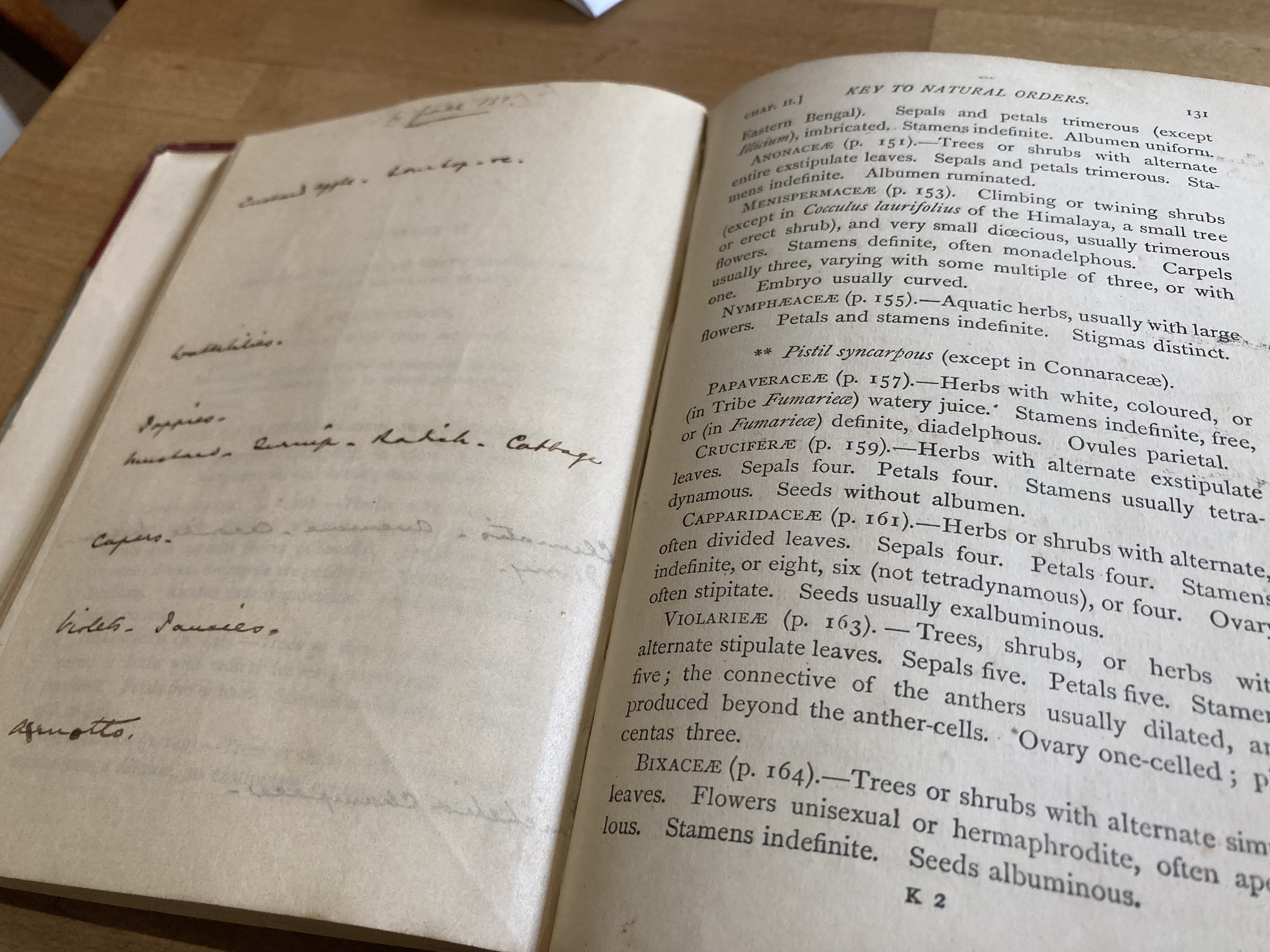
Now, who but the author would get the printers to bind in some notes – perhaps for the second edition? 

No one, right? 

So, we have the author’s notes.

And who was he?

Well a friend and collaborator of Charles Darwin.

( You might have read something about this in a previous blog, but either way, you have to admit the first edition of a book with handwritten notes by a collaborator, protege and friend of Darwin is looking very promising.)

Daniel Oliver.

He was ‘Librarian of the Herbarium, Royal Botanic Gardens, Kew from 1860–1890 and Keeper there from 1864–1890, and Professor of Botany at University College, London from 1861–1888. Wikipedia

In fact, he was recommended for the UCL job by Darwin.

There are in the Darwin Correspondence Project (darwinproject.ac.uk) pages of letters to and from Oliver and Darwin, also between Hooker and Darwin mentioning Oliver. 

He knew what he was on about in botany.

( And as a small diversion, I dipped into some of these letters, understood nothing of the botany but found Darwin’s humour:

‘Here is a good joke; I saw an extract from Lecoq. Geograph. Bot. & ordered it & hoped that it was a good sized pamphlet & my God nine thick volumes have arrived!’

‘I have written you a frightfully long letter not worth the trouble of decyphering…. Forgive me scribbling at such length, & believe me Yours very sincerely

C. Darwin’)

Anyway, there was also a previous owner’s name on the flyleaf which was deciphered by the sleuth-niece to be Alfred Venning.

She did an amazing amount of research I would never have found on Alfred and I could fill several blogs with what she found and wander about in among those leads and snippets and find more.

But I need to stick, more or less, to the point.

And, more or less, everything below is what the BB’s N discovered and all credit goes to her.

So, Venning was a tea or coffee planter in Ceylon in 1870 but had abandoned that by 1884.

(There is a whole lot of interesting stuff about a parasitic fungus which killed off the coffee plantations in the then Ceylon, and the impact that had of tea and coffee growing in the region but we are not going there now.)

Venning held all sorts of colonial administrative roles but is most remembered ( perhaps apart from the riots about scales and weight units, but no we are not going there) for creating a huge park in Kuala Lumpur, started in 1888.

It is still there now, all 173 acres of it.

Whilst at the time it was a pleasure park – including a golf course – now it is more of a botanical gardens which would have pleased him.

He was, significantly for our story, a botanist.

For the next ten years Venning continued to maintain and improve the park and in 1900 Venning was transferred to Perak where he stayed in the town of Taiping. Whilst there he is recorded as collecting some plants in 1901 or 1902 which ended up in the collection of the Singapore Botanical Herbarium.

‘The Singapore Herbarium was essentially set up by Kew and a system of plant exchanges with other herbariums was set up. This was at a time that Daniel Oliver was keeper of the herbarium at Kew so would have been in regular correspondence with Singapore.

There are no records of the samples Venning collected in the Singapore Herbarium though there are multiple samples under his son’s name dating from 1907 (when the son would have been 24).

He did however donate samples from Ceylon to the Kew herbarium in 1916. 

Oliver died in late 1916 but it is possible he would have seen these donations as he was clearly still involved that year as there is a photo dated to 1916 of him and all other subsequent keepers of the herbarium.

This is the best link I have managed to find between them but Kew’s herbarium database is currently down so I am unable to see if these samples are still there.’

So, this was all well and good.

We had Oliver linked to Darwin, we had his notes in bound into the first edition of his book and we had lots of information on the second ( presumably) owner who was also a botanist.

I consulted with our antiquarian book expert and we decided it was probably, even in its dodgy condition, with its provenance worth about £1200 – or at least that was what we were going to ask for it.

As a last thing to do, I contacted Kew to ask them whether they had a second edition of the book so that we could see whether the notes he had made were incorporated and changed the text.

I sent photos and expected, which I got, an automatic reply telling me I could consult with their online archives.

And then I got an email from a nice woman at Kew, I will call Alice, saying she had had a look at my email and checked a few things out – and the handwriting was not Daniel Oliver’s.

What? 

Who else would have had that book unbound, inserted their notes and re-bound?

Well I don’t know.

Sleuth-Niece did better than I could and found a sample of Alfred Venning’s handwriting and here it is:

Does it match the notes? I am not sure.

If I had the time and knowledge of botany, I would search out a later edition and compare the notes we have with that text and that would presumably tell me whether Daniel Oliver got an underling/his wife/a colleague to write the notes and then incorporate them.

So the book will be listed in Oxfam online along these lines:

First Book Of Indian Botany – with bound in handwritten notes

First edition. 1869. Macmillan. 

Front hinge is broken and front endpaper is detached and the rear hinge is holding on but only just, and will probably break sometime soon.

Block, however, is solid.

There are handwritten notes on ( here I will insert some notes about the notes) bound into the block between pages ( and here I will insert the details.)

The notes do not match Daniel Oliver’s handwriting (as confirmed by Kew) and we have not yet been able to compare with the any second edition of the book to ascertain whether they were incorporated. 

Author Daniel Oliver was a friend, correspondent, botanical advisor and protege of Charles Darwin.

He was Professor of Botany for University College London and head of the Herbarium at Kew.

Previous owner’s name on the flyleaf is Alfred Venning, a colonial administrator and botanist who is most famous for creating the Perdana Gardens in Kuala Lumpur, then called the lake Gardens.

We cannot be sure that the notes were made by Venning.

Whilst we cannot make any direct connection between Venning and Oliver, we do know that Venning did donate botanic samples from Ceylon to the Kew herbarium in 1916 – which was the year Oliver died.

We have more search on possible connections between Venning, Kew and Oliver and for more information, please get in touch.

There is probably a lot more research to be done on this little book, but it is unique.

First editions of it are rare and these bound-in handwritten notes make it a one off.

This small, damaged book is a mystery waiting to be solved and a link to botany research with a direct connection to Charles Darwin.

Whoever buys it will you please let us know what you find out.

This is what Cambridge University says about the book:

Well known among his contemporaries for his unrivalled knowledge of aberrant plants, Daniel Oliver (1830–1916) ran the herbarium at Kew Gardens and held the chair of botany at University College London, for which he was recommended by Charles Darwin. Although Oliver never visited India, his expertise in Indian botany grew considerably after he worked with an enormous number of dried specimens rescued from the cellars of the East India Company. In this book, first published in 1869, he sets out the basics of botanical study in India for the absolute beginner. It includes instruction on the anatomy of simple plants, lessons in collection and dissection, and explanations of botany’s often dense terminology. Annotated diagrams appear throughout, in both microscopic and macroscopic views. Rigorous and carefully structured, Oliver’s book remains an excellent resource for novice botanists and students in the history of science.

Clubbable Types

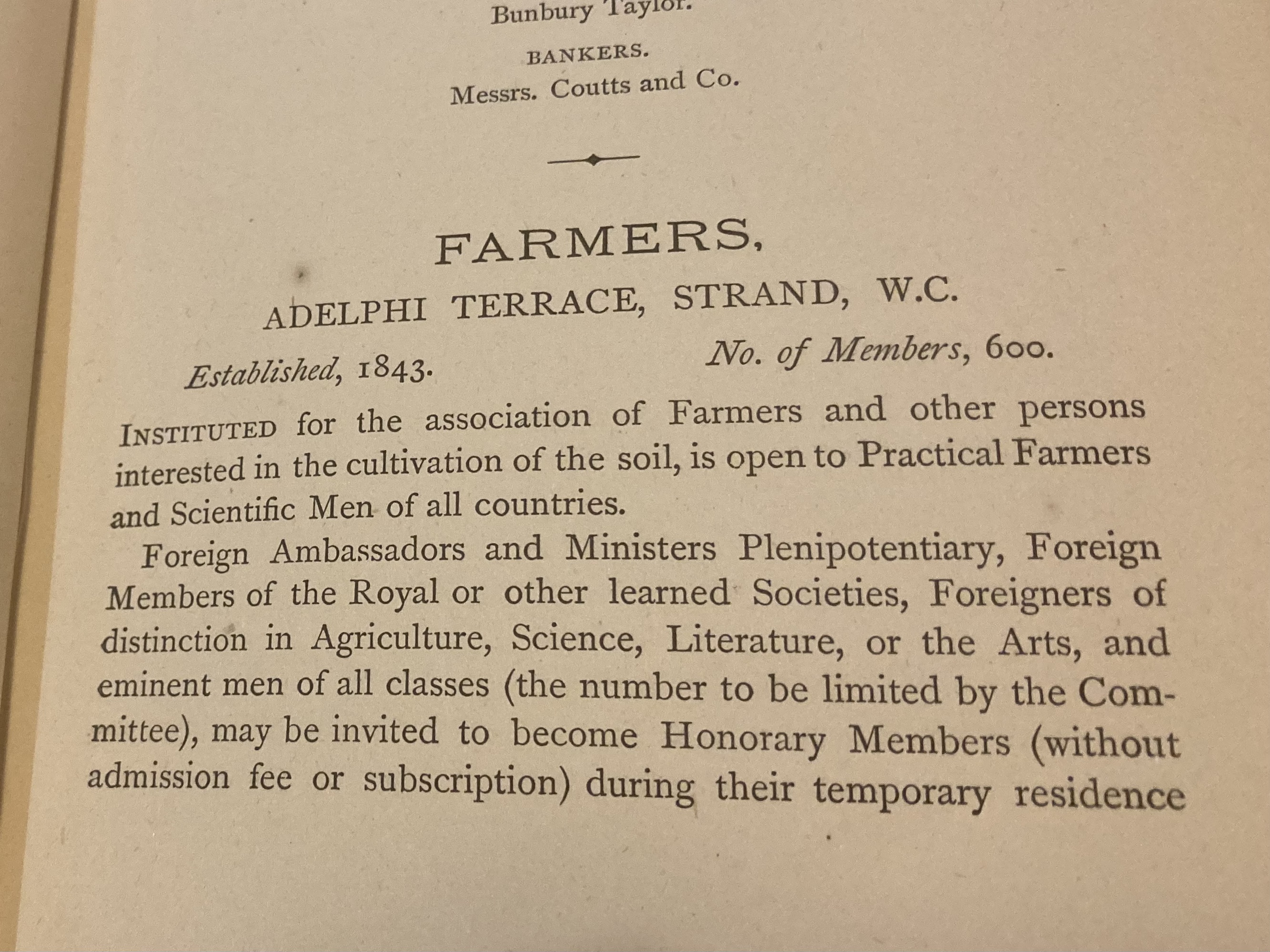
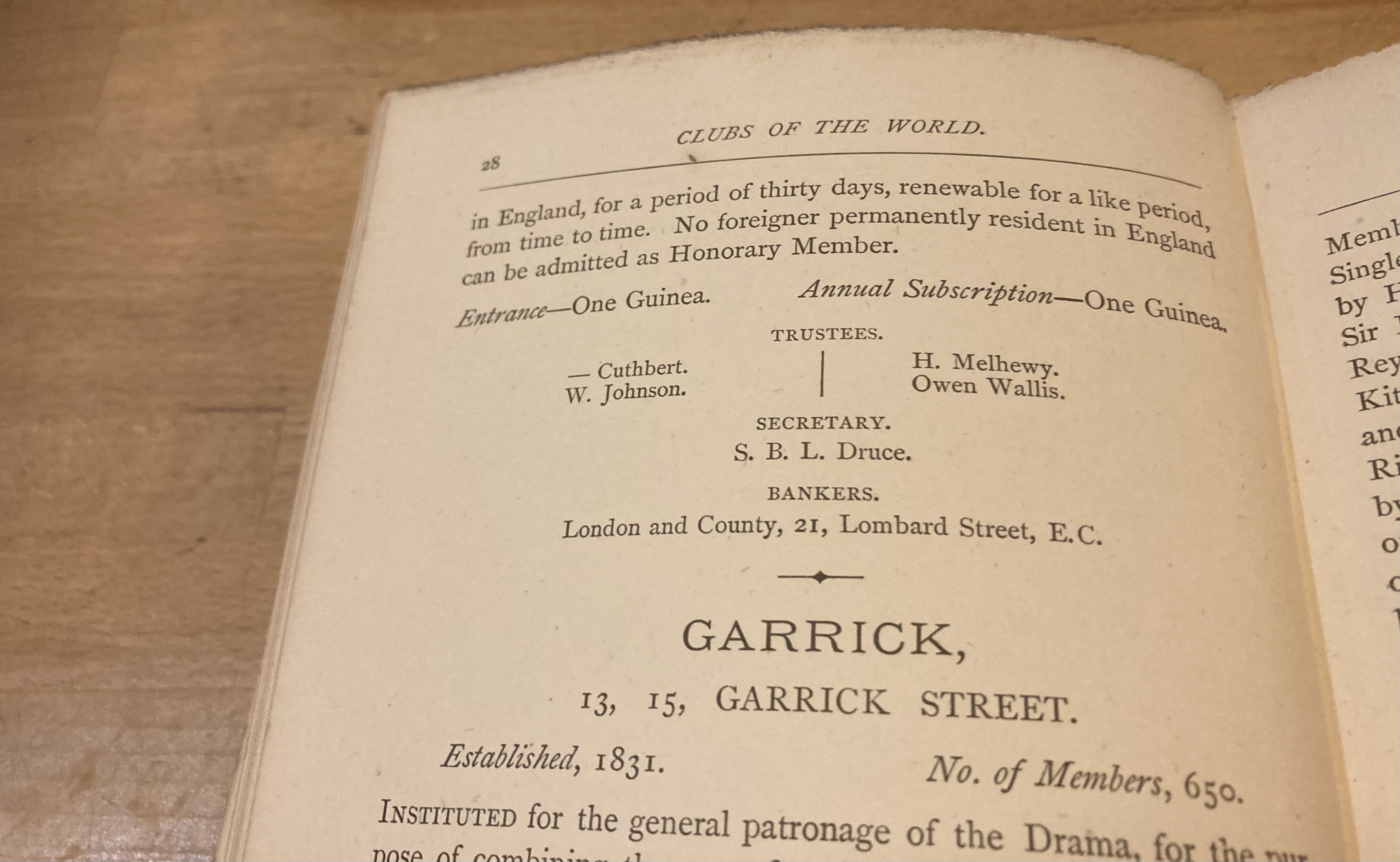
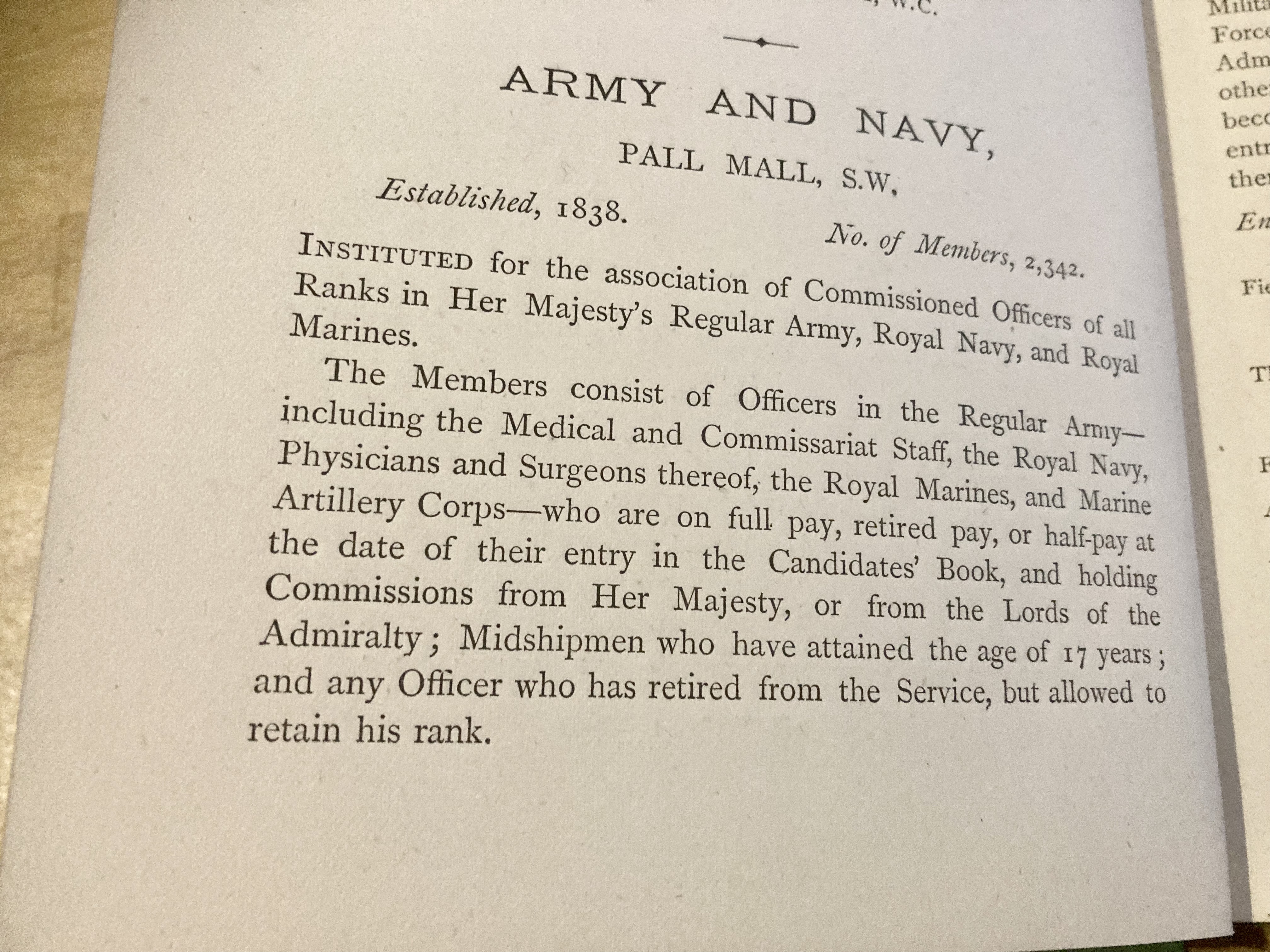
The Directory of Clubs (1887) book came into the shop recently and there is little to say about it except what it says itself on the mores, values and attitudes of the time so I will let it ‘speak’.

Except to say that when I was living in Europe but had work in London, I looked around for a club to join so that I would have an overnight base here.

The Liberal Club would have been convenient but one visit confirmed I was the only woman within sight and the youngest (then) by about 40 years.

It was a half-hearted search on the basis that I did not really want to join the kind of people who sat in leather armchairs with their friends from Eton days and discussed off-shore bank accounts and how the poor should get off their lazy asses and get a job.

I should have stuck with it and joined The University Women’s Club but too late now.

( Mind you, there is a bit of me that could embrace the idea of coming up from the country for a night or two to see a couple of exhibitions, do cocktails and dine with a few friends and visit my dressmaker…..)

According to Wikipedia:

‘Men’s clubs were also a place for gossip. The clubs were designed for communication and the sharing of information. By gossiping, bonds were created which were used to confirm social and gender boundaries. Gossiping helped confirm a man’s identity, both in his community and within society at large. It was often used as a tool to climb the social ladder. It revealed that a man had certain information others did not have. It was also a tool used to demonstrate a man’s masculinity. It established certain gender roles. Men told stories and joked. The times and places a man told stories, gossiped, and shared information were also considered to show a man’s awareness of behaviour and discretion. Clubs were places where men could gossip freely. Gossip was also a tool that led to more practical results in the outside world. There were also rules that governed gossip in the clubs. These rules governed the privacy and secrecy of members. Clubs regulated this form of communication so that it was done in a more acceptable manner.’

And,

‘Discussion of trade or business is usually not allowed in traditional gentlemen’s clubs, although it may hire out its rooms to external organisations for events.’

‘In recent years the advent of mobile working (using phone and email) has placed pressures on the traditional London clubs which frown on, and often ban, the use of mobiles and discourage laptops, indeed any discussion of business matters or ‘work related papers’.’

Mmm, I cannot quite believe that men of business and politics spend their time just discussing the cricket or how best to get the gardener to prune roses.

Luxury Bubble

We are on a holiday I never expected we would be on – the days were when we bought a Rough Guide, booked a flight and a hire car and took it from there.

But these days we have more limitations and the Best Beloved gets like a bear with a sore head in January/February so here we are.

( Before you read on, an apology that this is one of several pieces about another holiday. Please bear in mind, we don’t jaunt all the time and it is true that there is more time to write when you haven’t got a list of things to do and place to be when you are on holiday.

And, of course I have lots of holiday photos to share with you.)

But I will quite understand that reading the holiday rambles of lucky people may not be your thing so feel free to leave now and no doubt you have a list of things to do too.)

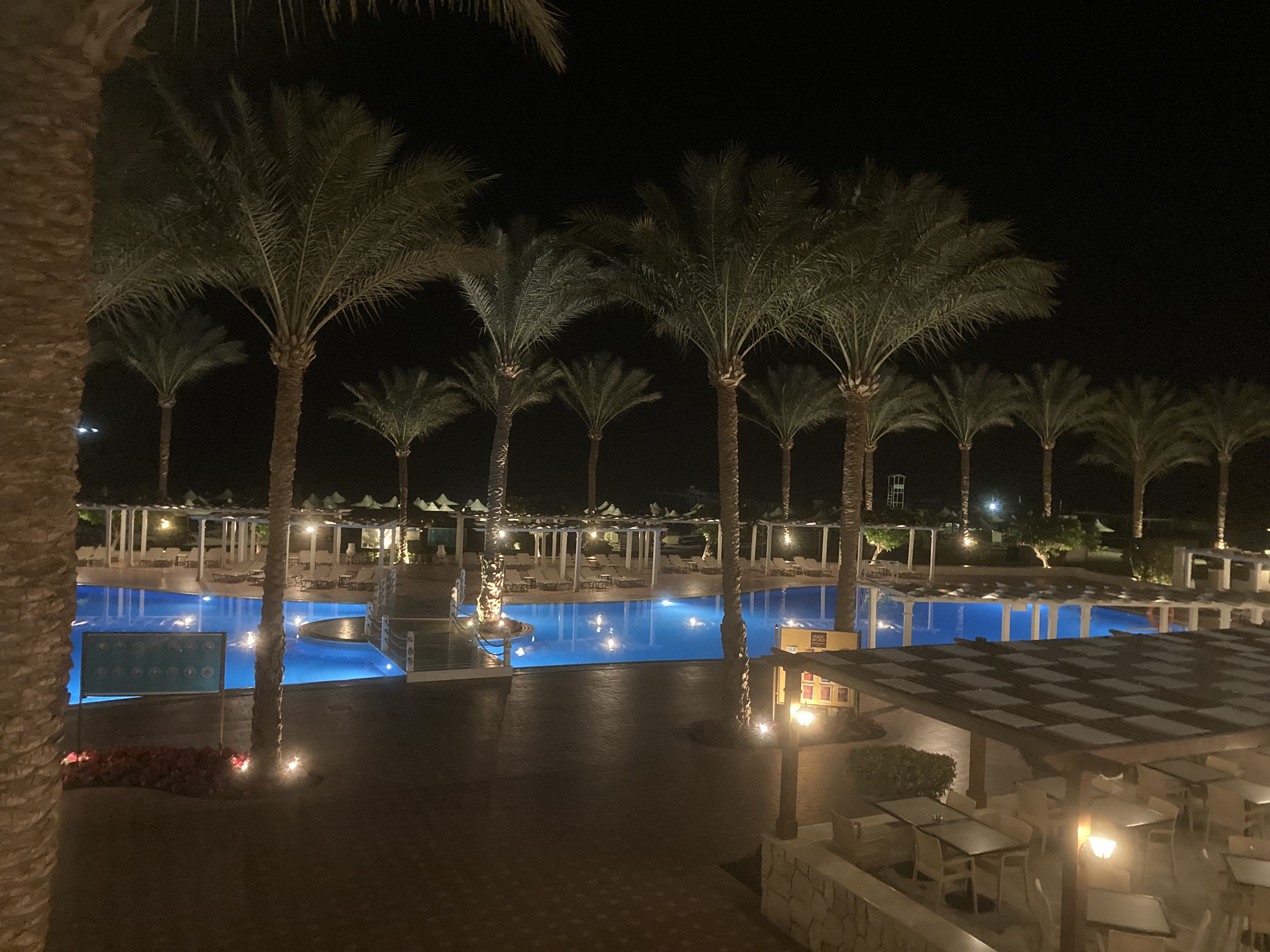
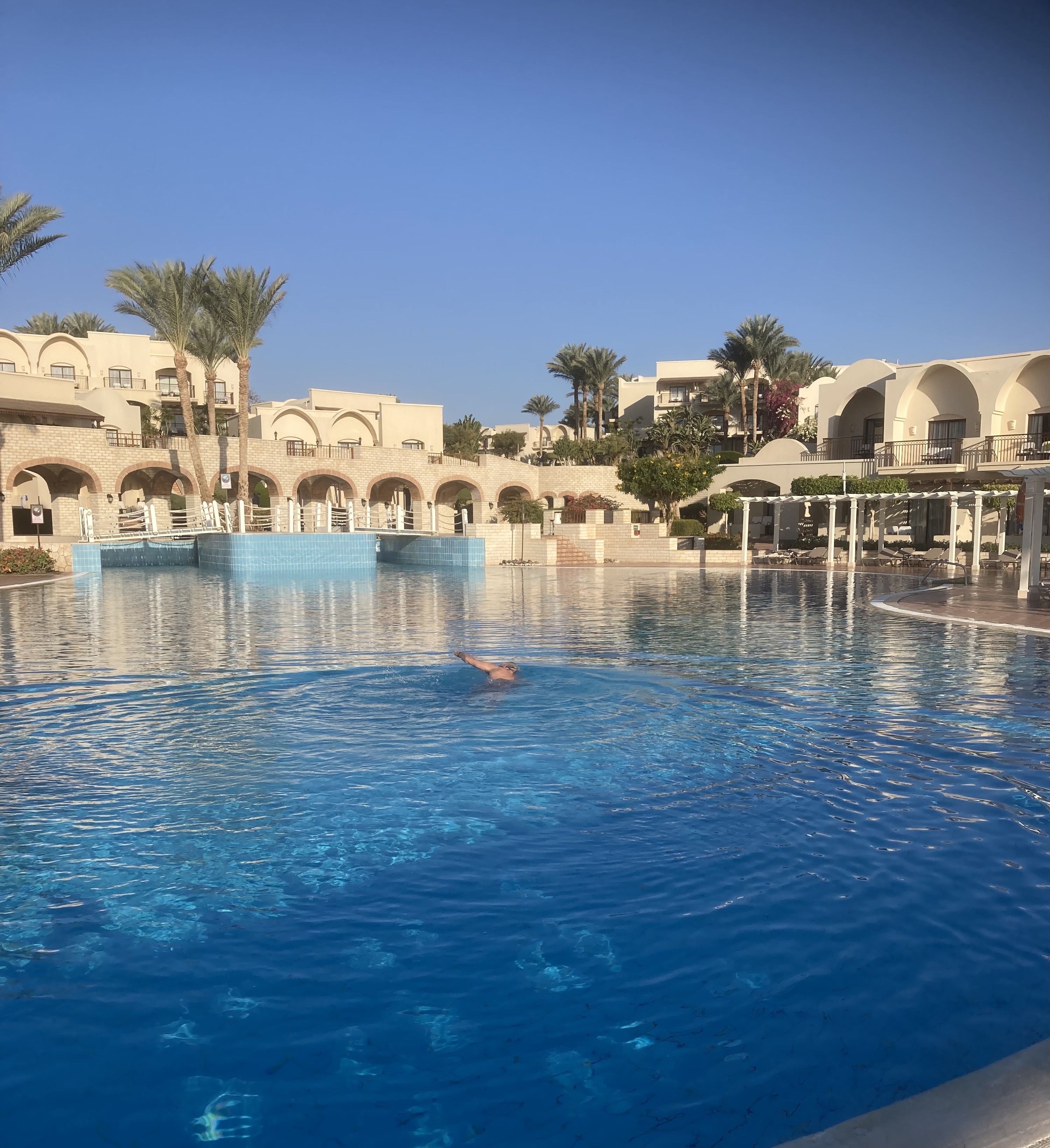
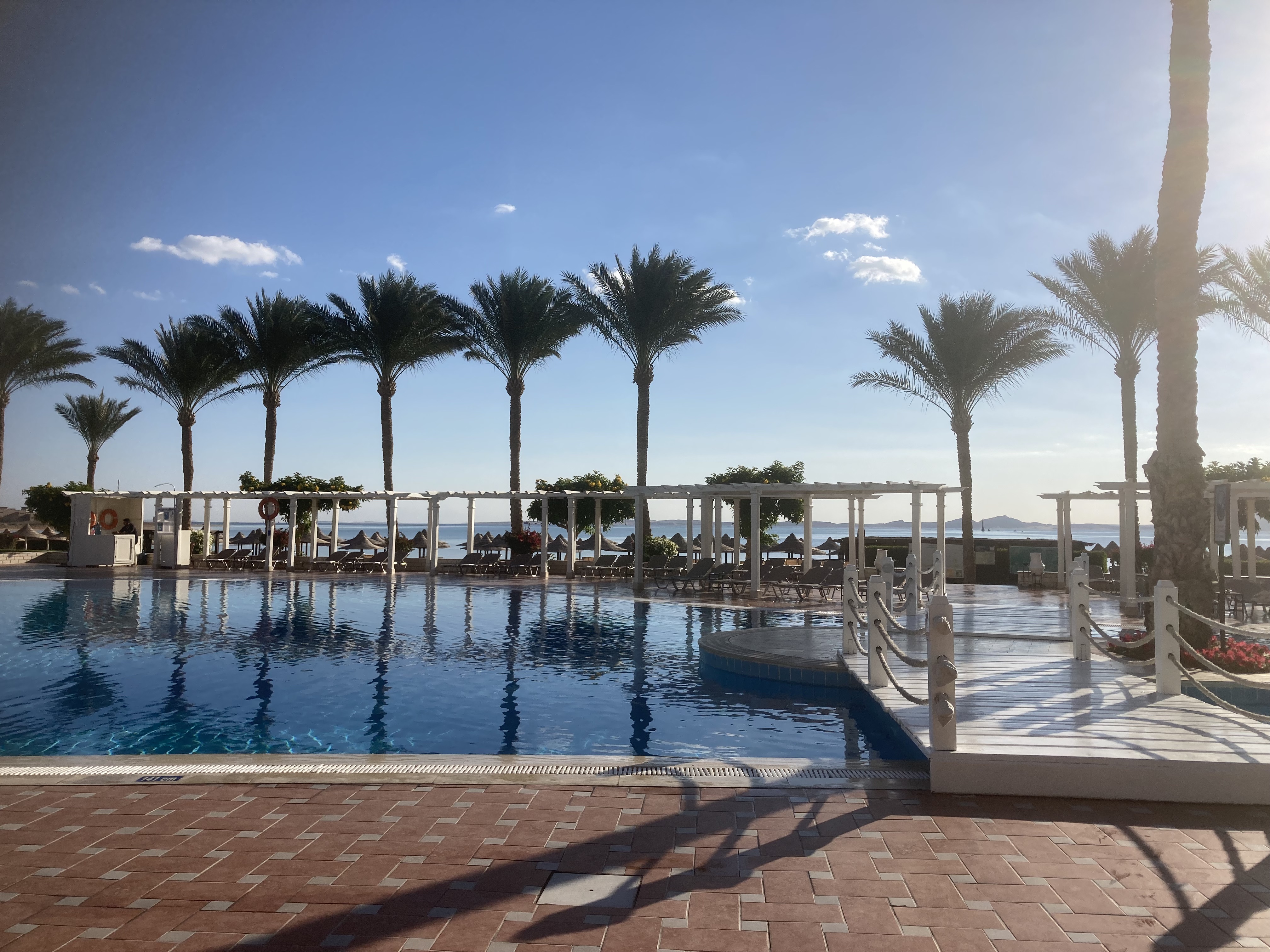
‘Here’ is a lovely hotel complex with two pools, a children’s pool, several terraces, overlooking the sea the beach and then the Red Sea and 317 rooms scatted in lovely gardens.

I am not complaining.

We are technically in Egypt but Sharm el Sheik is 300-hotel totally-tourist place.

There is a negligible local population – and I mean negligible.

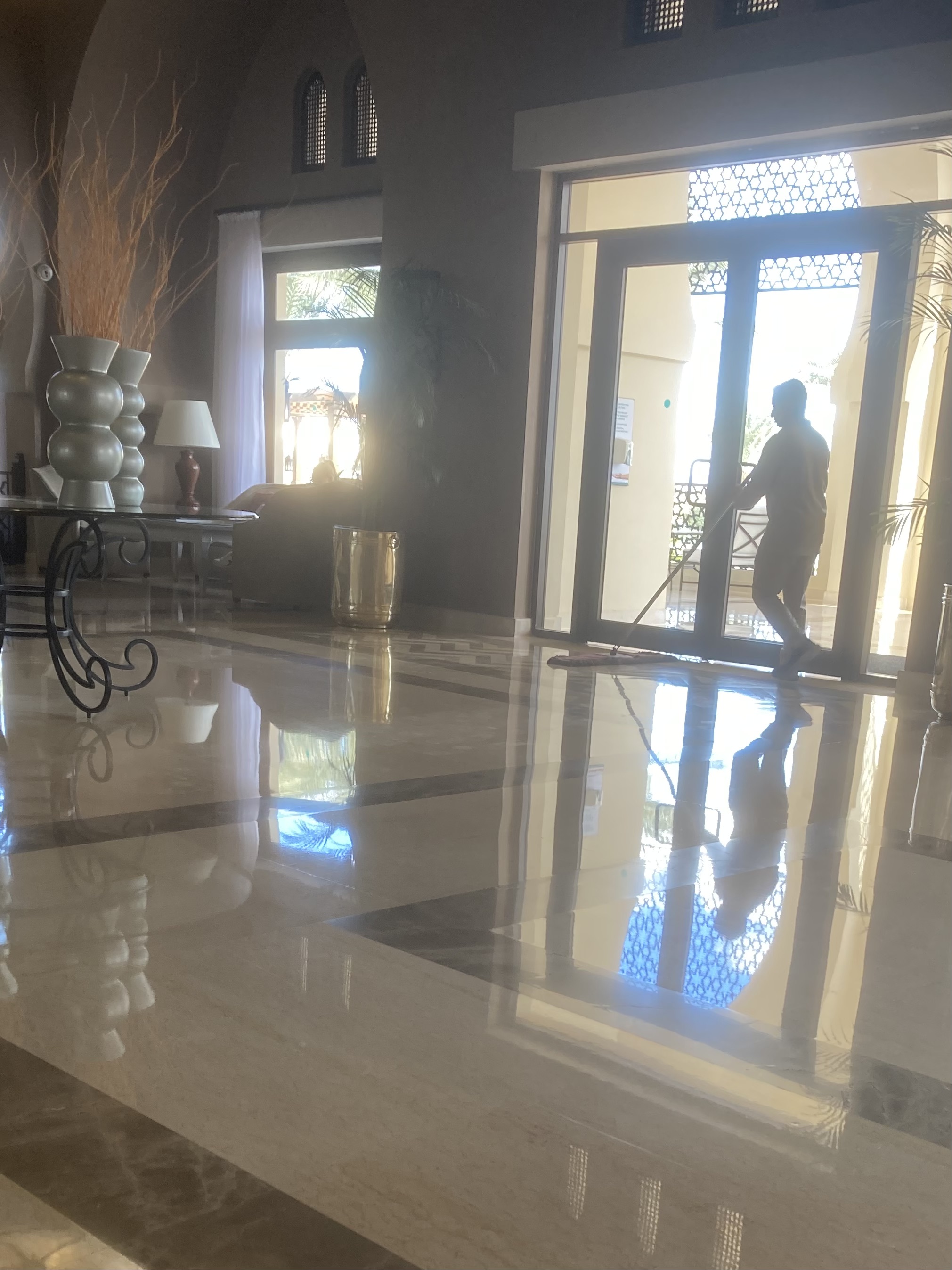
Every one of the army of people making our hotel complex immaculate, serving at tables, sweeping up bougainvillea blossoms every morning, cleaning the pools at sunrise and sunset, gently rolling the sand on the beach to eradicate yesterday’s footprints, reception staff, bar staff, cooks, room cleaners ( including folding towels into heart or swan shapes), those keeping the marble floors free of any dust or footprints – all of them come from somewhere else.

They are all in the hotel’s various liveries and all are smiling, polite and helpful.

We are here at the end of January which is the quietest month – and therefore really pleasant because they have time to stop at chat and there is an air of peacefulness about the place.

Things start to ramp up in February – halt-terms and all – and keep going up and up.

Despite, or maybe because of the fact, the heat ramps up too, British people come in their thousands and I mean thousands.

Apparently, there can be 10 planes a day from the UK into Sharm just from two holiday companies – and there are others.

And that is just the Brits. Apparently the Czech’s like summer here, the Russians come all year round, the French ( always adventurous when they leave France, come for the nights in the dessert), some Italians and Germans, but no Scandinavians because they don’t like that might heat – I am with the Scandis.

You can just imagine the fleets of transfer coaches just driving endlessly backwards and forwards all day and well into the evening.

The kitchen staff working flat out in up to 40 degree heat outside never mind inside.

The room cleaners dealing with the chaos a family of two adults and two kids can wreak on they room on a daily basis.

The shaded pool loungers occupied from early mornings.

Our last minute all-inclusive deal means we were given a green bracelet which means everything is free – all food, all drinks – the latter came as rather a surprise when I went to the bar to order some wine, of course I did.

The overwhelming majority of the lovely army of staff are young, fit, healthy and often handsome Egyptian men. 

I have seen one woman on reception one day, and one woman opening the door for you as you go into the restaurant.

It is a cultural thing.

Egypt has a very young population which may explain why they have put several steps all over the place – from one bit of the bar to another, from there to reception, from one poolside to another, from the terrace to ‘our’ terrace. And there is a flight of 22 steps from the bar to the restaurant level.

Except for the flight, none of them have handrails which is a little challenging for anyone with balance and walking issues – the Best Beloved says it will do him good but a unbalanced man tackling shiny marble steps with two sticks is a bit anxiety-inducing.

A few handrails around the place would be good. Mind you there is always some nice young man leaping forward to help if necessary.

Seeing endless young men running lightly up and down them without a thought makes me jealous for my youth, leave alone the BB.

Another surprise was the fact that the Wifi here is, well rubbish.

In our room there is none.

Needless to say the best place to get any reception is in reception which explains why I am practically sitting on the reception staff’s knee to post this.

And why reception has a scattering of lone people checking their phones at any time of day or night.

I am not sure why the Wifi is bad across Egypt and especially in the tourist Mecca that is Sharm.

Maybe, President El Sisi prefers it that way – a lot of controlling regimes do.

But I was told that one of the reasons why it is bad in hotels is that all the staff, away from home, with no Netflix and not much to do in their time off, download movies using up all the bandwidth. Good on them.

Meanwhile, the rooms were clearly designed a built some years ago because there just aren’t enough plug points to charge up – and that’s just the two of us leave alone if you had kids with you.

So it is either the lamp or the laptop – that sort of thing.

A paltry complaint but rather a surprising one in this day and age.

But really we are living for a week in a luxurious bubble.

I used to spend time working on intense short summer schools with 100 PhD students. 

You barely thought of the outside world, let alone ventured into it, you were in this other, entirely separate place for days on end.

That was in university accommodation of greater or lesser comfort and quality.

This feels a bit like that except without the students, the work demands and the lack of comfort.

I am not complaining.

Wildlife

So, another holiday piece I am afraid.

We went on a boat trip.

It was billed as a few hours in the lovely waters of the Ras Mohammed National Park, with stops to snorkel among the coral, have lunch on the boat and go to Egypt’s little Maldive-like island in turquoise sea.

Well….

First of all, it was windy and I mean gale force windy. Unusual by even the usual winds of February.

The captain, crew and fellow passengers were surprised, but we given our history of bringing bad weather to bemused fellow holidaymakers, really shouldn’t have been.

Very luckily, the sea was not rolling so no seasickness, phew.

But it was cold. 

The crew were fleeced up and sensibly stayed in the downstairs room when they could.

The passengers were out to get their money’s worth and stayed out on deck – at least for a while.

Most of us were British and included a range from those of us (not just me) who decided pretty early on that as a poor swimmer and novice snorkeler and already quite chilled (not out, just cold) not going in was the best option, to those who wild-swam in northern England and were going in come hell or high water.

Including one young woman who was determined to get a waterproof case for her phone and film every minute of her snorkel from the moment she jumped in.

( Her travelling companion got her swimsuit on twice and twice decided not to get in, causing a noticeable soupçon of friction.)

We were motoring along in the wind when I noticed a couple of birds just above the high rigging.

Gulls? no, wrong noise, wrong look but then what do I know about Egyptian birds?

The captain noticed them too and shouted down to the crew, presumably, ‘Oi someone up here now!’

He took one of the higher wires and the summoned crew member took another.

They gently flicked the wires which kept the birds away from the boat but they still wheeled around for quite a while and were lovely.

Turns out they are white falcons which are a sight to see.

But the reason they were flicked at was because if they poo and it lands on your clothes you will never get the stain out.

Presumably tourists must be protected in every and all ways.

There are protected ares of the park at certain times to let turtles breed and areas where tourist boats are banned to let coral recover.

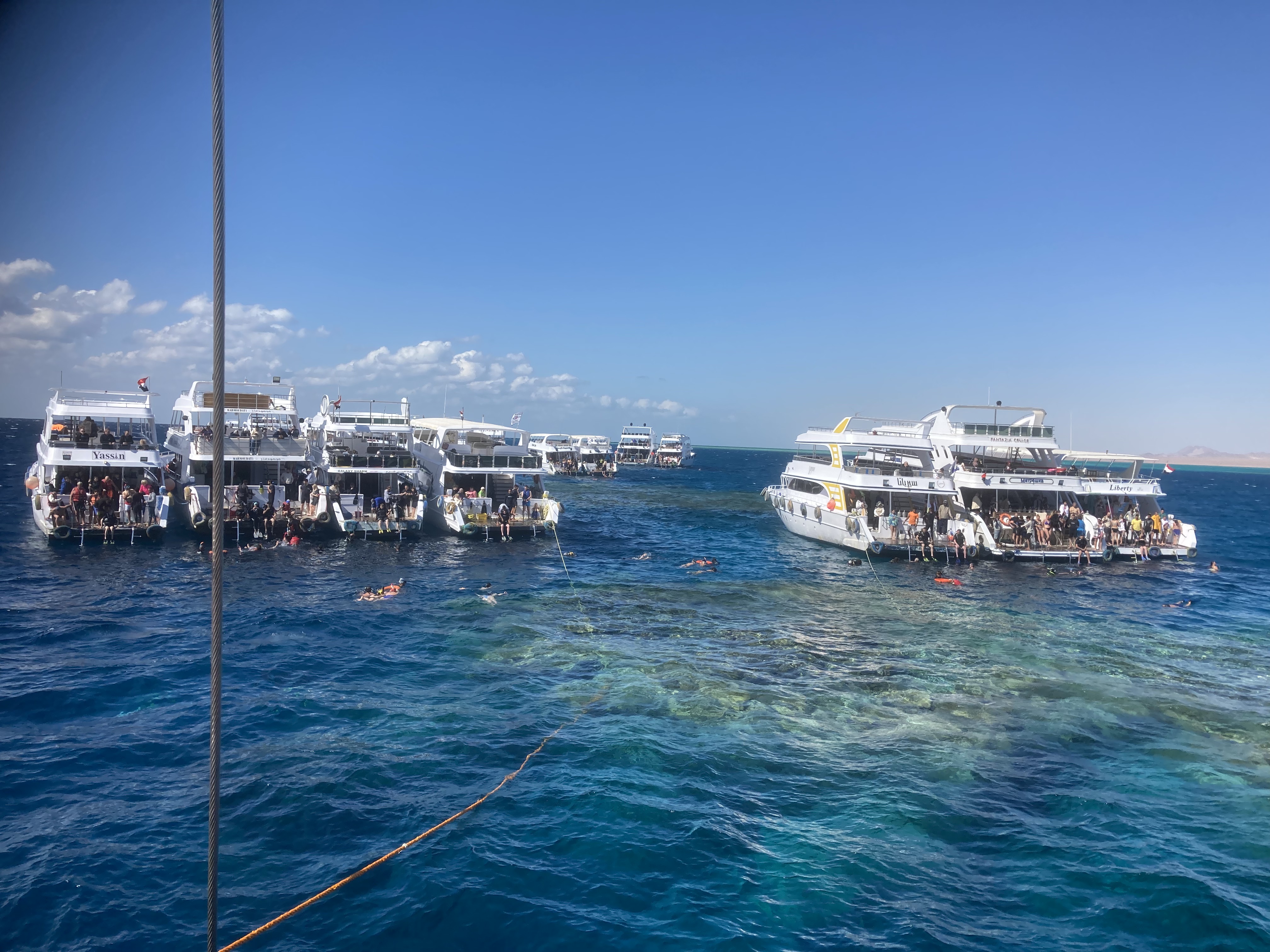
Mind you, bearing in mind this is the quietist month of the year and plane-load after plane-load arrive in the summer, it was quite a shock to see the size of the ‘flotilla’ of tourist boats on the same route as us.

I counted nineteen.

However, it is a navy military area which means like military areas in the UK, they are a haven for wildlife. 

All kinds of different fish including an eagle ray which I was called to the side of the boat by a crew member to see.

Actually, I had a) never heard of an eagle ray and b) could only see a darker smudge in the water.

Needless to say though, a crew member was sent in with a waterproof camera to go and get some decent shots so we could all see it. 

Meanwhile, our lovely and tactful excursion guide needed rescuing.

He was sitting next to a British woman who clearly did not do tact, had embarked on a conversation with him about the current Israeli war and I overheard her saying something along the lines of, ‘ well whatever, you have to feel sorry for those poor Israelis….’

I guessed her understanding of Middle East politics was not extensive.

I interrupted them with a question about the timings of the trip – something anodyne and a chance to change the subject.

‘We go to the White Island then back towards Sharm and there is another snorkelling stop,’  he said.

‘What?’ she said, ‘ I thought we were going to the national park.’

‘We are in it, ‘ I said.

‘But we are at sea,’ she said.

‘It is a maritime national park,’ I said.

‘Are you sure? I’ve never heard of one of those. Is it just in Egypt?’

I was even more convinced she probably was not the best person to break the unwritten code that everyone else had stuck to of not asking awkward political questions of the Egyptians we met.

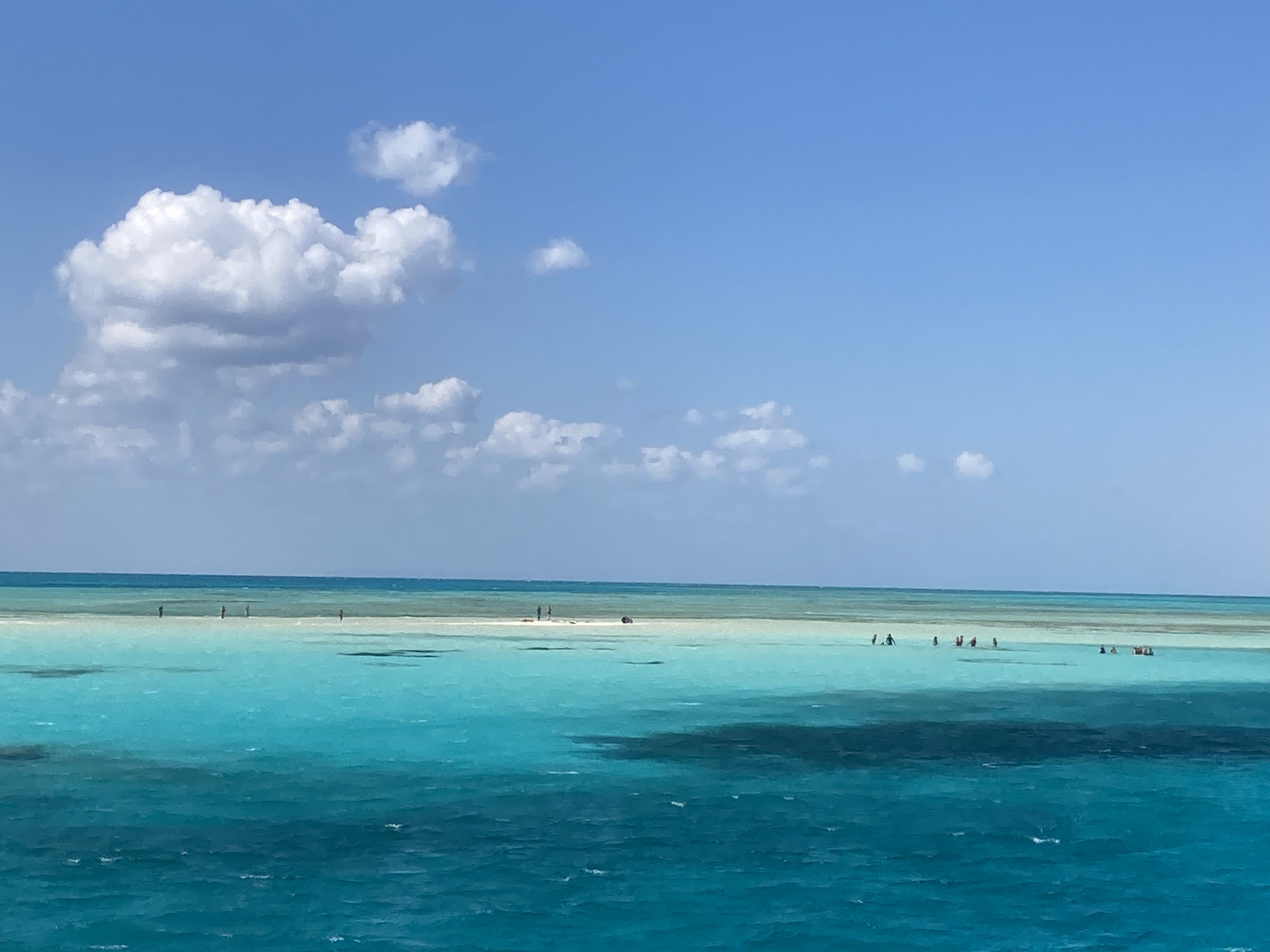
Anyway, we got to the famous Maldives look-alike White Island. 

I have to say that a sandbar in an admittedly lovely turquoise sea will not have the Maldives’ tourist authority quaking in their sandals.

There are sharks in the Red Sea, the BB’s daughter told him.

And I was told by the excursion guide (once rescued) that parts of the national park could be shut when there are sharks around.

That evening the Best Beloved admitted that he had wondered about sharks and had thought he might strap some nail scissors to his ankle in case he met a shark and apparently they don’t like to be stabbed in their gills.

OK, so he is being attacked a shark who is being asked to wait just there until he could swim behind its massive mouth fitted with hundreds of very sharp teeth, and hold still whilst he stabbed at its gills - with some nail scissors.

I laughed fit to burst my corset stays