You may recall that we had a book donated to the shop called The First Book of Indian Botany.

Well, it was interesting because it was a first edition but mind you, the spine had come away from the block of pages.
They were all holding together very well but just not attached to the spine.

Now, before you think ho hum, there is a mystery.
So, the pages are, of course, printed but bound in with them are some handwritten notes.
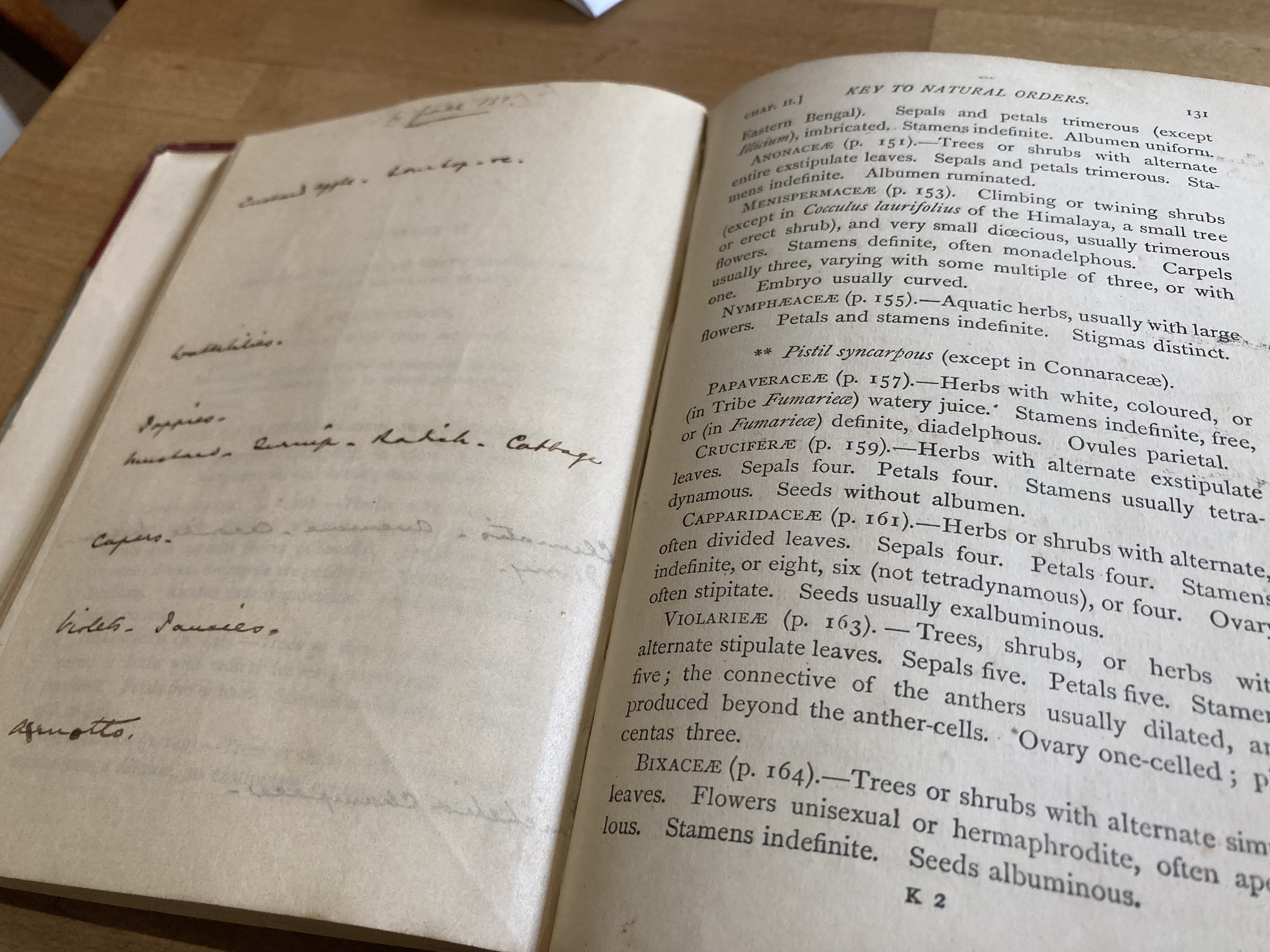
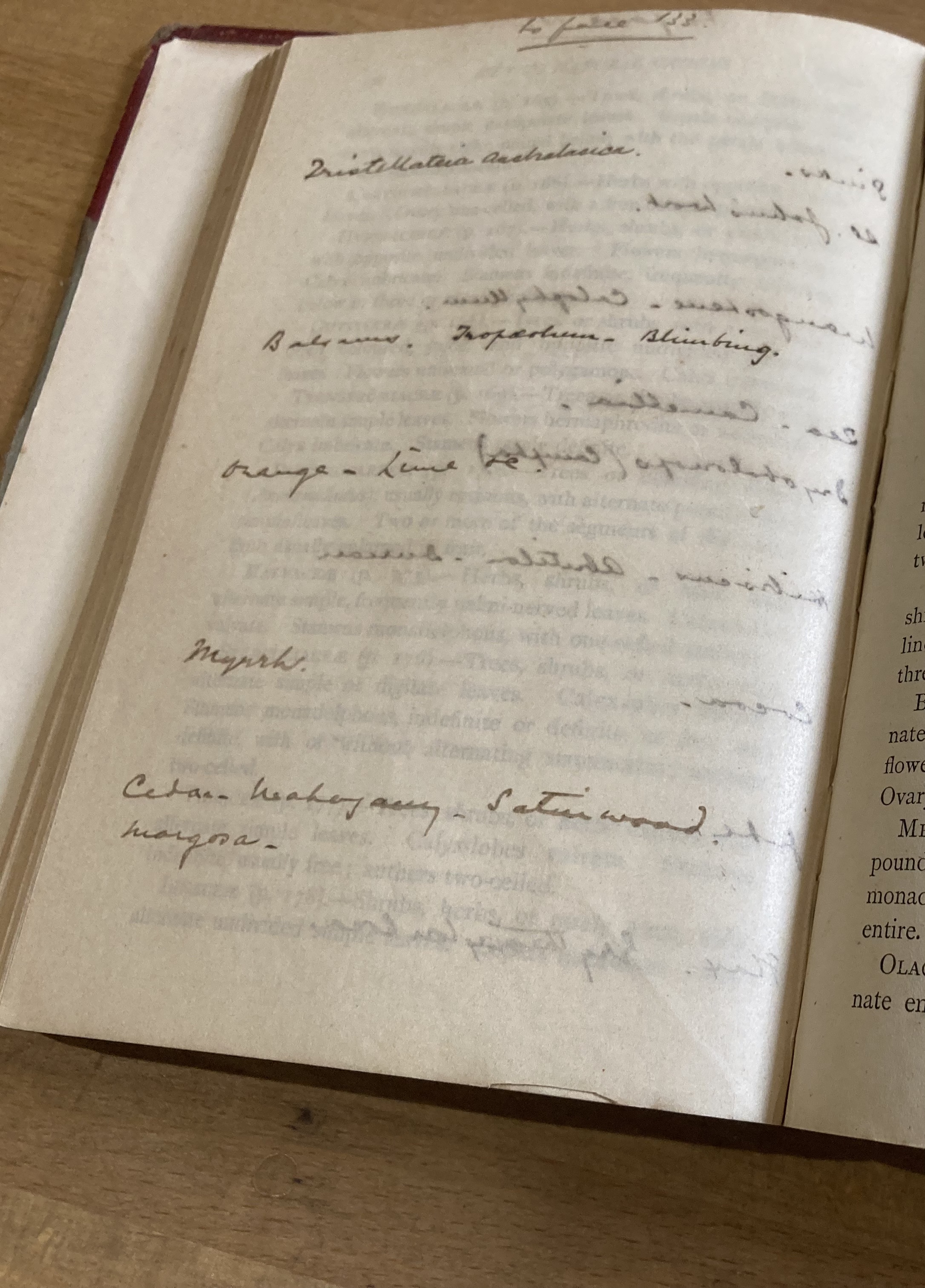
Now, who but the author would get the printers to bind in some notes – perhaps for the second edition?
No one, right?
So, we have the author’s notes.
And who was he?
Well a friend and collaborator of Charles Darwin.
( You might have read something about this in a previous blog, but either way, you have to admit the first edition of a book with handwritten notes by a collaborator, protege and friend of Darwin is looking very promising.)
Daniel Oliver.
He was ‘Librarian of the Herbarium, Royal Botanic Gardens, Kew from 1860–1890 and Keeper there from 1864–1890, and Professor of Botany at University College, London from 1861–1888. Wikipedia
In fact, he was recommended for the UCL job by Darwin.
There are in the Darwin Correspondence Project (darwinproject.ac.uk) pages of letters to and from Oliver and Darwin, also between Hooker and Darwin mentioning Oliver.
He knew what he was on about in botany.
( And as a small diversion, I dipped into some of these letters, understood nothing of the botany but found Darwin’s humour:
‘Here is a good joke; I saw an extract from Lecoq. Geograph. Bot. & ordered it & hoped that it was a good sized pamphlet & my God nine thick volumes have arrived!’
‘I have written you a frightfully long letter not worth the trouble of decyphering…. Forgive me scribbling at such length, & believe me Yours very sincerely
C. Darwin’)
Anyway, there was also a previous owner’s name on the flyleaf which was deciphered by the sleuth-niece to be Alfred Venning.
She did an amazing amount of research I would never have found on Alfred and I could fill several blogs with what she found and wander about in among those leads and snippets and find more.
But I need to stick, more or less, to the point.
And, more or less, everything below is what the BB’s N discovered and all credit goes to her.
So, Venning was a tea or coffee planter in Ceylon in 1870 but had abandoned that by 1884.
(There is a whole lot of interesting stuff about a parasitic fungus which killed off the coffee plantations in the then Ceylon, and the impact that had of tea and coffee growing in the region but we are not going there now.)
Venning held all sorts of colonial administrative roles but is most remembered ( perhaps apart from the riots about scales and weight units, but no we are not going there) for creating a huge park in Kuala Lumpur, started in 1888.
It is still there now, all 173 acres of it.
Whilst at the time it was a pleasure park – including a golf course – now it is more of a botanical gardens which would have pleased him.
He was, significantly for our story, a botanist.
For the next ten years Venning continued to maintain and improve the park and in 1900 Venning was transferred to Perak where he stayed in the town of Taiping. Whilst there he is recorded as collecting some plants in 1901 or 1902 which ended up in the collection of the Singapore Botanical Herbarium.
‘The Singapore Herbarium was essentially set up by Kew and a system of plant exchanges with other herbariums was set up. This was at a time that Daniel Oliver was keeper of the herbarium at Kew so would have been in regular correspondence with Singapore.
There are no records of the samples Venning collected in the Singapore Herbarium though there are multiple samples under his son’s name dating from 1907 (when the son would have been 24).
He did however donate samples from Ceylon to the Kew herbarium in 1916.
Oliver died in late 1916 but it is possible he would have seen these donations as he was clearly still involved that year as there is a photo dated to 1916 of him and all other subsequent keepers of the herbarium.

This is the best link I have managed to find between them but Kew’s herbarium database is currently down so I am unable to see if these samples are still there.’
So, this was all well and good.
We had Oliver linked to Darwin, we had his notes in bound into the first edition of his book and we had lots of information on the second ( presumably) owner who was also a botanist.
I consulted with our antiquarian book expert and we decided it was probably, even in its dodgy condition, with its provenance worth about £1200 – or at least that was what we were going to ask for it.
As a last thing to do, I contacted Kew to ask them whether they had a second edition of the book so that we could see whether the notes he had made were incorporated and changed the text.
I sent photos and expected, which I got, an automatic reply telling me I could consult with their online archives.
And then I got an email from a nice woman at Kew, I will call Alice, saying she had had a look at my email and checked a few things out – and the handwriting was not Daniel Oliver’s.
What?
Who else would have had that book unbound, inserted their notes and re-bound?
Well I don’t know.
Sleuth-Niece did better than I could and found a sample of Alfred Venning’s handwriting and here it is:
Does it match the notes? I am not sure.
If I had the time and knowledge of botany, I would search out a later edition and compare the notes we have with that text and that would presumably tell me whether Daniel Oliver got an underling/his wife/a colleague to write the notes and then incorporate them.
So the book will be listed in Oxfam online along these lines:
First Book Of Indian Botany – with bound in handwritten notes
First edition. 1869. Macmillan.
Front hinge is broken and front endpaper is detached and the rear hinge is holding on but only just, and will probably break sometime soon.
Block, however, is solid.
There are handwritten notes on ( here I will insert some notes about the notes) bound into the block between pages ( and here I will insert the details.)
The notes do not match Daniel Oliver’s handwriting (as confirmed by Kew) and we have not yet been able to compare with the any second edition of the book to ascertain whether they were incorporated.
Author Daniel Oliver was a friend, correspondent, botanical advisor and protege of Charles Darwin.
He was Professor of Botany for University College London and head of the Herbarium at Kew.
Previous owner’s name on the flyleaf is Alfred Venning, a colonial administrator and botanist who is most famous for creating the Perdana Gardens in Kuala Lumpur, then called the lake Gardens.
We cannot be sure that the notes were made by Venning.
Whilst we cannot make any direct connection between Venning and Oliver, we do know that Venning did donate botanic samples from Ceylon to the Kew herbarium in 1916 – which was the year Oliver died.
We have more search on possible connections between Venning, Kew and Oliver and for more information, please get in touch.
There is probably a lot more research to be done on this little book, but it is unique.
First editions of it are rare and these bound-in handwritten notes make it a one off.
This small, damaged book is a mystery waiting to be solved and a link to botany research with a direct connection to Charles Darwin.
Whoever buys it will you please let us know what you find out.
This is what Cambridge University says about the book:
Well known among his contemporaries for his unrivalled knowledge of aberrant plants, Daniel Oliver (1830–1916) ran the herbarium at Kew Gardens and held the chair of botany at University College London, for which he was recommended by Charles Darwin. Although Oliver never visited India, his expertise in Indian botany grew considerably after he worked with an enormous number of dried specimens rescued from the cellars of the East India Company. In this book, first published in 1869, he sets out the basics of botanical study in India for the absolute beginner. It includes instruction on the anatomy of simple plants, lessons in collection and dissection, and explanations of botany’s often dense terminology. Annotated diagrams appear throughout, in both microscopic and macroscopic views. Rigorous and carefully structured, Oliver’s book remains an excellent resource for novice botanists and students in the history of science.
 thereluctanthousewife