On And Off

Following on from the last piece, remember the ‘modern proverb’ If at first you don’t succeed, try turning it off and on again?

Well, the Best beloved needed (another) spine operation and, as is usual, he went for the obligatory check ups before.

They found he had a slow heartbeat.

This was not a surprise as for every other operation he has had in our however many years together, every time the medics have commentated on his slow heartbeat.

No worries, we said.

Mmm, they said.

And then they said, Go home with a monitor strapped to your chest for a night or two and we shall see.

He did.

They were not impressed.

You need a pacemaker, they said.

Now here was the rub, the surgeon doing the operation ( privately, I have to say) was going on sabbatical so we had to get the pacemaker in before he left.

A privately funded pacemaker cost nearly as much as the spine operation – really you ask, yes indeed.

So I spent a lot of time on the phone with medical secretaries – secretaries/assistants/receptionists are always the route through a problem.

Eventually after a lot of chasing around the NHS to try and get this done in time, the private/NHS heart doctor who had first had said  said, Do you know what, just add him to the end of my list and I’ll get it bloody well done.

And I close quotes.

So, it is a quick in and out to get something put in the size of say a 50 pence piece and yes it is visible under the skin and it takes about 40 minutes under local anaesthetic.

We were very grateful and relieved. 

And when it is done they strap you up to a monitor to make sure all is well and leave you on a bed for an hour or so.

So, all is well.

The monitor is behind the BB’s sightlines but visible to me as I sat solicitously (and rather impressed by my own ability to get this done in time with the help of several great women).

I could see that his heartbeat was registering not so much rather high as alarmingly high.

But he was chatting away and offering crossword clues.

In the end I asked a nurse to come in and check things.

She took one look at the monitor and called in someone else.

But he is fine, I said.

Mmm, she said.

She took his pulse in the old fashioned way.

And said, Mmm….

I’d better call the technicians but that may take some while.

I said, Shall we just try the turning off and on again trick? After all it is only a monitor not something keeping his heart going.

Mmm, she said.

But we did.

And do you know what – all was just fine.

It’s a great proverb and, along with the 80/20 rule, one that I swear by.

Queer Proverbs

There are books with titles which would probably not be used today.

But in 1886, things were a bit different.

Anyway, Edwin Hodder writing as ‘Old Merry’ had indeed some rather odd proverbs as well as some still very familiar – and his discourses are nothing if not a little idiosyncratic.

You know how some sayings get embedded in your family?

Well, the one I remember from my mother was, “ What the eye doesn’t see gathers no moss.’

I am not sure exactly what she meant by eliding those two proverbs but generally, I think she used it when she wanted to sidestep something awkward, and get away with it.

Anyway back to Old Merry.

‘The cat in gloves catches no mice’ 

And there is a picture.

As well as a moral ‘sermon’ to children from the ‘pulpit.’

I won’t bore you with the several pages of Victorian ‘humour’ and moralising on all the proverbs. 

‘Phew,’ I hear you cry – and in the hope I can detain you just a little longer, here are just a few more snippets.

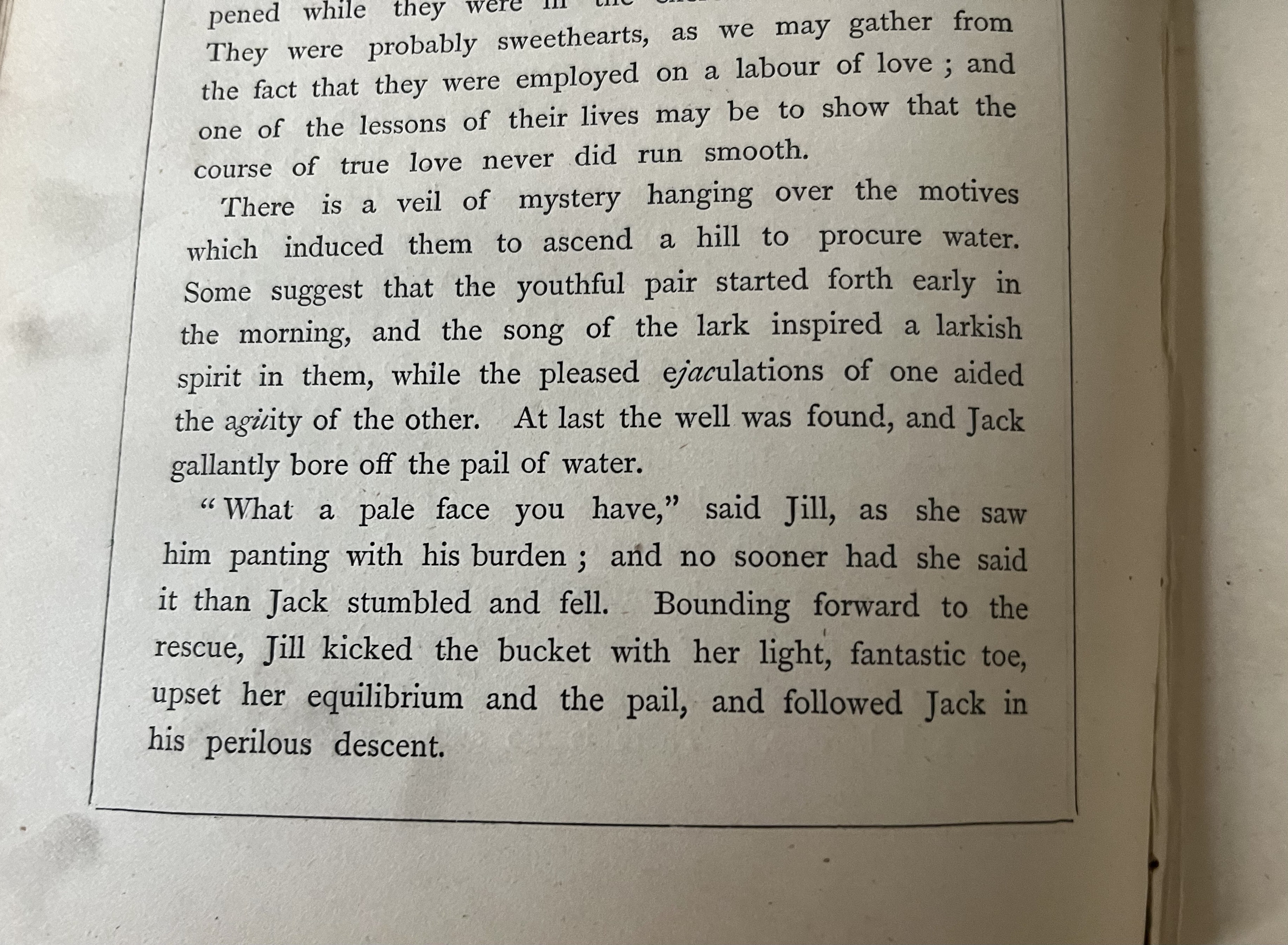
Jack and Jill

Interestingly, though he says later, addressing the rapt Victorian children I assume, there are two lessons, only No 1 seems to be identified. 

Perhaps he needs the same proverb as I do – something about attention to detail.

The Best Beloved says I need to be followed around by a tame pedant.

And, he says, my life is like an impressionist painting, all looking good from a distance but up close, it is a mess of random dots.

As for attention to detail ‘proverb’, I am going with “ Look after the (non-financial) pennies and the pounds will look after themselves.’ 

Doesn’t trip off the tongue I know, but will work on it.

I also like the quote:

‘Success in any endeavour requires single-minded attention to detail and total concentration.’

Willie Sutton (aka, “Slick Willie, the famous bank robber)

Well, back to Old Merry and 

‘Every ass likes to hear himself bray.’

Is it too cheap a shot to want to have that projected onto the walls of parliament?

Old Merry however, makes no such comments, instead he writes five pages in defence of the donkey and says,

‘I confess I have respect for donkeys and should like to join a crusade for the vindication of their rights.’

‘ Costermongers are now the greatest donkey holders in the land, and we have not to walk far to see how brutally the poor things are used, what cruel work they have to do, and what horrid society they have to mix with.’

So, here are a few more Old Merry’s to leave you with:

‘It is not the cowl that makes the monk.’

‘He that is afraid of wagging feathers must keep from among the wildfowl.’ No, I have not much idea either though I gather it is a Scottish proverb, so all Scottish ideas welcome. 

‘ Fools make feasts, and wise men eat them.’ As a happy cook, I rather resent this one. And I am not sure Old Merry clears up the meaning of this proverb as he witters on about the difference between a simple person and ‘ a simpleton’. Just saying

‘Keeping from falling down is better than helping up.’ 

And finally from Old Merry

‘Merry Christmas.’ 

Now that to me is not a proverb, and reading through Old Merry’s take on this I feel that he might just have read Pickwick Papers published in 1837.

No Scrooge as a repenting ‘sinner’ but a contrast between idyllic Victorian Christmas full of joy and candles and good food, and Nelly trying to read to her parents by the light of a meagre fire, the dead son Tom…..

But to make things a bit lighter I give you some modern proverbs:

If at first you don’t succeed, try turning it off and on again. Neil Whyte. ( One I put into action all the time – remember me to tell you about the BB’s heart monitor sometime.)

You Brexit, you fixit.” Alistair May

You only find out who is swimming naked when the tide goes out. Warren Buffet

The problem is between the keyboard and the chair. ( no attribuation)

One ought to try everything once except incest and folk dancing. Arnold Bax

Never wrestle a pig; you will both get dirty, and the pig likes it. Richard Calhoun

From Cave Man to Serif

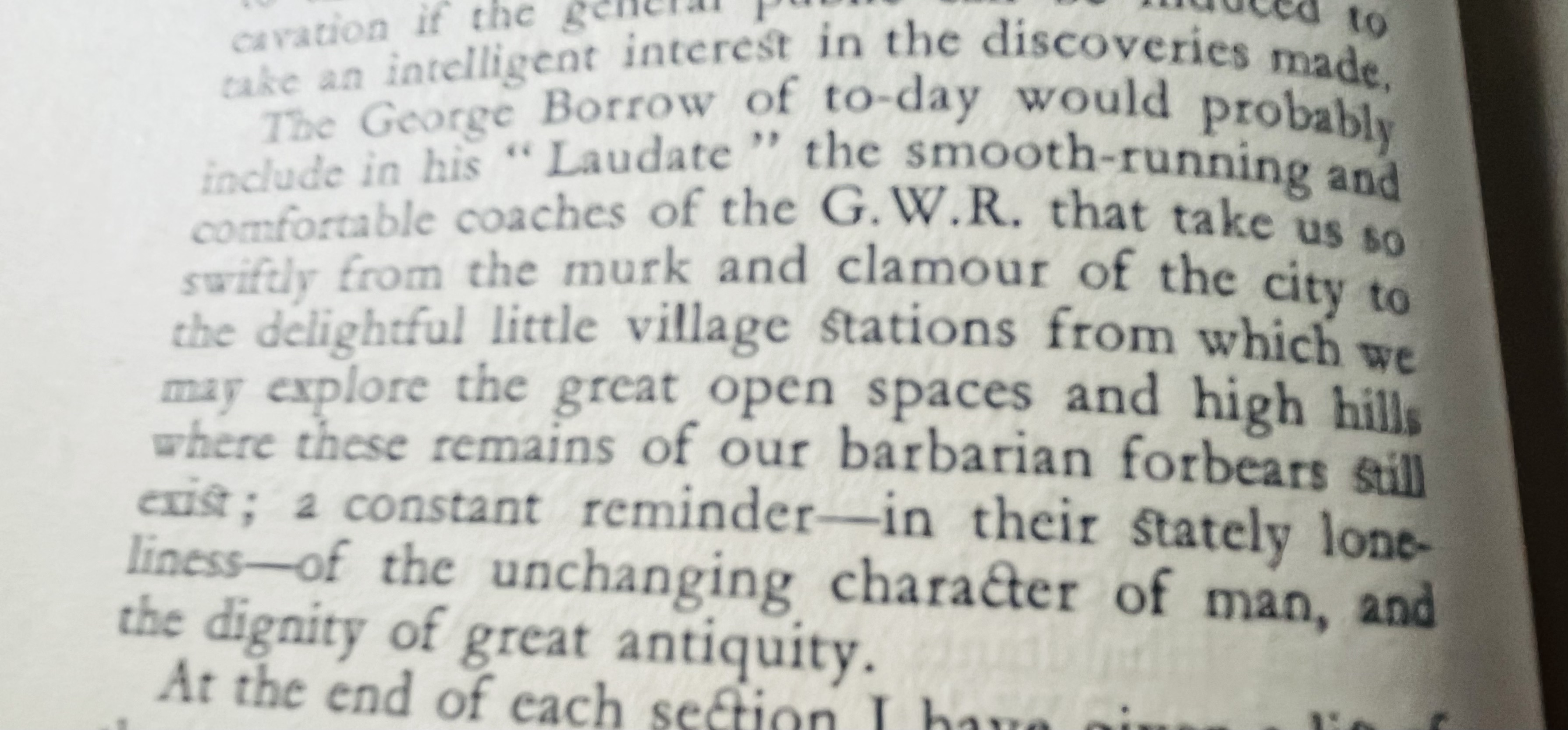
‘It is a far cry from the Age of Flint and Neolithic Man to the Age of Steel when the Great Western Expresses thunder from the East to the extreme West in less than 6 hours.’

Well it takes even less time now (sometimes), but no doubt costs a lot more.

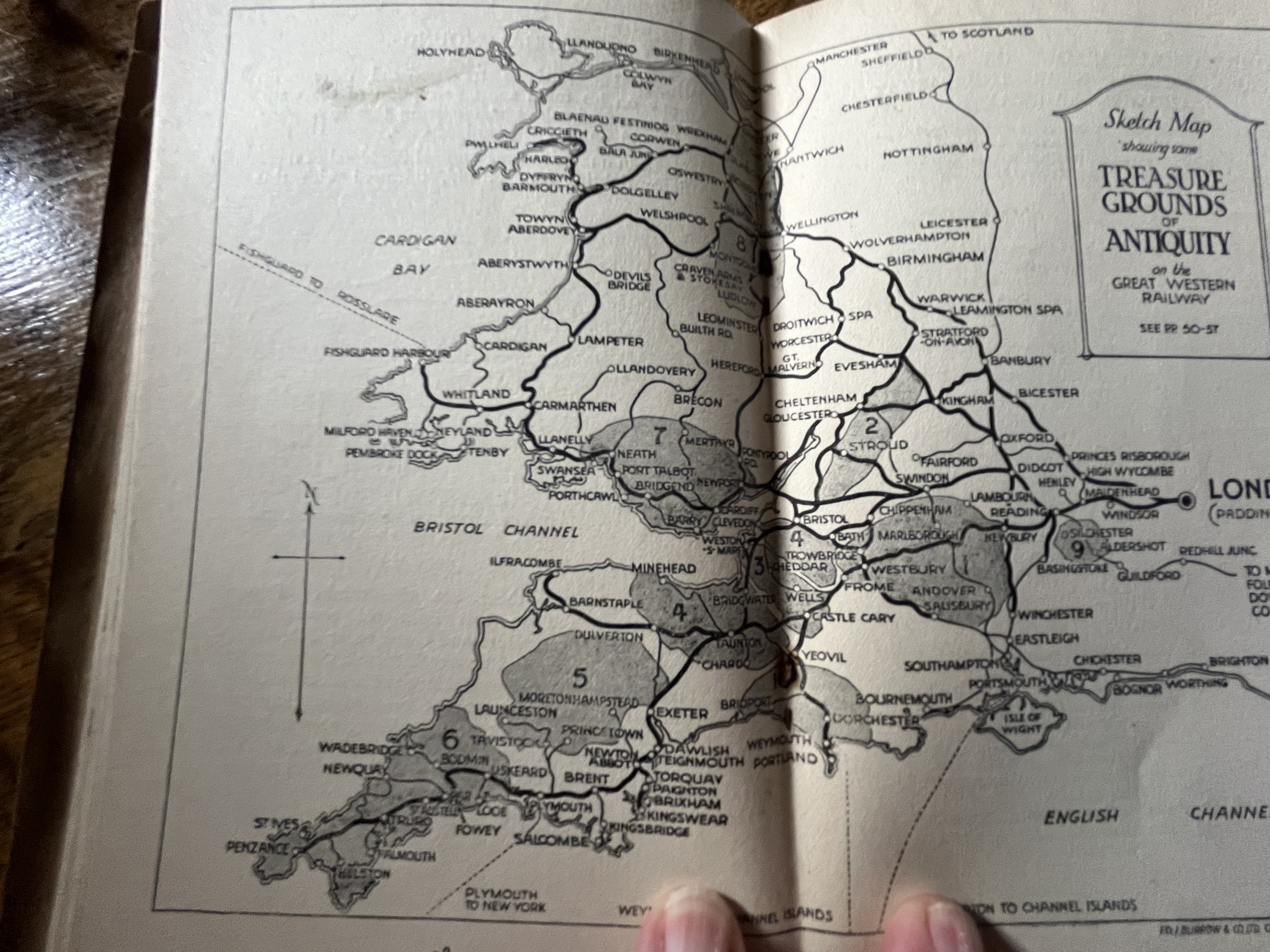
This is about a delightful little paperback guide from, I think, 1926 to where you can get off from the Great Western Railways expresses and get to, by whatever other means, see ancient sites.

George Burrow, the author and illustrator was clearly a man for who ancient sites held particular thrall.

According to Wikipedia:

Edward J. Burrow (8 June 1869, Wellington, Somerset – 19 September 1934, Cheltenham) was a prodigious engraver and founder of Edward J. Burrow and Co., a printing and publishing firm.[1]

Beginning in the years before the First World War Burrow published more than 500 travel guides in a series titled The “Borough” Pocket Guides (also known as The “Borough” Guides) to various localities of the British Isles and some parts of the Continent.[2] In the 1920s he published a book series titled Burrow’s “RAC” Guides,[3] which were issued under the auspices of the Royal Automobile Club Touring Department. In the 1930s he issued another series named Burrow’s Grey Guides.[4]

Until the 1960s Burrow was the most prolific publishers of local authority official guidebooks in the UK, from booklets covering small rural districts to large civic handbooks for London metropolitan boroughs.

So, our little book is hardly a rarity but it is nevertheless rather charming in lots of ways including the rather nice typeface.

There was a lot of GWR inn those days

I have not the time to do the research but would love to know what typeface it is. 

I tried a gentle tootle around to see if I could get a link to the Cheltenham Press who printed the booklet but nothing – it was not a rigorous and thorough search.

The serif links st, ts,  and ct. 

It looks a but Arts and Crafts to me but what do I know. Would like to though, so when it is raining and when isn’t it these days, I might spend an afternoon searching old typefaces unless anyone can get their quicker…….

Life in the USSR

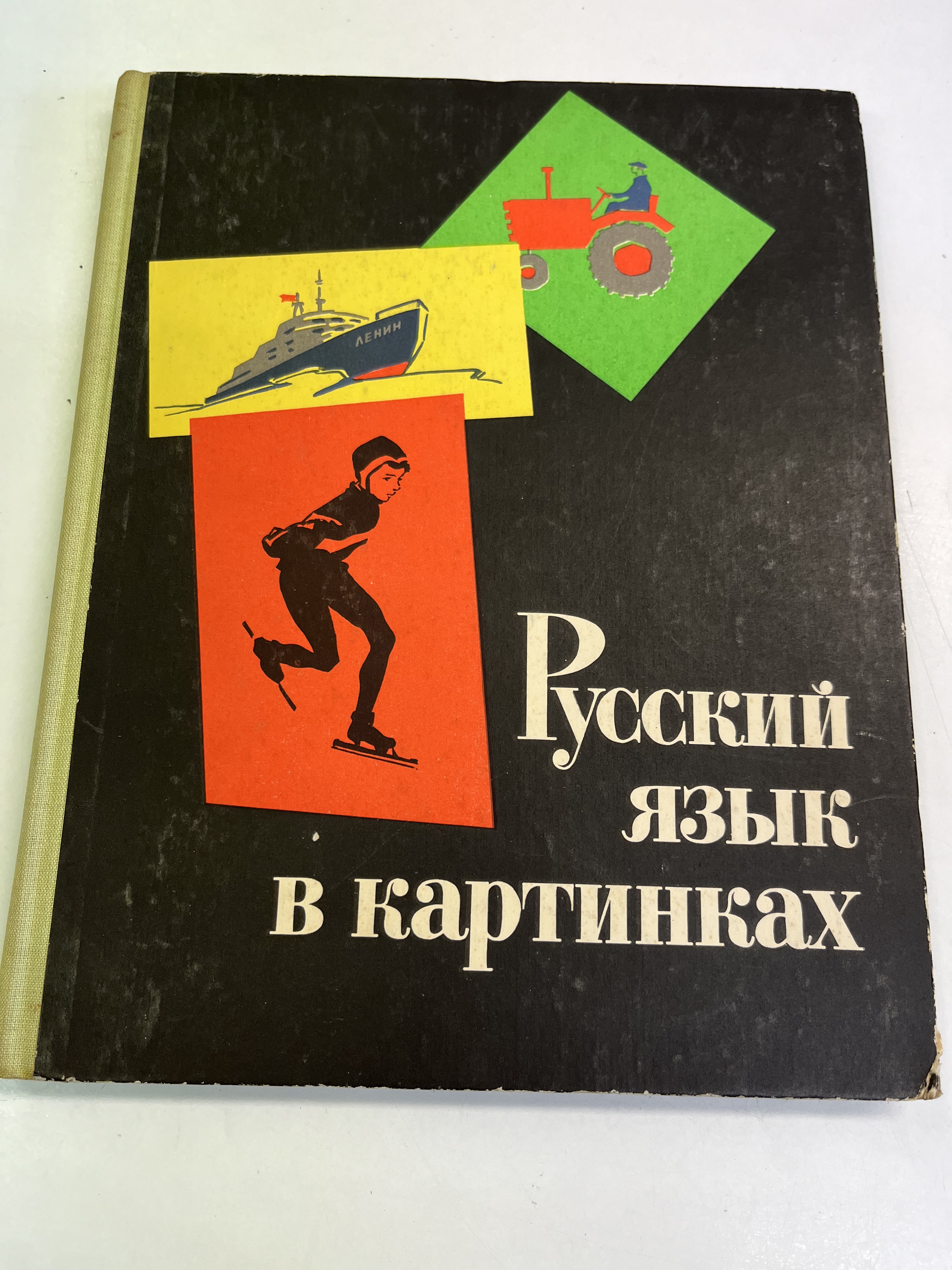
So, this book came into the shop and luckily I knew someone who was a Russian linguist – at least I knew his mother and two degrees of separation is just fine with me.

He told me the title is ‘Russian Language in Pictures’.

Published in Moscow in 1960, it is the images which are so redolent of the Soviet art of the era and a portrayl of life as it not count wasn’t, but the authorities wanted to say it was.

I leave you with the pictures.