I got a bit interested in churches, monasteries and similar stuff whilst on Sifnos – not least because there are a lot of them.
But it turns out that accurate and consistent information on them is hard to come by.
Not least just how many there are – Wikipedia says 360, and rather inaccurately, the author says, ‘as per days in the year.’
Whilst the Sifnos website says there are 237.
Anyway, both agree that is more than any other island in the Greek Cyclades.
If you are already bored, please do feel free to leave.
I had it on shaky authority that there are only four full-time priests on the island but my informant, by his own admission, takes very little interest in all things religious.
The local bar owner, however, said, ‘Maybe about 10 priests.’
(Given that a significant proportion of the population leave the island once the season is over – to travel, put their feet up in Athens, shake the dust of tourists off their heels – perhaps four priests are enough and the other six can also put their feet up.)
Both my informants, along with many, many others will be at the famous church in Chrysopigi on Thursday – sadly the day after we have left – to welcome the icon of Panagia (Mary) who arrives by boat from the island’s main port, Kamares.
I had imagined a decorated traditional boat with a band of the faithful bringing it into the Chrysopigi, but apparently, and more prosaically, it comes on a ferry making a detour before heading back to take passengers to Piraeus.
The traditional ritual which is followed is kept unchanged throughout the years and the custom is guarded with great respect. Each year, a member of the church has the fortunate fate of being selected to keep and preserve for one whole year the sacred illustration of Panagia; this is considered a great honour and a blessing for that person, who is in charge of taking care of the picture and making sure that it is maintained in the best way possible. And when the day that the name of Panagia is celebrated comes, he/she has the responsibility not only to undertake the whiting and the adornment of the church, but also the expenses for the whole panigiri, including the food and the wine, offered.
So, just to be clear, that is the responsibility and cost of a meal of traditional chickpea stew, then lamb and sweet things, plus wine and etc etc. and for a lot of people…..whitewashing inside and out and putting up the bunting.
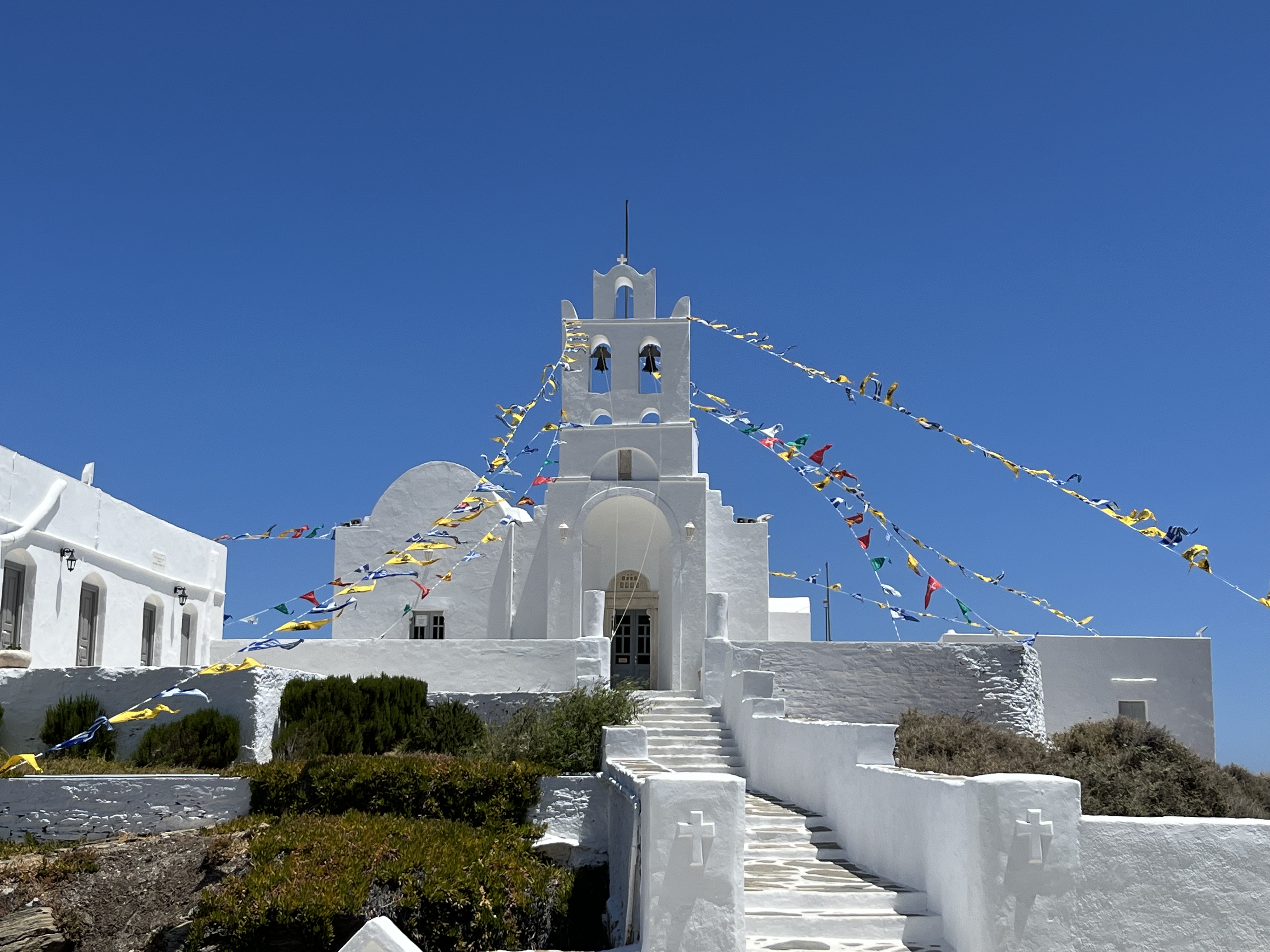
The food part of the event is called ‘the love table’.
I’ll bet it is.
Apparently, there is a long waiting list for this honour…….
I checked this out with the local bar owner and she said yes indeed there was a list. The numbers were picked by something like a tombola and if you ‘won’ you could say thanks but no thanks, ‘ I do no have the economy to do that.’ or yea bring it on.
The icon of Panagia Chrysopigi, which is a true treasure for the Sifnians, was found in the sea by fishermen during the Iconomachia period and was transferred to the holy rock where her Temple was built on the site of a pre-existing temple. It is even said that as many times as they tried to transfer her to another temple, the Virgin became unliftable like a pencil.
I am certainly not in any position to challenge anyone working in another language but a pencil? (Perhaps the lead of the pencil?)
And, in case you were wondering about why you didn’t recall the Iconomachia period:
The term originates from the Byzantine Iconoclasm, the struggles between proponents and opponents of religious icons in the Byzantine Empire from 726 to 842 AD.
Iconoclasm was largely an Eastern Christian conflict. Western Christianity never became seriously concerned with it, to the delight of art historians.
So, as the patron saint of the island Mary splintered her little promontory from the headland the prevent pirates of some sort ‘attacking’ devout women.
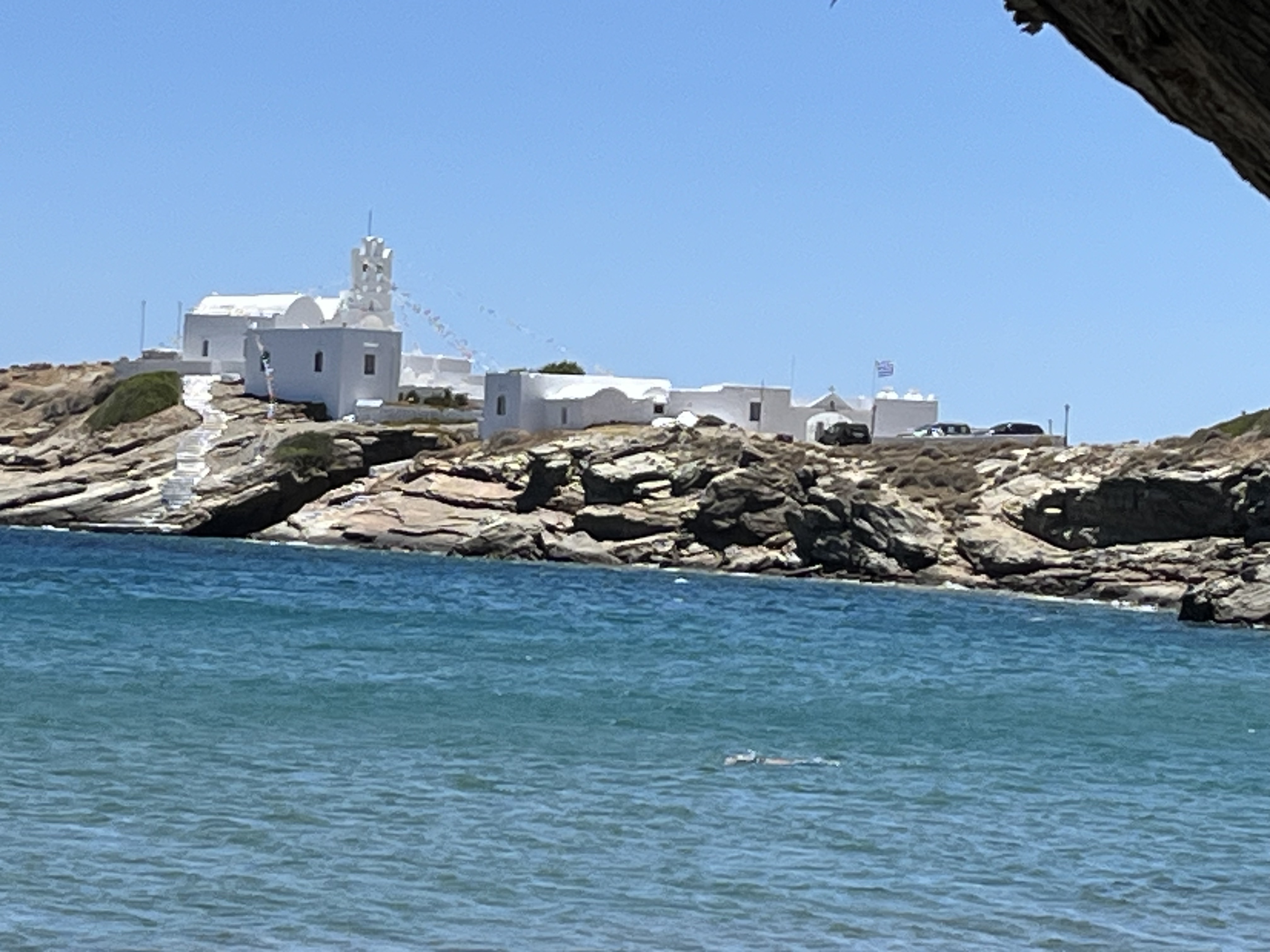
She stopped the plague twice and in 1927 after her icon procession, the locusts plaguing in the island upped and left.
And, she is responsible for ‘many miracles of healing from incurable diseases, but above all miracles of spiritual rebirth and moral regeneration.’
But enough of the glam Panagia.
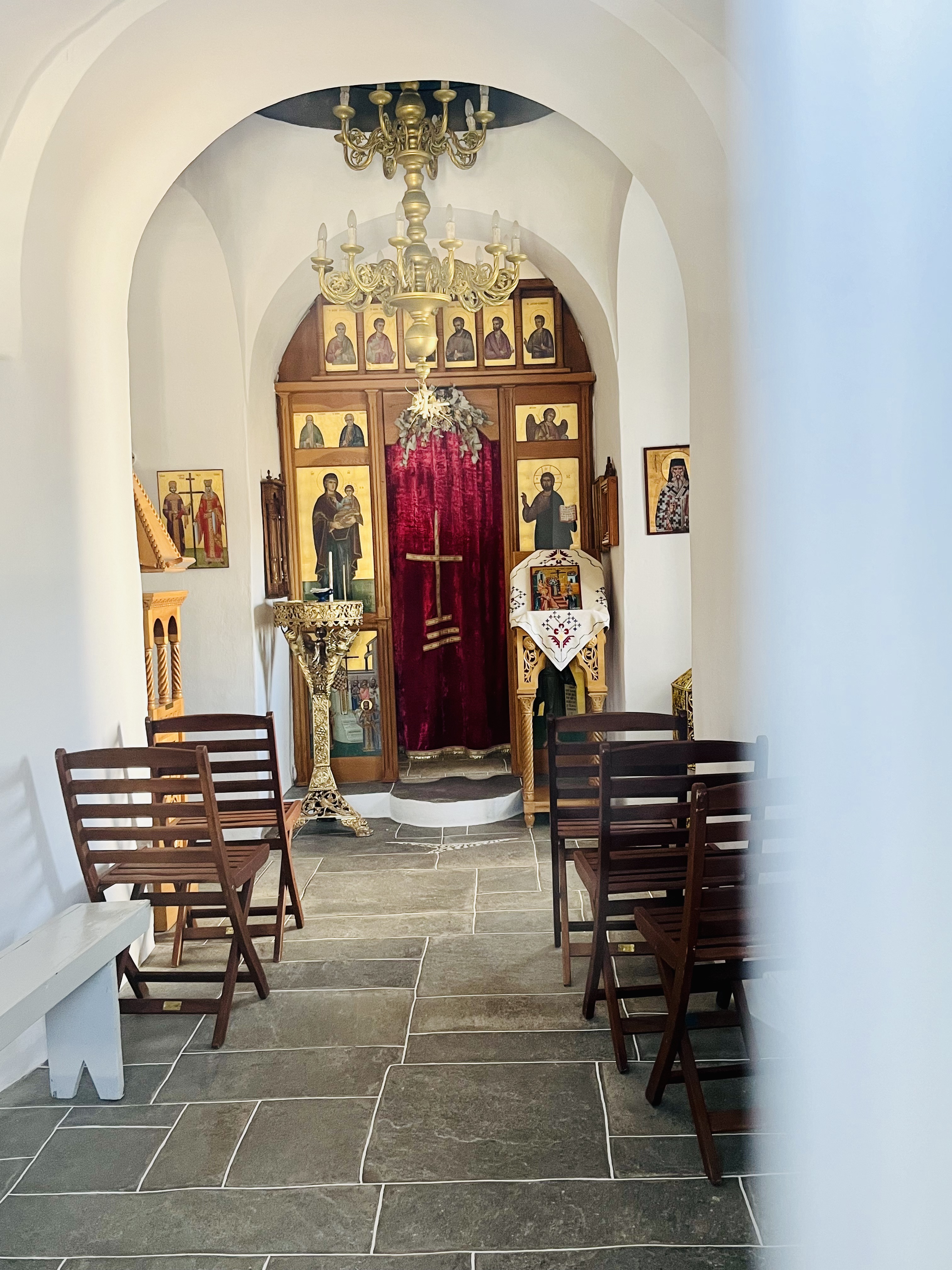
On my morning walk there is a church, of course there is, on a headland but it is shut like so many others dotted across the landscape, and not one of the many monasteries has a monk to be found.

I am told, that each and every one of these churches are maintained by volunteers (according to one source ) or diocese-paid workers ( according to another.)
My bar owner said each church, however remote, was looked after by one family, and ‘my’ church was looked after by the Stavros family ‘they live in the big houses up the road.’
Given the immaculate state of ‘my’ church, they do a good job.
And each church has to have one service every year to remain registered as a church.
Never mind Chrysopigi, I’d love to be here when the tiny gem of ‘my’ church had its annual service, but I get the feeling these services might be locals-only events.
 thereluctanthousewife