Six Things

We recently spent a weekend with friends in a satisfyingly echo-chamber of our own views and values.

(The food was lovely, the wine was too, the conversation was interesting, the dog was great, the afternoon out was a delight of art and alms houses ( get me on to that in a later blog) and tea in Soho-meets-rural-village was a very nice surprise –  and so on and so on.

We left feeling our good friends were doing so much more with their lives – and so much more good – than either of us were.

Peace and reconciliation work, acute mental health work with damaged children, rescuing imploding charities, a pop-up centre for the town’s people who had nowhere else to go, project managing a development for older people to live well to the end of their lives…

We couldn’t compete but then it wasn’t a competition – just a get together – and we left doffing our imaginary hats to our friends and their lives.

Anyway, a public doffing of hats is not what I was going to write about.

It is (alarmingly and unbelievably) a special birthday for me at the end of the year and I am not gong to have a big party.

(It is too near Christmas, everyone makes an effort to come because it is a big deal and so many people are there that you never get chance to talk to them etc etc.)

Instead I decided that in this year and next year – the run up to and the run into years – I would do six of a variety of things so that at the end of these two years, I would have achieved a good list of things to celebrate.

At the weekend, I told my friends this and explained that so far, I had thought of reading six sci-fi books – not a genre I know.

Seeing six good films – we don’t often make the schlep to the cinema given that it is at least 40 minutes away. And, we have already seen Three Billboards Outside Ebbing Missouri which was fantastic.

Going on six walks to amazing venues with my best friend who also faces this big birthday. The first will be to Hampton Court.

Learning six new things including how best to poach and egg and to throw a pot of some sort ….

And then I left them, with a notepad, to think about what else I could do while I went into the kitchen to help with supper.

Eating supper took over – and talk of the fallout of Brexit, the nightmare that is the reality of the planned idyll of co-housing, how you should never, ever, refer to the Sami people of Finland as Lapps, and so on.

In all that, the list they had drawn up of six things I should do, only got examined when I got home.

Yes, to visiting six islands – apparently only to be reached by boat, as a bridge was a cheat.

Yes, to six places important in Brexit terms – Lisbon, Maastricht, Dublin but I am not sure why somewhere called Leibach is – scrawled on the page ( much wine had been drunk…)

No to six premier rugby grounds – I am guessing that other people’s six of the best lists were coming into play here.

And  six leper colonies? Really?

Anyone with good ideas of six things to do is welcome and indeed encouraged to let me know – and anyone who knows of six leper colonies ……



Things you see on a bus trip

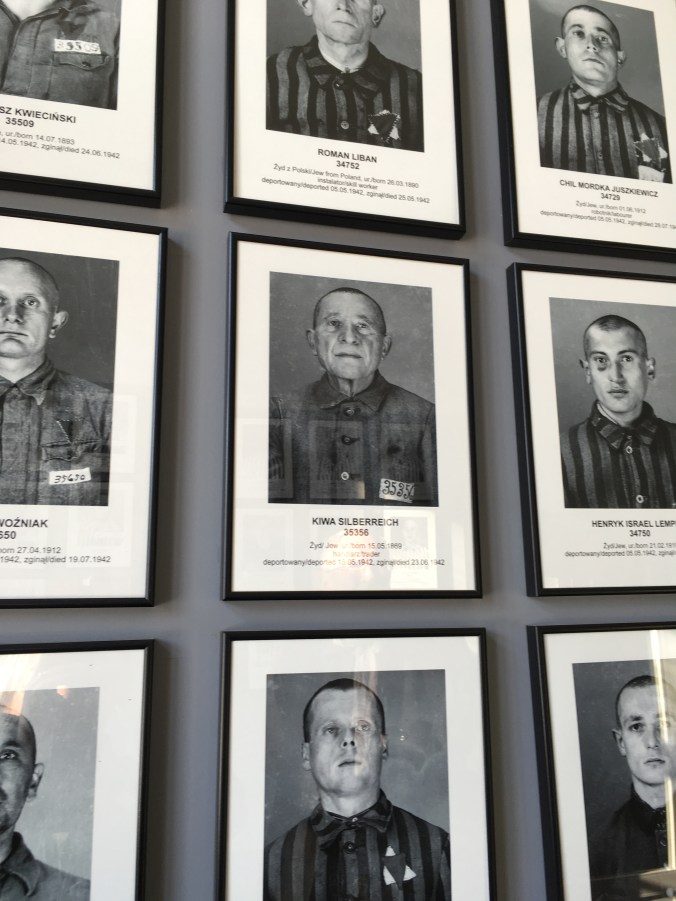
We recently went to Krakow and that meant – at least for us – we had to go to Auschwitz.

At this point, I am going to tell you that I am not going to write about what I saw and felt there, because I cannot ever match you watching a newsreel from the time, hearing real life accounts, reading a Primo Levi book ……going yourself.

So I am just going to tell you about the bus trip to Auschwitz.

We didn’t do one of the many organised tours and decided to get there and back under our own steam as it were.

We had been advised (via the internet) to get there early to avoid the arrival of massed crowds of people on coaches.

So, we went to the bus station by 7am and got a seat on a minibus – de-regulation of buses has really got going in Poland.

The ‘bus’ took just over an hour to get there and looking out of the windows I noticed, particularly, a couple of things – the houses, and the number of learner drivers.

The houses were larger and more had more space than ever would be the case in Britain unless you were looking at the richer part of an area – and maybe we were.

(Given that we were heading to Auschwitz, I rather hope that the outskirts have not become a des-res area…)

They were mainly detached and large – I mean I looked at them and thought ‘five bedrooms, maybe six even..’

And the Poles ( at least in this area) are not gardeners.

Their gardens were grass (at best) with a boundary demarcated by – and brace yourselves – all too often by leylandii.

Occasionally you would get a bit of topiary…. but where were the kitchen gardens, the fruit, the veg, the stuff that would feed the (I am guessing, given the size of the houses) three generations of the family?

In other (yes, I admit) Mediterranean countries, you could not go anywhere without seeing stuff even in February poking their veggie shoots through the soil – but not in this part of Poland.

And I have no proof, but I am guessing that these gardens did not have flowers in spring and summer – there certainly didn’t have evident flower beds.

Now perhaps if I went back in the summer, there would be an abundance of produce but I have to say I doubt it – no evidence of raised beds, tilled soil, in fact any interest in the outside at all.

The first learner driver I noticed, with mild interest, had an L plate up on the top of the car – signalling for all to see that here was someone who needed to be treated with road care.

And then there was another one, and then another, and by the time we had gone there and back, I had counted more than a dozen learners out and about on the roads between Krakow and Auschwitz.

Is this a learner driver specialist area? Are there a lot more learner drivers in this part of Poland than anywhere else? Is this a particularly good place to learn to drive?

Why don’t the Poles interest themselves in vegetables and flowers in their gardens?

Who knows?

Despite the fact that our driver had spent 13 years living in Bath, I didn’t get the chance to interrogate him – in his very good English – as to why there was a surprising preponderance of learner drivers and no vegetable and flower gardening.

When we got to Auschwitz we were indeed just ahead of the coach arrivals, and had the place more or less to ourselves, but as we were leaving, they were arriving.

As we headed to the bus stop go back, we saw coach arrival after arrival.

One group were Israeli schoolchildren, and all their coats had bright green stickers on them.

Of course it was to make sure they din’t get lost or mixed up with another group but the irony of ‘labelling’ Jews with identifying stickers on their way into Auschwitz stuck with me.

IMG_1234IMG_1235


A view from the shop floor

Haiti is a long way from Petersfield.

Indeed the connection between the day-to-day running of our Oxfam bookshop and the people working on the frontline of famine, war and disaster has always been a very long, and sometimes invisible, thread.

Many of our volunteers – including me – volunteer in the bookshop for our own reasons and they often don’t much include daily thoughts about crisis in Yemen, the Syrian nightmare, the disaster of an earthquake or Tsunami.

But every book we sell is a small piece in a gigantic jigsaw that helps Oxfam to help people – and Oxfam is a good thing.

Oxfam is a big bureaucracy and it gets things organisationally wrong – we see domestic bits of that in the shop.

Every big organisation does too. The lines of communication, feedback mechanisms, the transparency of decisions, the view from the top and the differing views from the sharp end – it doesn’t matter if you are IBM or Oxfam, these are always issues.

Someone perceptively said on the radio this week that when you set up a charity on day one your focus is the ‘client’ – by day two it is protecting the reputation of the charity to keep the money coming in.

And I am sure that protecting Oxfam’s reputation played a part in how the organisation handled what happened in Haiti – and no doubt, other bad stuff elsewhere.

I was in the pub last night and was talking to someone who said his wife had worked for another charity and had seen frontline workers coming back from some war torn nightmare or another and their behaviour showed their strings were very taught –  and sometimes snapped.

They had people repatriated for wrong doing – there won’t be an international charity out there of any significant size that has a not faced very wrong behaviour by some of its staff.

Someone also said to me that if the Ministry of Defence was asked to account for the behaviour of every British serviceman who was serving abroad or on peace keeping duties, there would be a very long list of sexual misdemeanours.

This is not to excuse what happened in Haiti but it is to say that charities, like Oxfam, have people who go places the rest of us won’t, to help in ways that we hope make life better for people who have little.

And, yes, yes of course no one in the position should exploit those people or their colleagues – in any shape of form and of course too, the vast majority of charity workers on the frontline, don’t.

And, yes of course, Oxfam should have acted better at the time – Oxfam has apologised, profusely, and if any charity will get its safeguarding act together now you can bet it will be Oxfam.

And, I expect every other charity in the sector is racing around trying to make sure that they stay out of media sight and get their house in order too.

Meanwhile, using Oxfam as a stick to beat the aid budget, is just plain wrong.

Penny Mordaunt, the relevant minister who, as a colleague said last week, ‘ sees a bandwagon a mile off and races to get on it,’ should of course demand more action and transparency – but what good does it do to reduce Oxfam’s funding?

Back in Petersfield, I was in town the other day doing errands and was stopped three times by regular customers saying they felt that Oxfam, though not coming up smelling of roses, was being unfairly hit.

I had not been in the shop for a few days so called in briefly this morning, and was gratified to see that donations had kept coming in, there were customers in the shop and that Oxfam’s trading director was due to come in to talk to people about what was happening.

I am very much hoping that our customers – many of whom probably see us as a good second hand bookshop first and foremost – stay with us and think, as they usually do, that buying from or donating books to Oxfam, is a good deed as well as a pleasure.


Hand Me The Flustertute

The planning for our annual village festivities has begun.

Regular readers, and there are a few, will recall the fractious relationship I had with the church, its wardens and vicar last year, over the siting of the bookstall – this year I decided to leave that to someone ( anyone ) else.

But I did agree to take over the booking and organising of the other stalls – we apparently have quite a lot.

These stalls go along the village street, which is closed for the event and have to be cajoled, slotted, moved about a bit, fitted in and generally made to happen.

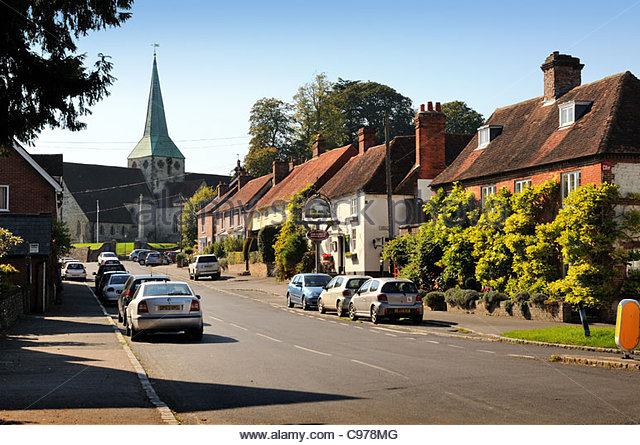
Here is my venue:

centre-of-south-harting-villagewest-sussex-c978mg.jpg

And this was like many other things I agree to – seemed like such a good idea far in advance of having to do anything and much less of a good idea when I have to get into action.

( See also waves of visitors over Christmas and New Year.)

The previous stall manager has moved, and though he is on the end of the phone and email, and endlessly helpful, it is not quite the same as having him down the road doing it – and me able to tug on his coat-tails asking how this and that was sorted out.

I have this awful image of the event this year with me running around trying to squish a gazebo in here, move a potter over there – and badly needing everyone to stand up straight, keep quiet and listen to instructions. (See below for what I need.)

And like all village stuff, there is a lot of history about who has what pitch and why, the village flower stall having a fight with a newcomer etc etc etc …..

Today I am trying to set up a database of potential (and hopefully, real,) stallholders and sort out pricing and location and what I need to send them and whether they need a link to the website.

Well, I did some of it and….

Always one to make displacement activity into an art form, I found myself going through my desk drawer and found a note of a few German words – you know the ones where they put a whole phrase into one word.

We have German friends and the words come from meeting up with them – well the first two do – I am not at all sure why I got  the third one…

So, just before I go downstairs to make supper, polish some shoes, write from scratch a legal contract for my upcoming ( rare) piece of work – anything but sort out the stalls, here are those words:

Flugbegleiterrufknopf – flight attendant button

Flustertute – megaphone – isn’t that great? Hand me a Fluster Tute at the festivities I say.

Insolvenzverschleppung – now, am pretty sure you are not going to get that one.

No?

Well, I’ll tell you – delayed filing of insolvency.

‘Damn,’ you are thinking, ‘of course!’


A Few Mysteries


We have had a few mysteries in the bookshop recently.

At this time of year, we often get unwanted Christmas presents and that can only be the explanation for two copies of the same – rather unusual cookbook – in separate donations on the same day.

fullsizeoutput_cf7

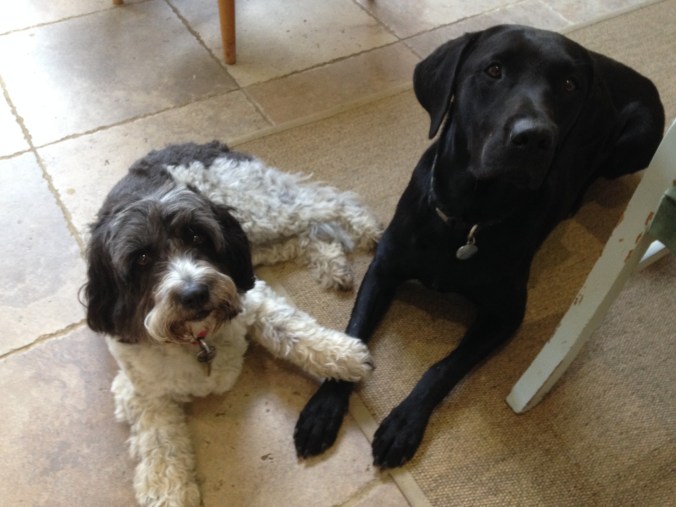
(Perhaps there are a few hungry dogs in deepest Sussex as we speak – and no, though Jessie, our’s –  and Mungo, not our’s but here now and then – would have been very pleased to see me walk through the door with it, I have not brought one home.)


IMG_2831.jpg

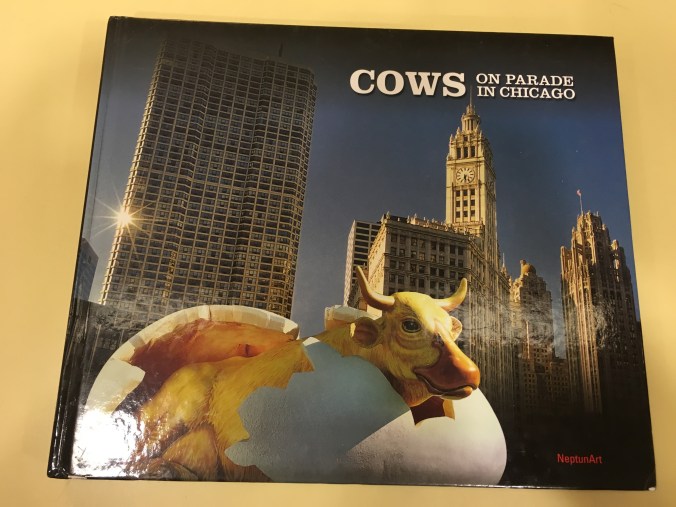
Whilst we are on animal books – who would have guessed there would be such a book as this:

fullsizeoutput_cf8

Then, we had quite a few boxes of sci-fi books – a rarity in our neck of the woods.

Now, at the risk of heaping down on my head accusations of arrant sexism and stuff, I would have expected them to have been donated by a man.

But no, they were donated by a woman of a certain age who brought them in over several days with the help of a sack truck – all carefully boxed and labelled.

As it happened, the day after we got them all Ursula Le Guin died – one of the few famous women sci-fi writers.

Now, I feel I should read more sci-fi – well, any, actually – but I really know nothing much about it.

Yes I did know who Ursula Le Guin was and that she had written Earthsea, and Iain M Rankin, Neil Gaiman and his collaboration with Terry Pratchett who I have read  a lot, and I was looking for a good copy of War of Worlds……so I am not altogether ignorant but pretty much so.. )

By coincidence, a fellow volunteer who happened to be in at that time, said he was a bit of a sci-fi fan – a surprise to me  – and would sort out the wheat from the chaff as it were.

So, all those coincidences added up to a table display.

IMG_1186

Then this, – donated separately but had to be displayed together. I hesitate to say Pauline was being indiscreet – but who knows?

IMG_0790.jpg

Meanwhile, our antiquarian book expert told me a while ago that old crime novels could be quite valuable so when some came in, I though I would look them up and we could do a table on crime – not least because we have a boxful of those old green penguins which are mostly crime too.

Who would have thought that someone called Clive Witting was so much in demand – the covers though are a delight and someone will want them just for the look of them.

( No, I haven’t read them…nor did I remember to photograph them so just let your imagine run riot and meanwhile appreciate this, and yes I do know that it is of its era:)

IMG_1108

Then there was the Nabakov donation.

Everything he had ever written as far as I could tell, along with a few biographies of the great man.

But not a copy of Lolita – the most famous book he ever wrote and indeed the only one that most people have heard of.

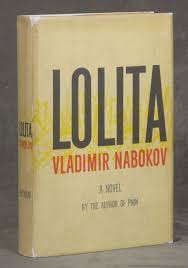
So, now we have two boxes of Nabakov waiting for a copy of Lolilta to appear – something like this first edition – preferably signed…..

Unknown.jpeg


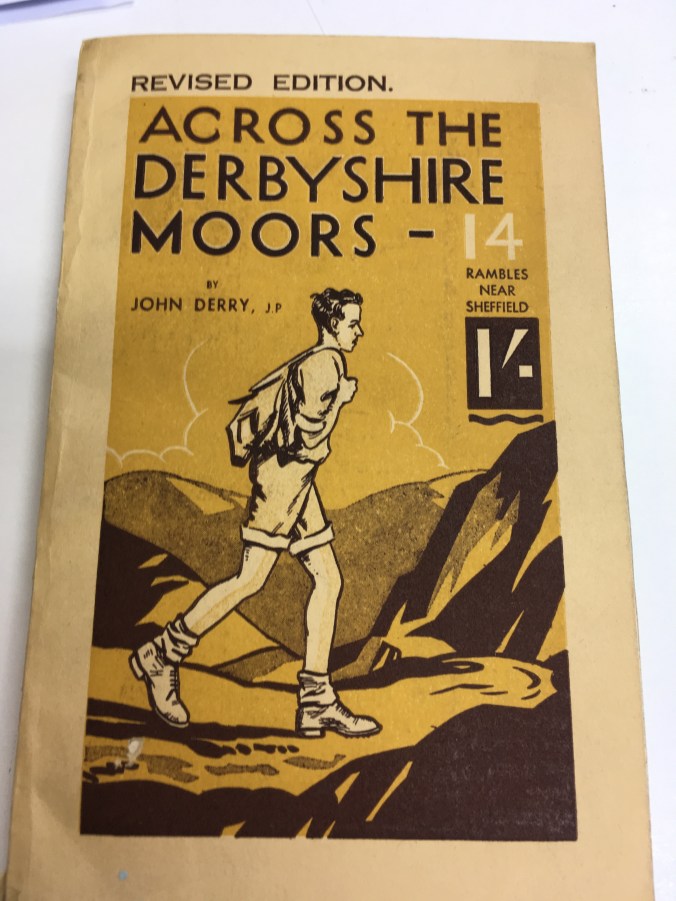
This little booklet is no mystery – except why anyone would give it away – what a little delight.

IMG_1188

And this, another lovely little book, has all its fold out maps intact – again, why would you give that away?

IMG_1193

Of course, we are grateful to everyone who does given them away to us, allow us to ‘re-home’ them, and raise money for such good causes.

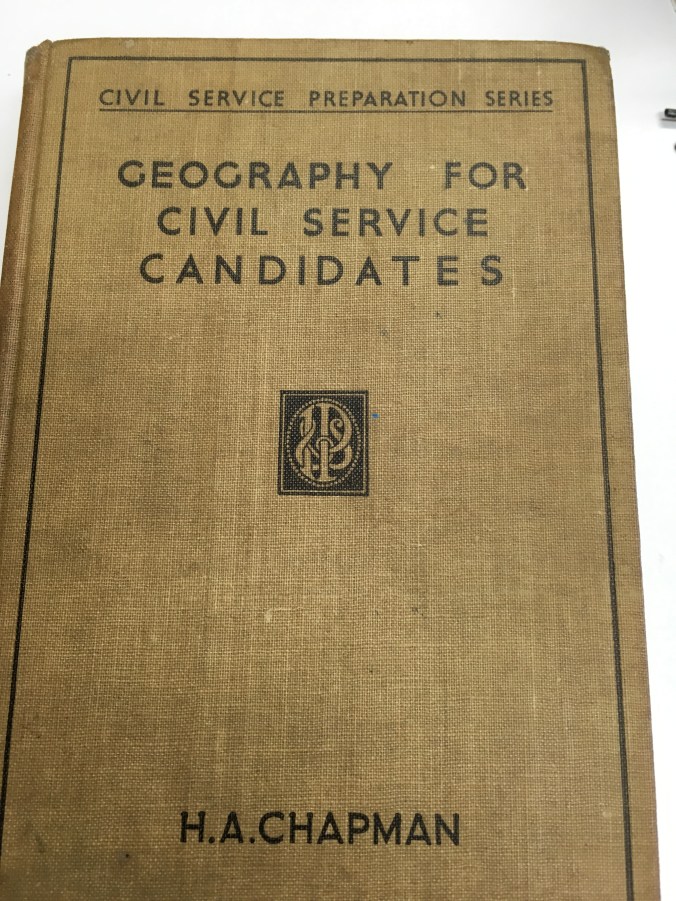
Mind you, I am not sure who needs this book in their life – any aspiring civil servants out there?

IMG_1192


Framing the Birds

For while, there has been a dearth of donations of old and interesting books to our Oxfam shop – but recently there have been some treats.

I should (re) mention that old and interesting is the category on the till – quite a lot of the time, old does not equal very interesting at all.

Anyway, with Christmas gone and the leftover crackers, candles, cards and so on, consolidated into a few SALE shelves, we had space which needed to be filled with old and interesting so all donations have been welcomed.

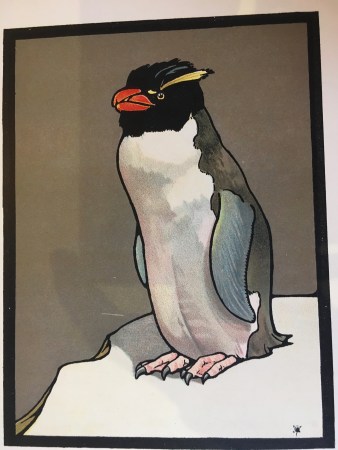
Please bear with me, this does get a bit more interesting later on, and to prove the point, here is a lovely picture:

fullsizeoutput_cf0

Meanwhile, a fellow volunteer had mentioned that in the Winchester shop (always to be envied given that it has tourists and university students, which we don’t) had taken plates ( pictures) out of decrepit books and put them in mounts and had them for sale.

We could do that, I thought.

And, by coincidence or the inscrutable movement of the universe, whichever you prefer, a donation came in which would be an ideal candidate.

It was Grimm’s fairy tales illustrated by W Heath Robinson – falling apart and some child had scrawled with crayon over some of the pages, making it unsaleable except to someone who wanted to take out the plates and frame them….

My best beloved is something of a star amateur picture framer so you can see where this is going.

He said, though, the plates were not in great condition and anyway were a bit ‘wishy-washy.’

I was deflated but not despondent on the basis that wishy-washy was better than nothing.

But then we had a treat, actually two treats.

As you know I am an amateur upholsterer – oh what crafts people we both are – anyway, I found this in the back of a book amongst several boxes of books – all old and about Paris.

( I have put a shelf of them out but I think you can only do one such shelf in a Petersfield bookshop – obviously if we were in Winchester…)

fullsizeoutput_cf6

So, French upholsterer to her majesty – presumably Victoria – and doing work for Mr Franck Boggs – great name.

Someone will like that framed, I thought.

And then another book came in, and it had already fallen apart, but what fantastic plates.

It turns out these were produced by two brothers who approached Dent with what they had done, and the publisher said, ‘oh yes please.’

We have the first edition of their first book – but all the pages are loose and couldn’t be sold as a book.

(If you want to know more about Maurice and Edward, here is a link
http://www.avictorian.com/Detmold_Charles_Maurice.html)

They were influenced by Japanese art – very popular at the time – and you can see it in the style.

So, these delights will be framed by the BB and will be the stars of my new bookshop venture. ( I may well keep the book cover for us.)


The Natural History of an Oxfam Bookshop

It is January, and the donations to Oxfam come in droves – well actually bin bags, collapsing boxes, crates that the donator wants back – but, ‘hey, could you empty that more quickly as my car is on a yellow line.’

And there is something about January donations.

They tend to be the ones that come from cleared out garages or attics.


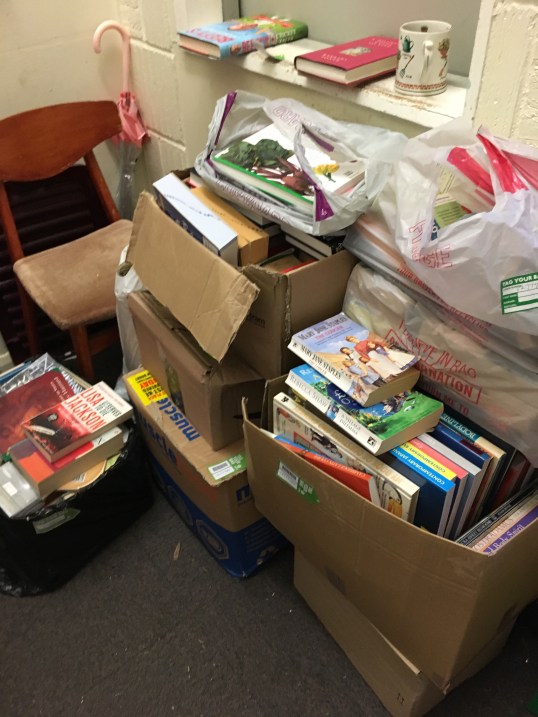
IMG_1184

(By the way, that is my mug and that umbrella has been there for several months.)

And that, dear regular reader as you must know, means they are damp, browned, aged – but not so aged they could be worth something…..

So, I went into the shop to re-arrange it, and a great volunteer agreed to do an extra shift to help me.

The thing is that we move (to Bognor or a re-cycling sack) a lot of books to allow space for the ‘new product’ Christmas stuff – and afterwards we can not quite remember what was there before and more to the point, we don’t have enough stock to just fill up those shelves.

(We had completely removed Self Help – as it never sells – whoever bought those ‘how to make your life better books’, did not find that having them on their bookshelves automatically sorted the issue. Self help books are usually donated in pristine condition.

But in January I need to re-instate that shelf – and do we have enough books to do that? You bet we do.)

I got permission from my manager to move the CD’s and extend the children’s shelves and generally move everything around so that we could re-fill the space left by the bedraggled remnants of Christmas stock.

It was a quiet Monday morning so the volunteer on the till and the extra-shift volunteer set to moving all things around.

Was I just issuing commands? Well, yes and no.

I was peering round from the door at the back issuing further instructions and generally thanking and praising, between dealing with ( and ‘dealing with’ means a lot of books into re-cycling sacks and relatively few into crates to be sent upstairs to be priced and shelved) an apparently never-ending slough of donations.

The teetering pile had had a dent made in it on Saturday by another sterling volunteer, but just as I thought I might me making headway on Monday, another smiling donator would bring in ‘the first of a few boxes…’

And so it went on – and on, and on.

By 3pm I had had enough, and decided to leave.

The shelves looked OK, the pile was cleared – but things are still amiss:

For the first time since I have worked there – and yes dear reader, that is some years – we are short of natural history books.

Those shelves, upstairs and down, are literally bare.

We usually have loads of books on birds, animals, insects, the geology of Cornwall (actually we do have one of those but it is not likely to be a great seller in Petersfield), the Natural History of Selbourne (Gilbert White lived just up the road), trees, the coast etc etc.

But right at this moment, nothing.

As you know, I change the table display every week usually on a Thursday.

This week, I am planning to put The Geology of Cornwall and the one, solitary, bird book we have, on the table with a notice saying:


Thank you so much to everyone who donates books here.

Oxfam could not do its work with the poor and war-torn without you.

Our bookshop could not survive without your donations.

We are grateful for every donation but we would especially be grateful for books you no longer need on anything to do with

NATURAL HISTORY.

Thank you.

What do you think? Will that work?


Sparklies with meaning

I do love a sparkly.

I am a big fan of jewellery and I have to say that my best beloved is a good sparkly buyer.

It doesn’t all have to be expensive – but more of that later.

A wise friend once told me that she bought a piece of jewellery for herself when anything significant happened in her life.

So, I took a leaf out of her advice, as it were.

I have earrings which commemorate my resignation from a difficult organisation, earrings which commemorate me finding this place to live, a bracelet for a good friend who died, another for a significant birthday…

The first ring my BB bought me, the owl brooch he bought back from Paris, the Saxon scarf pin made into a necklace he bought for a birthday, and the diamond ring from a pawn shop in Brussels to try and convince Washington that we were married – it was never needed for that purpose but I still wear it as if it was……..

My jewellery box is memories and, I have to say, is used to make sure each piece is worn with the right outfit.

Not all of my jewellery is ‘real’.

I have this necklace bought in Accesorize way back when.

It has large amethysts, small diamonds and pearls ( no, of course not real) and it decorates your décolletage, as they said in Brussels.

And when I wore it in Brussels so many people complimented me and ooh’d and ahh’d that I fell into a story.

‘My great great grandmother had to flee Russia just after the revolution and she brought it with her. Almost the only thing she managed to get out. It was sewn into the hem of her dress and though her husband had promised to follow with the rest of the family jewels, he didn’t make it out.

She married a man she met in London when making her living in the East End and said that the necklace would always be passed to the eldest daughter.’

And that, dear reader, was me, as I told a breathless audience of Brussels cocktail party women.

Anyway, just before Christmas I was shopping, as you do, and trying to tick off everything on the list, as you do, when my sis rang me.

She was doing the same, and had had a moment of missing our mum – no one to check the arrangement details with, however frustrating that was now and then.

Mothers leave a very significant mother-shaped hole in your life.

As I was walking back to the car park, laden down ,as you are, and wondering how much time I had left on the car-park ticket, I stopped to look in the window of a second hand jewellery shop.

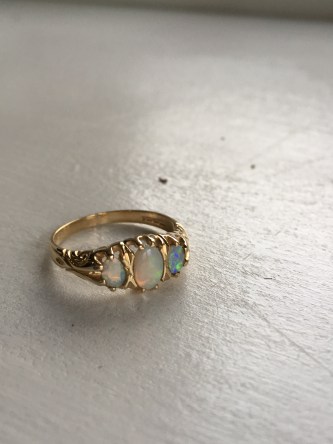
I  saw an opal ring and went inside.

I waited whilst the rather elderly woman served the previous customer and he was collecting a mended something for his wife of 50 years and they talked about it, and his long marriage.

I was conscious of the time ticking away but I stayed, and when she got to me and asked what I wanted, I got to try on the opal ring.

It fitted exactly, and I explained that I was looking to buy something to remember my mother by – something I could wear that she would have said, ‘ Oh darling that is lovely’ and every time I put it on, I would hear her say that.

‘I am retiring after many years in this business and I like stories of how my jewellery will be worn so let’s halve the price and you will wear that ring and I will think of you wearing it,’ she said.

IMG_1132

For once I was not so pleased by the bargain as for the gesture, and I am wearing it, and I hope both she and my mother are pleased.


Rescue Mission

Buying something from an auction is as much a rescue mission as a shopping expedition,  I tell my best beloved.

And here is a tale of one great rescue mission:

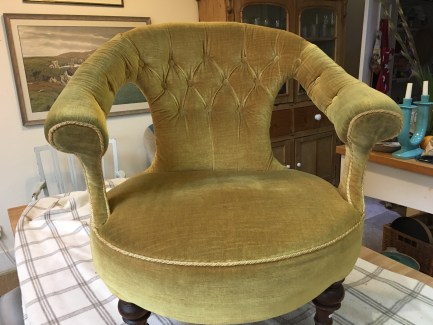
I went to a country auction looking for a chair to re-upholster and I was in bullish mood – a button backed one, I thought.

(To non-upholsters, I need to mention, button-backing is a more than usually fiddly business in an already time-consuming business, so you need to gird a few loins if you are going to do one.)

I found this one.IMG_1071.JPG


(It is Victorian and won’t have the gold draylon on it when I have finished with it.)

This auction requires you to go and have a good look around on the Friday and give up a lot of your Saturday to be there for the bidding.

Of course, you see several chairs and have to juggle your bidding.

Lot 100 at 11.30 maybe be a goer as far as you are concerned but lot 320 at 1.30 is a much better bet – but can you chance missing the first lot and then be outbid on the second…. you see what I mean.

Anyway, I wandered around, looking for the chair that I wanted,  pulling and pushing to see which chairs were strong, and so on.

I saw other stuff which was lovely and should I have won the lottery and moved to a much bigger house, I would have bid on.

‘Brown’ furniture may be making a come-back in London but here in the depths of the countryside you can get it for a song – and for some of those pieces, I would have sung.

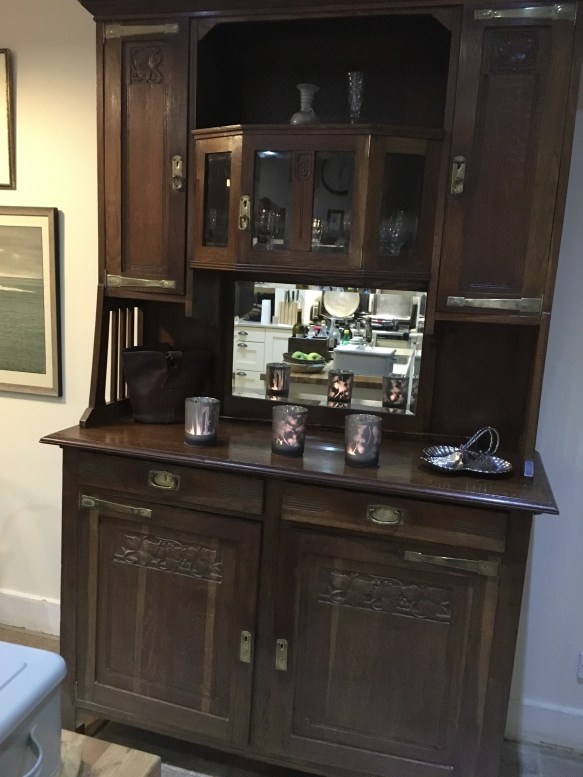
There was this lovely arts and crafts/art nouveau dresser.

Hand-made, of course, in oak with brass fittings and carving decorations and, and, and.

I had seen it and admired the side-racking, the proportions and, and – and  thought it would make at the auction, say, £700 given that this is not retail, so you get things cheaper.

So, I identified my chair(s) and went back the next day and waited, and waited.

My first choice of chair – dear reader, I have a better eye than wallet – went for far more than I could afford, so I was hanging around for the next lot.

Whilst viewing I had seen a croupier’s rake.

Smooth, light, old – no doubt with a lot of stories to tell and very tactile.

The lot came up and no one bid.

I looked at it, reached over to where it was lying and touched it.

‘Come on madam. There’s a whole new career beckoning  you,’ said the auctioneer.

So I bid, and got it for £5.

And then, when I was waiting for my chair lot, the dresser came up.

‘Ahh,’ I thought, ‘ I always have a better eye then wallet.’

But, dear reader, no one bid at all.

I got it for £50.

Of course, there was the commission, and to pay for it to be delivered – and persuade my best beloved, who I have to say, was easy to persuade, that we should swap our old pine dresser for this one.

But all in all it cost me just over £120.

Old (and indeed not so old) pine is still in fashion and so we sold our previous dresser online and we have made a considerable profit.

And we love our rescued dresser.

IMG_1086


Gold Stars

So, there I was telling you all about how we were preparing for Christmas in the Oxfam bookshop, when little did I know that a really big cheese in Oxfam shops was planning a (nearly) night before Christmas visit.

He is a nice man and lives relatively locally so this should have just been taken in our stride – but I wanted to have gold stars raining down on us.

I dragooned other volunteers into extra tasks, fretted and chivvied and tidied and organised, and I went into the shop every day in the run up – ignoring my own plans to approach my own Christmas with a zen-like calm and to be festively organised for the rather extensive flow of family and friends.

Making sure the table was all set up and rather lovely – though I say it myself and (metaphorically) patting down my apron and brushing back a lock from my sweaty brow, I awaited his arrival.

IMG_1137

He was running late. He had to go back to Oxford to sign something.

I titivated – which in Oxfam bookshop terms, means re-arranged front-facing books, got all the craft section in order of hobby – knitting, sewing, teddy bear making, ancient Chinese calligraphy, etc.

Biography was in alphabetical order of subject, literature was actually literature and no stray copy of Jeffrey Archer was lurking there, all the books which had been donated were sorted, children’s books were all of excellent quality and looked enticing etc etc.

Yes, of course, I had made sure all this was already done….but I needed to keep busy.

I had planned to walk him around what we had been doing behind the scenes to make sure our Christmas sales were a success, and then hand him over to the till – he wanted to spend time in the shop – with a pre-primed lovely volunteer.

But he was late and then when he did arrive, he had phone calls he had to make.

I forced him to admire the table, made him a cup of tea and gave him a delicious pastry made by our Syrian refugee volunteer, and left.

He made his calls.

Then he left – he never made it to the till or to admire just how well organised and lovely the shop looked.

I was just a little deflated.

He did say he would come and volunteer for another shift – I just hope it is not a surprise visit on a wet Wednesday when I have been a little less than enthusiastic about getting everything looking just tickety-boo – I want those gold stars.