You may, or then again may not, remember that I had a boat stolen from the Oxfam window display.
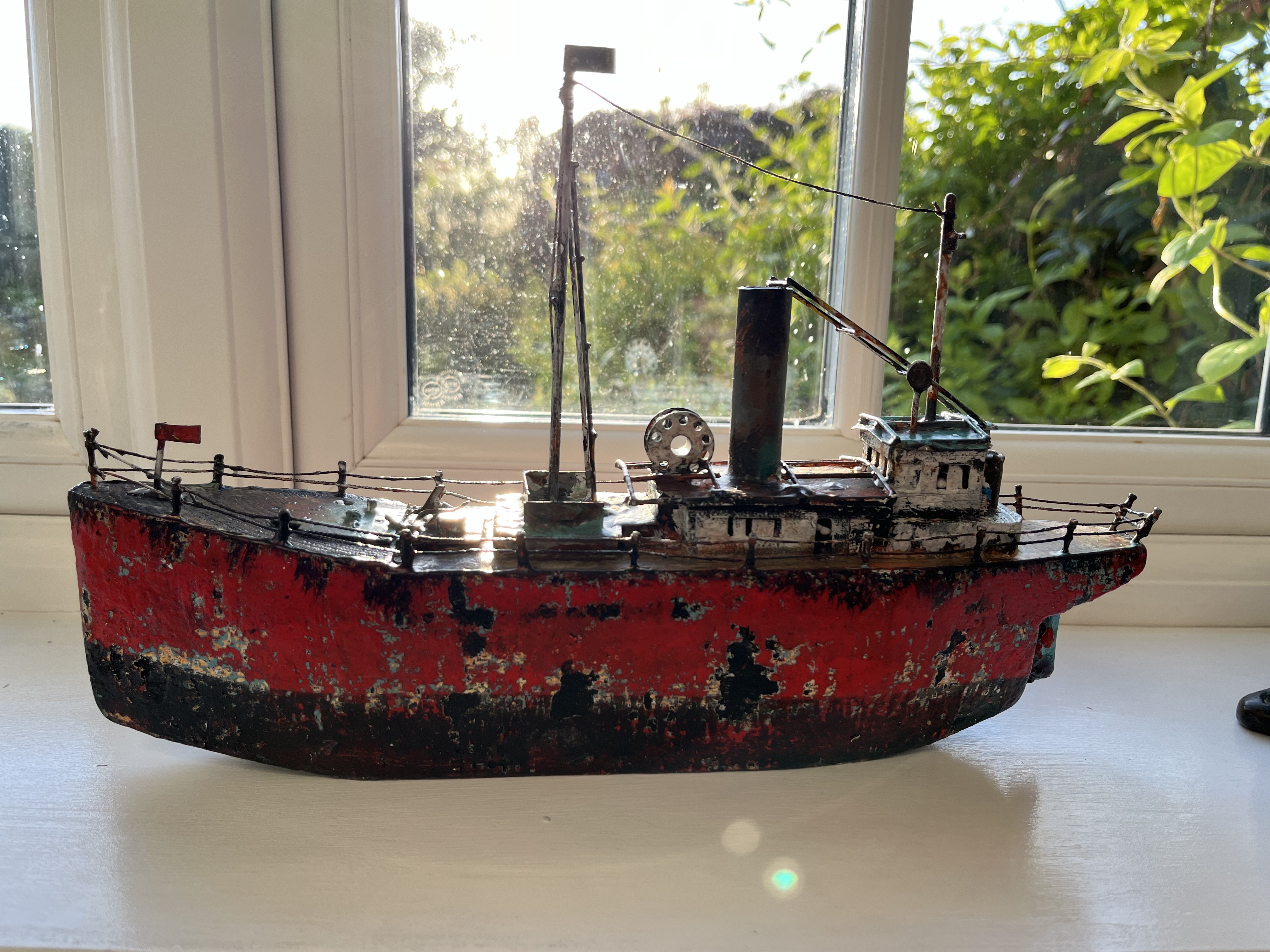
I set out to find a replacement. Given that these model boats were individually handmade and each was different, it was never going to be an exact replacement but I did hope I could find one which would look as nice – in our sitting room I hasten to add, need again would I risk something as valuable to me in the Oxfam window.
Anyway, I needed to find the shop in Corfu where we had bought it – along with a pair of earrings and icky had kept the earrings in their box which had a hone number on it.
But the number rang and rang and though I tried to leave a message, there was no response. I also sent an email having got what I hoped was the right email address – but nothing.
So, I went the old-fashioned way of hunting – the stuff I did as a young journalist many many moons ago when typewriters were the order of the day.
I would have contacted the ex-pat English ‘speaking’ newspaper – bound to be one on an island like Corfu, so long popular with the British.
These days though it was online.
So I contacted them to ask if they knew about these boats and how I might get in touch. They didn’t but suggested I posted something on the facebook group Corfu Grapevine.
So much for old-fashioned hunting then.
I did and was hugely gratified by the response.
There were people who thought they knew the shop, to those offering to hunt around in the old town to find it, to someone who said she was going to Corfu for five weeks and would bring back a boat if one was located.
Then I got an email from the very nice Elli who said the boat-maker had retired and stopped making boats for sale but that he had a few left and would send me some photos.
He apologised for the delay in replying but said there had been a few English people coming in and asking about the boats for someone back in England who had had one stolen.
My lovely Corfu expats basically nagged him into action.
The Best Beloved and I decided on a boat and within a week, Elli had it packed up into a box which would have practically contained a life sized boat, and sent it to deepest Sussex.
And with thanks to complete strangers who restored my faith dented by the Oxfam thief, here she is.
I got a bit interested in churches, monasteries and similar stuff whilst on Sifnos – not least because there are a lot of them.
But it turns out that accurate and consistent information on them is hard to come by.
Not least just how many there are – Wikipedia says 360, and rather inaccurately, the author says, ‘as per days in the year.’
Whilst the Sifnos website says there are 237.
Anyway, both agree that is more than any other island in the Greek Cyclades.
If you are already bored, please do feel free to leave.
I had it on shaky authority that there are only four full-time priests on the island but my informant, by his own admission, takes very little interest in all things religious.
The local bar owner, however, said, ‘Maybe about 10 priests.’
(Given that a significant proportion of the population leave the island once the season is over – to travel, put their feet up in Athens, shake the dust of tourists off their heels – perhaps four priests are enough and the other six can also put their feet up.)
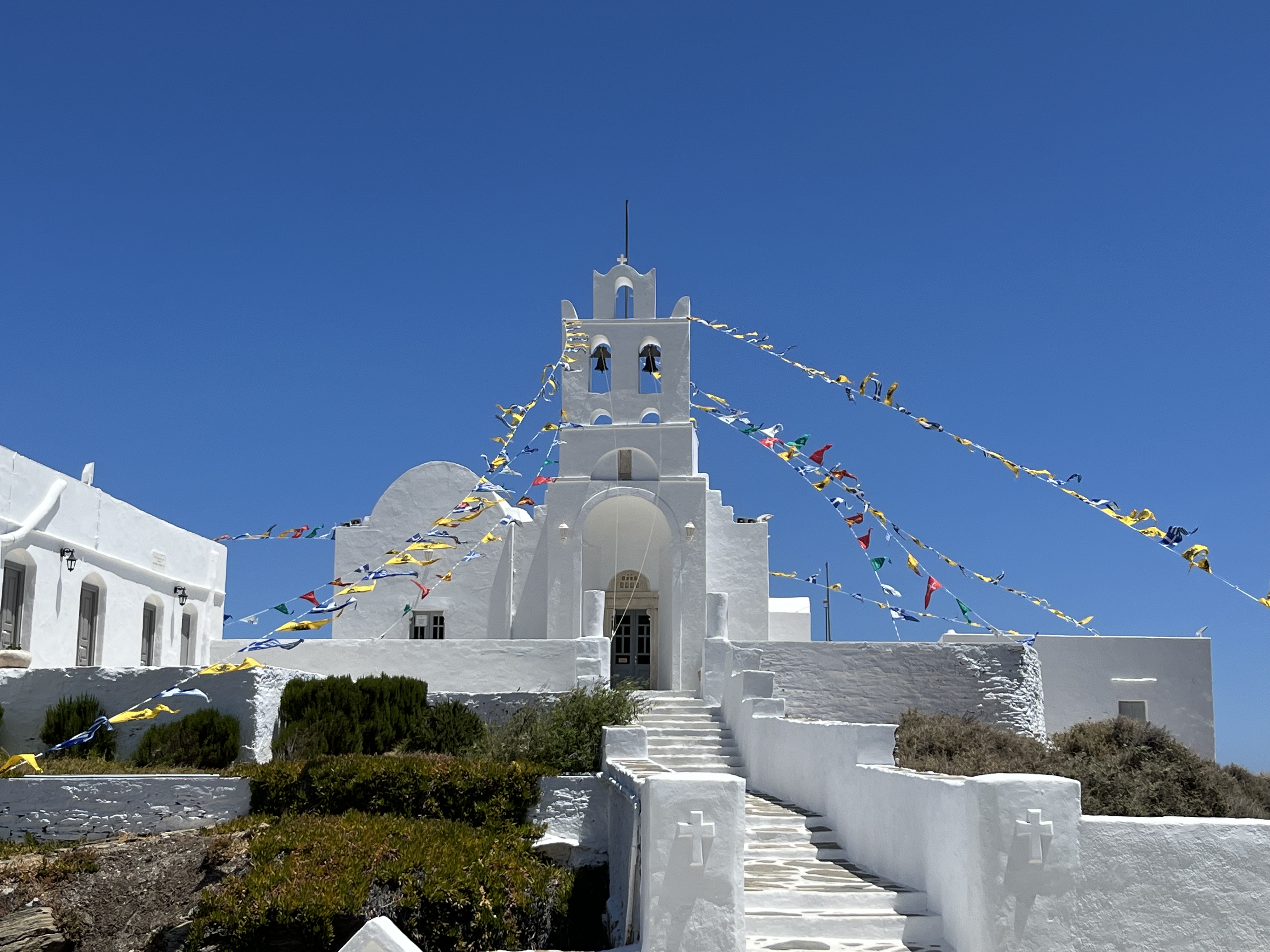
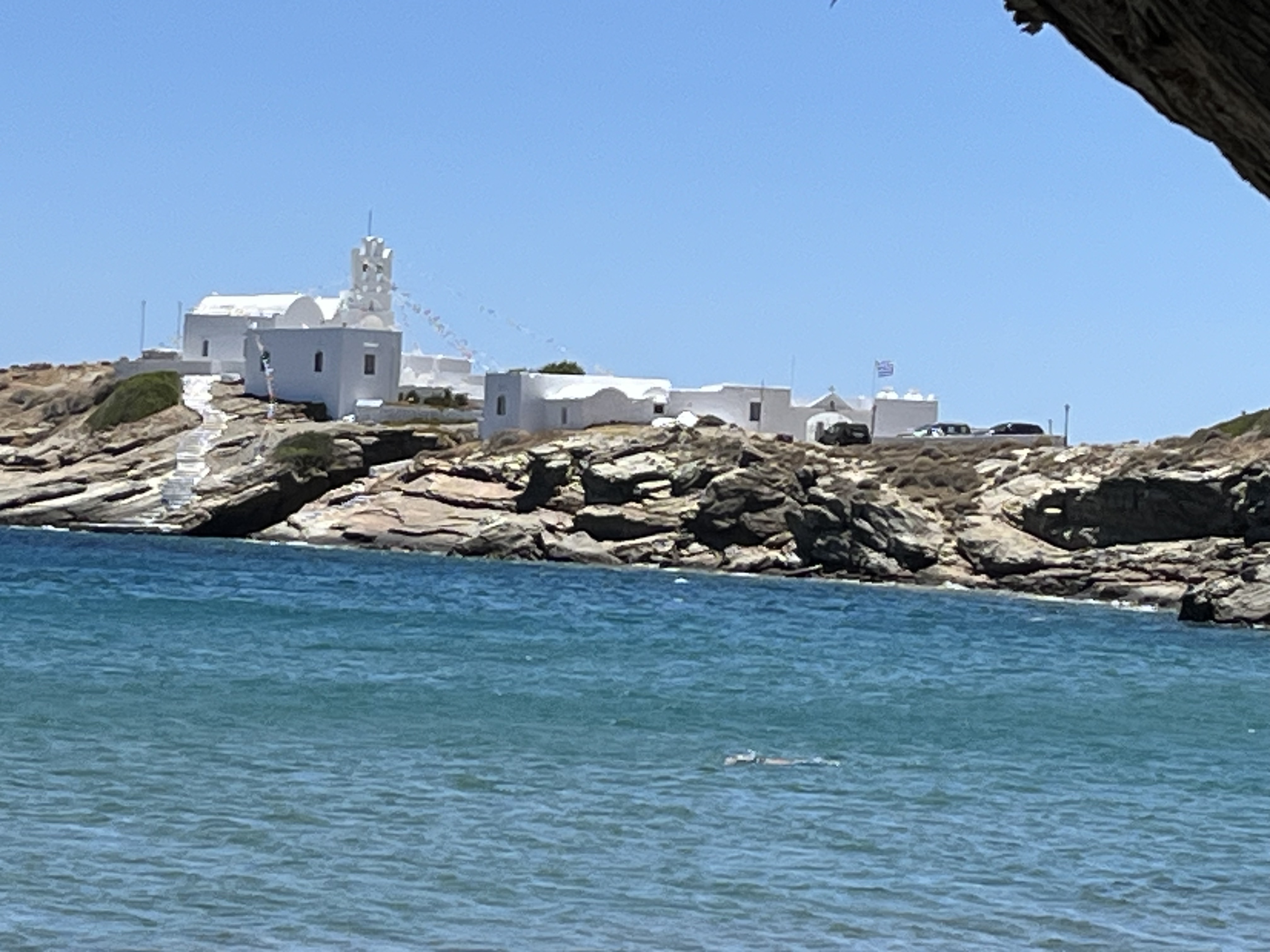
Both my informants, along with many, many others will be at the famous church in Chrysopigi on Thursday – sadly the day after we have left – to welcome the icon of Panagia (Mary) who arrives by boat from the island’s main port, Kamares.
I had imagined a decorated traditional boat with a band of the faithful bringing it into the Chrysopigi, but apparently, and more prosaically, it comes on a ferry making a detour before heading back to take passengers to Piraeus.
The traditional ritual which is followed is kept unchanged throughout the years and the custom is guarded with great respect. Each year, a member of the church has the fortunate fate of being selected to keep and preserve for one whole year the sacred illustration of Panagia; this is considered a great honour and a blessing for that person, who is in charge of taking care of the picture and making sure that it is maintained in the best way possible. And when the day that the name of Panagia is celebrated comes, he/she has the responsibility not only to undertake the whiting and the adornment of the church, but also the expenses for the whole panigiri, including the food and the wine, offered.
So, just to be clear, that is the responsibility and cost of a meal of traditional chickpea stew, then lamb and sweet things, plus wine and etc etc. and for a lot of people…..whitewashing inside and out and putting up the bunting.
and all decked out ready and waiting
The food part of the event is called ‘the love table’.
I’ll bet it is.
Apparently, there is a long waiting list for this honour…….
I checked this out with the local bar owner and she said yes indeed there was a list. The numbers were picked by something like a tombola and if you ‘won’ you could say thanks but no thanks, ‘ I do no have the economy to do that.’ or yea bring it on.
The icon of Panagia Chrysopigi, which is a true treasure for the Sifnians, was found in the sea by fishermen during the Iconomachia period and was transferred to the holy rock where her Temple was built on the site of a pre-existing temple. It is even said that as many times as they tried to transfer her to another temple, the Virgin became unliftable like a pencil.
I am certainly not in any position to challenge anyone working in another language but a pencil? (Perhaps the lead of the pencil?)
And, in case you were wondering about why you didn’t recall the Iconomachia period:
The term originates from the Byzantine Iconoclasm, the struggles between proponents and opponents of religious icons in the Byzantine Empire from 726 to 842 AD.
Iconoclasm was largely an Eastern Christian conflict. Western Christianity never became seriously concerned with it, to the delight of art historians.
So, as the patron saint of the island Mary splintered her little promontory from the headland the prevent pirates of some sort ‘attacking’ devout women.
She stopped the plague twice and in 1927 after her icon procession, the locusts plaguing in the island upped and left.
And, she is responsible for ‘many miracles of healing from incurable diseases, but above all miracles of spiritual rebirth and moral regeneration.’
But enough of the glam Panagia.
On my morning walk there is a church, of course there is, on a headland but it is shut like so many others dotted across the landscape, and not one of the many monasteries has a monk to be found.
I am told, that each and every one of these churches are maintained by volunteers (according to one source ) or diocese-paid workers ( according to another.)
My bar owner said each church, however remote, was looked after by one family, and ‘my’ church was looked after by the Stavros family ‘they live in the big houses up the road.’
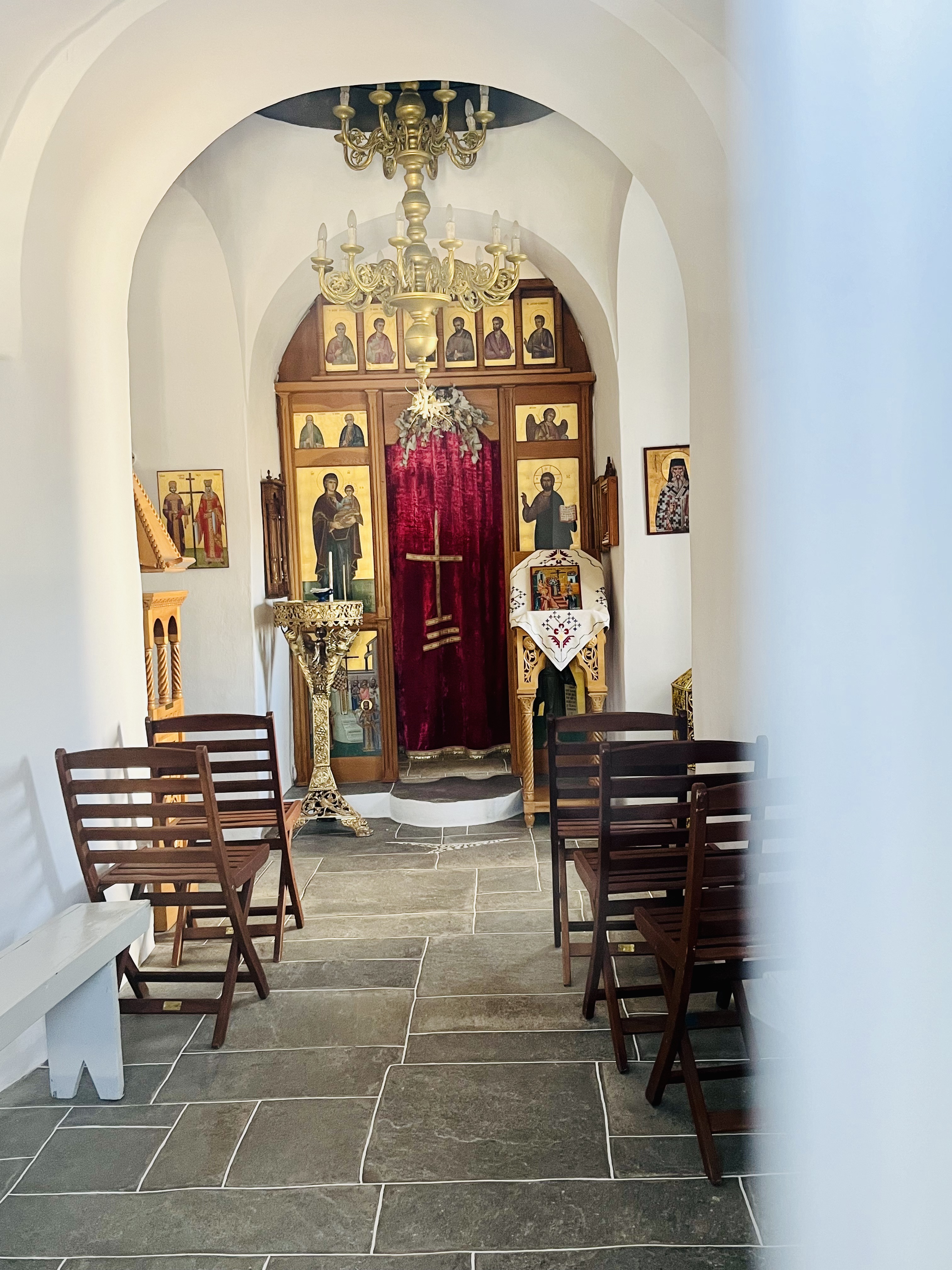
Given the immaculate state of ‘my’ church, they do a good job.
And each church has to have one service every year to remain registered as a church.
Never mind Chrysopigi, I’d love to be here when the tiny gem of ‘my’ church had its annual service, but I get the feeling these services might be locals-only events.
photo taken peeping through the glass of the locked doors
‘Our’ Greek Island is blessedly peaceful compared to many others, and that peaceful life means the holidaymaker’s mind turns to the small things in life.
In these days of contactless, is there still the ‘old woman’ who keeps the collections from the districts’ church services to offer the local bar owners small denomination notes for the 50 euro notes tourists proffer for two beers?
Does the casually but elegantly dressed French woman bring the remains of her croissant to feed the fish every morning?
Why are so many churches and monasteries but on the tops of very steep hills?
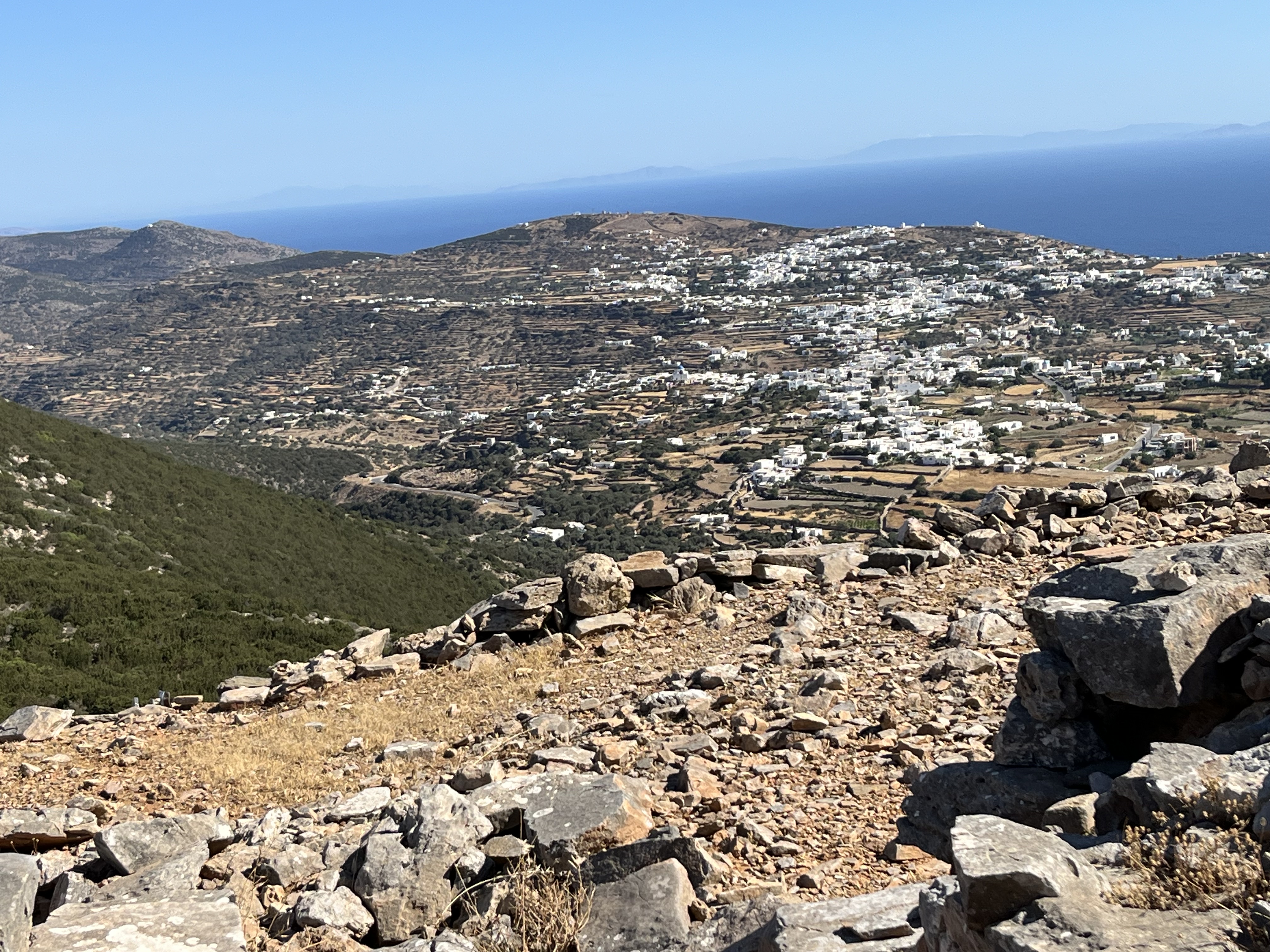
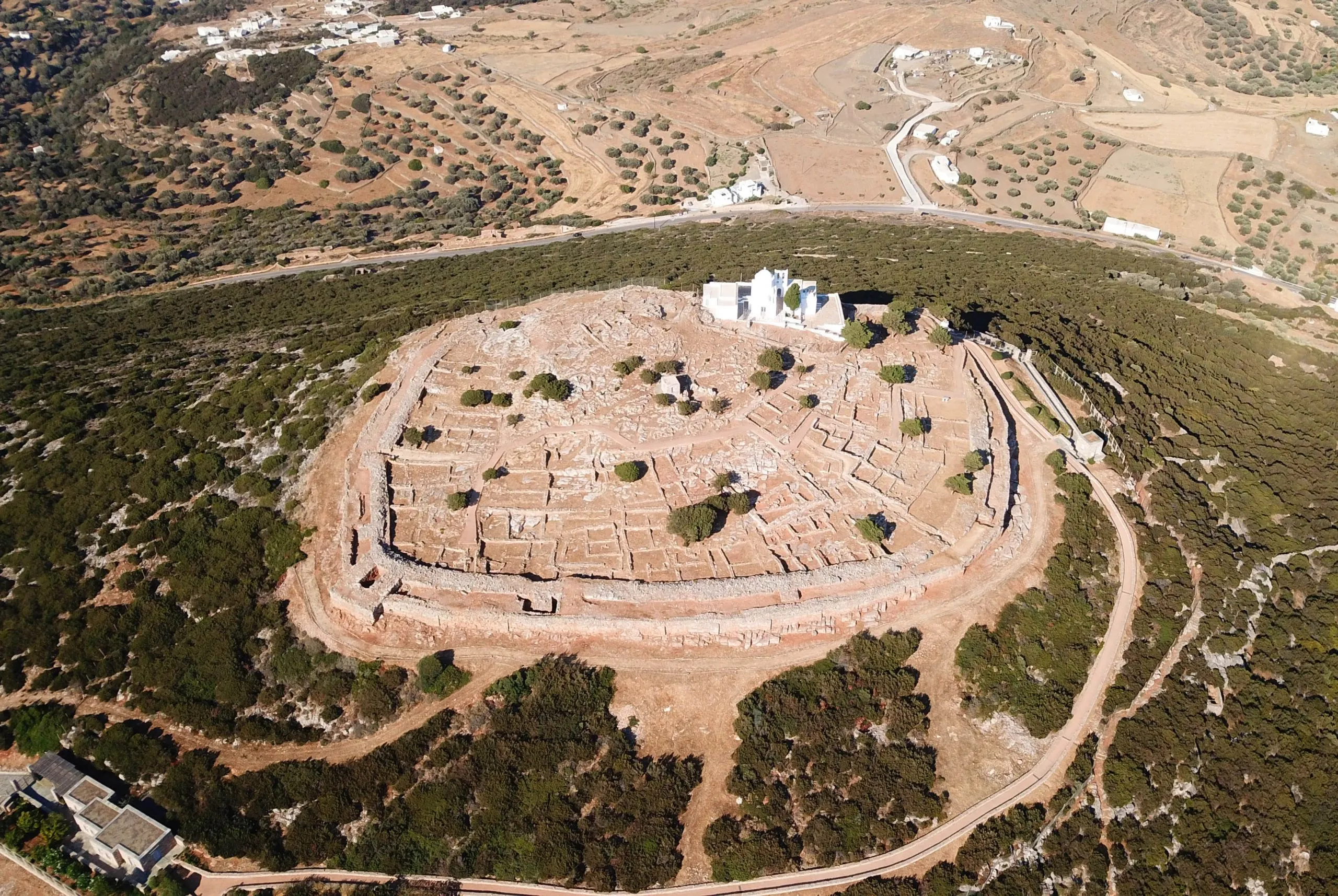
Agios Andreas is a famous ex-monastery set among the remains of a primarily Mycenaean settlement.
It is 425m above sea level and though you can walk up ( and up, and up) to it, that is not for us these days. We drove to the bottom of the site.
It is always impressive to think of people building a sizeable settlement in such a place. How much effort that would take, how hard it must have been to survive, eat, drink, live in such a place.
The Mycenaeans did it apparently, in the 13th century BCE because these islands were at risk of pirates and were hardly the idyllic peaceful holiday islands they are now.
But to choose to put a monastery there?
I, with time to muse on this, and with time to see churches all over this hilly/mountainous island got to wondering.
There are inaccessible religious places everywhere you look – especially if you look up to summits.
Perhaps there was some long standing boys’ oneupmanship about who could build in the most remote, difficult, hard to reach site.
I am pretty sure if women had been in charge there would have been much more practical sitings.
‘Why on earth do you want to build up there? Closer to God? Oh give over. Try growing something to eat on a pointy bit of rock – really?
‘So, we will be down here where it is not blowing a gale, has soil, we can keep an eye on the sheep and goats, and tend them without having to abseil. I am sure if God is all forgiving, he will see the sense in that.’
When we visited Agios Andreas and its tiny museum of found artefacts, we were the only people there apart from the two custodians.
( It was 9am on a Sunday morning.)
The nice young woman was heading up the site to take her station in the church and with a rucksack which I assumed was full of books on the grounds there would be bugger all else to do for hours and hours.
Her ‘partner’ was back at a small house tending his/their vegetable patch, next to the ticket office.
Well the Mycenaeans must have grown food and so it was good to see tradition continuing with some very nice looking courgettes, runner beans, inevitably geraniums, basil in recycled containers – oh a very affectionate cat who took to the Best Beloved and he to her.
One of the great things about working at the Garden Shows is the birds of prey.
( There are lots of things actually: enticing ways to spend your wages on everything from bulbs to handmade jewellery, clothes, sausages made by ex-offenders and I recommend the fennel ones. The great group of crew and organisers, the many nice stallholders and the generally appreciative visitors in their hundreds and on a good day, thousands.)
But it is a special delight to watch these amazing birds in action.
So, they are housed for the day in mesh tents and you can go and learn about them from their trainers/keepers.
Then they fly.
Once, just once as it happens, we had a stallholder who had a wedding business bringing a flock of doves to fly around your ceremony. When he mentioned that he let them out so potential customers could see them in action, I had to make sure he knew when it would be a very, very bad time to do that.
And once one of the birds of prey went awol and her tracker ran out of battery. She was only located in a nearby village when someone posted on Mumsnet, ‘does anyone know what this really big bird on my bird feeder is?’
Mostly though they are very well behaved, not worried by an audience – indeed quite pleased to show off it seems.
Luke who owns the centre where they live, and flies them, is knowledgeable, assured, gives a really interesting running commentary on what they are doing, how they fly and their habits.
He is a man who knows what he is doing.
This year he brought a sea eagle along.
‘She is new to all this,’ he said, ‘And at the moment not at all sure she wants to be involved.’
‘She’ll fly to the gauntlet but if she’s not amused a cross bird of that size, flying at speed, onto your arm makes her point.’
Over the three days of the show, he let her out first on a leash and just let her survey the crowd.
On the second day, he let her fly on a long leash – though he did have to ask the parents of a small child running across the grass to ‘remove temptation.’
And on the last day, he let her fly free though I have to say it was a rather sulky flight and she spent a bit of time ostentatiously sitting in a tree looking anywhere but at either Luke or the rest of us.
On the Saturday, Luke said to me he needed to get away promptly as he had to go to a hen party.
‘Wow,’ I said, ‘ birds of prey at a hen party – that’s novel.’
Luke said, ‘ Oh you don’t know do you? My other life is as a drag queen.’
Well you could have knocked me down with a falcon’s feather.
I don’t regularly work a Saturday afternoon in our Oxfam bookshop, and it is a rare ( but a very nice time) when a book is united with someone who really wanted/needed/appreciated it.
Mostly instead it is nice customers who have been recommended a good paperback fiction book by a friend or a sister, or who has read one of the author’s books and wants to read more – or indeed never tells me why they are buying the book.
But this afternoon was a bit different.
We have a glass cabinet ( I have to say rather thrust upon us by a previous area manager) into which we put ‘specially attractive books.’
I put books in there that I really hope will sell because they are delightful/interesting/unusual – but often the book-buying public of Petersfield finds them less so…..
Anyway, the one I put in a few days before my Saturday shift was not really a book.
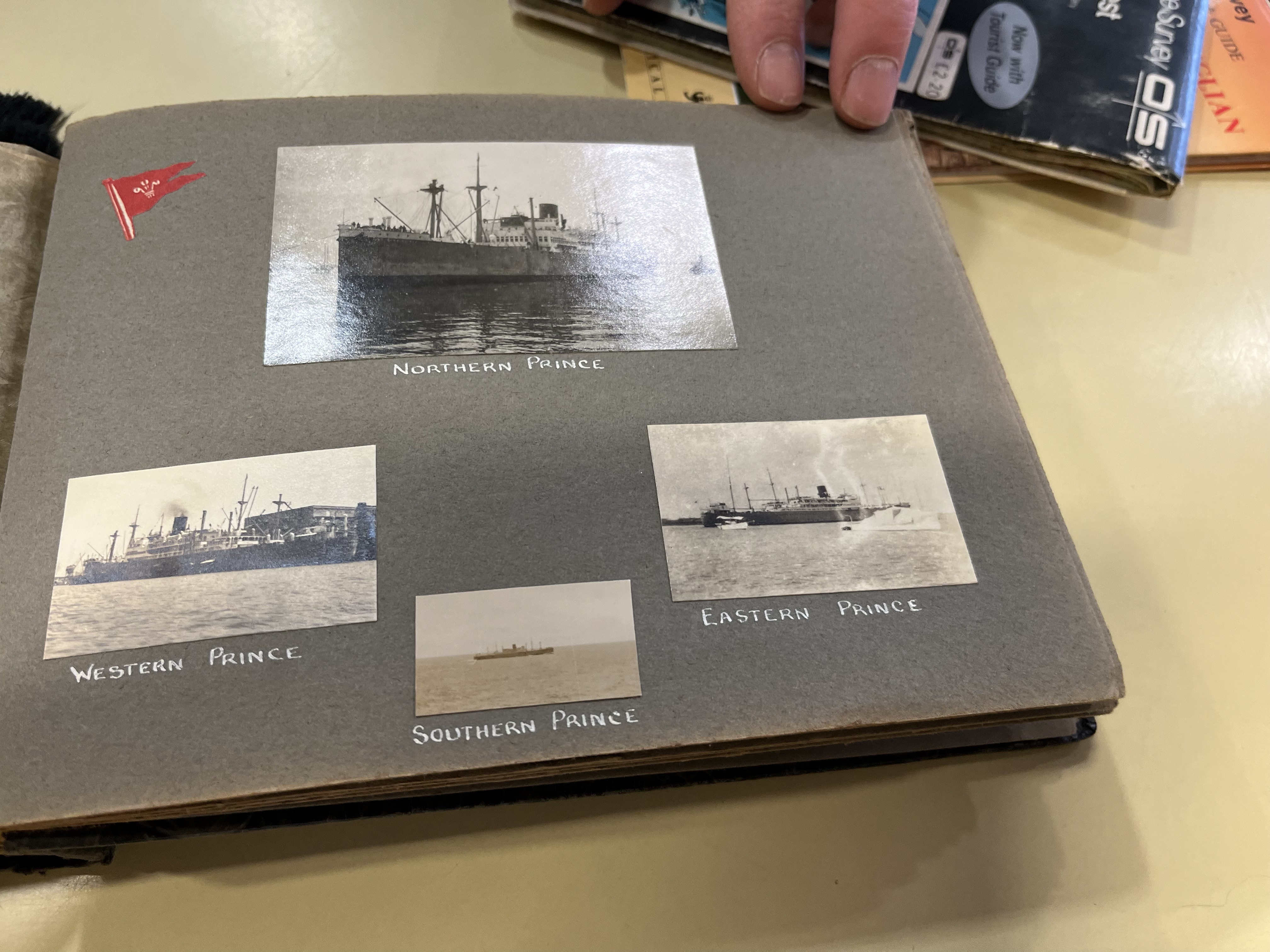
It was a photograph album of ships.
It was donated by who knows who.
It had no name of the ‘author.’
Every page was completed and every page had a tissue guard – that, just in case you didn’t know, means a bit of photographic tissue paper to protect the photographs.
Except, I am not sure they were photos – some were the size of old-fashioned cigarette cards, some the size of postcards, some bigger.
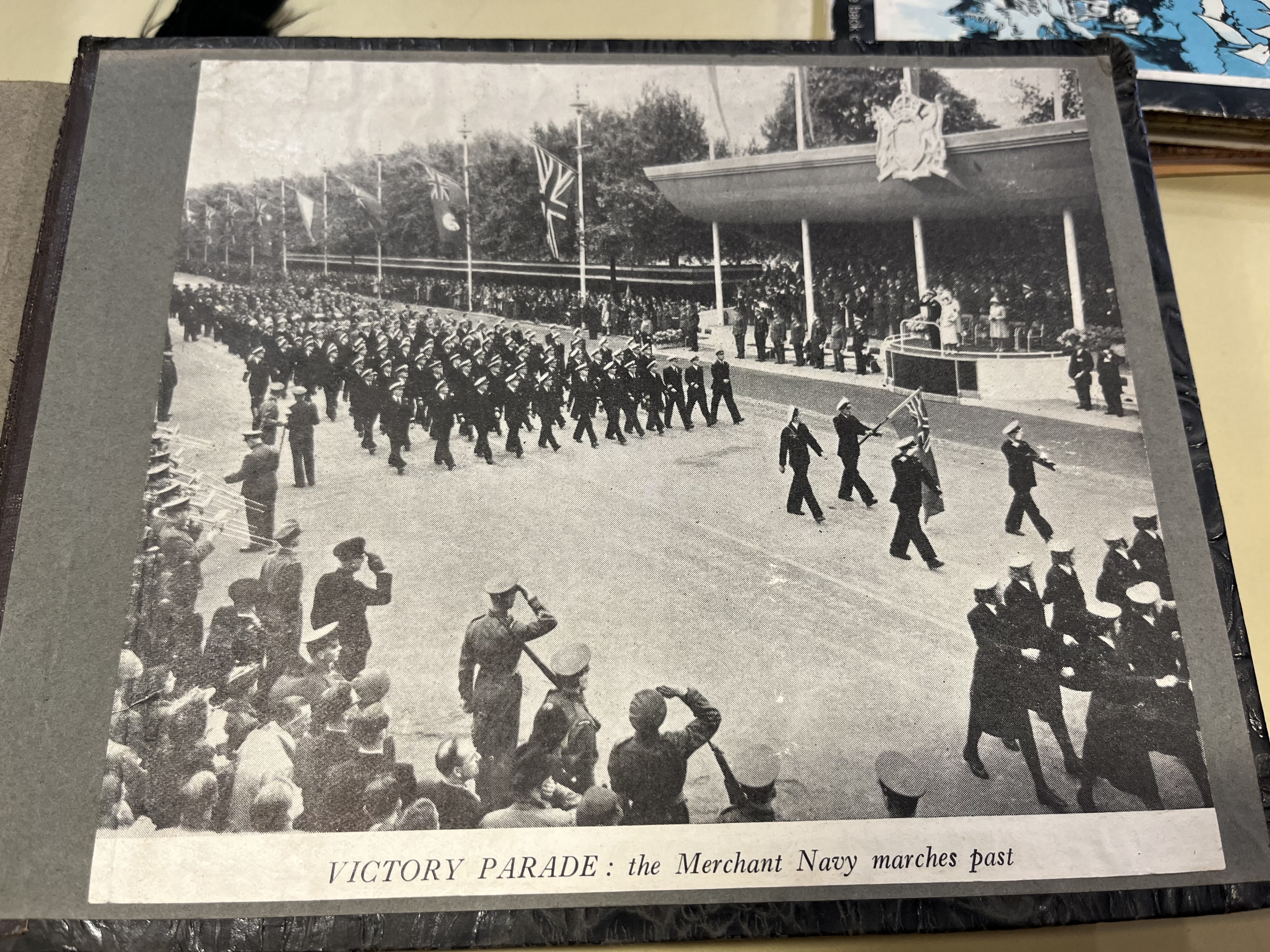
Most of the images, it seemed to me, with a relatively cursory look, were merchant shipping vessels and at the end of the book was an image of the merchant navy victory parade at the end of World War II.
I had looked at this and wondered who as the person who put it together?
But assiduous readers of this blog ( and that must be just me ) will remember I disappeared down a rabbit hole of naval mutinies a while ago and so I decided not to take on any research into this album.
I steeled my heart, as the best beloved would say, picked a figure out of the air and put it in the cabinet for £20.
So, there I am on a busy Saturday afternoon and someone asks if he might take it out and have a look at it.
Of course. And just then the shop was not too busy so we started talking about it.
Then customers started wanting to pay for books, asking for books we might have not on display, wanting to know whether the book they had seen ‘about two weeks ago and it was about, well I am not really sure but something to do with… have you still got it?’
So I left the man and his wife leafing through the album until the shop went a bit quieter again, and he said something along the lines of:
‘I am going to buy this and try and find out who he was. There must be ways of finding out the crew on all these ships and if there is a name which appears on all of them or at least some of them.’
A man after my own heart.
I asked him if he would let me know what he found out, if he ever does.
I have given him my name and phone number and one of these fine days I might find out what he has found out.
‘It is amazing and rather sad,’ he said, ‘that a family have let this history go.’
But he doesn’t work in an Oxfam shop where you get all sorts of donations and think why did you let that go?
But, as someone donating the other day said, ‘ I hope you can find someone who likes old stuff because we don’t.’
I remember my mother saying, once retired, she had no idea how she had managed to fit in a full time job.
Being in my 30s at the time, I was just a bit sceptical and had always worked on the basis of ‘if you need something doing, ask a busy person.’
But now I find myself agreeing with her – and I am sure if she was still around to hear that, she would be sporting a rather self-satisfied smile.
Over the years, I have slipped from employment, into self-employment, into less self-employment and since the pandemic, no real paid work – and never actually retiring in the sense of ‘ Ok that is it, work over, retirement here we go.’
It turns out, I have plenty to occupy my time.
And what a heady mix of ‘plenty’ that turns out to be; Oxfam, upholstery classes and a bit of hammering and banging, re-stuffing and hand-stitching on the side at home, dog-walking fixtures, lunch outings for an elderly relative, gardening, cleaning out the fridge now and then……
Not exactly running from pillar to post, I hear you say, and indeed I was feeling guilty about being so ready for a holiday and relishing the thought of waking up and not having a list of things to do, places to be, over and above when to go for the first dip in the sea, and where to eat that evening.
Meanwhile, there is something very nice about sitting with the Best Beloved on our terrace watching the yachts coming into the bay and sorting out where and how to anchor.
This was always a tense time for us on sailing holidays ( actually one of quite a lot of tense times) and remind me one day to tell you about our anchor coming loose and our boat bumping (gently) around and into all the other boats in the bay.
So there is a lazily delicious schadenfreude in watching the oh so usually competent Swedes (among others) spending an anxious hour going backwards and forwards to the prow and peering down to check their anchor is still laid.
obviously some boats are easier to anchor than others
We have two weeks of time to spend pretty much like this and I have a feeling that much though I was very, very keen to get here, there will be a bit of me itching to get back, get busy, and do the Oxfam window display.
The window theme is travel, so no irony there then.
Some years ago, when we moved to Deepest Sussex, I said to the then village shop owner, ‘ I am going to stand outside your shop and ask everyone who comes out with The Guardian to be my friend.’
‘ Mmm well you won’t have many friends Lucy,’ he said.
As it happens, we have found people who spiritually, if not literally, do buy The Guardian.
But an exchange in the village shop this week reminded my that it is the case that the piles of The Daily Mail, The Telegraph, The Times, even The Express go down a lot more quickly than The Guardian.
I stopped on the way home from my upholstery class ( of course I did, Sussex housewife as I am) and asked the lovely woman at the counter whether my husband had been in for his Guardian.
‘I don’t know,’ she said, ‘ I am not sure who he is. Describe him?’
‘Tall, wears glasses, can’t walk very well, Oxbridge accent’’
‘That would cover about half our male customers, so not much of a clue.’ she said.
A fellow upholsterer, in the shop too, said,’ If I was asked to describe my husband, I’d have just said grumpy.’
Lovely woman at the counter said, ‘ I would say fuck knows since the last 15 years and that is just fine by me.’
‘He would have had a voucher to buy The Guardian,’ I said.
‘Ah well, he hasn’t been in. No Guardians sold so far today. Here, have one – bring in the voucher when you next pass – I am pretty sure we won’t run out.’
Following on from the last piece, remember the ‘modern proverb’ If at first you don’t succeed, try turning it off and on again?
Well, the Best beloved needed (another) spine operation and, as is usual, he went for the obligatory check ups before.
They found he had a slow heartbeat.
This was not a surprise as for every other operation he has had in our however many years together, every time the medics have commentated on his slow heartbeat.
No worries, we said.
Mmm, they said.
And then they said, Go home with a monitor strapped to your chest for a night or two and we shall see.
He did.
They were not impressed.
You need a pacemaker, they said.
Now here was the rub, the surgeon doing the operation ( privately, I have to say) was going on sabbatical so we had to get the pacemaker in before he left.
A privately funded pacemaker cost nearly as much as the spine operation – really you ask, yes indeed.
So I spent a lot of time on the phone with medical secretaries – secretaries/assistants/receptionists are always the route through a problem.
Eventually after a lot of chasing around the NHS to try and get this done in time, the private/NHS heart doctor who had first had said said, Do you know what, just add him to the end of my list and I’ll get it bloody well done.
And I close quotes.
So, it is a quick in and out to get something put in the size of say a 50 pence piece and yes it is visible under the skin and it takes about 40 minutes under local anaesthetic.
We were very grateful and relieved.
And when it is done they strap you up to a monitor to make sure all is well and leave you on a bed for an hour or so.
So, all is well.
The monitor is behind the BB’s sightlines but visible to me as I sat solicitously (and rather impressed by my own ability to get this done in time with the help of several great women).
I could see that his heartbeat was registering not so much rather high as alarmingly high.
But he was chatting away and offering crossword clues.
In the end I asked a nurse to come in and check things.
She took one look at the monitor and called in someone else.
But he is fine, I said.
Mmm, she said.
She took his pulse in the old fashioned way.
And said, Mmm….
I’d better call the technicians but that may take some while.
I said, Shall we just try the turning off and on again trick? After all it is only a monitor not something keeping his heart going.
Mmm, she said.
But we did.
And do you know what – all was just fine.
It’s a great proverb and, along with the 80/20 rule, one that I swear by.
There are books with titles which would probably not be used today.
But in 1886, things were a bit different.
Anyway, Edwin Hodder writing as ‘Old Merry’ had indeed some rather odd proverbs as well as some still very familiar – and his discourses are nothing if not a little idiosyncratic.
You know how some sayings get embedded in your family?
Well, the one I remember from my mother was, “ What the eye doesn’t see gathers no moss.’
I am not sure exactly what she meant by eliding those two proverbs but generally, I think she used it when she wanted to sidestep something awkward, and get away with it.
Anyway back to Old Merry.
‘The cat in gloves catches no mice’
And there is a picture.
As well as a moral ‘sermon’ to children from the ‘pulpit.’
I won’t bore you with the several pages of Victorian ‘humour’ and moralising on all the proverbs.
‘Phew,’ I hear you cry – and in the hope I can detain you just a little longer, here are just a few more snippets.
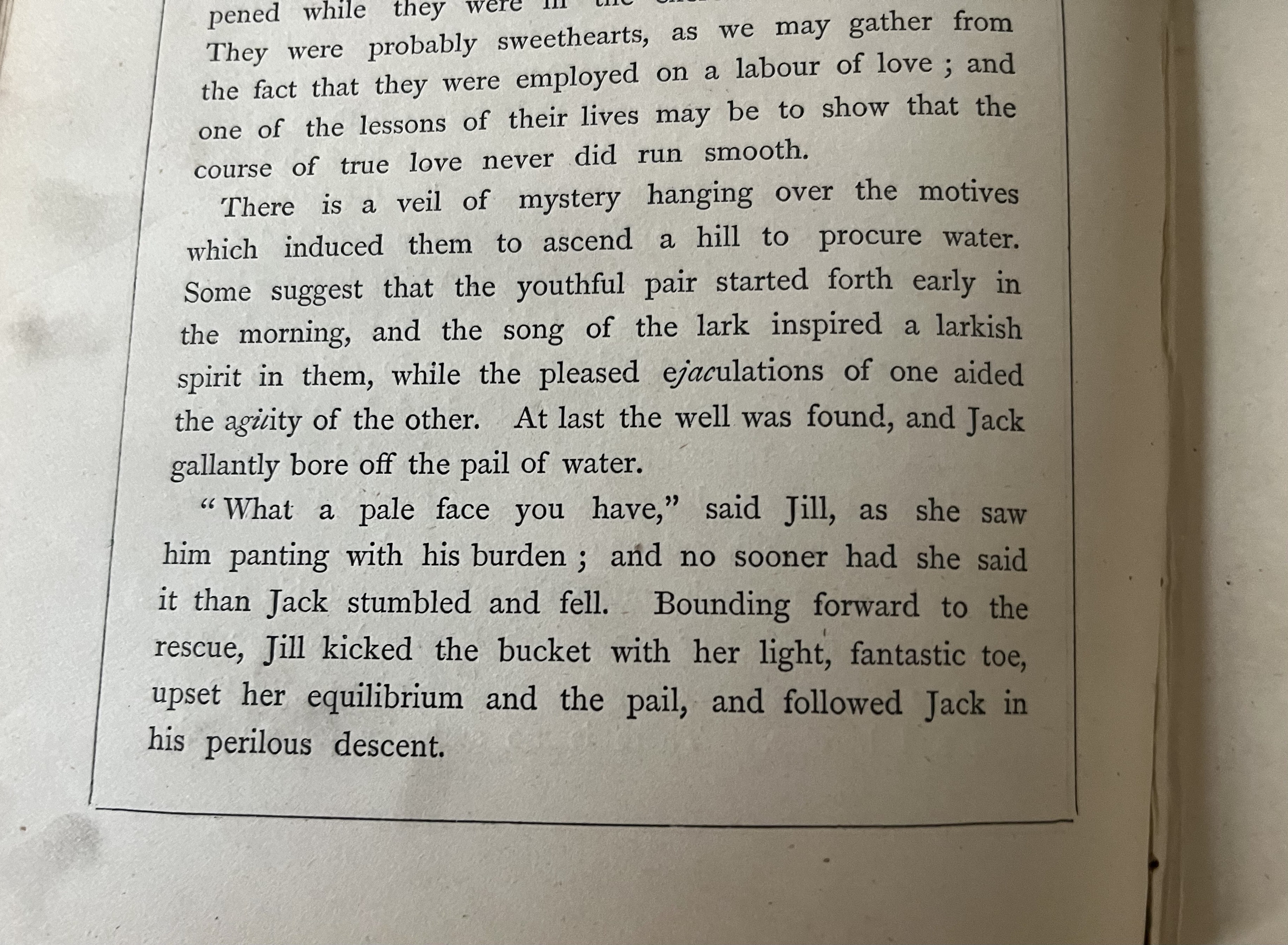
Jack and Jill
Interestingly, though he says later, addressing the rapt Victorian children I assume, there are two lessons, only No 1 seems to be identified.
Perhaps he needs the same proverb as I do – something about attention to detail.
The Best Beloved says I need to be followed around by a tame pedant.
And, he says, my life is like an impressionist painting, all looking good from a distance but up close, it is a mess of random dots.
As for attention to detail ‘proverb’, I am going with “ Look after the (non-financial) pennies and the pounds will look after themselves.’
Doesn’t trip off the tongue I know, but will work on it.
I also like the quote:
‘Success in any endeavour requires single-minded attention to detail and total concentration.’
Willie Sutton (aka, “Slick Willie, the famous bank robber)
Well, back to Old Merry and
‘Every ass likes to hear himself bray.’
Is it too cheap a shot to want to have that projected onto the walls of parliament?
Old Merry however, makes no such comments, instead he writes five pages in defence of the donkey and says,
‘I confess I have respect for donkeys and should like to join a crusade for the vindication of their rights.’
‘ Costermongers are now the greatest donkey holders in the land, and we have not to walk far to see how brutally the poor things are used, what cruel work they have to do, and what horrid society they have to mix with.’
So, here are a few more Old Merry’s to leave you with:
‘It is not the cowl that makes the monk.’
‘He that is afraid of wagging feathers must keep from among the wildfowl.’ No, I have not much idea either though I gather it is a Scottish proverb, so all Scottish ideas welcome.
‘ Fools make feasts, and wise men eat them.’ As a happy cook, I rather resent this one. And I am not sure Old Merry clears up the meaning of this proverb as he witters on about the difference between a simple person and ‘ a simpleton’. Just saying
‘Keeping from falling down is better than helping up.’
And finally from Old Merry
‘Merry Christmas.’
Now that to me is not a proverb, and reading through Old Merry’s take on this I feel that he might just have read Pickwick Papers published in 1837.
No Scrooge as a repenting ‘sinner’ but a contrast between idyllic Victorian Christmas full of joy and candles and good food, and Nelly trying to read to her parents by the light of a meagre fire, the dead son Tom…..
But to make things a bit lighter I give you some modern proverbs:
If at first you don’t succeed, try turning it off and on again. Neil Whyte. ( One I put into action all the time – remember me to tell you about the BB’s heart monitor sometime.)
You Brexit, you fixit.” Alistair May
You only find out who is swimming naked when the tide goes out. Warren Buffet
The problem is between the keyboard and the chair. ( no attribuation)
One ought to try everything once except incest and folk dancing. Arnold Bax
Never wrestle a pig; you will both get dirty, and the pig likes it. Richard Calhoun
‘It is a far cry from the Age of Flint and Neolithic Man to the Age of Steel when the Great Western Expresses thunder from the East to the extreme West in less than 6 hours.’
Well it takes even less time now (sometimes), but no doubt costs a lot more.
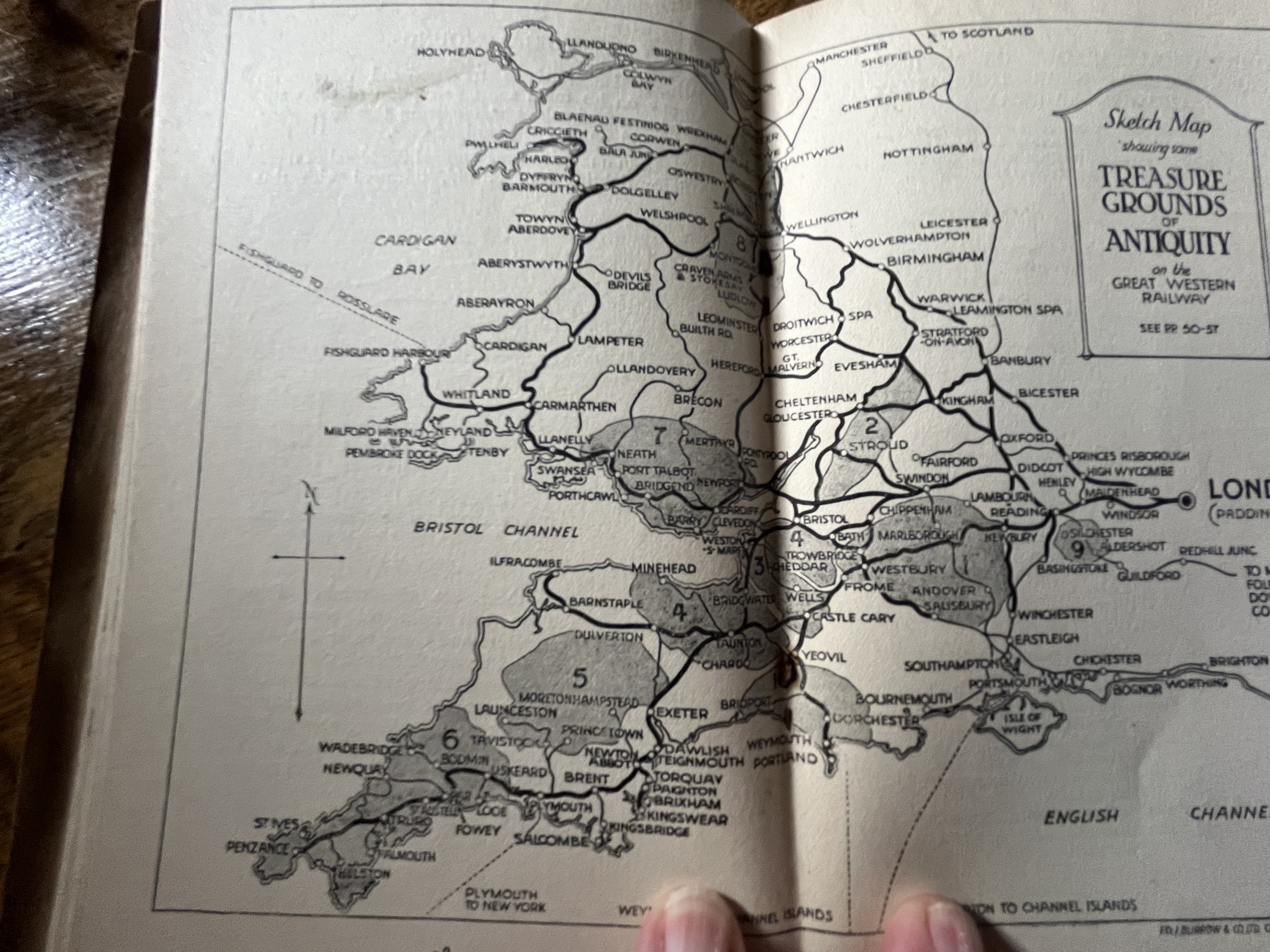
This is about a delightful little paperback guide from, I think, 1926 to where you can get off from the Great Western Railways expresses and get to, by whatever other means, see ancient sites.
George Burrow, the author and illustrator was clearly a man for who ancient sites held particular thrall.
Beginning in the years before the First World War Burrow published more than 500 travel guides in a series titled The “Borough” Pocket Guides (also known as The “Borough” Guides) to various localities of the British Isles and some parts of the Continent.[2] In the 1920s he published a book series titled Burrow’s “RAC” Guides,[3] which were issued under the auspices of the Royal Automobile Club Touring Department. In the 1930s he issued another series named Burrow’s Grey Guides.[4]
Until the 1960s Burrow was the most prolific publishers of local authority official guidebooks in the UK, from booklets covering small rural districts to large civic handbooks for London metropolitan boroughs.
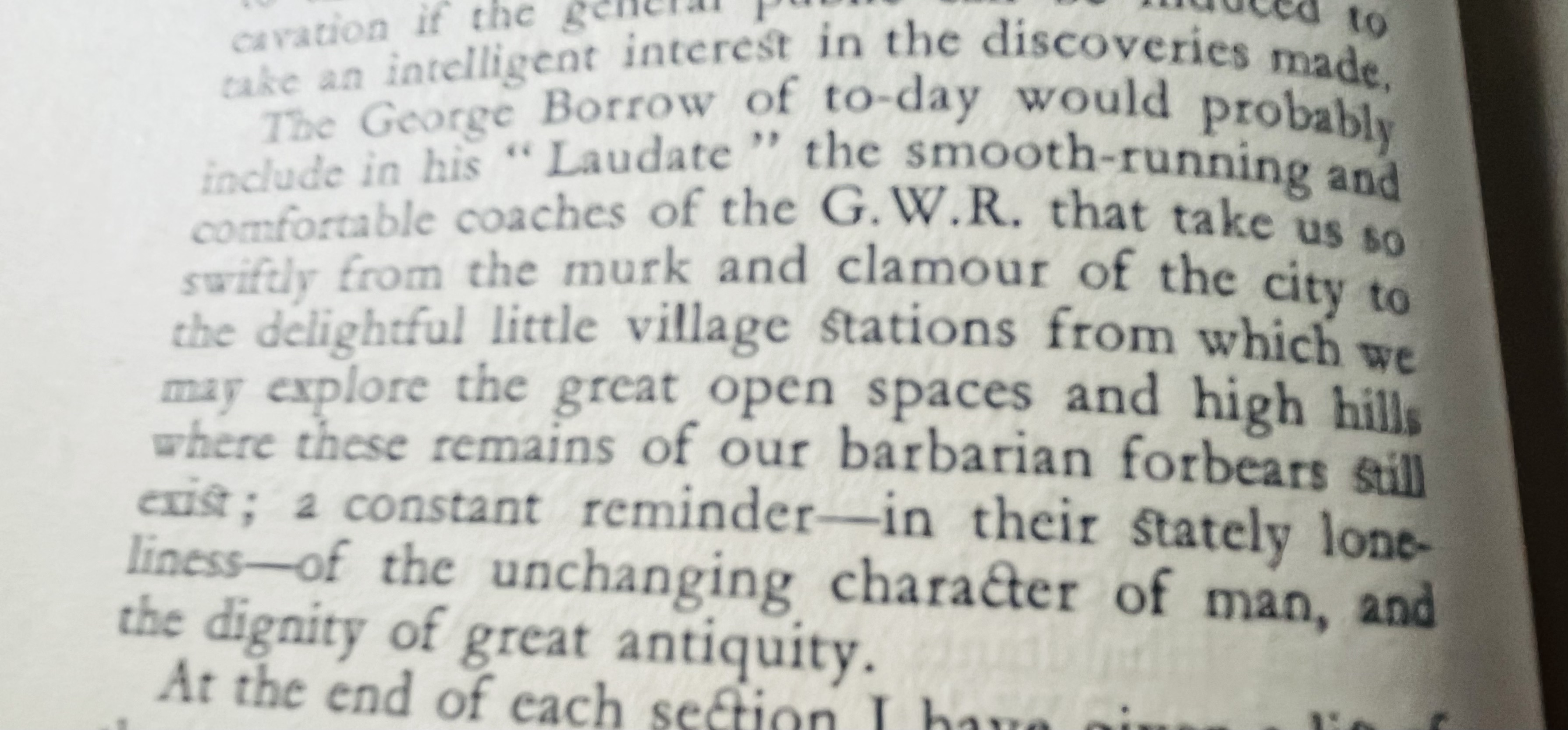
So, our little book is hardly a rarity but it is nevertheless rather charming in lots of ways including the rather nice typeface.
There was a lot of GWR inn those days
I have not the time to do the research but would love to know what typeface it is.
I tried a gentle tootle around to see if I could get a link to the Cheltenham Press who printed the booklet but nothing – it was not a rigorous and thorough search.
The serif links st, ts, and ct.
It looks a but Arts and Crafts to me but what do I know. Would like to though, so when it is raining and when isn’t it these days, I might spend an afternoon searching old typefaces unless anyone can get their quicker…….












 thereluctanthousewife