Mamie Dickens Signed This Book

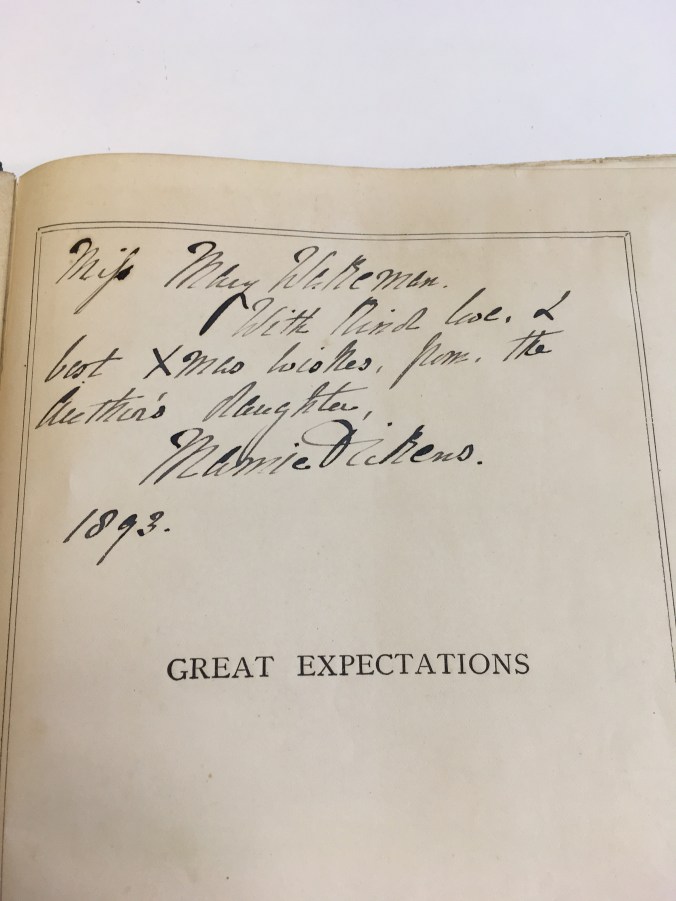
There are few times in an Oxfam volunteer’s ‘career’ that you get a book which might be worth a few thousand pounds. But then again not many are signed by Dickens’ eldest daughter.

No, I didn’t find it at the bottom of a box – another volunteer did.

I take my hat off to him.

Not least because I have to admit that if it had come through my hands for sorting, I might have thrown it in a sack without looking inside.

But he put it one side and made me look at it.

It is ‘The Household Edition’ and over the years I have learned there were a lot of them printed and quite a few of them come into our shop – whereas, dear reader, not a lot of them sell.

But this one has this dedication:
 

IMG_0834


Mary (Mamie) it turns out, helped run the new household when Dickens left his wife taking the children with him and set up home with his sister-in-law Georgina Hogarth and may, just may, have had an affair with her – or more likely gone on to have an affair with Ellen Ternan.

It wasn’t until after her father’s death that Mamie re-contacted her mother.


.PRdickensMAR1.jpg

(Charles Dickens with Mamie and Kate, two of his daughters)

Georgina found living with Mamie difficult, complaining that she was drinking too much. In the late 1880s she persuaded Mamie to move to Manchester where she lived with a clergyman and his wife.

Georgina wrote, “Mr Hargreaves is a most unworthy person in every way – and it was always amazing to me that she could keep up this strong feeling and regard and affection for him to the very end of her life. Mrs Hargreaves has kept true and devoted in her attentions to Mamie during her long illness.”

(I am not sure what the definition of drinking too much was in Victorian times but I suspect Georgina would not approve of my plans for a large glass(es) of white tonight….)

Back to the book: I think the dedication is to Mary Wakeman but I have failed to find her and thus a connection to Mamie.

The dedication is after Charles Dickens’s death and by that time Mamie had gone to live with a Rev Hargreaves and his wife in Manchester which was in itself, or had occasioned, a ‘scandal’ according to Wikipedia.

Then she left Manchester, and retired to ‘the country’ which was in this case, Farnham Royal in Berkshire and is now, to you and me, an extension of Slough – and there she died.

So, I looked at this book and its dedication and I Googled and got nowhere with any search of a similar book and dedication.

When I called our antiquarian book expert, who was on his way to somewhere to do something, he said not to get my hopes up as he didn’t think it was going to set the Oxfam Petersfield Bookshop world alight.

But, and dear reader and this is not something I often say, I thought he was wrong.

He turned up in the shop today to say he was. ( That conversation made me miss Pilates which is not something a Sussex housewife should do.)

Anyway, in the meantime, I had contacted The Dickens Museum in London who said it would be a great book to add to their collection but they didn’t do valuations.

I would like to go to them and if it turns out to be worth £100 they can have it with our blessings and free postage and packing.

But if there are (probably Americans) willing to pay hundreds, even possibly thousands of pounds that is what we will do.

After all this is not, I understand, even in my excited state, a national treasure.

So, I have contacted someone in Bonhams who has helped us before – usually that involves politely telling me what I have is not worth their thinking about.

I have contacted Peter Harringtons, a posh bookseller in London and another posh bookseller called Sotherans, and the retiring board member of the Dickens’ Society at the University of Iowa.

I have emailed the Slough Observer on the basis that Mamie must be a local celeb and perhaps they know of a local historian who knows of her friend and has some more information.

(Do they believe I am an Oxfam volunteer or do they suspect that I am posing as one so they will be nice to me?)

So, now dear reader, I will leave you to try and find Mary Wakeman and who was she to Mamie Dickens, where was Mamie Dickens when she gave this book as a Christmas present, are there any other books out there signed by Mamie, and I will keep checking my emails to see if any of these experts are excited.


It Can’t Happen Here

Recently a book came into the shop which I hadn’t seen before and was called ‘It Can’t Happen Here’ by John Sinclair originally published in 1935 and (smartly) re-issued this year by Penguin.

The blurb says:

‘A vain, outlandish, anti-immigrant, fearmongering demagogue runs for President of the United States – and wins. Sinclair Lewis’s chilling 1935 bestseller is the story of Buzz Windrip, ‘Professional Common Man’, who promises poor, angry voters that he will make America proud and prosperous once more, but takes the country down a far darker path. As the new regime slides into authoritarianism, newspaper editor Doremus Jessup can’t believe it will last – but is he right? This cautionary tale of liberal complacency in the face of populist tyranny shows it really can happen here.’

The hero of the book is an editor of a local paper and there are all kinds of echoes about the president’s antipathy to mainstream media – or in the case of 1935, just the media.

The latter half of the book talks about camps – now this was 1935 so no Auschwitz in sight, and anyway, I thought/think that is just not going to happen in this day and age.

Mind you, I had not though a president would defend the Klu Klux Klan.

I thought, for what it is worth, it was not a good idea to bring down the statue of Robert E Lee – you can’t re-write history and as Trump said, who is next? after all Thomas Jefferson was indeed a slave owner.

But then i found out that quite a few of these statues had been put up long after the war, in fact into the 20s, 30, 40s and even 50s – and were more of a reminder to the black population of who was in charge than any commemoration of the time.

And the supremacists were there because for them, the statue was a symbol of what they stand for and that is not equality for all, whatever colour, sex or religion you are.

And, yes, I am sure there were leftist protestors who used violence and would do so again.

I am also sure there are those on the right, who went to that march to campaign for the right to keep the statue who were horrified at the sight of someone driving at full speed into a crowd of opponents.

But there is no excuse or defending of white supremacists, anyone nearing the racist or fascist.

So, here’s the deal:

Poor, white men ( and also some women) feel hard done by because they have lost out and in their view, women, black people, gays have had the attention of the establishment, too much support and have ‘gotten’ an unfair deal.

The point is that white men (poor and otherwise) have had to face attempts to equalise society with others creeping up on their supremacy and they want to revert to the status quo – white men in all shapes and sizes, in charge.

They have faith in a man who says he is working for them and against the liberal establishment and maybe he is.

Liberal complacency on my part? Hands up. I had hoped, even presumed, he would never win and that liberal, progressive views would win through. Easy for me, you might think.

Any change of heart? No. I am a liberal and I want equality for everyone.

A wish to get out of my bubble and listen to other views? Well, I’d like to say yes but really….

and that probably is part of the problem.


What I did on his holidays Part 2

So, this is indeed Part 2 of what I did in the two weeks the best beloved was digging up (very small) pieces of roman history.

And it is a litany of failure I’m afraid – there are by contrast just a couple of things which I can recount with an iota of pride.

But then, that is so often, my life – the 80/20 rule.

(I am going to keep the glimmers of self satisfaction until later as by then I might well need to boost a very flagging sense of self worth.

And if you are one of those people who believe wholeheartedly in being so very positive about yourself, you might want to look away now.)

Firstly, there were the crab apples.

You can’t buy crab apples in the shops, not even at organic, local, grocers.

So, given that we have a crab apple tree I do feel obliged to harvest them and make crab apple jelly – as far as I know there are no other recipes for crab apples.

Anyway, for the first couple of years we were here, it was an autumnal delight, but then became an obligatory chore. ( It is the business of having to get the ‘mush’ to drain through muslim bags overnight and then boil up and etc etc etc…)

So, last year, I gathered them up, simmered them into a mush and put them in the freezer, thinking that I would make the jelly sometime when I was not so busy – later in the autumn.

Yes, indeed dear reader, that overnight dripping day never quite arrived and two large bags of mushed crab apples filled up a goodly part of the freezer until last week.

So, I got them out, defrosted them, hung them to drip and felt a small amount of satisfaction that I had not succumbed to binning them and getting on with the rest of my life.

The next morning – and I would like to remind you that this dripping involves muslim bags hanging from broom handles wedged between chairs all over the kitchen – there was about an inch of crab apple syrup.

IMG_0785.JPG

Clearly, they do not take well to freezing for nearly a year.

Not enough to make a decent jar’s worth and I had, of course, steralized quite a lot of jars.

The mush went in the bin – which with the benefit of hindsight…..

At least I tried with the crab apples.

I like a pedometer, it makes me do my 10,000 steps. I am not interested in a Fitbit or similar, just want to know the steps.

The one I had got very, very wet at the outdoor event I did a couple of weeks ago and it really wasn’t up to the rain – so I ordered another one and it arrived. See below for how wet it was.


IMG_0779.JPG

Can I get it – something really quite simple – set up to my stride. Well of course I could if my brother-in-law who is techy and usually does it on an occasional trip from York, hadn’t been inconsiderately on holiday in Greece.

I have shoved it and its instructions into the back of a notebook. But I have a plan to go into the nice techy boys in Carphone Warehouse in town and claim I have forgotten my glasses so can’t see the instructions and could they just help me, even though it is not a phone, but I am a customer…

So, this week, my oldest friends came down to stay the night and I invited local good friends for supper.

The garden had had some attention on Sunday but it really needed the grass cut to look anywhere near tidy.

The best beloved has always cut the grass. I dimly recall in the early days of our relationship thinking that this was something I should fight and that it was utterly ridiculous to assume men had to cut the grass.

Indeed, telling this to a friend who would not call herself a feminist as I do, she said, ‘I’d never let my husband cut the grass, he’s rubbish at it.’

For the first 45 years of my life, I cut the grass. But somehow, over the last seven years, that has slipped into being something the man does.

‘What!’ I hear you cry, ‘Did you not remind yourself of your feminism and bloody well cut the grass – for heaven’s sake it is hardly brain surgery. You just get the mower out and get on with it.”

But no, I asked my oldest friend if she would ask her husband – I was too embarrassed to ask him directly – if he would do it.

And he did. And it looks great and yes, of course, I am grateful and ashamed.

I have a plan to cut it next week and restore my sense of grass-cutting self – but will I ?

But then, if that was not enough, the old friend came in from cutting the grass and asked why did my Twitter account direct everyone to another Reluctant Housewife, who lives in America and writes about Walmart?

‘No idea, ‘ I said, and indeed I didn’t.

He is also a techy person so I asked him to investigate.

After a while he said, ‘ I don’t understand why this would happen.’ Then after some more time, he said, ‘ You listed The Relucant Housewife.’

I was never one for details….

So, to boost my flagging ego, I will point out that I was, meanwhile, making a nice meal.

Get some nice brisket. It is a slow cooking meat and brown it. Then roll it in fennel seed and dried oregano.

‘What,’ I again hear you cry, ‘they are not herbs for beef.’

Live with me on that, and indeed I added bay leaves. You could do more traditional beef herbs if you liked.

Put the brisket back in a casserole  – mine is a Le Creuset given to me by my mother who first imported them when I went off to university and I have been using it ever since – and add the better part of a bottle of red wine and some decent bought beef stock.

Bring up to a simmer/near boil.

Leave to cook at a low oven for a long time – like five hours.

Meanwhile, slice up some really nice tomatoes. ( Actually some were from my garden thanks to good friends who suggested using a tin bath as a veg garden.)

Pulverise some anchovies, washed capers and black olives.

When the meat is cooked, and rested, put the sliced tomatoes on a large plate. Add anchovy stuff. Put slices of meat on top.

Oh, I should have said, cook some oven chips and have them ready.

I had also made a polenta and orange cake and served with marscapone… but hey you don’t want to hear about that.

And today, in Oxfam, I sorted out the DVDs.

Now I know that doesn’t sound much but it was  – and I could bore you with how much that matters in terms of getting our new ‘ film’ volunteer underway …. and how different there before photo would have looked.

IMG_0793.JPG

But this is already far too many words so I will leave that out of my list of things I am not ashamed of.


Another Day in A Life

For regular readers, and I know there are one or two ( thank you very much), this might be a bit repetitive – more on the life of an ordinary Oxfam bookshop.

And some days it feels a bit like that for me too, but then you have those days when you stumble across all sorts of weird and wonderful books.

So here is what I found at the bottom – it always is at the bottom – of a box:

img_0241.jpg

Well, well, I thought, there is indeed a book out there on any subject in the world you can think of. And, dear reader, thumbing through it was a real eye opener.

Dedicated readers will know of the Petersfield Porn shelf in our shop where we stash all those rather racy books we cannot put out on the shop floor, and we keep for the owner of the second-hand bookshop in the town who buys them in a job lot.

Even more dedicated readers will recall that our book expert wants Petersfield to be the porn hub of Oxfam on the basis that erotica gets thrown out, but some of it is worth a lot of money – so all the other bookshops should send theirs to us. He made this impassioned appeal at a volunteer conference but sadly, none has yet arrived.

And then there was this – handed to me by a fellow volunteer who said, ‘You will put this in a blog I expect.’ So, here it is.

img_0242

Then there were the several, actually many, boxes of Mills and Boon. I would not say it was the complete oeuvre on the basis that would be so many books, we would be filled to bodice brimming – but certainly there were a lot of them.

We used to send them on to the shop in Cosham which relished – and sold – them but sadly Cosham Oxfam is no more.

They were all in very good condition which suggests they were recently bought and read, and the feminist in me is appalled – but maybe given a spare moment, I might want to know how the seductive miss worked….and where else would you see the word ‘reprobate’ on a book cover?

img_0229

And then there is this gem. It is a lovely book with all sorts of illustrations and samples of wood to show the cabinet maker what they were working with.

The cover is designed by Talwin Morris who was, according to Wikipedia ‘ a prolific book designer and decorative artist working in the late 19th and early 20th centuries, particularly known for his Glasgow Style furniture, metalwork and book designs.’

img_0236

Finally, I was jus wondering what to do with two donated camping stoves when I came across this little gem and thought there is a box of camping stuff to be started here so should you have any books on camping or caravanning that you have no need of, please drop them off.

I have to say that the ‘cheese a broccoli rolls ‘ did not sound all that appetising….

img_0243

Just a snapshot

A few months ago I discovered three photograph albums at the bottom of a box.

I am not sure why treasures are hidden at the bottom of boxes, but it is nearly always the case.

Anyway, these needed some researching – they were clearly old and of the aristocracy and were in what would have been very nice albums in the 1860s.

As is the way, I put them on a high up shelf  (out of the way and not likely to get thrown away by mistake) ready to ‘have a go at’ when I had time.

I got them down once to show our antiquarian book expert who said, yes, they were interesting but neither of us had much time, so they went back up there and I forgot about them.

This week, he came into the shop for a few hours and rootling among the  books I couldn’t value or didn’t know how to describe in the internet and needed him to look at, I found the photo albums.

There is something about old photos because of the effort needed to produce them – the subject sitting still for a long time, for a start.

I thought of the thousands of photos I have on my laptop – taken instantly, in colour, many taken on my phone and most of which don’t have much in the way of artistic merit – then again these albums are full of rather unattractive, stern looking, rich Victorians….

Neither of us are photographic experts so we did what anyone would do, and set about Google.

We worked out that at least one of the albums had been put together by Lord Raglan and we think he was the son of the more famous father. ( Papa had sent off the Charge of the Light Brigade.)

We also discovered there had been a relatively recent battle over the inheritance of the title, and all it entailed, between two nephews of the childless 5th Lord Raglan – you can read about this in an entertaining sidetrack https://www.ft.com/content/5b3fa2e2-6194-11e3-916e-00144feabdc0.

Anyway, whilst reading around this court battle we found the name Jonathan Spencer and he was the lawyer for the British nephew ( the one who thought he was going to inherit, only to find the 5th Lord had decided his American nephew would get it all.)

Rootling around, we came up with contact details for Jonathan Spencer and decided to give him a call to see if the family would be interested in having the photos back – for a small consideration of course.

I was rather surprised that such an eminent lawyer would answer his own phone but not half as surprised as Dorset solicitor Jonathan Spencer was – he had never heard of the Raglan Row ( as we are now calling it,) leave alone been the lawyer involved.

So, back to Google to find another route.

By this time, I had taken the albums home to spend an evening seeing what I could find out.

I discovered that some of the photos were taken by notable photographers and the ones of Queen Vic and Albert were taken by someone who was appointed to do that for her.

Others were prominent photographers of the well-to-do.

In case you are interested: Camille Silvy, and the National Portrait Gallery has stuff of his – that made my heart beat a little faster but for all I know, they have millions of his old photos, worth not very much.

(He went back to France thinking he had been poisoned by the chemicals used for developing but, according to Wikipedia, he probably had manic depression and indeed his self-portrait does not show a jolly chap.)

Then there are John Mayall, Negretti & Zambra and W & D Downey  – the Downeys were brothers from Newcastle who made good in London.

But I still don’t know if we are sitting on a small goldmine of early photography or whether they are not interesting to anyone at all.

Through a friend, I have made contact with the book department at Bonhams and have sent off an email, with attached images.

Through Facebook, I have made contact with a friend of a friend and likewise sent off images.

All I can do now is wait, and in the meantime it is back to sorting paperback fiction.

There are times when I wonder

There are times when I get fed up with Oxfam. Well, actually it is nothing to do with Oxfam, just the bookshop.

Today I put out a lovely collection of textile art books and thought that instead of working five or six shifts this week, I could use that time to reinvent myself as a textile craftsperson.

Instead of coming back from two weeks’ holiday and finding the place so full of books that you could hardly move – most of which dear reader, as you might know by now, went in a sack – I could do something delightfully creative and in my own time.

img_1980

But it is not going to happen.

Firstly, I need structure and left to my own devices, I would fiddle about with time week after week, after week, until months had gone by and I would have nothing to show for it.

Secondly, I need contact with people and am rubbish at doing stuff on my own – I am not sure how many collective textile art beginners groups there are in Petersfield, but I am guessing not that many.

And I like my fellow volunteers and enjoy their company. The dog is great and the Best Beloved is great too, but they are not as good at being bossed around and they have their own stuff to do all day – sleep and write history, though the dog’s book is coming along very slowly she says.

img_2824


Thirdly, I would really miss the books.

For all the sacks there are gems. For all the depressing piles of browned Dick Francis collections, collections of  guides to the stately homes of England, all creased, and  who wants to buy a second hand guide to Windsor Castle? – there is a delight.

At the moment, I have a collection of old books on nature – ‘Nature for Bright Boys’ for example. Dull boys presumably should go off and make model aircraft or something.

And there are books with bizzare subjects. Who would think you could make your own horse equipment or why you would want to do that. Does stacking wood the Norwegian way differ from the way you would stack it in Deepest Sussex – too late to find out as it sold ten minutes after I put it out.

img_2660img_2692


A book on the children of the ‘Persian’ royal family – battered but worth a couple of hundred quid.

Books, with just really good titles.

img_2282

Old knitting books with cover pictures of extremely glum-looking children – mind you considering what they are wearing, I am sympathetic.

IMG_2023.jpg

So, I will – and dear reader you can no doubt see my martyred air – carry on juggling shifts and sacking books and making plans which I never get to carry out because there are too many books to sack and sort and price.

But in between all that, I will build a collection of old medical books, books which are so pristine we can sell them at Christmas as a gift that the receiver will never know is a second-hand book.

I will look up all the old annuals we have been given – some are worth something but most aren’t – and put them out with the Tintin books which sell like hot cakes.

I will build a collection of princess books around the wrought iron frog wearing a small crown – he sold so there must be a princess somewhere in Petersfield who is an optimist.

img_2826

I will polish my halo and carry on, and secretly wonder if I would ever have made a textile artist.


The Visit

We were told that our Oxfam shop was to be inspected by our area manager.

First off, I must say that she is a good woman who sees us (thankfully) as a very well-run shop and so, sensibly but a little exhaustingly, devotes her energies largely to shops that are having problems.

Occasionally she will turn up in Petersfield just to visit a shop that is fine, thank you very much, drink tea and just have a rest from sorting out problem stuff.

But anyway the rules are that we should, on a regular basis, cull books that don’t sell and ideally send them on to another shop for another chance.

Sadly, the last but one shop we were designated to send them on to closed. Then it was Bognor’s turn, but at risk of plagiarising a King George V,  Bognor is buggered. Or at least it is not taking our culled books any more.

Be warned dear reader, this is just the beginning of me explaining how we price books and run the shop so you can pick up a copy of Bedside Algebra (yes there is such a book – and we have it in stock) if you want something more riveting.

Anyway, the rules are that paperback novels should be culled every three weeks.

My great colleague Stella does that – and makes sure they are all in proper alphabetical order. And I mean proper order.

But that relies on having the stock to do it – and for the first time since I have been there, we are short on paperback fiction.

(So, by the way, if you live near Petersfield and have a lot of good quality paperbacks please bring them to us.)

The same three weeks lifespan, apparently, should be true of non-fiction, but really, give over. We just don’t have the stock.

But our area manager was due to visit us to make sure that everything was up to date, so we needed to make it easy for her to sign us off as being a shop that ‘does the right thing.’

At this point I should explain how this works:

Every book that comes into the shop has to be sorted – will it live or will it be put in a re-cycling sack? – what category should it be assigned to, will it fit onto the appropriate shelf upstairs before being brought down into the shop.

We have pricing guns that print the price and category. They are a bit old, hard to work and it took the manager being off ill for some time before I finally mastered how to re-load them with new rolls of labels.

It turns out that if you throw them across the room, they break easily and are a surprisingly expensive £50 to replace. It wasn’t me, but it could have been.

(Should you need to know, I can tell you each and every book category by heart. So, category 15 is for old and interesting and category 5 is hobbies and category 8 is travel – see what I mean.)

And then the week is put on in pencil. And that’s so that you can pick a book, any book, of a shelf and know how long it has been sitting there.

In an ideal world, you would have a culling regime and a small army of enthusiastic volunteers would take books off the shelf that had been there for too long (more than three weeks), and replace them with newly donated books, all checked, priced and sitting neatly on a shelf upstairs.

We don’t live in that world.

So, the point about putting the week in pencil is that if we want to leave a book to get another (rather more lengthy) chance, we can rub out the week and put another (later) week on it. (Should you be in the slightest interested we are currently on week 18.)

Because we are a) short of stock and b) short of people who do systematic culling, I decided to get every book in the shop re-labelled as week 16 – the week the area manager was due to visit.

I do realise that this is cheating. I do realise that the area manager is not stupid and she will know what is what. But also, I know that the rules don’t quite work if you end up with empty shelves. (I also know that our shop manager has to live by the rules so there are things it is better he doesn’t actively know about.)

Dragooning fellow volunteers into this plan, I had many a person armed with a rubber and a pencil to re-week for England.

Whoever had been putting the weeks on with a biro was soundly cursed – even though they may well have claimed that if culling was done properly, it wouldn’t need to be in pencil….. Yeah, whatever.

The shop looked really good. The day before the area manager was due , I got an extra shift out of one of my colleagues and, building on two weeks of work, we changed every front-facing book, re-did some books in the window (but knowing they were likely to sell quickly didn’t put them out until 4.30 so that they would be there when she arrived the following morning.)

I was on the till, he was upstairs rapidly clearing boxes of books – pricing them, tidying shelves, emptying bins, making sure we had chocolate biscuits – anything and everything to make the shop look Sunday Best.

Of course, dear reader, you will have guessed that an emergency came up and the area manager didn’t come.

I comfort myself with the notion that we are never one of her emergencies and the shop is now ready for us to manage the culling properly.

We now can go round systematically and cull based on the fact that week zero (or week 16) has been established – and more to the point, the only one of our volunteers who did proper culling in moving to Sheffield.

Of course, all of that relies on the good people of Petersfield having a clear out of books.


Daphne Du Maurier and Brexit

“Emma, who lives in Cornwall with her retired grandmother, a famous retired actress, wakes one morning to find that the world has apparently gone mad:

No post, no telephone, no radio, a warship in the bay and American soldiers advancing across the field towards the house.

The time is a few years in the future. England has withdrawn from the Common Market and, on the brink of bankruptcy, has decided that salvation lies in a union – political, military and economic – with the United States.

Theoretically, it is to be an equal partnership; but to some people it soon begins to look like a takeover bid.”

This is on the flyleaf of Rule Britannia, written by Daphne Du Maurier in 1972.

I had never seen this book before – but as you, dear reader, know by now, Oxfam is a Pandora’s box of surprises.

(Yesterday the box opened to reveal an inundation of books – just when Duncan, an Oxfam stalwart if ever there was one, and I thought we had the shop all sorted out – and they were mostly recycling-sack fillers.)

Back to Daphne.  As a (deflated) Bremainer, I am sure that we are living in the phoney war period and the real fall out will come over months and then years.

Yesterday, I was culling the Old and Interesting shelves and although we give them a longer chance than say, gardening, there comes a time when all good things must come to an end, and they have to go.

I picked up a book on the history of the Liberal Party in its early days and was about to throw it onto the reject pile, when I thought again – for the very pragmatic reason that I didn’t have enough alternatives to fill up the shelf.

Now, that book has been there for months but blow me down as they say, half an hour after I had moved it from one shelf to the one lower down, a woman bought it.

I asked her if she was a political historian and she said no but her daughter had done a masters in international politics and was now working in London.

Then she reduced her voice to a whisper and said, ‘ She was so angry about the Brexit vote that she joined the Liberal Party. She would have joined Labour but there isn’t really a Labour Party at the moment.’

(Whilst social and mainstream media is full of stories about vile threats and angry denunciations of Remainers and Brexiteers alike, in Petersfield it seems, we reduce our voices to a whisper when talking politics.)

And that young , likely-to-be-on-the-receiving-end-of-the-bad-news-about-Brexit  womanis right, there isn’t really a Labour Party at the moment and not likely to be one, or for that matter much in the way of a vigorous opposition party, for the foreseeable future.

So, with Trump dangerously likely to end up in the White House and the fallout of our referendum still to come, I am off to read what Daphne Du Maurier prophesied.