Moving With A Crab Apple Tree

We are selling our house. 

The idea is to move from the countryside into the giddy bright lights of Petersfield.

It will be a wrench but it will, hopefully, give the Best Beloved a new lease on life, you can’t use a mobility vehicle across muddy fields.

Anyway, we have had to make the house viewer-friendly instead of presenting an eclectic choice of furniture and general stuff – gone are the two vintage French fire buckets, and the (reproduction) Greek nude statue, the old (again) French wooden cockerel with a bit of a missing beak, the usual chair with half-finished upholstery that I am working on.

And trust me, quite a lot more.

Our house used to be the school house for Uppark (our local National Trust house) and when we changed the one brick-thick porch on the house to something better and well insulated, we kept the bench and coat pegs the children knew and used.

But apparently, our coats should not be hanging on them….

So effective was this clear out that a friend came into our kitchen and said, ‘Blimey there is an echo in here. ‘

Who knew you had to make sure your kitchen bin should be hidden – do people viewing houses not know that kitchens need a bin? 

All our stuff – not the kitchen bin – is now in one of our garages. 

Thank goodness for garages – mind you two garages, a sizeable loft and a cellar does mean you have quite a lot of stuff some of which has already and thankfully been cleared out.

On the Rightmove description of our house, the garden was described as pretty and nature friendly – that is code for untidy in estate agent speak I suspect.

(See the large wooden horse’s head I bought at auction when I went to buy a Georgian tip-top table. ‘Come on Madam,’ the auctioneer said, ‘ Just one more bid and he is such a bargain.’ )

Should you want a look: https://www.rightmove.co.uk/properties/166715627#/?channel=RES_BUY 

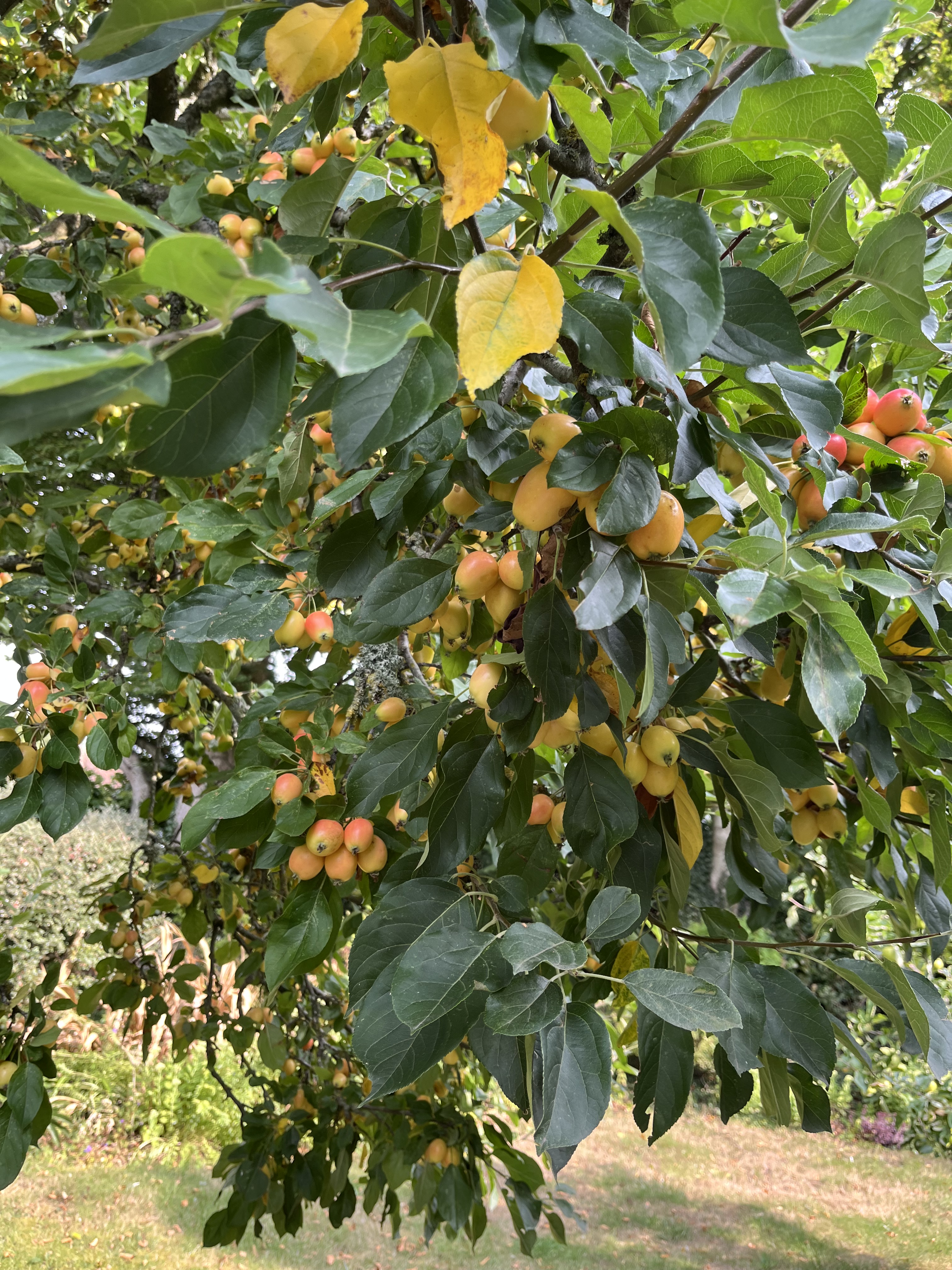
Anyway, we have a lovely crab apple tree and she ( I am not sure about this, but she has always been a she to me) produces less and more of a crop on alternative years. 

This year was a very big crop.

She rained crab apples down around herself and littered our path with them.

I had taken a decision not to make crab apple jelly this year as it is a rather laborious and time consuming task, and I had other stuff to think about.

( In previous years, I have made it and scattered jars liberally around the neighbours, but this year it was a jelly-making step too far.)

The postman, Steve, said he’d take some and he did, but there were still lots and lots. 

And it was not, we decided, a good idea to have any viewer slipping on rotting and crushed crab apples as they walked up the path so we diligently removed them from the path.

We left those, looking rural and artistic, under the tree with a scattering of cyclamen coming up.

But before we came away (more on that another time) we decided they also needed removing.

So we cleared several garden buckets full, and crab apples are not light so, lugging away, is probably a better description.

And the BB mowed that bit of the grass, avoiding the cyclamen. (We have grass, not a lawn, see previous comments about garden description.)

The next day there were more crab apples on the path than there had been throughout her shedding.

Personally, I think she was protesting that I had failed to use the fruits of her labours, and was displeased.

The people who are buying the house, not enthusiastic gardeners (yet), will have to learn her ways and moods themselves.

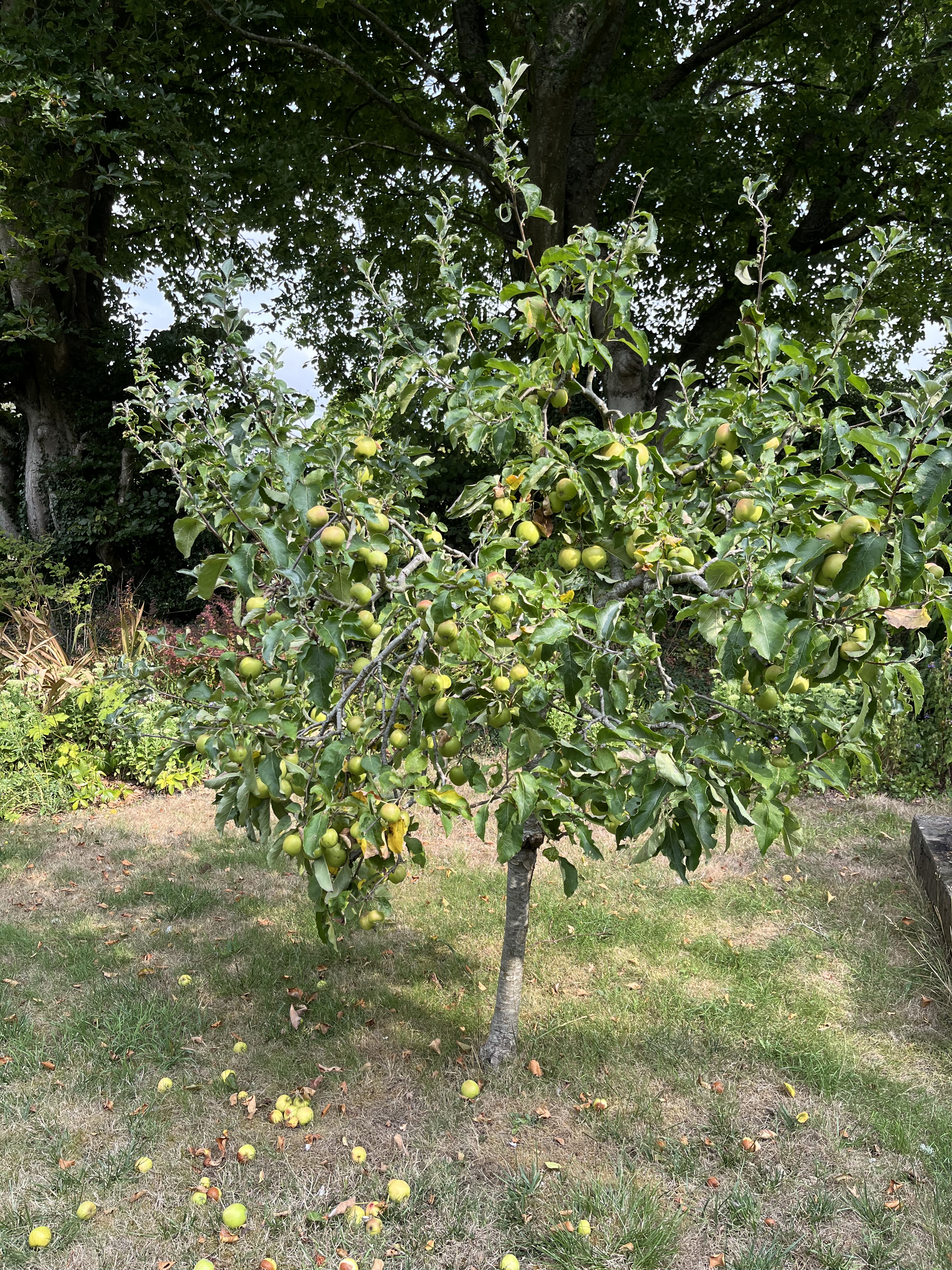
Our amazing tiny little apple tree, not much taller than me, was more forgiving.

Phrase, Fable and Proverbs

One of my favourite books for dipping into is Brewer’s Dictionary of Phrase and Fable.

My best Beloved introduced me to it and if you too have not come across it, nip into your local Oxfam bookshop and they will have a copy (or several), trust me.

So, it was originally published in 1870 and compiled by the delightfully named and bearded Ebenezer Cobham Brewer.

It is described as a reference book containing definitions and explanations of many famous phrases, allusions, and figures, whether historical or mythical.

The delight is not just the juxtaposition of unrelated phrases, people, sayings etc only brought together by the alphabetical order, but how often you are referred somewhere else when you look up something….

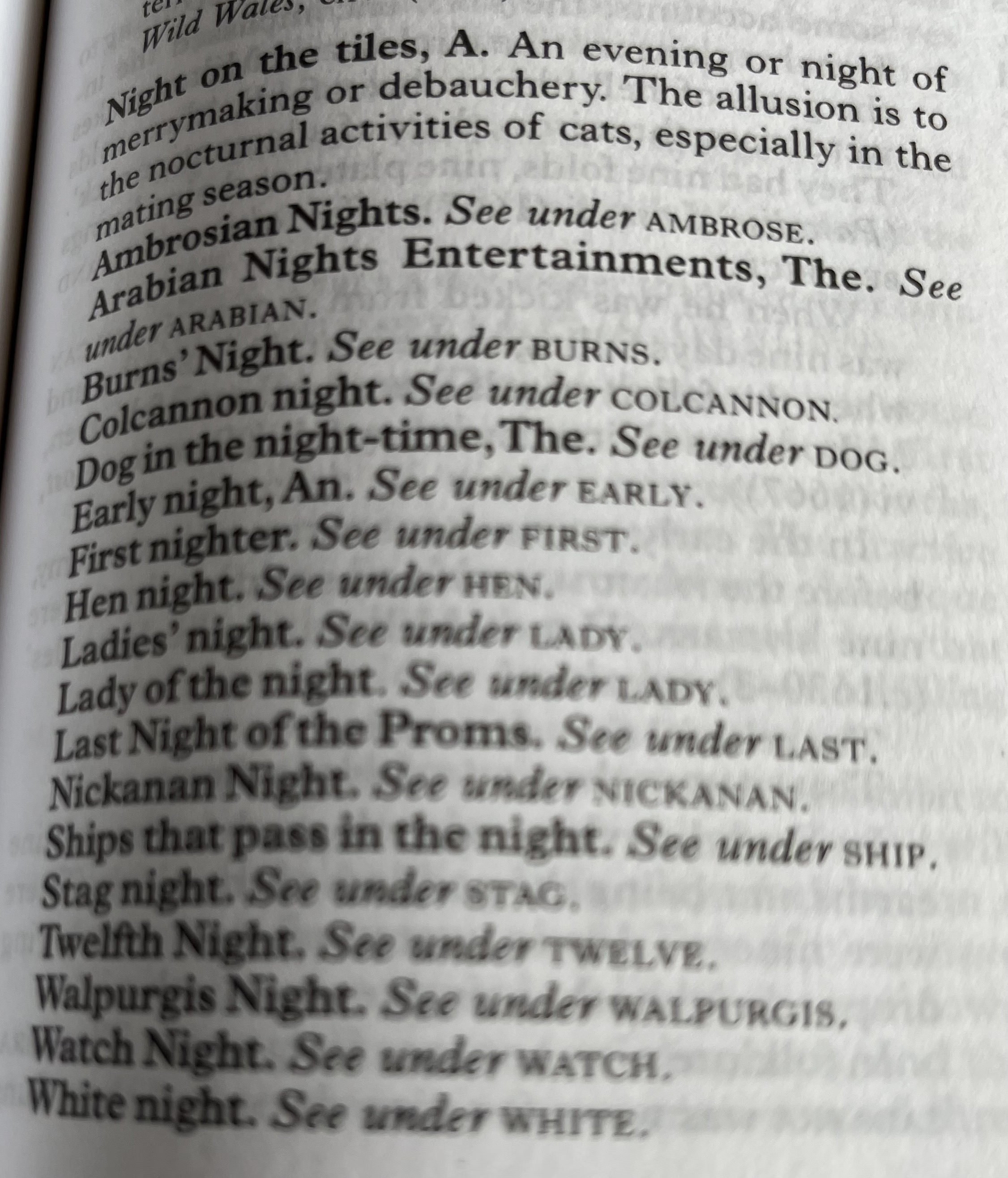
I am not sure why ‘night on the tiles’ gets its explanation and we are not sent off to ‘see  tiles’.

Mind you, a page that is Nightingale, followed by Nightmare, followed by Nihilism, followed by Nike ( who, by the way, is the Greek winged goddess of victory – not a trainer.)

I have the edition published in 2001 so it contains some entries I am sure Ebenezer would not have included:

Nicknames of drugs for example. Not being an expert, I am not sure which are still valid but I am pretty sure Brewer would not have recognised Charlie, coke, crack, dust, flake, freebase, leaf, nose, rock, snow.

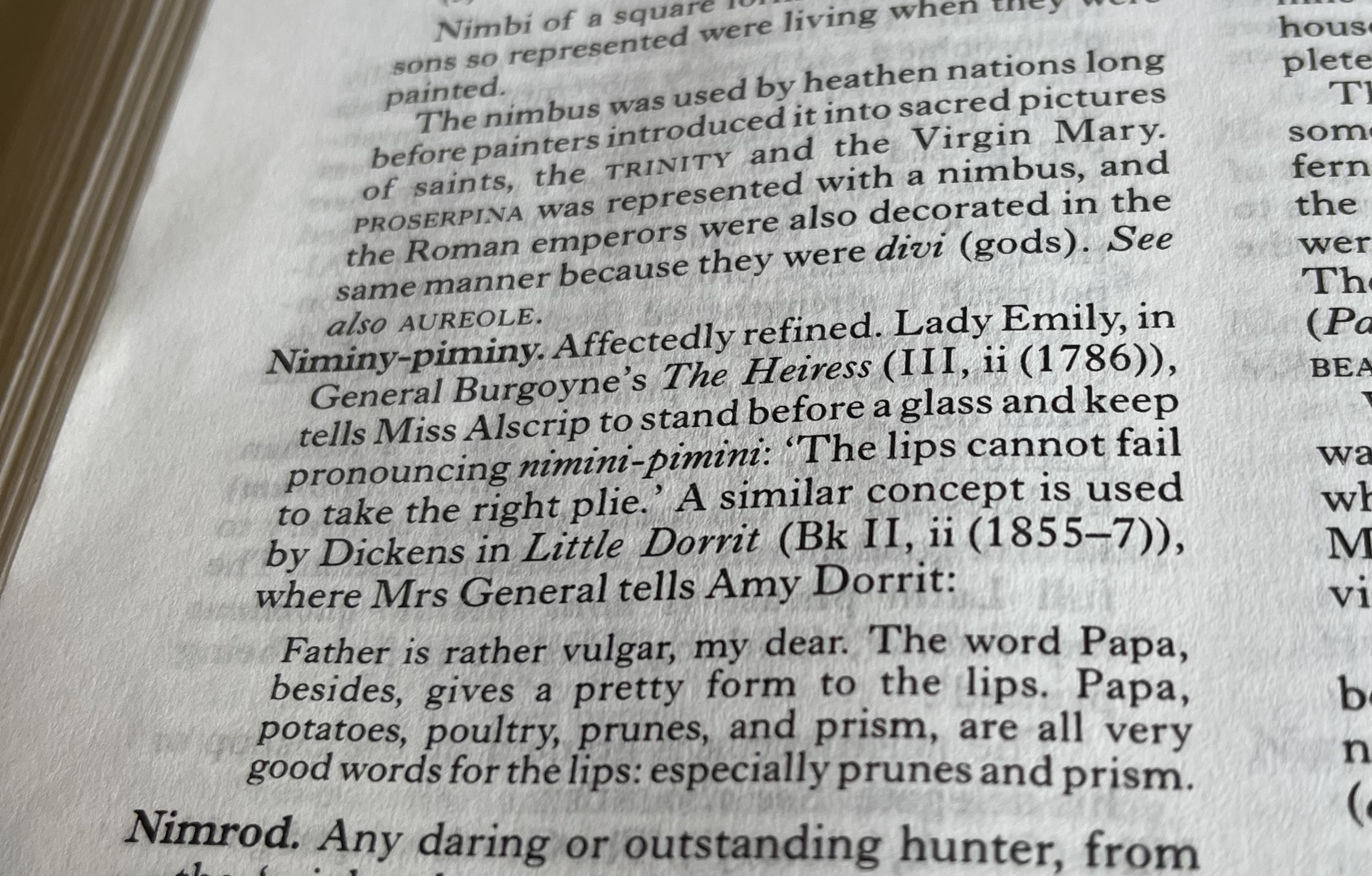
However, he might have felt more at home with the entry for Niminy-Piminy.

(An explanation to which you are referred should you look up prunes and prism – which of course you might well have been tempted to do.)

There is Pantisocracy, followed by Pantomime, followed by Pants. Ants in one’s pants see under Ants, Hot Pants see under Hot.

Salts of lemon see under misnomers.

And when you get to misnomers, you find that salts of lemon are ‘in reality potassium acid oxalate.’

And that comes before ‘Slow-worm: neither slow nor a worm.’

As you can see, some of the entries are rather sharp and short whilst others are rather more obscure, detailed and lengthier than they might be – for example, four paragraphs on Mise:

“ A word to denote a payment or disbursement, and in particular the payment made by County Palantine of Chester to a new Earl….’ and so on and so on.

When you look up Poison – a word you would think could fairly well use up a few paragraphs of its own – you are referred to Mithridate.

And the entry tells you:

Meanwhile, back to poison, you get definitions of Poison-pen letter, Poisoned Chalice, Poison Pill but then you get to One man’s meat is another man’s poison and you get told to go and look under ‘one.’

For ‘what’s your poison’ you have to thumb through until you get to the entry ‘What.’

Of course you do. 

Anyway, I could happily spend hours going backwards and forwards to entries. 

But what sparked all this was the appearance in our Oxfam bookshop of a niche little book.

( Yet again proving, if you wait long enough, you will see a book on every subject under the sun.)

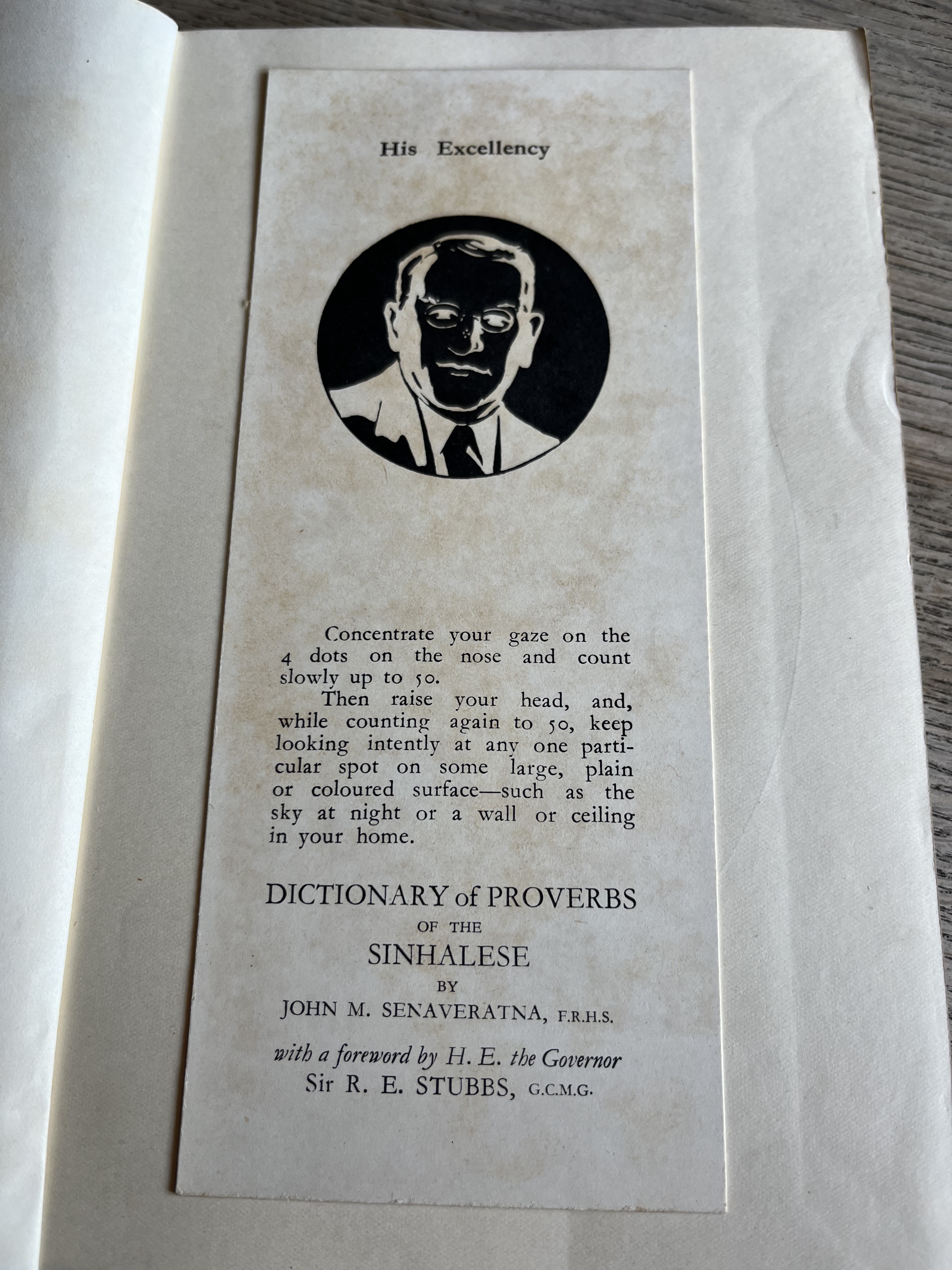
Compared to the weighty tome which is my Brewers, John M Senaveratna has produced a very slim volume indeed.

Perhaps he had less to work with, though you might think that a list of subject matter which includes everything from adages to folk tales might have provided more. 

Anyway, to make things even more interesting he has included a rather odd bookmark – at least I suppose it is a bookmark. 

The forward is by the Governor Sir R E Stubbs, who my researches tell me was the British Governor of what was then Ceylon and is now Sri Lanka, from 1933 to 1937.

And he had had a similar role in Jamaica, no doubt explaining his knowledge of cats and prickly pears.

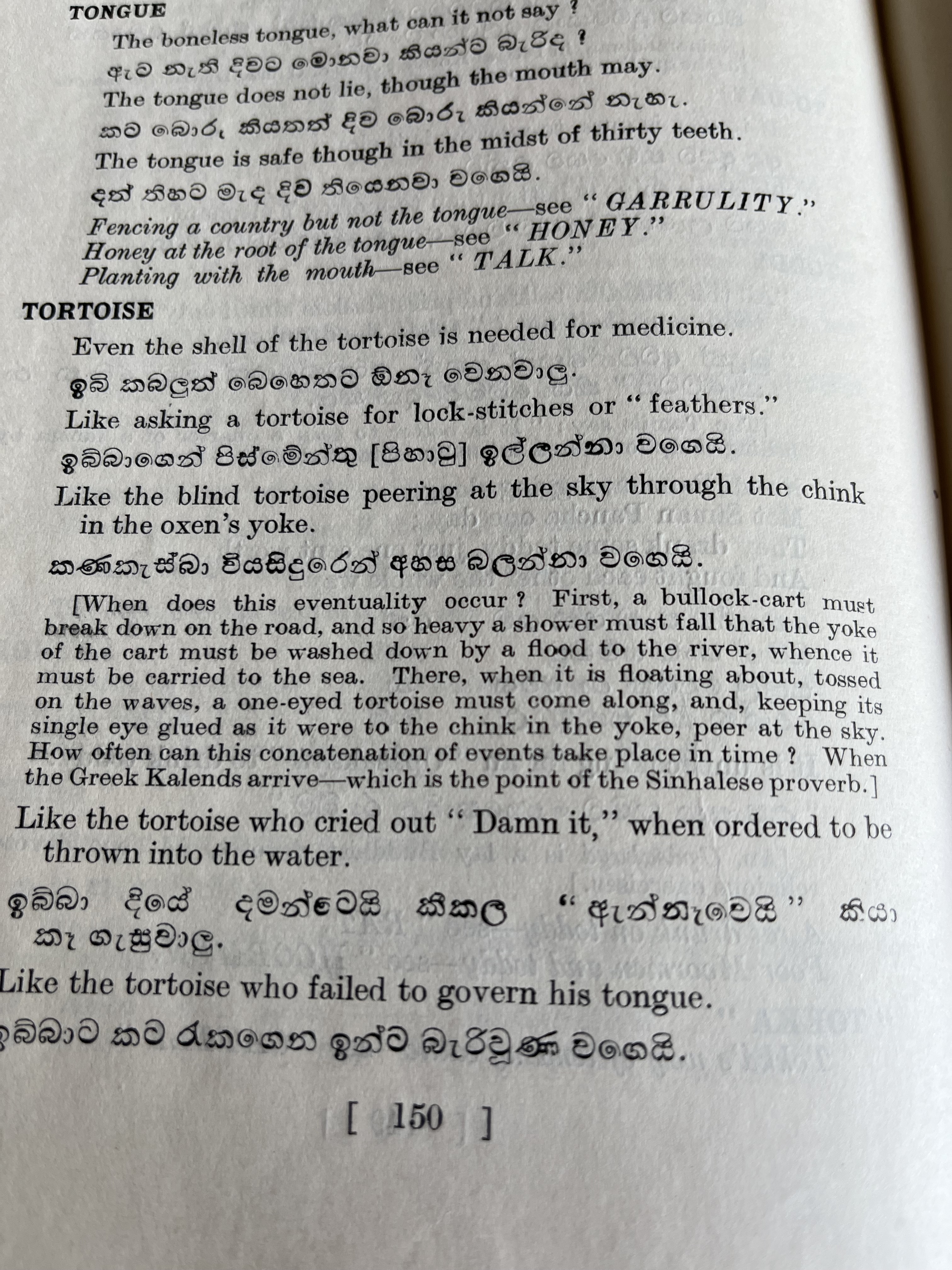
John, ( I am going to call him that as typing out his surname all the time might well become tedious) starts on a very Brewers note with his first entry:

‘Abode.The bat visiting another bat’s abode – see Bat.’

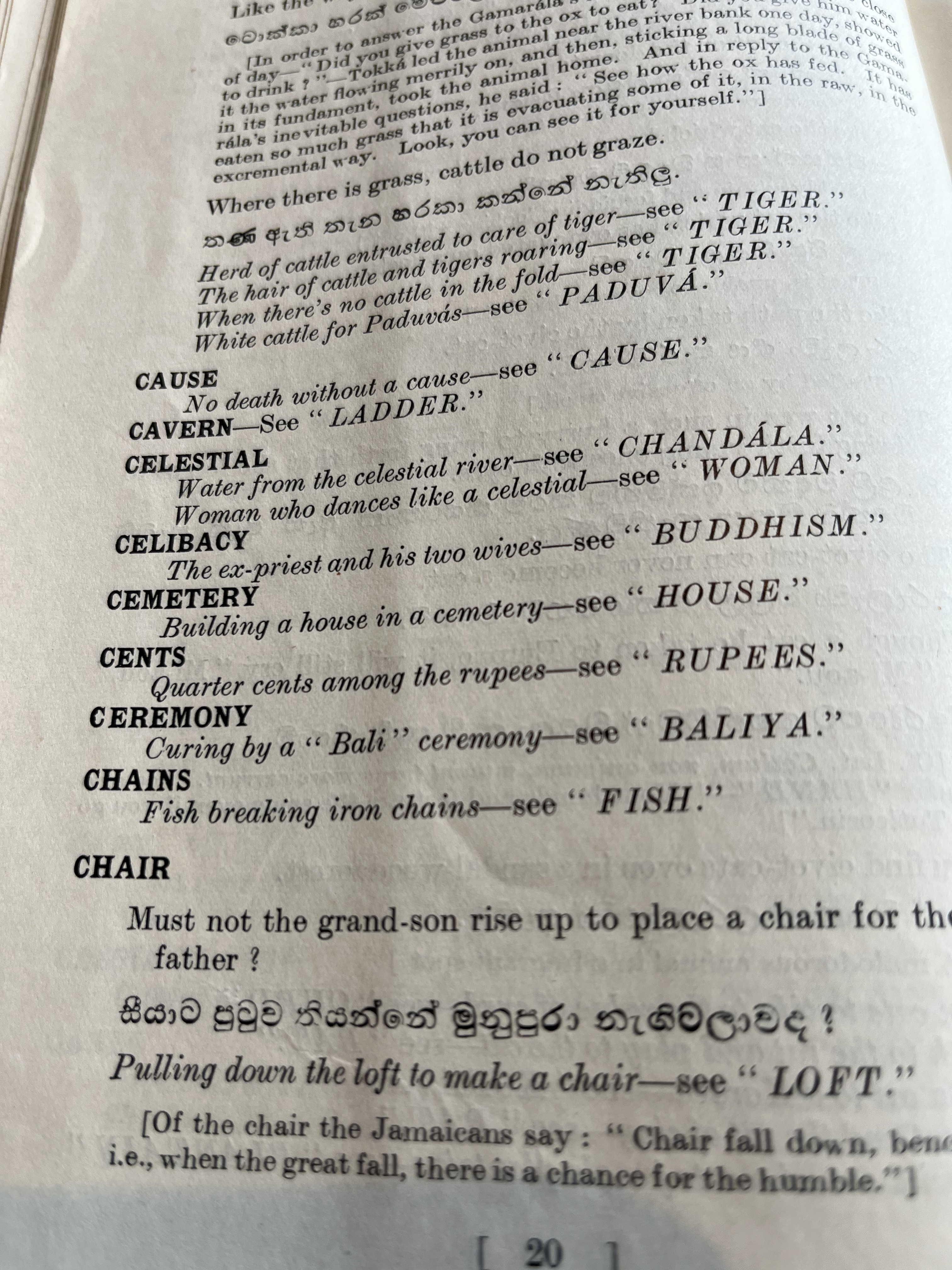
There are plenty of other such referrals: 

There are four pages of referrals on Like.

Quite a lot is rather obscure, unclear or downright baffling, even with the explanation:

‘The swelling of a finger must be proportioned to its size’ which apparently means ‘cultivate a sense of proportion.’

‘For those who cried standing we should cry standing; for those who cried sitting, we should cry sitting.’ 

Quite a few of them under Sinner:

‘The sinner will not take up a book, but will carry a load.’

‘What sago congee for sinners?’

‘Wherever the sinner goes there is a hailstorm.’ A variant is apparently, ‘ There is a certain to be a hailstorm when the unlucky man gets his head shaved.’

Some of them are what we might describe as culturally specific:

Slave ‘Better to be born a slave than the youngest in the family.’

‘Mother: Like placing blocks of wood before mothers ( who have borne children.) 

( I have no idea, and there is no explanation from John.)

‘Mad: Like the mad woman’s bag of herbs’.

‘Death: When a man with projecting teeth dies, you feel doubtful of his demise.’

Country: In one country you cannot yawn, in another you cannot clear your throat.’

Clearly, some needing a more detailed explanation:

And some just seem to be stating the obvious:

‘Hip Bone. Boxing cannot cure a dislocated hip. see Boxing’

( Mind you if you do go back to Boxing, you find ‘ Can boxing cure a dislocated hip?’ mmm)

Or

‘Horoscope:What is the use of consulting the horoscope when the man is dead.’

Well on that note, and if you have got this far, I hope you be able to impress your friends with a nonchalant dropping in of a Sinhalese proverb or two.

See under ‘dropping’.

Books and their private lives

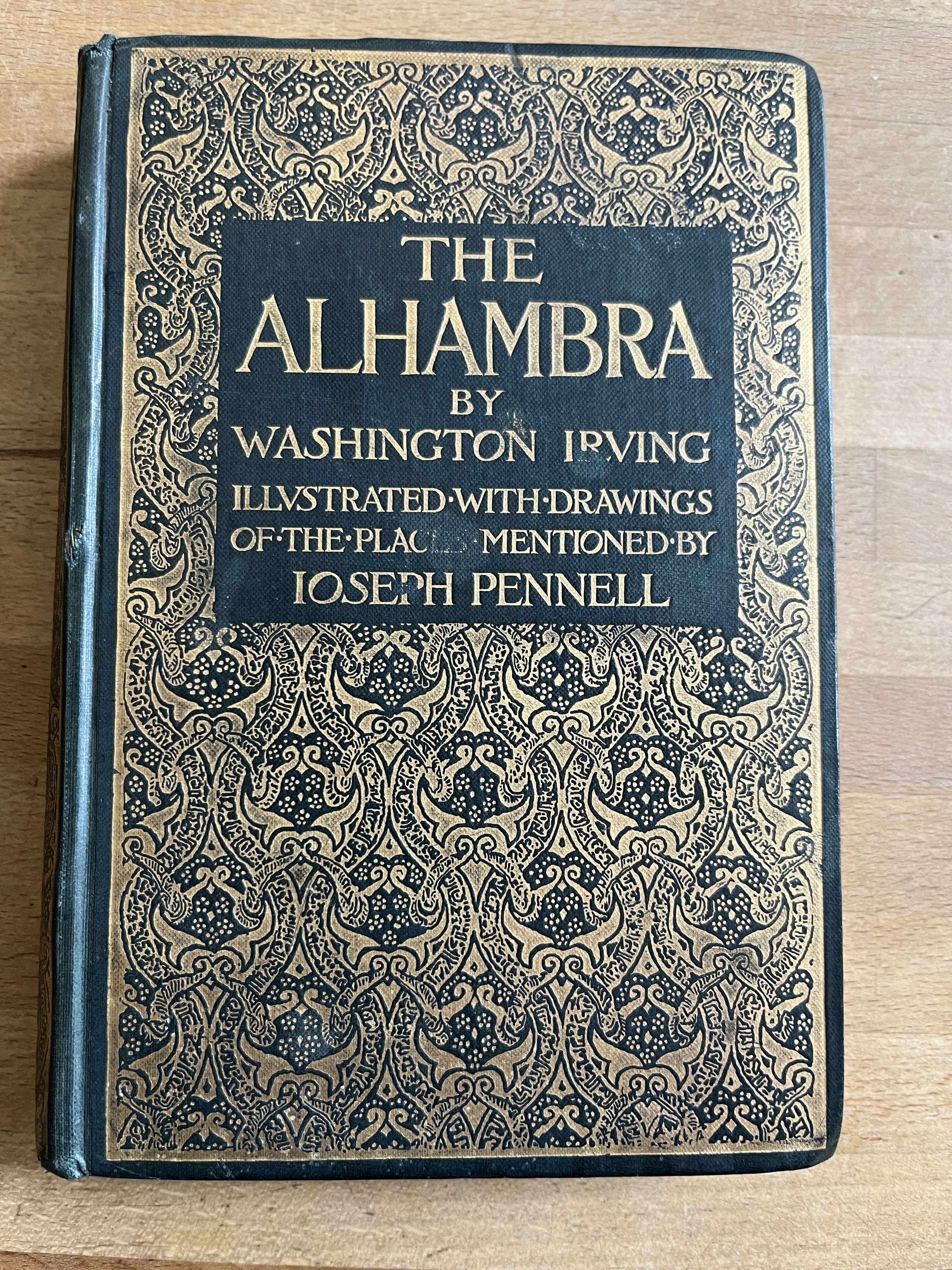
As everyone knows you can’t judge a book by its cover, but sometimes covers are really rather more interesting than the contents.

Having skimmed through the contents – Washington Irving was put up in the Governor’s apartments of the Alhambra, lucky him – and spent some of his time writing a rather flowery account of his time in the palace and surroundings.

Flowery prose is not my fave.

“The inn to which he conducted us was called the Corona, or Crown, and we found it quite in keeping with the character of the place, the inhabitants of which seem still to retain the bold, fiery spirit of olden time, The hostess was a young and handsome Andalusian widow, whose trim basquina of black silk, fringed with bugles, set off the play of graceful form and round plaint limbs. Her step was firm and elastic; her dark eye was full of fire and the coquetry of her air and varied ornaments of her person, showed she was accustomed to being admired.”

I rest my case, and there are another 435 pages in the same vein.

But, luckily, I am not here to read it, I am here to see if it is worth something and we can sell it.

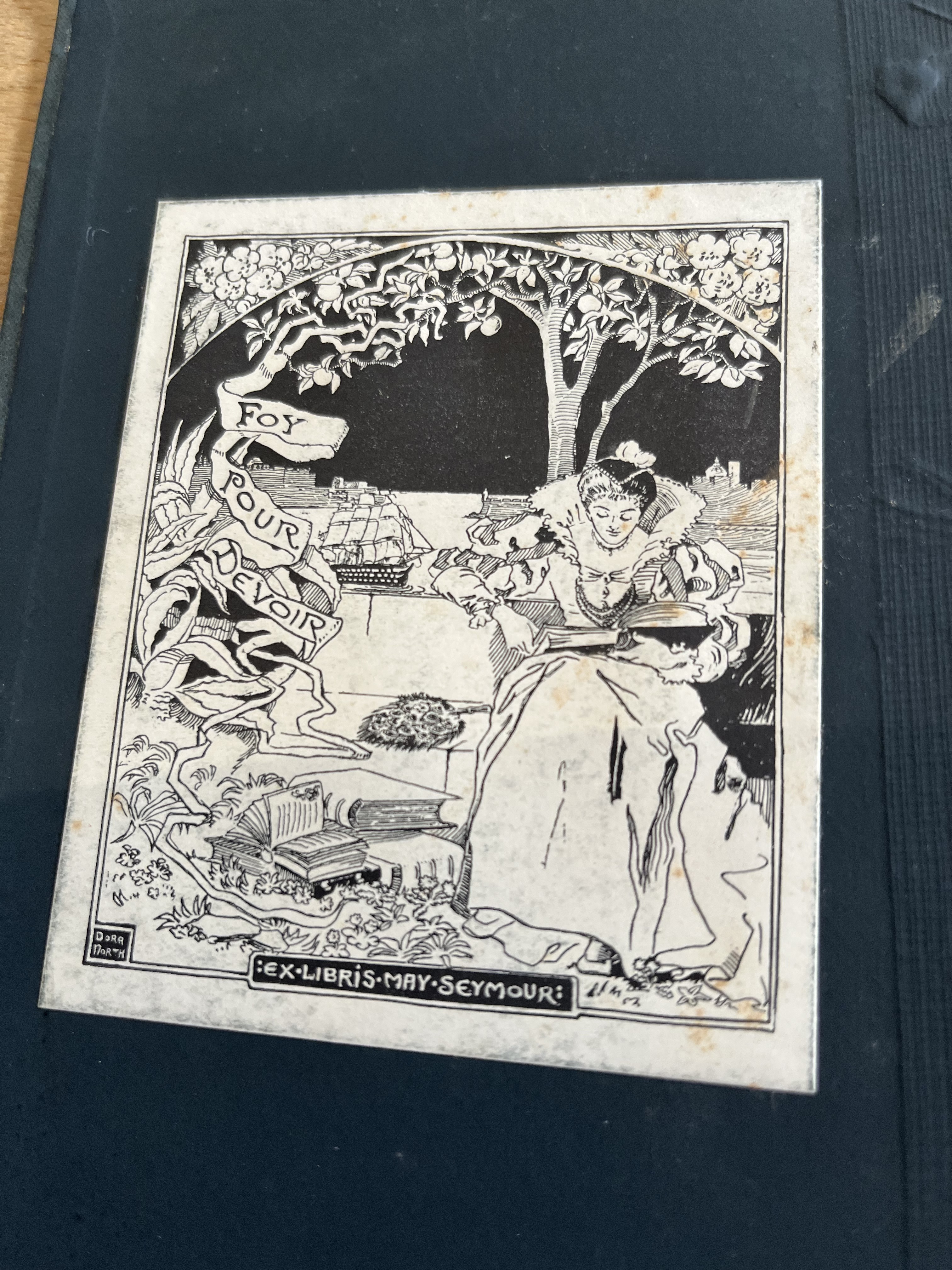
Inside though was a bookplate which was rather interesting and more decorative than usual.

It turns out that ‘Foy Pour Devoir’ is the motto used by the Seymour family dating back to 1547 and 

‘The present dukedom is unique, in that the first holder of the title created it for himself in his capacity of Lord Protector of the England, using a power granted in the will of his brother-in-law, Henry VIII

I don’t have the time, inclination or access to try and track down where May’s branch of the family started life in America. That’s not on my to do list.

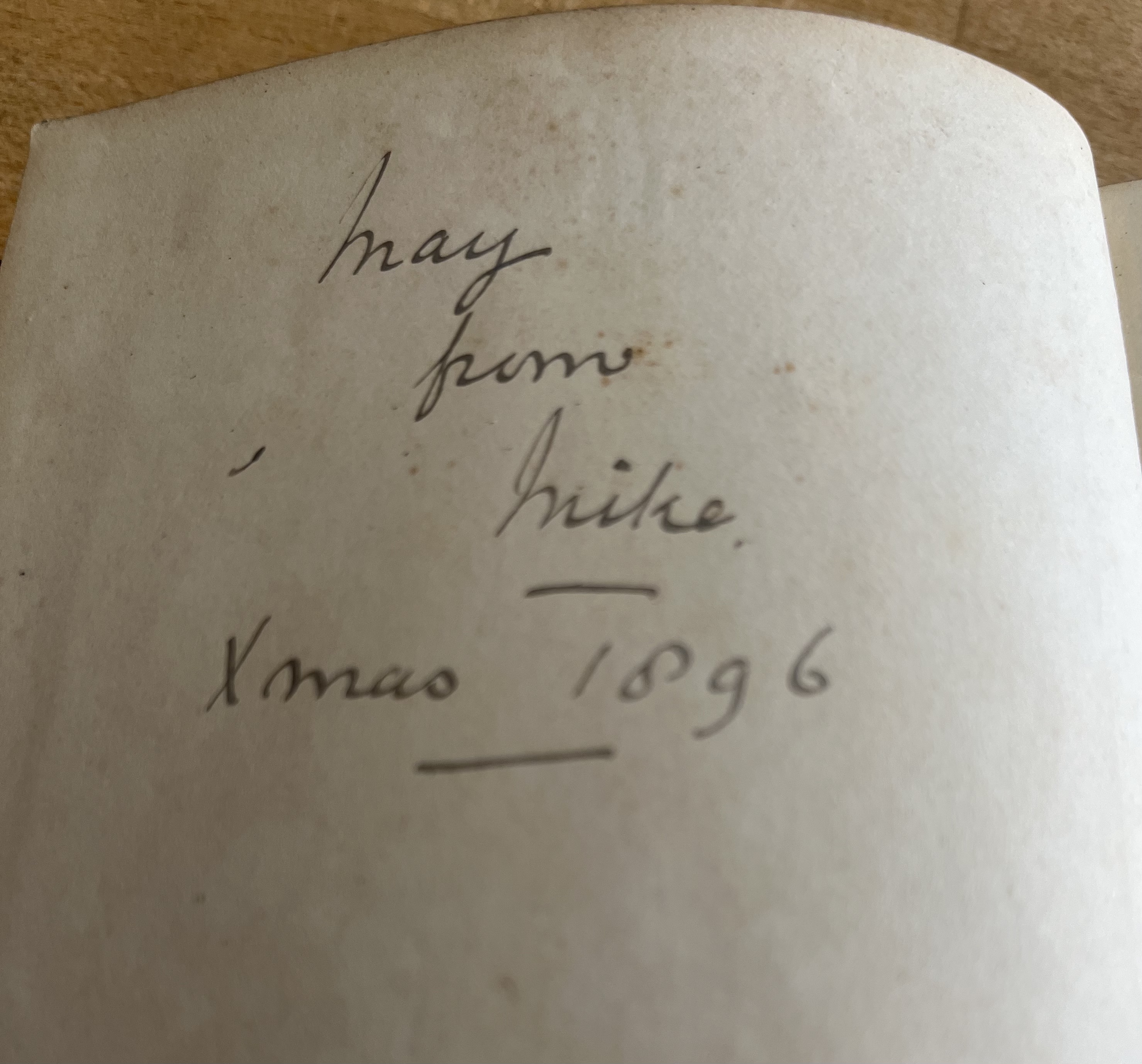
And I have no idea who Mike was:

But I did find out that May Seymour studied library science and she was one of 20 students in Melvil Dewey’s first librarian class at Columbia College.

(I am not sure if my May Seymour is the same May Seymour, but if so, I am sure her bookplate will add to the value…… just saying.)

Dewey was appointed New York State librarian and he took his library school with him from Columbia to. May Seymour was one of the five instructors who moved with it. She also worked at the New York State Library, where she was in charge of classification.

Seymour collaborated closely with Dewey on the development of the Dewey Decimal Classification (DDC) and the preparation of the 1904 American Library Association (ALA) catalog, which listed over 8,000 books essential for libraries.[4] In the 1890s, Seymour and Florence Woodworth boarded with the Deweys. (wikipedia)

However, in 1906 the ALA censured Dewey for his behaviour towards women which included ‘unwanted kissing and hugging’. 

And also in 1906, Seymour was fired from the New York State Library. Seymour moved to Dewey’s Lake Placid Club, where she worked on editing the fourth through eleventh editions of the DDC.

I don’t know why she was fired (and, an admittedly cursory, search on Google didn’t help).

This club was set up by Dewey and his wife:

They chose this site as a place where they could establish contact with nature, find relief from their allergies, and to foster a model community that would provide for recreation and rest for professional people, specifically, educators and librarians. Dewey and his wife felt that occupations involving “brain work put people at higher risk of nervous prostration that, if not checked, would lead to fatigue and even death”

You can read more about this in an article https://www.adirondackalmanack.com/2020/12/dewey-lake-placid.html.

I found it interesting but I can quite understand if you don’t have time.

Dewey as well as his behaviour towards women, may well not have endeared himself by banning any black people or Jews.

A club pamphlet read: “No one shall be received as a member or guest, against whom there is physical, moral, social or race objection. … It is found impracticable to make exceptions to Jews or others excluded, even when of unusual personal qualifications.”

Dewey was sacked, also in 1906, when the pamphlet became public. 

In 1927 he hired a stenographer but Aafter he hugged and kissed her in public, she threatened to file charges and ended up settling with Dewey for $2,147.66. 

Dewey was apparently upset with the settlement not because he had been reprimanded for anything improper, but because he worried the stenographer might spread rumors that “she got $2,000 for no work.”

In 2019 The ALA removed Dewey’s name from their leadership award.

Anyway, it would appear that May clearly didn’t object to public unwanted caresses or racism….. oh May, I would have hoped for better of you.

She died in Lake Placid on June 14, 1921. (wikipedia)

Meanwhile, as they say, Joseph Pennell is the illustrator of our copy of the Alhambra.

In 1880, Pennell was involved in the violent expulsion of African American artist Henry Ossawa Tanner, a fellow student, from the academy. Tanner had suffered bullying at the academy since his entry earlier that year, which culminated when a group of students, including Pennell, seized Tanner and his easel and dragged them out onto Broad Street. The students tied Tanner to his easel in a mock-crucifixion, and left him struggling to free himself. Pennell apparently did not regret this action; many years later, when Tanner was already renowned in Europe and beginning to gain repute in the United States, Pennell recounted the attack as “The Advent of the Nigger,” writing that there had never been “a great Negro or a great Jew artist.” (wikipedia)

It does rather seem as if this little book has some tenuous but unpleasant connections.

( Just say Washington Irving seems not to have been, at least publicly racist or sexist, so perhaps I should have stuck to reading the text.)

A Justified Complaint

At the risk of spinning out holiday stories well beyond their sell-by date, this is somewhat different.

It is about accessibility, public money and management speak. 

( You can switch off now if the above is all rather alarming.)

As a happy-to-admit-it-leftie, I am not convinced that all things public are bad, wasteful, lazy, and all things private are fast-moving, clever, better value for money.

I think a glance around today’s world will show you that private enterprise, capitalism, is generally not spending much of its energies on anything that might approximate to the furtherance of general good, equality in any shape or form, reducing the gap between the have-nots and the-haves-more-than-they-can-ever-possibly-justify, and and….

Of course there are exceptions, in both camps.

Anyway, this not a polemic on that, well not yet.

So, we were in Malta and going to see the newly renovated Grand Master’s Palace ‘partly’ funded by the European Development Fund. How much of a part is not divulged.

We had been to the marvellous Malta Postal Museum which seems to have used its European money very well, imaginatively and frugally and run by one amazing woman who let you use the lifts all by yourself. (see below.)

We had also been to the National Archaeological Museum which seems not to have had much money spent on it since say 1990, but is rather charming because of it.

And accessible to someone needing two sticks to navigate the world.

In each of the Archeological Museum rooms there was a chair holder. You could unhook and take out a fold up chair, take it where you needed it, sit on it and return it. Simple. Practical, Cheap. Not needing any attendant and, actually in our case, very useful.

But the Grand Master’s hangout is another case entirely.

And it is a place which has, so we were told, been designed to combine tech with the integrity of the building.

‘What,’ I hear you cry as one,’is wrong with that?’.

Mmm, well.

Follow me when I go into this palace with my Best Beloved who can walk with the aid of two sticks, gently, and with some places to sit.

Now, a lot of people who visit museums are people of a certain age. Don’t get me wrong, parents with children do, and many are determined to do so. Young couples do, single women on a break do. People with specialist interest in the subject of the museum do too. And good on them all.

But any museum needs to take into account people whose mobility is not that of the 36 year-old-designer and his cohorts of tech-enamoured followers.

Tech could, should, and sometimes does, great things to make a museum come alive and be possible for people to use well – but then again, not always.

The first rooms of the Grand Master’s House had nowhere to sit. It had a rather confusing 3D tech plan of a bit of Valletta virtually rising within a bit of the floor. But it was just blocks, not anything really visual. 

You were not allowed to touch the rail which went round this despite the fact it was sturdy metal and would have been useful for someone a bit unsteady. An attendant was there to tell you so.

Then you went out into the courtyard. Nowhere across the whole space was there anywhere to sit. No bench, no low wall. Nothing.

To get to the famous armoury ( BB’s inclination rather than mine) you needed to go upstairs or take the lift.

The nice man who had taken our tickets said he had to contact his colleague to come out of the building on the other side of the courtyard, conduct us to the lift, he in turn had to call his colleague on the next floor up to meet us, and then we could travel in a lift one floor. That is three attendants for us to take a lift from the ground floor to the first floor. I rest my case…..

In the armoury there were benches a-plenty against the walls. There were (and those of us not fascinated by the means of killing each other) an awful lot of exhibits – four lines of showcases of guns, armoury, knives, swords etc etc.

Then there was a lower floor with the grand rooms of the house/palace.

But to get there was a flight, not a long flight, but a flight nevertheless, of highly polished stone steps. Nothing to hold on to. No ramp. And, can you believe it, a sign saying be careful because they were slippery.

We asked an (another) attendant and she said there was a lift, but it was broken and hadn’t been fixed for ‘a while.’

There is no way someone with balance issues, using two sticks to walk around in the best of circumstances, was going to attempt a flight of steps of polished stone with an arse-saving notice saying basically you were warned that these are slippery, so your fault if you fall.

Yes, he could have gone down on his bum but really, would you? Would you want to have to do that?

We left. 

On the way out we were talking to the nice man by the ticket machine, who lifted a barrier he no doubt shouldn’t have, to let the BB access to a seat. He told us he had to stand for his whole shift because the cameras watched him and he was reprimanded if he was caught sitting down.

I was cross. Clearly millions have been spent on this renovation and so little spent on making it accessible – children were being brought in, but where was the child-friendly stuff/space to make it all make sense to them? I have no idea what there was in aid of helping visually-impaired people – no audio that I saw. Leave alone anything else. 

Below is from the website:

(So, Heritage Malta’s CEO is Noel Zammit who says of himself, )

Software engineering skills and national heritage are rarely uttered in the same sentence. However, as CEO for Malta’s National Agency for museums, conservation practice, and cultural heritage, I find myself relying on my extensive experience in the former to improve and promote the latter.

My professional career as software engineer began in Malta and continued in the United Kingdom, where I provided development solutions to multinationals, giving them a competitive edge in their respective sectors.

Eventually, I made my way back to Malta, where I worked within the Malta Centre for Restoration until it was ultimately absorbed by Heritage Malta. Within the Agency, I gradually climbed through the ranks, moving through IT, finance, marketing and business development, until I was appointed CEO in 2017.

In my few years in this role, I have pooled my knowledge and experience, spanning over two decades, to lead a massive internal cultural shift in Heritage Malta, through careful re-structuring, re-branding and strategic alignment.

Heritage Malta clients and observers have surely noticed our focus on digitisation and market presence of our cultural heritage, not just as a way of remaining accessible through COVID-19 or to ensure long term sustainability, but also as a way of safeguarding a heritage that is, as our motto implies, ‘Part of Us’ all.’

That is the language of business-speak if ever there was. 

There is nothing wrong in coming from a ‘different’ background into the heritage field, I am sure that could be a very good thing. The issue is what he wants to say and do.

What is ‘strategic alignment’ when it comes to history and making that accessible in all sense of the word? Just for example.

I’ve no knowledge of Zammit but hope 

  1. he speaks human to his friends and family 
  2. he is doing better with the people who work for him than teaching hem management speak 
  3. he is not part of the notoriously corrupt Maltese elite
  4. he reads the email I have sent him and does some simple things to make accessibility better in the Grand Master’s House.
  5. an answer would be nice but I am not holding my breath.

And by the way The Grand Master’s Palace had the worst, least-stocked museum shop I have seen in a long time. Not that I am in a complaining mood……

Final Oddities – for now

I can feel you are getting a bit bored with Oxfam surprise donations, but I am going to chance my arm with just three more….. and there are more pictures than text, if that helps.

But even so, I do warn you,, I am cramming in, so it’s a long read.

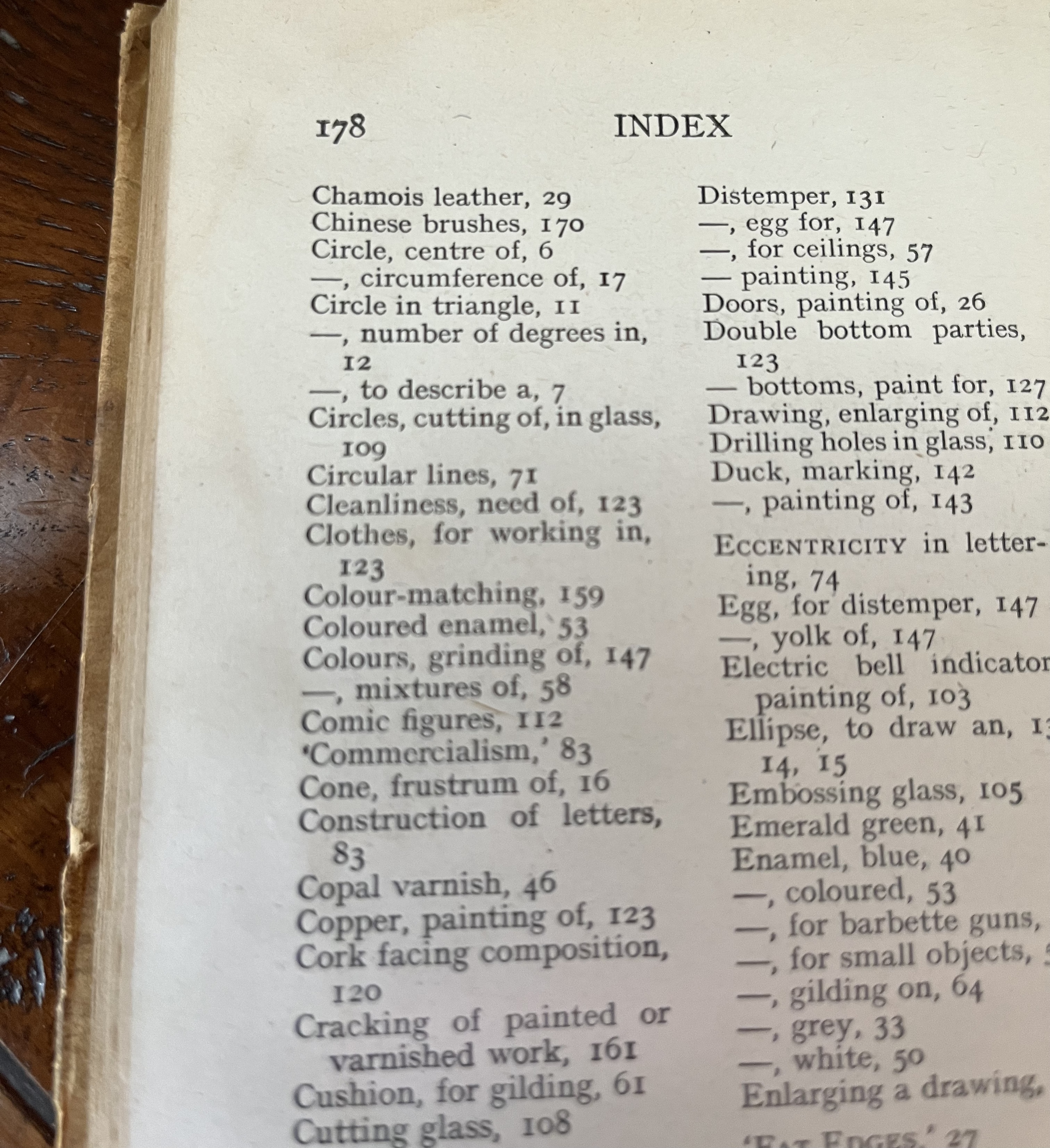
Firstly, the humour and interest in alphabetising. Not a sentence you hear every day, I do know that.

This made me laugh and I had to turn to the entry on hair pencils…

Well, apparently they were paintbrushes made of hair, called pencils because they were so fine you could ‘draw’ an line and were used to fine gold leaf work.

(If you Google hair pencils today you get a lovely Wikipedia article on butterflies:

Males use hair-pencils in courtship behaviors with females. The pheromones they excrete serve as both aphrodisiacs and tranquilizers to females as well as repellents to conspecific males.)

Then we got this strange book — actually maybe one of the stars of the window display when we do one celebrating 200 years since the invention of the railway.

who knew there were Guinea Pig exhibitions……
cattle and caustic soda – except as above…..
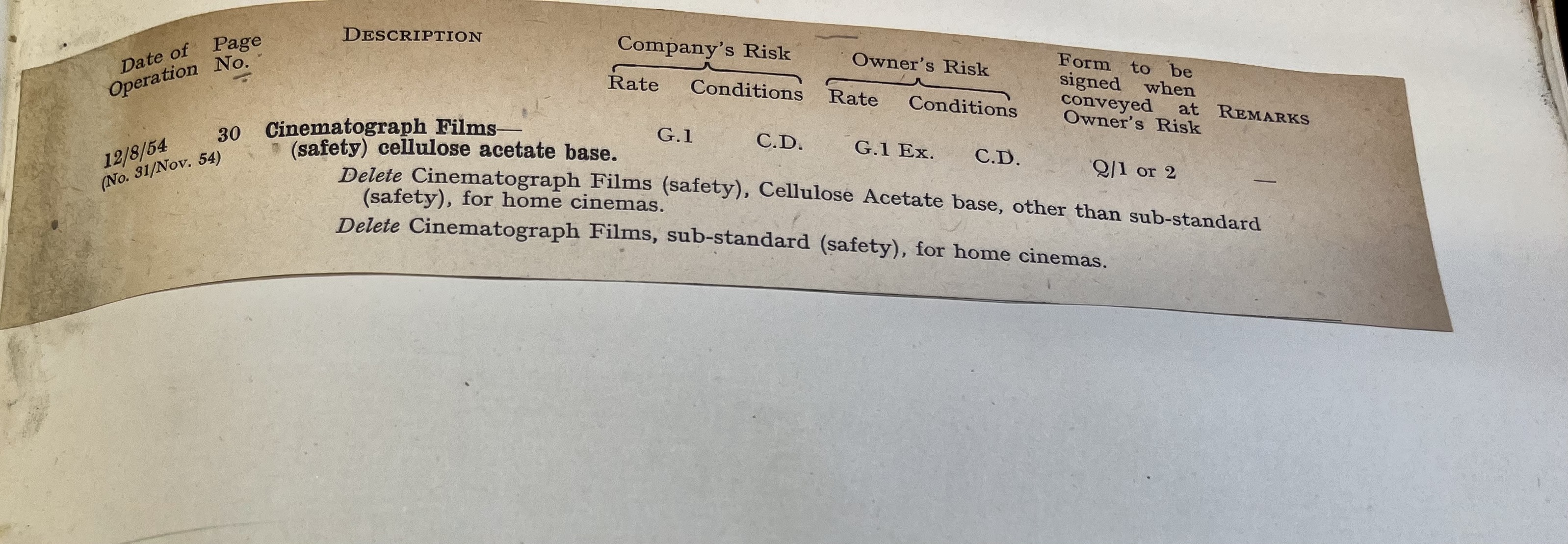
unsafe films?
were land skiffs, whatever they were, banned?

And finally, and I promise no more oddity blogs for a while.

It does again fall into the category of well, I would never have thought there would be a book about that …..

It is surprisingly detailed and specific and, for a small book, packs a punch of information. 

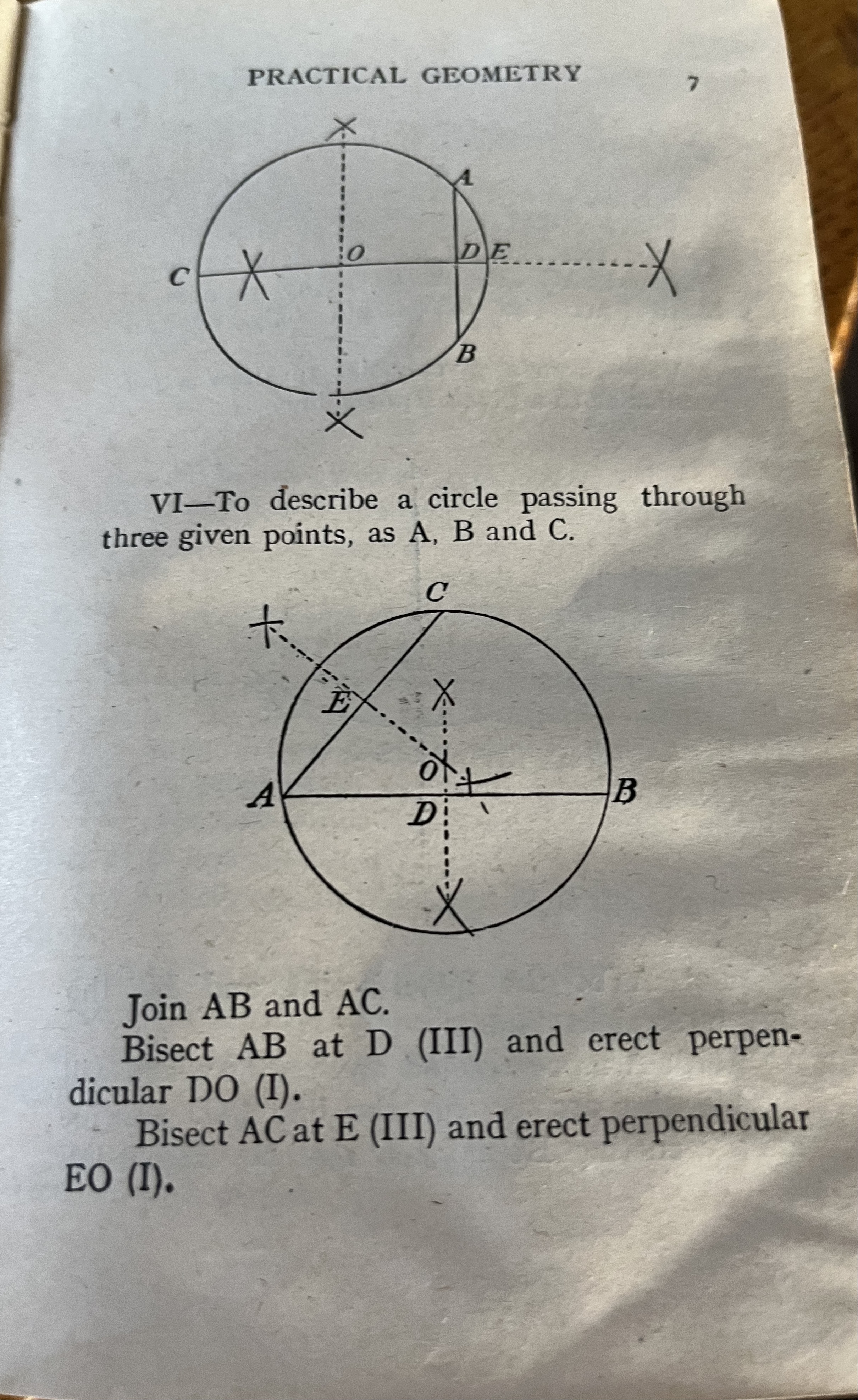
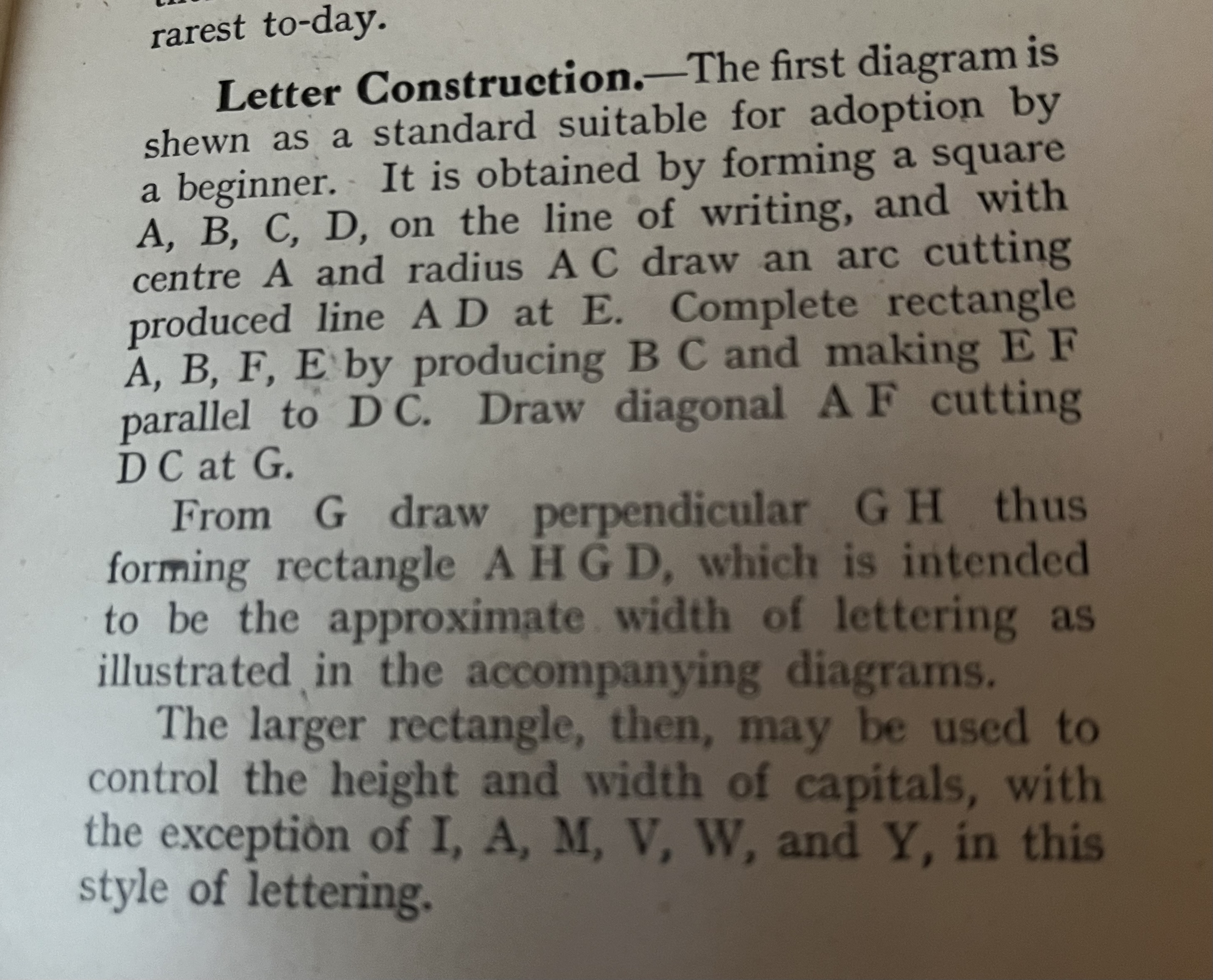
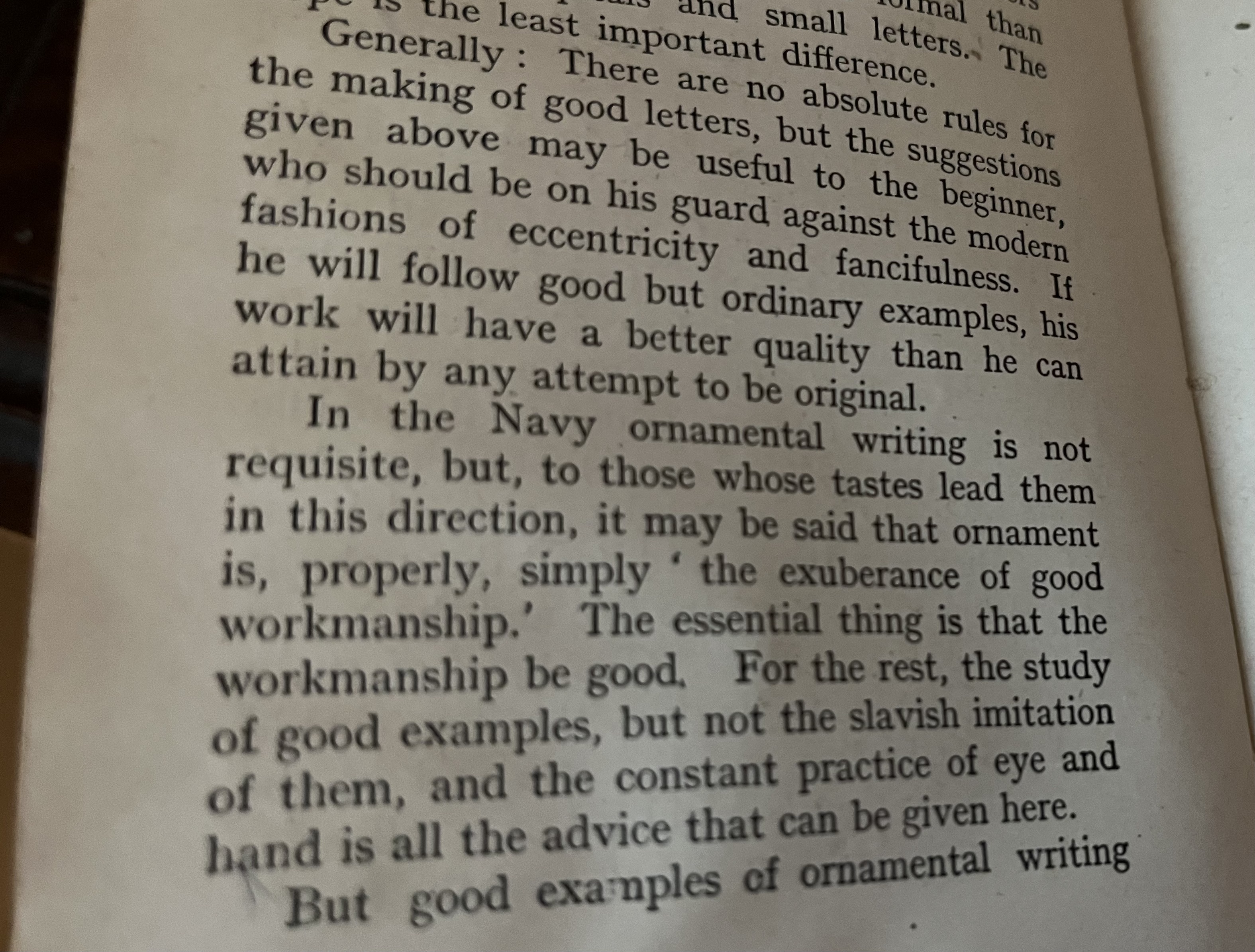
Who knew you needed seven pages on the ‘Practical Geometry’ on ship painting – and that being the first chapter indeed.

There is everything from painting Barbette guns, whatever they are, to how to hang wallpaper in cabins.

Pages 68 to 97 are entirely devoted to ‘Letter Writing’ with the instruction:

‘To be a good letter writer should be the ambition of every young painter. In the Service his skill in this respect is in constant demand, and, if facility with the pencil be acquired, very little leisure will be at his command.’

Mind you according to Chapter 13 and the 29 pages of it, very little seems to be a simple as having a pencil tucked behind your ear.

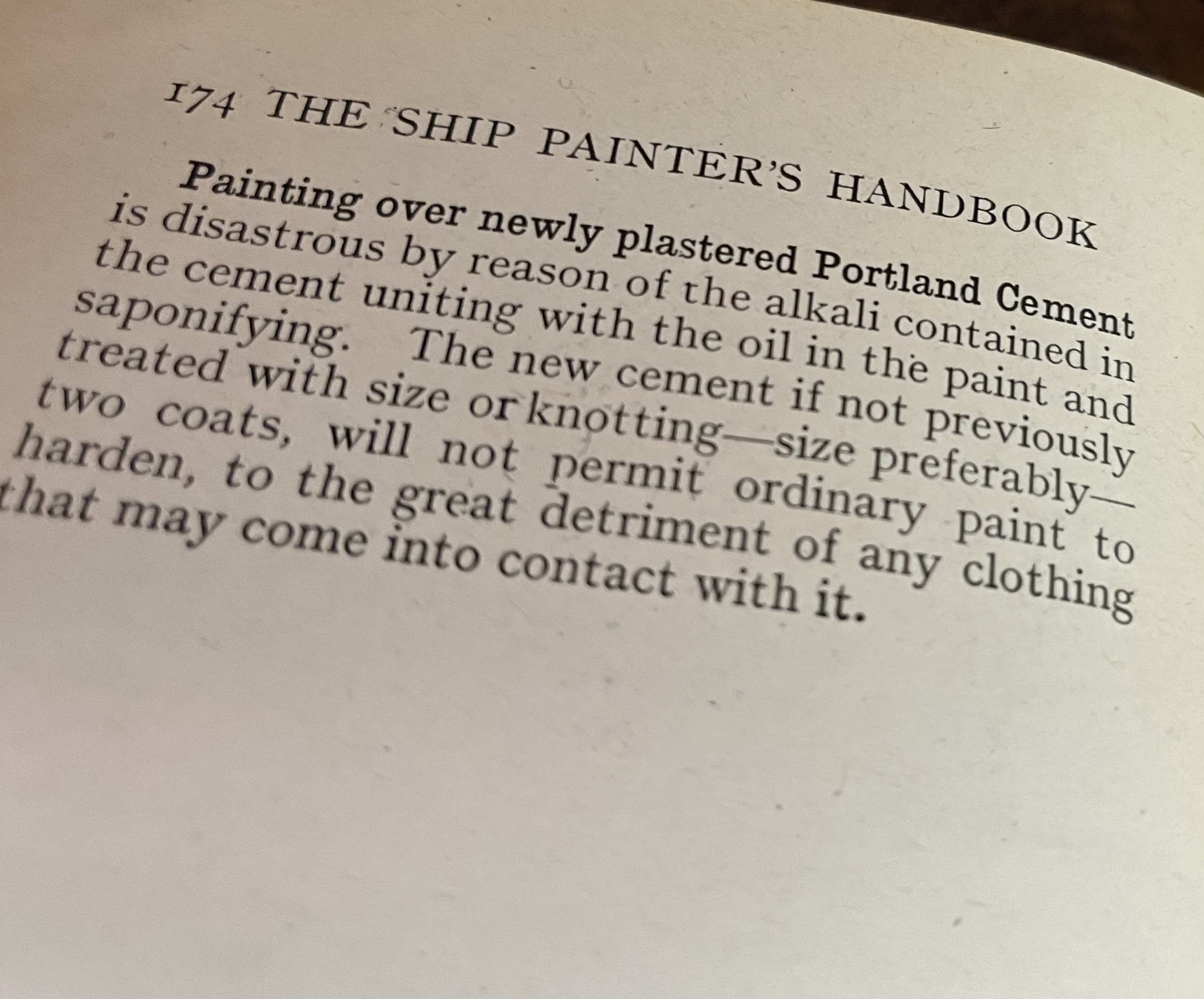
Given this detail, I was rather surprised to find 19 pages in the Miscellaneous chapter. 

Including:

And, on the last page a warning:

And just to circle back, as they say, here are some alphabetical amusements:

A Few More Oddities

A few more bookshop delights and surprises….

Some (actually quite a few if I’m honest) books come into the shop in such bad condition they can’t be sold. Most end up in re-cycling but a few have such lovely plates (pictures) that the Best Beloved can make something of them.

Because we get quite a few donations of paintings – yes I don’t know why they are given to a bookshop either – we have an art sale about twice a year and we will add in these little delights.

And, we also get picture frames donated so the BB had these three to play with…
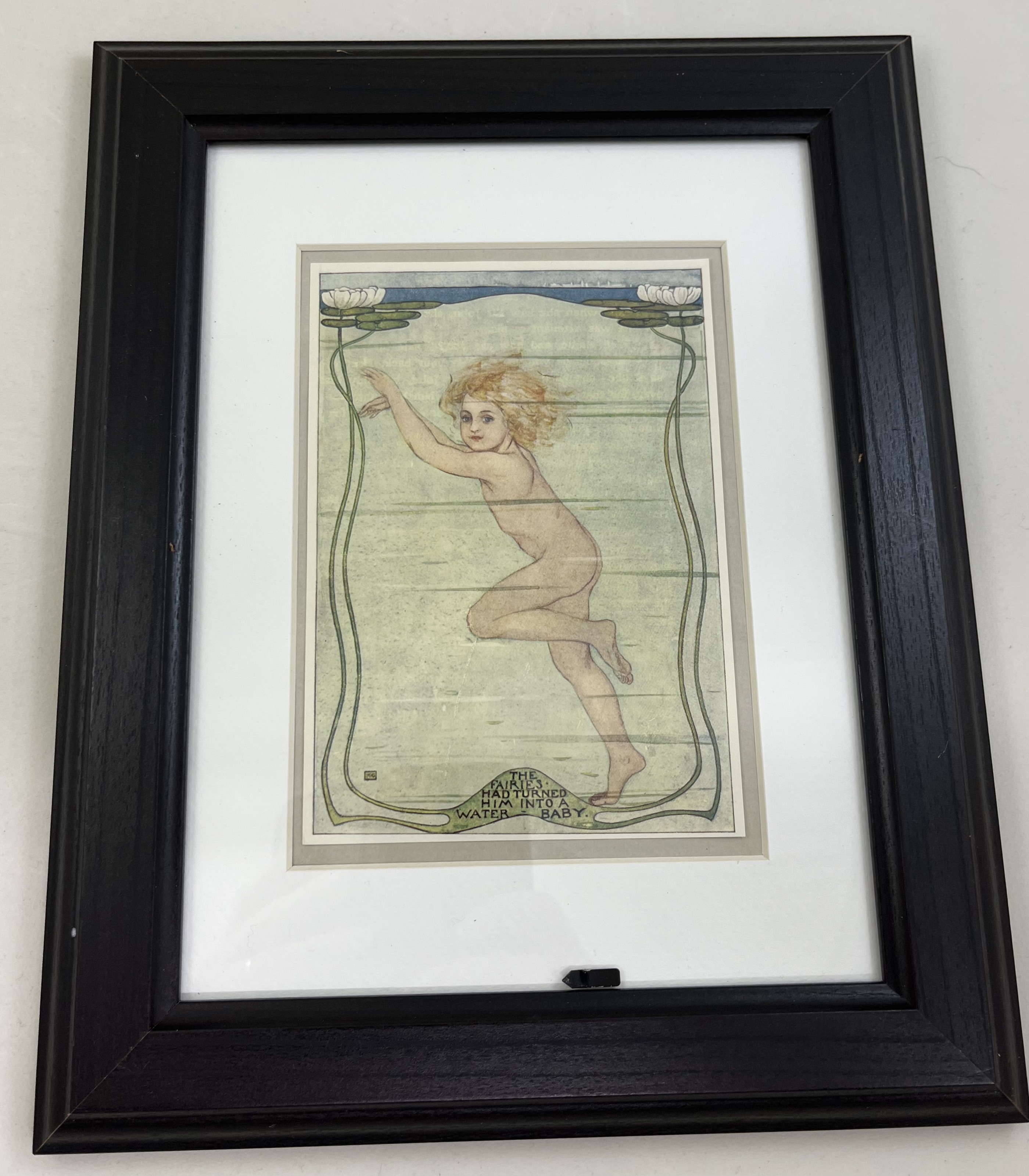
They are from the 1905 edition of The Water Babies and are the work of Katharine Cameron. And it is true that images of naked children were more innocent in those days.

Anyway, you may be interested to know that Katharine Cameron (1874-1965) ‘studied at the Glasgow School of Art where she became part of a group of artist-friends known as ‘The Immortals’, which included sisters Margaret and Frances Macdonald and Charles Rennie Mackintosh. She later attended the Académie Colarossi’s in Paris and made frequent study trips to Italy. She is best known for her sensitive flower and landscape paintings, etchings and book illustrations. Katharine was a member of the Royal Scottish Watercolour Society.’ (National Galleries of Scotland).

She is second on the right of the middle row of this photo of The Immortals.

The next oddity is from lives a lot less rarified than the Scottish artists.

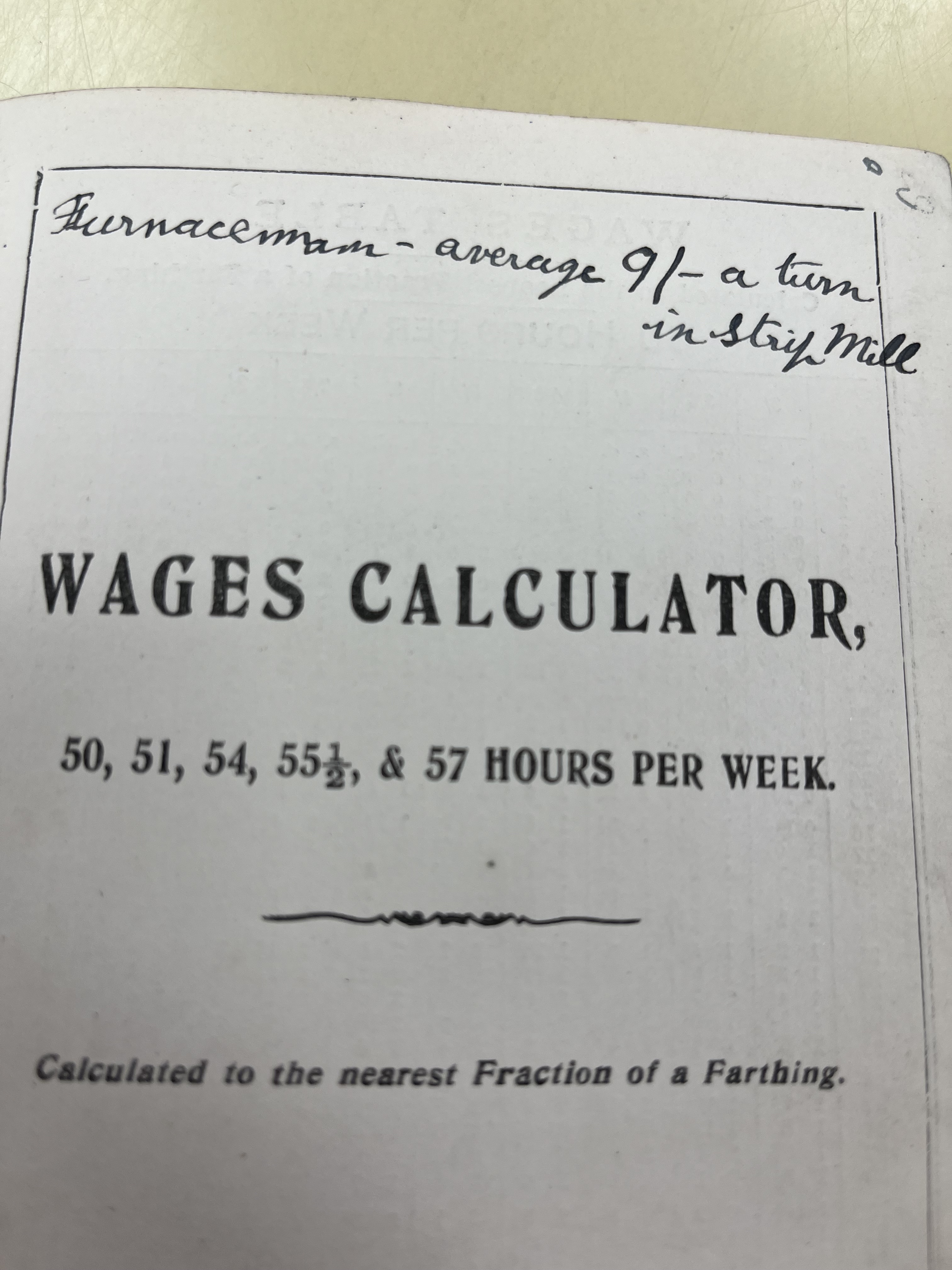
Judging by the stationer’s imprint and the name and address at the back of the book, this was a log of Sheffield workers’ hours and payments kept by a Mr Hunt who lived at 302 Staniforth Road, Attercliffe, Sheffield. This was not a difficult deduction.

It begins in July 1914, and finishes when the book is full in August 1917.

I assumed they were all men and worked in a protected industry which could well have been a related to steel in some way or another, it being Sheffield.

And then I thought, of course I could be wrong and it could be a workforce of women taking over jobs ‘left’ by men fighting in the war.

I liked that idea and conjured up all sorts of mental images of feisty women and their stories, but a more detailed look (by the Best Beloved) ‘unearthed’ this at the back of the book and more references to furnacemen at the front.

Interestingly, as I say at least to me, there is a knife-making company called Samuel Staniforth making knives who say they were established in 1864. I am temped to contact them and see if they are interested in this part of their history. https://www.s-staniforth.co.uk

There are some handy wages tables at the back ‘calculated to the nearest fraction of a farthing’ and in terms of hours, go up to 57 hours a week.

Whoever C Wise was, he is present from the beginning to the end. (But W Wise, makes only one entry right at the beginning. 

I am speculating of course, but could be father and son….)

In 1914 he was earning £2 and two shillings, but by 1917 was on £3/19/6d.

Interestingly, at least to me, is that although there are smatterings of records advance in wages throughout the book, many of the men took at advance in June 1915, August 1916 and April 1917.

I was thinking that this coincided with Wakes Weeks. A particularly northern tradition which started in the Industrial Revolution and was when the factory/works was closed for a week, quite often for maintenance work.

And they were, certainly originally, unpaid weeks so you would need an advance if you were going anywhere.

As a child I remember Wakes Weeks in the cotton mills in the Lancashire town where I was born – and the tradition was to go to Blackpool.

So popular was it that in the peak of Wakes Weeks in the 1860s (and no, I don’t remember that ) 23,000 holidaymakers left the town of Oldham alone, and headed to Blackpool.

Or, if you were better off, Morecambe Bay.

Wakes Week in Blackpool with the tower in the background

Should you want to know more https://northernlifemagazine.co.uk/wonderful-wakes-week/

There were some wage advances recorded in the book in the run up to Christmas but were for a lot less money than the holiday demand.

Except, that was my theory until I checked the dates and, no, the factory/works was not closed for the following week, and the same men were recorded as working and for much the same number of hours.

So, it remains a mystery.

Another Oxfam mystery, however, was solved by a very nice auctioneer who helps us out with some of our oddities.

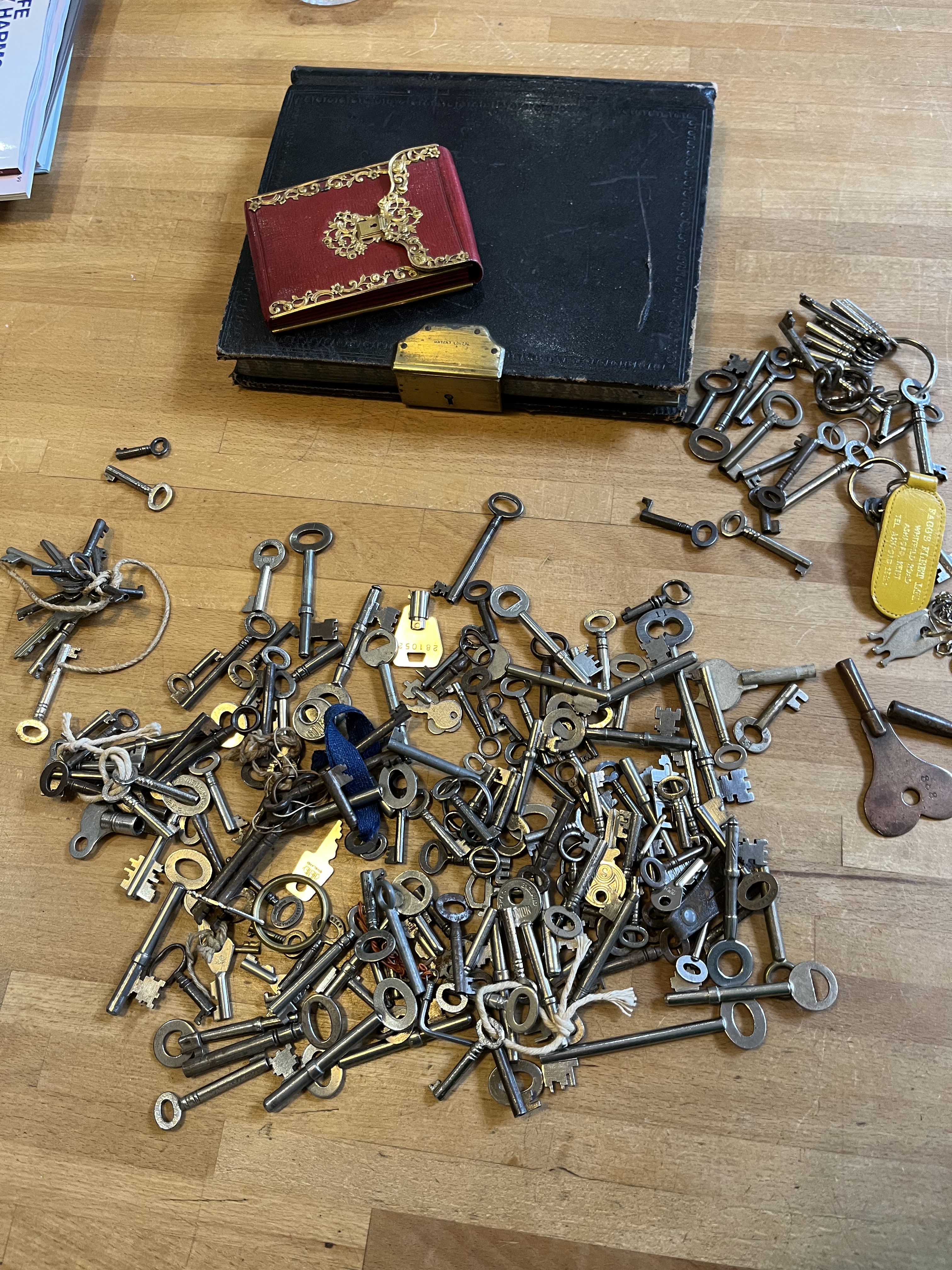
These were donated by a friend and some have ended up in an auction, but one of them was locked.

The nice man brought down his box of keys acquired over the years and I spent a pleasant but fruitless couple of hours trying to find one that worked. ( And indeed, watching the Brummie Lockpicker on YouTube.)

The nice man had said he thought it was a carte de visit holder and took it away to try and sell it for us.

He realised ( as probably I should have) that it wasn’t a lock as such and you could get it open.

And here is what he found:

Apparently,

‘It is a ladies etui case still containing a few of the original implements. 
Ivory writing tablet
Pencil
Combined ear scoop and toothpick.

When looking at it under a glass it was evident that the lock does not require a key. The centre pin is on a spring and just needs pushing down to open.’

Rootling around in the bottom of capacious shoulder bags over the years, I’ve all sorts of forgotten things – and indeed notebooks and pencils – but never a, presumably ever-useful, ear scoop and toothpick

A Few Oddities

Like most jobs the work of an Oxfam volunteer has a lot of routine stuff in it – but oddities, strange things, little gems and surprises make it all worthwhile – well most of it anyway.

So rather than bore you with an account of the routine, but necessary, stuff that needs to be done to keep the shop alive – though I could tell you about the alphabetical ordering of paperback fiction, the donations of souvenir books of people’s travels ( and indeed who in Petersfield will buy a glossy book of photos of Nebraska ) – I will instead delight you with some of the oddities.

First up, and an exception to the rule as above, a little paperback survivor of book on Lucerne and its surroundings.

I looked up Polytechnic Conducted Tours and found this:

The Polytechnic Touring Association was a travel agency which emerged from the efforts of the Regent Street Polytechnic (now University of Westminster) to arrange UK and foreign holidays for students and members of that institution.[1] The PTA became an independent company – though still with close links to the Polytechnic – in 1911. Later it changed its name to Poly Travel, before being acquired in 1962 along with the firm Sir Henry Lunn Ltd. A few years later, the two firms were merged and eventually rebranded as Lunn Poly (and later on as Thomson Holidays). The PTA was one of a number of British travel agencies formed in the latter part of the 19th century, following on from the pioneering efforts of Thomas Cook. ( Wikipedia)

Next up is another little book which I think falls into the categories of ‘there is a book out there on any subject under the sun and if you wait long enough, it will come into the Petersfield Oxfam bookshop. Along with people have unusual passions, and find the time to write a book about it. (This latter category includes, by way of example, a book on post boxes in Devon, and a book on fishing with bamboo rods.)

And this one….

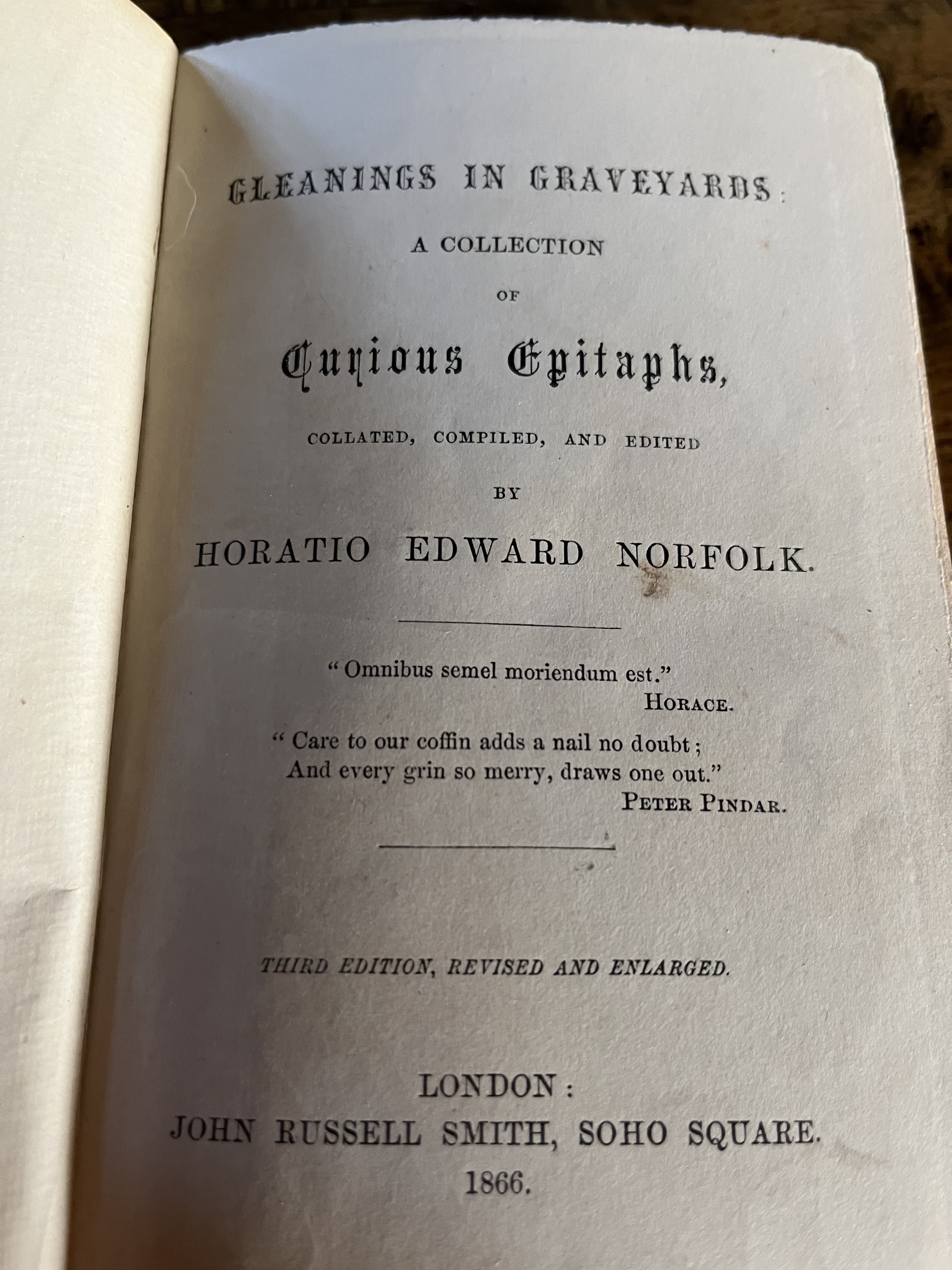
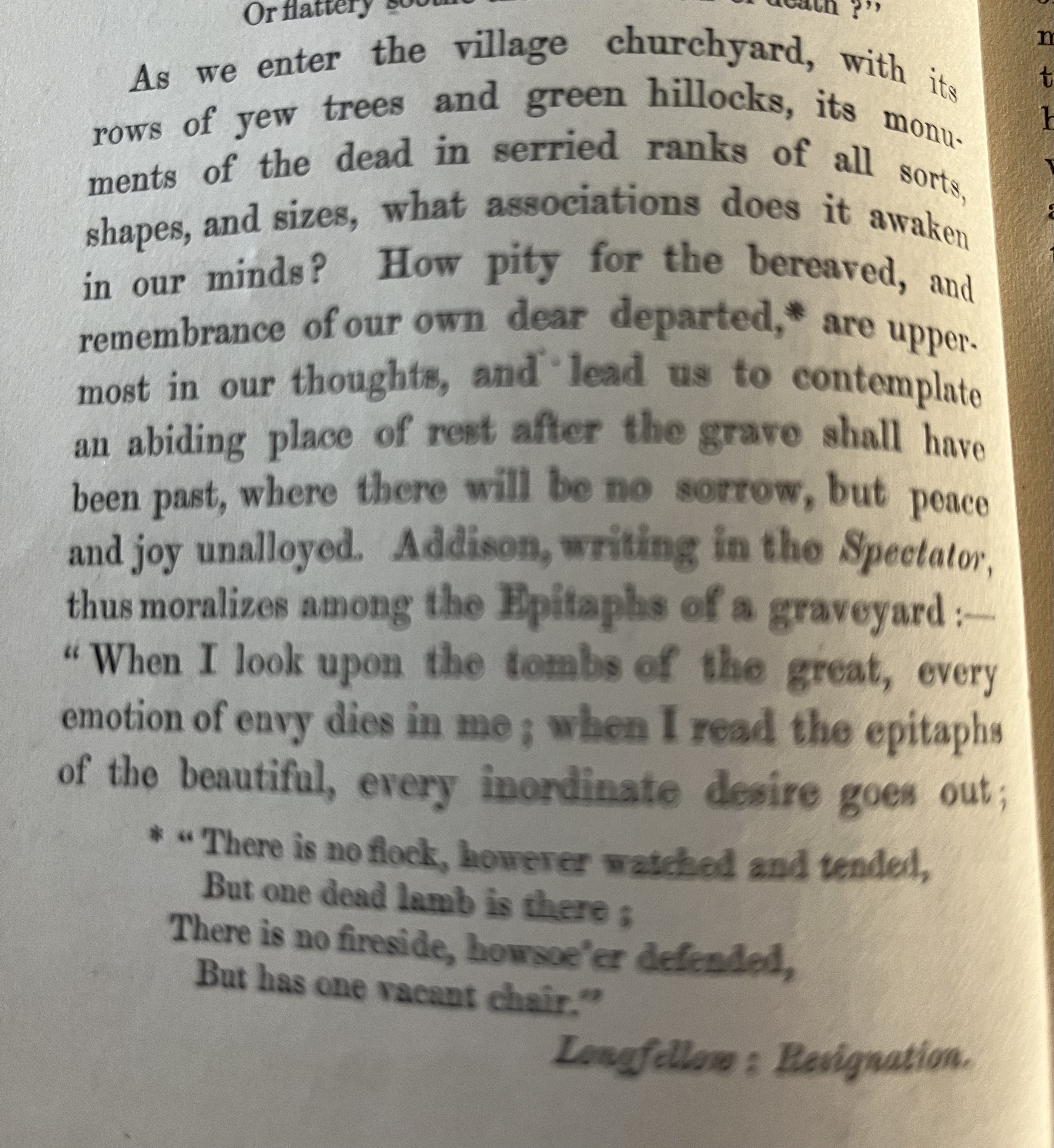
Anyway, where was I. Apparently wandering around the graveyards, or ‘God’s Acres’ of the country.

Where, according to Horatio Edward Norfolk, ‘ the mind of of even the most careless man should be directed into a train of serious and healthy reflection’.

He does pontificate rather:

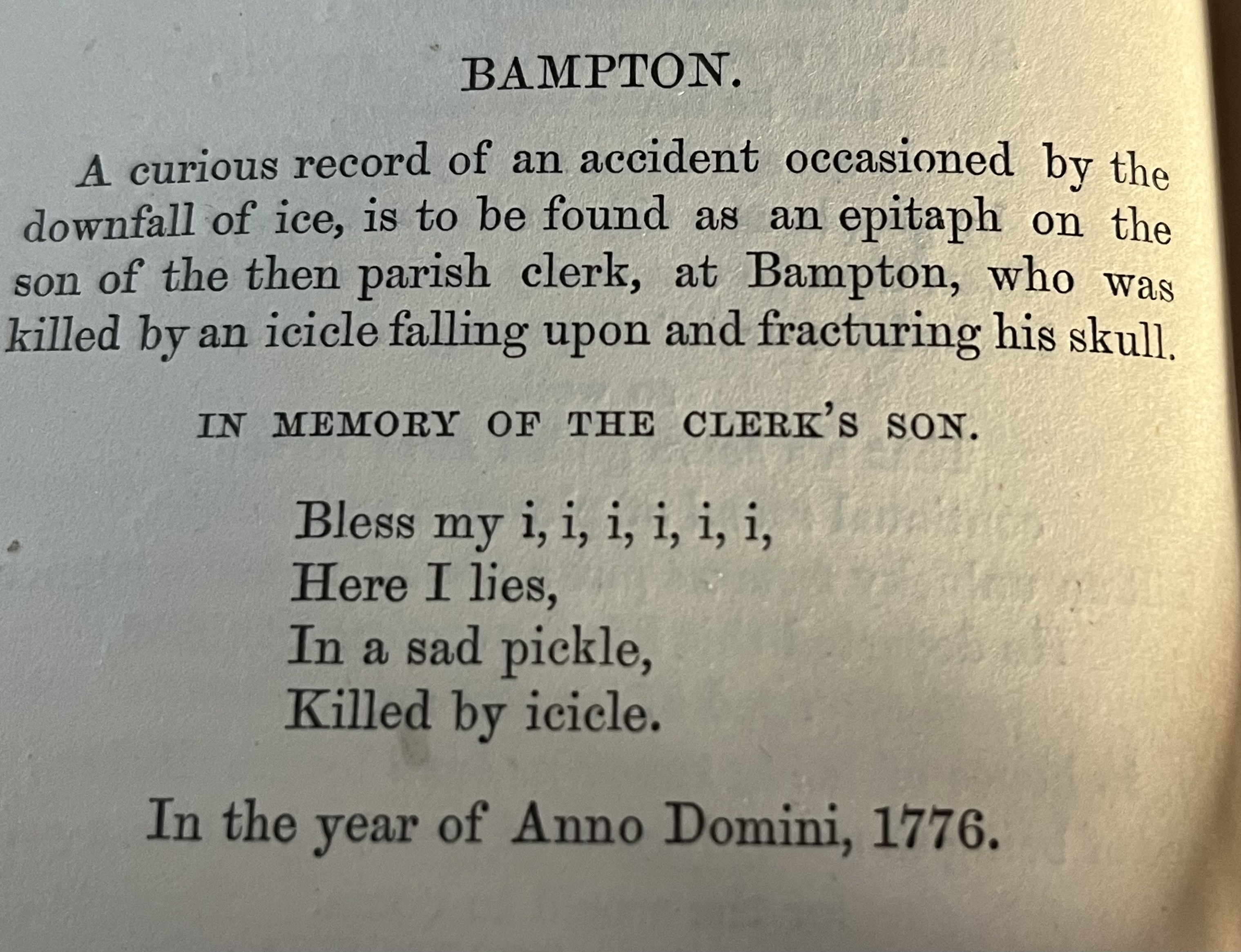
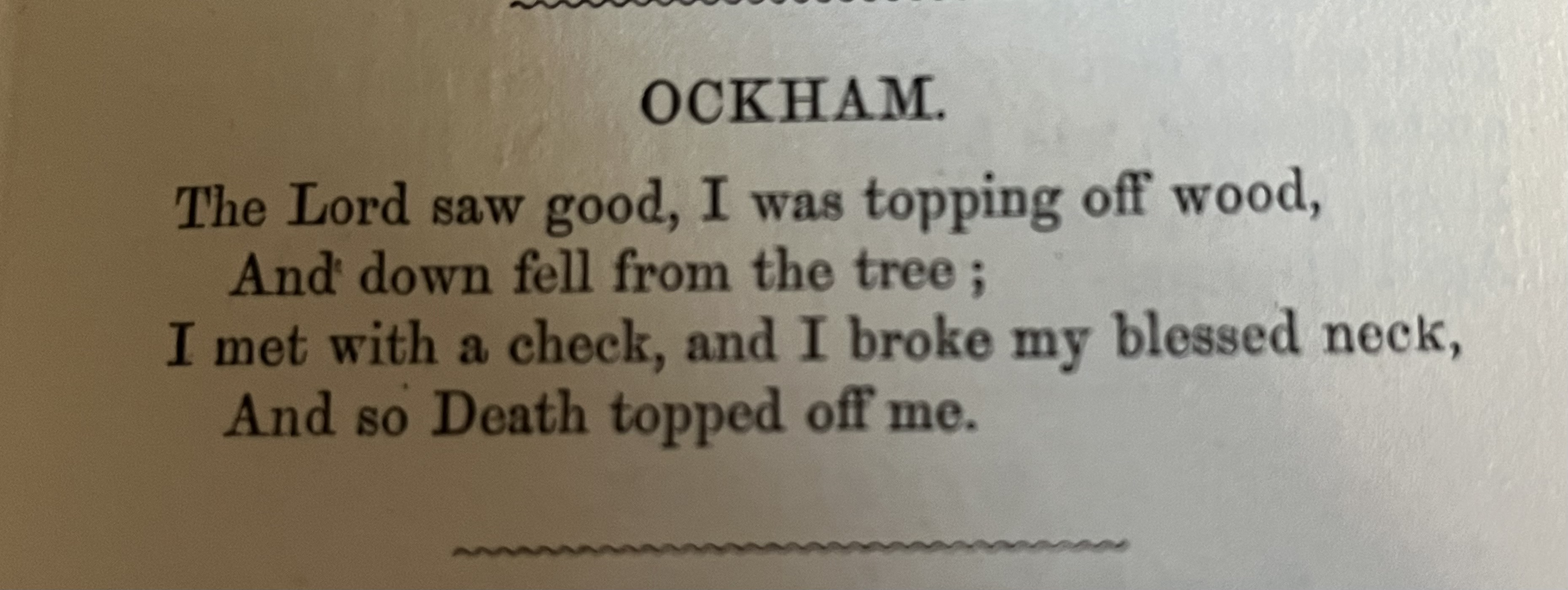
And here are some samples of what he found:

Ouch
and ouch again
May she indeed! I am assuming/hoping some of those 24 children were ‘inherited’ from a previous wife….
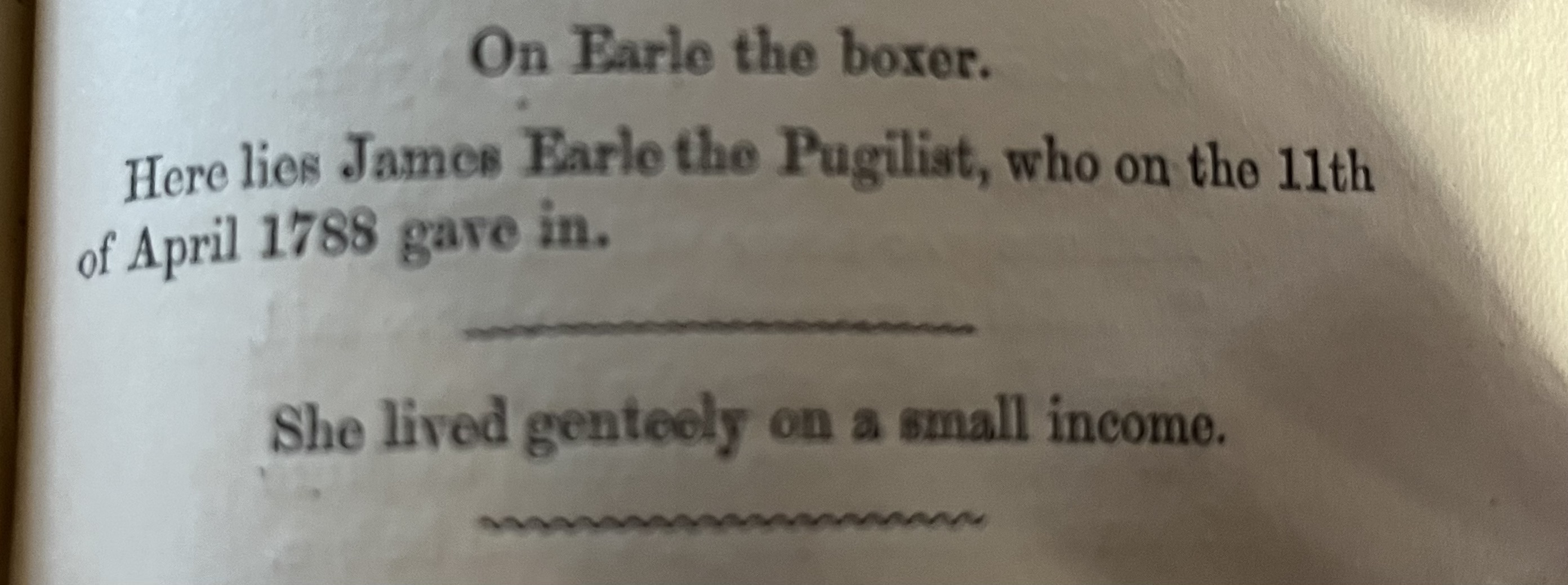
No name for the genteel lady on a small income – the story of her life

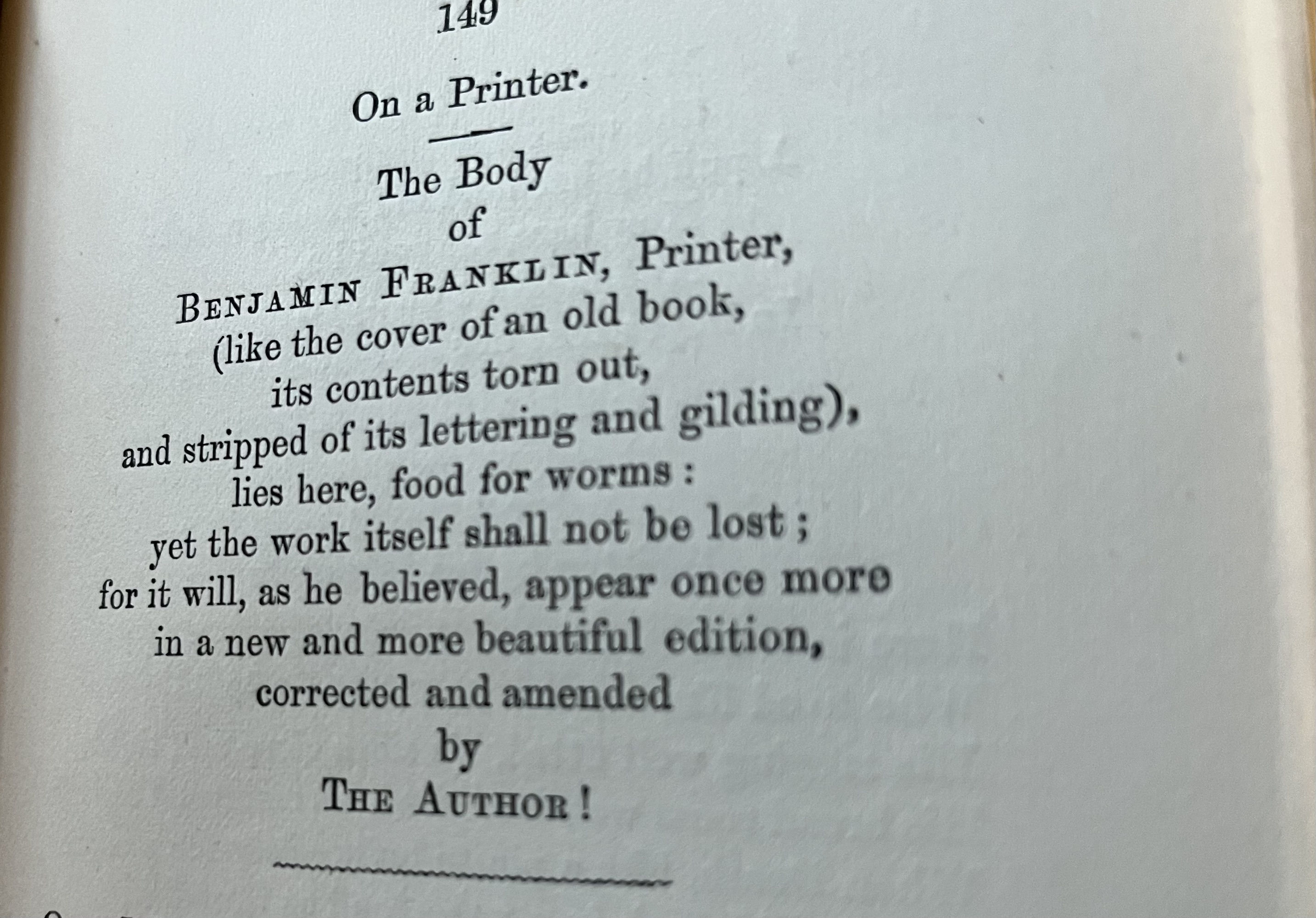
couldn’t miss a book person
and some of them a heartbreaking

Presumably, as this was found in an Oxfordshire churchyard and not London, it was the plague outbreak of that year which killed them all, rather than the Great Fire of London.

I have a few more oddities to tell you about but in the interest of bite-sized pieces, I will leave them until next time.

Shipwreck Celebrations

Whilst we were in Malta, it was the celebration of  the extended holiday on the island of St Paul who, perhaps unsurprisingly, became their patron saint.

Apparently he got shipwrecked there in a February though it is not entirely clear which one( As I said before, we probably should have checked the weather before we booked a February trip – shipwrecking month).

He was there, so it is said, for three months before carrying on to Rome to plead his case against being arrested in Jerusalem.

He had been accused of defiling the temple by bringing gentiles within its precincts and apparently 40 jewish locals said they would eat or drink nothing until they had killed him.

Luckily for him, his nephew hears of this plot and Paul was given a protective escort and sent off to Felix governor of Caesarea who put him under house arrest but gave orders that his friends could look after him well and he wasn’t to suffer hardship. For two years.

No snap legal decisions then.

But Felix was replaced by Festus who said Paul should be hauled back to Jerusalem and face the music. 

Paul exercised his right as a Roman citizen to ‘appeal unto caesar’ and, btw, being a Roman citizen had also prevented him from being flogged. 

So, off he sets and gets shipwrecked on Malta with 275 companions. Rather a precise number you may think to be sure of after all this time but then there are people who believe the world was literally created in seven days.

I don’t know about you, but I‘d be hard pressed to muster 275 companions never mind saying to them that they should accompany me on a perilous journey to Rome where Christians were not, shall we say, universally liked/tolerated/allowed to live…

Anyway, they swim ashore from their shipwreck and make it to land where they are found by locals who despite them being wet and foreign, warm them by a fire and give them food – yes all 275 of them….

A snake appears roused by the warmth of the fire, and bites Paul on the arm.

The previously welcoming locals take fright and assume this is a sign of an evil person, but when Paul carries on talking ( I am guessing a bit of preaching thrown in) with no ill-effects they change back to being welcoming locals, and indeed are impressed.

Paul manages to convert the whole island ( and its small neighbour Gozo) within his three months and according to the locals, find time to bathe in St Paul’s bay – well why not.

This landing on Malta is mentioned in the Bible’s Acts of the Apostles ( my auto correct just had that as Scots of the Apostles which may indeed have been a more interesting story) so the Maltese have something to point to.

Just to finish the story, he does make it to Rome where he is again under a rather lenient house arrest for two years until he a) dies in a fire b) was martyred but its is not explained how exactly or c) was ‘slewn by Nero’. I am guessing on the orders of rather than directly but then who knows with Nero.

Meanwhile, the Maltese have annual celebration involving a lot of fireworks, some processions, busy buses with people on a day off, and eating prinulatta which is I am told some almond-based dessert always eaten on St Paul’s day. ( I am not a sweet-eating person or I would have done more investigation and found you a recipe….)

Just one last thing, another source I have just found says Paul had 274 companions. Just wanted you to know there are some aspects of this story which don’t necessarily add up.

And whilst on the subject of shipwrecks, guess what just got donated to our bookshop.

An Afternoon Shooting Books

As I have said many times before, working in the Oxfam shop is a mixed bag, indeed box.

Sometimes you have boxes and indeed bags of books which are just not saleable. They have been stored in a garage for years, they are what is politely called well-read and in fact means they have been trashed – by children.

They are a collection of books about royal weddings – long divorced. They are dated cookery books with no charm, they are guide books printed in the 1990s and whilst the monuments may not have changed, all the restaurants, hotels, bus timetables will have.

But of course, and it is the thing that keeps us book sorters happy, are the treat and novelties.

We don’t have time or indeed the patience to go through every book but there is usually a general check that it is not written in, scrawled in, has the first few pages missing ( all rather depressingly regular).

But after that we are busy processing the next batch.

So, a colleague was on the till the other day when a customer approached and said he had been looking through the book he fancied buying and found a £50 not sandwich between two pages. 

He handed it over to the rather surprised volunteer, bought the book and went home.

We have no idea who it was who donated the book so all I can say is that I hope they would have been pleased we got an extra £50 for their donation.

And then I spent an afternoon in the company of many, many books on hunting, shooting and indeed one or two on trapping and snaring.

This came about because someone I know locally has an auction company and is an antiques collector.

And he has been really helpful with old coins we have had for example, and lately he has agreed to sell a Victoria century carte de visit holder. (In case you were unaware, in those days, people dropped a card in with your manservant to say you had called and would be delighted to invite you for a cup of tea, game of cards, etc etc.)

Whilst we were talking he said he was having a clear out of books. Now for him, a clear out of books is not a couple of Waitrose bags but a good few very large packing boxes.

I took one  for now – bearing in mind we don’t have a lot of space and certainly not that much.

It turns out this was part of a library he had bought from someone and it was his collection of all things hunting and shooting.

I have to say it was a very strange time, spending a whole afternoon on my own upstairs in the shop valuing all these books about killing wildlife.

As some of them were old, and some valuable, I had to look through them all.

To the sensibilities of most people in this day and age, the thing that is striking is the fascination with nature along side the fascination with how to kill it on a one to one basis.

Some of these books were illustrated with great engravings and images.

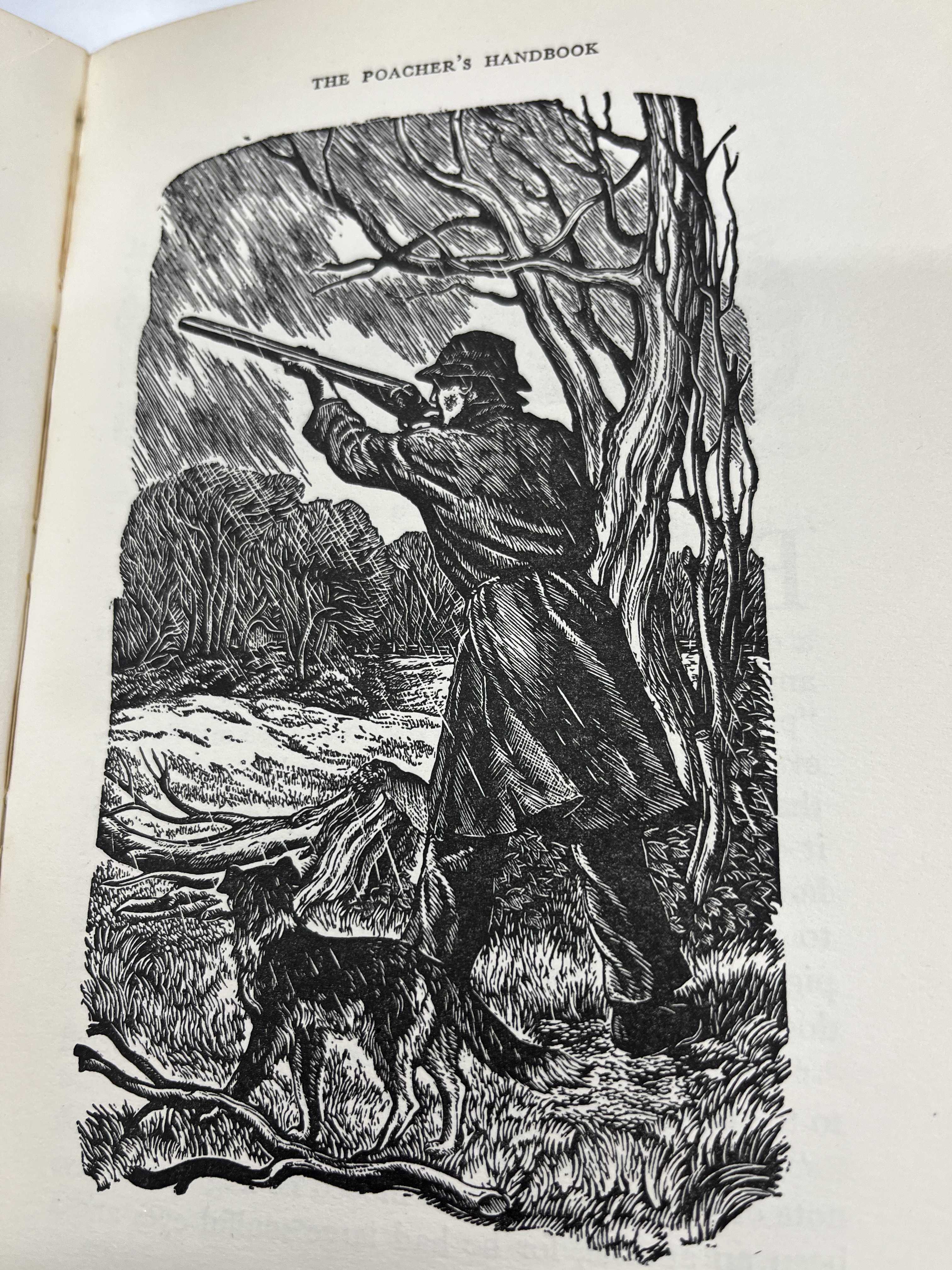
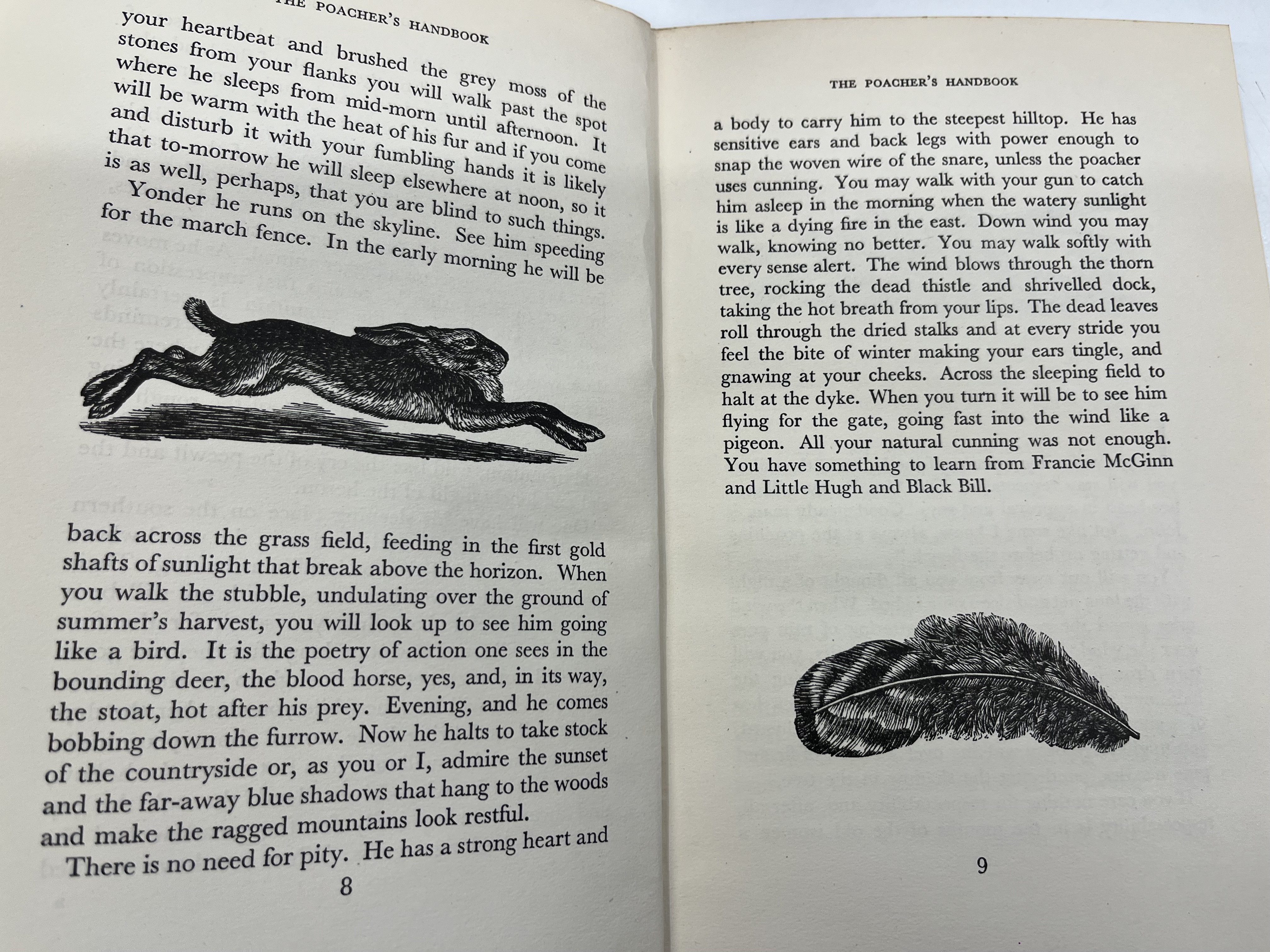
But then you read what Ian Niall has to say about the hare:

Lovely lyrical description of the countryside and then explains you need to be a really cunning poacher to make sure you trap its legs so it can’t get free. How does that fit?

And you get this:

Followed by this:

Yes it is the same delightful bird and coveted shooting trophy.

Luckily and by sheer coincidence, as I was taking a break from killing, I found this is a nearby box of donations.

Yes it is a bit twee, but have to say it made me feel a lot better.

When I nipped downstairs to take the till volunteer a cup of tea, I bumped into a regular customer who I know because he drew up our wills.

‘Have you got anything on fishing?’ he asked.

‘Ahh, I thought, hunting shooting, and now fishing.’

As it happens I found him a rare-ish book on making fishing rods out of bamboo. He is apparently delighted.

Nearly Jamaica Inn

A while ago we went back to Hawes ( in a lovely part of North Yorkshire in case you didn’t know).

Years ago, we had ended up staying there in a last minute booking in a pub which took dogs. 

When we came downstairs ( after that delicious moment when you take your boots off after a good day’s walking) we found the bar was fully carpeted in dogs.

Bigs ones, little ones, working ones, mutts, proper sheepdogs, waggy tails, bored resignation faces and all with waitresses adeptly stepping over them with full plates in their hands.

The Best Beloved loved it, so our recent trip was a bit of a pilgrimage – though we actually stayed in a rented cottage nearby.

The pub has moved on since we were there – something the BB always disproves of as everywhere should stay as he fondly remembers it.

There was real carpet, and fewer dogs. Ah well.

Anyway, we decided to play by ear where we should stay heading back down south, after all last minute Hawes (those many years) ago had worked out fine……

So, I booked a room for the following night in South Yorkshire hotel. 

Should have read the reviews, taken just a bit more time in sussing it out and where is was, taking good note that it didn’t serve food, mention of karaoke, the website saying it had been recently re-furbished in 2015…..

But we had a rendezvous with a pilgrimage pint, so I was not as assiduous as I should have been – not by a long chalk.

We arrived and parked on the run down road in the run down town, and heard the music from quite a long way away.

I went in to find it very, very busy given that it was early evening on a Sunday. No one seem riveted to the four large sky screens in the bar which was strange as trying to have a conversation over the music was impossible.

Suffice it to say in order to hear what I was saying to her ( ‘sorry we are not staying’), the nice young woman behind the bar had to usher me down a corridor into the function room…..

But then we got lucky.

Sitting in the car madly Googling dog friendly pubs with rooms nearby with immediate availability, the BB found the Dog and Partridge in Flouch ( no, I had never heard of Flouch either which is probably not surprising as it seems to be in the middle of nowhere but with the A628 to Manchester running directly outside.)

Inside, it was wood floors, log fires, a herd of young farmers, a walking group, nice good, comfortable room (the last one they had – phew) and effective double glazing so the A628 was like a film backdrop.

And out the back is moorland as far as the eye can see. 

Imagine Daphne Du Maurier’s Jamaica Inn only in the North and run by thoughtful, kind, efficient, nice people.

We were sitting doing some of the back catalogue of Wordle, when a couple stopped and proffered a semi-drunk bottle of wine. 

They were on a tour of the country as part of a significant wedding anniversary celebration and had had more champagne than meant they could finish the wine.

Oh well, it would have been a shame to waste it. And of course, we got chatting.

In one of those amazing coincidences, he had been brought up in a village three miles from us.

Anyway, the next morning the view was not evident on account of it lashing with rain, wind and cloud so low you could touch it.

I didn’t have to, but would have been willing to beg to be allowed to stay another night instead of facing hours of driving down the ever-unlovely M1 dealing with lorry spray, lane-hogging, windscreen wipers on fast.

So, there we stayed.

Walkers had about an hour’s worth of discussion about whether they should abandon that day’s leg of their walk. They did and left.

The anniversary couple set off for Scarborough with (a vain) hope that the weather would be better over there.

And the three of us had the place to ourselves only being interrupted to ask if we needed more tea.

Bliss.