For Rosa

I can still remember the day I got my A level results.

I was expected to get an A (an A star by current standards) in English.

So, I had always been a bookworm and knew more about books than my fellow students, would be called back by my English teacher talk about books I had read which were not on the curriculum.

I had written a short story which got a national award. 

I was really on for a good grade.

I got an E.

I was absolutely devastated. 

I can’t even remember my other grades, I was so shocked by the English result.

So, a friend who had left school at 16 who was thoughtful, and in lots of ways smarter than me, and who died two year later in a motorbike accident, took me for a walk.

He made me walk a long way from my home, up to the Malvern hills and then up to the Worcestershire Beacon – and sit.

He had timed it right, so we watched the sun go down and he said to me, ‘You are more than your A level results. Whatever you do, I will still be here, and you will be amazing.’

He wasn’t, and I wasn’t.

But I have had a good professional life which has had nothing, absolutely nothing to do with my A level results.

Easy to say now, if I was back on that day, or on this day with those stupidly given grades, I would still be devastated.

So, for my niece who is funny thoughtful, amazingly smart, who is surprisingly 18 and who still disarms me with memories of how we checked out my jewellery stories, who knows to take a water sprayer on a hot dog walk, who has passed her driving test, who has thought about what she wants to do with her life much more than I ever had at her age…and so much more that are just between aunt and fave niece.

I salute you.

I want to say to you, ‘I will still be here for you and you will be amazing.’

From books to beans

Looking for an alternative to Oxfam, no one who knows me well will be surprised to learn,  I have turned to food.

My grandmother who taught me, among many other things to make good pastry, and was no mean cook – her meat and potato pie was a legend in our family – was also of the generation who thought food waste was a crime.

My mother was a more adventurous cook – my grandmother thought olive oil should be bought from the chemist, and warmed so cotton wool could be dipped in it and put in your ear to sort out earache. My mother wanted to make an interesting salad dressing.

So, with these inheritances, I am embarking on a new volunteering career campaigning against food waste.

( Living on the cusp of Deepest Sussex and Hampshire, I contacted both county councils and Hampshire won hands down – a phone call a day later and a friendly and welcoming man talking to me about how welcome I would be – Sussex, not a word…)

I know quite a but about rootling around in the back of the fridge and finding a few ingredients which need using up – a poor childhood with a mother and grandmother behind me, worked wonders.

But if I am honest, I waste more food than I would like to.

At the start of lockdown, I was really good.

The fridge ( like the rest of the house) was cleaned and organised within an inch of its life ( that I must add, was a one-off.)

And I couldn’t nip into Waitrose at the end of an Oxfam shift to pick up a little something for supper. No Oxfam, no Waitrose, no driving anywhere….

Getting a few things added to next door’s Occado delivery was a heady delight.

And not a thing went to waste. 

But now, for the moment, things are easier and I am being more free and easy with my stocks.

Neither have I ever learned much about food waste except to know there is a lot of it and it isn’t good.

So, if dear reader, you have got this far and only really read my blog for interesting books stuff, now is the time to (hopefully) regretfully turn away.

Thanks to a friend here is a link which might you stop and think – only read if you are a meat-eater – 

https://www.theguardian.com/world/2020/aug/09/shelf-life-of-21-days-or-more-could-save-red-meat-waste-say-uk-industry-bodies?CMP=Share_AndroidApp_Outlook

Who knew?

I will be talking to my local butcher about this.

Meanwhile, here is a recipe based on a desire not to waste food and the belief that a tin of tomatoes can be the basis of a hundred meals. ( I am lucky and therefore buy good quality Italian tins, but I can see Jack Munroe wincing as I write.)

Since lockdown, I have supplied some friends and neighbours with food – I can cook for four as well as for two and not everything will freeze so they have had my surplus.

I say that because my neighbour loved this.

We have grown french and runner beans this year. I was not a fan of runner beans until I ate them in Greece last year. And we now have a glut and I wanted to make something using them.

The Greeks cook them long and slow in a tomato sauce.

( Yes, garden space to grow veg, shopping in Waitrose, holidays in Greece – they are not a precursor to cooking this but I do realise how privileged it all is.)

Anyway, my friends and neighbours will attest to the fact that I rarely have a recipe so I will just talk you through it.

Aubergine Pie

So this is a pie which uses aubergines instead of pastry. You can fill it with anything you like – I have done lamb and mint, courgettes and lemon, sausages removed from their skins and broken up to cook with mustard and greens…… this version is vegan.

All you need to remember is that you need a tomato sauce and to make the filling thick enough to cut into ( maybe a bit sloppy) slices. Pasta helps with that but so would potatoes, lentils or just a sauce packed with vegetables or meat of whatever kind you fancy.

For four people:

Make a tomato sauce.

Fry some onions slowly for a while ( say a gentle heat for 20 minutes) then add some garlic to taste, some dried oregano to taste, or any other herb you fancy – fresh or dried. The only thing I am sure makes all the difference is a couple of bay leaves.

Add a tin of tomatoes, and keep the tin to one side. Cook, stirring and add some salt and pepper and/or my favourite Marigold bouillon. 

You need a thick sauce but you may need to rinse the tin of its last dregs of tomato-ness with some water to make a sauce not a burnt offering.

Of course you can make or use any tomato sauce you fancy or have.

Take the stringy sides of the runner beans and chop into any size you like, along with chopping up any other green beans you have.

Boil for a few minutes, drain and then put into cold water to keep them nice and green.

( If you have no green beans to hand, think about a tin of butter beans, or any other beans you have in a tin at the back of the cupboard.)

Add to tomato sauce and keep cooking until everything is nice and soft – this is not a recipe for crisp veg and indeed runner beans are not nice like that if you were of a mind to ask me.  

Stir now and then whilst you are doing something else – I have some good book recommendations and you could easily get through a chapter whilst this is cooking.

Take four aubergines and slice them lengthways and thinly. Doesn’t matter if they have been in the fridge for a while but is nicer if they are fresher.

Heat a griddle pan on a medium heat for say five minutes if you have one, or a frying pan. Brush one side of the slices with oil.

Put in the pan oil side down. When they are softening and there is not much less good to eat than an undercooked aubergine – brush the dry side with some more oil.

When they are cooked put to one side  and get on with the rest of them.

When they are all cooked get a flan or cake tin or a dish.

Lie some of the aubergines on the bottom – pretend it is the pastry bottom of a pie. If you have a small dish or enough aubergine slices, you can bring them up the sides.

Then cook some pasta – short of any kind, broken up spaghetti, tagliatelle or whatever. 

Pasta/sauce ratio is up to you, but bear in mind you want to be able to cut the finished rest into slices

Add a the pasta to the tomato sauce with a drop of the pasta cooking water if the sauce will take it without turning too runny.

Stir and pile on top of the aubergine slices. 

Cover with the rest of the slices. Drizzle some oil on the top or indeed, if feeling flashy, some grated cheese.

Put in the oven at 180 fan and leave for about 20 minutes or half an hour.

Eat hot or cold and send a slice round to the neighbours and then wait for appreciative comments.

Two things I have learned so far:

Blimey, it is hard to write anything approaching a recipe if you didn’t start with one. 

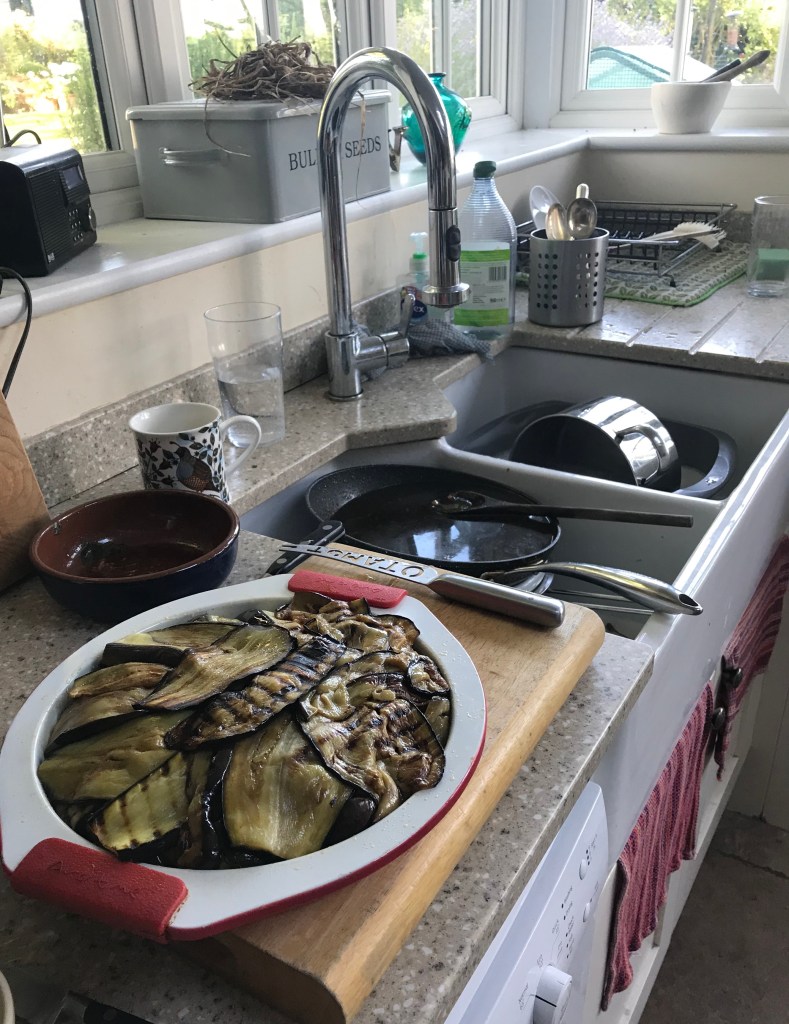
I am not a food stylist. See below

Leaving Oxfam 1

My days at the Oxfam bookshop in Petersfield are currently over. 

Here is my long, and rather self-indulgent, elegy to those days so do feel free to get on with other important things in your day. 

But if you stay with me on this, next time you go into a charity shop, a bookshop or indeed any local – and please shop local – shop, have a thought about the work and thinking that goes into making it happen.

People are it.

You might think that people who volunteer in a charity shop are all ageing women who have led sheltered, domestic, rather boring lives and –  of course – you would be wrong. For a start, not all our volunteers are women – but that is just the start……

I have worked alongside someone who has sheltered children during the Biafran War.

Someone who has survived, and dealt with, two brain tumours and gone on to spend a lot of time out and about and at the theatre, been a stalwart of Oxfam, and who gently manages all of us who are in her orbit.

Someone who spends her other time dealing with disadvantaged kids and refugees as well as her children and grandchildren and will call to say she is a bit late because she is juggling all those things.

The book sorter who races through sorting donations as quick as he (apparently) cycles, the other book sorter who  deals with ageing and indeed dying parents and a business selling bee homes, and has chats with the DVD volunteer, who by the way is a film-maker.

A volunteer who made, among many other creative stuff, a street of snowy houses as a backdrop for the table in winter and has more creative ideas of how to make the table look good than you can shake a stick at.

The expert in old books who taught me all I know about every old book – binding marks, pagination, half-calf, the importance of maps at the back, the delight of period adverts …. and who always got a cup of tea, and sometimes a chocolate biscuit.

People with illness, disability, difficulties of all sorts going on in their lives.

People who have moved on from death or divorce, dealt with cancer whilst still coming into the shop, and people who are willing to be (sometimes) bossed into doing extra stuff.

An artist, a full time environmental worker who gives up her Saturdays, two vinyl addicts, a classical music expert, an immigrant over here to be near grandchildren, an engineer, a brilliant ex-teacher who taught me so much in my early days and who makes the shop a lot of money by putting clothes online – yes even a bookshop takes clothes and makes money out of them for Oxfam, the woman who has children in school and had a bored brain and wanted to give something back, a friend roped in to come and help, and the volunteer who (very surprisingly) introduced me to the books of Game of Thrones. 

I hope I have covered everyone but a sure I have missed someone(s).

Volunteers do everything from being at the till and dealing with difficult regulars, taking the towels home to wash, tackling a huge pile of donated books, pricing, shelving, re-arranging the books front-facing, re-stocking the shelves, moving stock to create space for new goods, checking off barcoded goods, looking up the value of a donated dress, measuring the inside leg of a pair of donated trousers, putting on the gift aid stickers (which bring in an extra 25% of the value of a sale), making sure the paperback fiction is in proper alphabetical order, spending an evening searching for the value of a donated book from the 18th century, putting out a display of special classical music and much more.

And that was all before Covid, So, now their brilliant contributions, thoughts ideas of this might work should all be brought together to make the shop work. 

And not for money, just for appreciation, a thank you, and of course for a very good cause. 

Marvellous Book Days

It seems like a very, very long time ago ( time has warped) that I was busy bossing people around in the Oxfam bookshop, clearing out donations, looking for hidden treasures and reaching around another book sorter to put a pile of rejects into a plastic crate. Oh, those were the days….

But this weekend, we had a pop up village book swap/stall/get a new read event – and it was lovely.

I set up a WhatsApp group for our village of 70 households and someone put on a post asking for books for her mother.

That set me thinking that there must be other people looking for something to read, so I put a call out for people to donate books and leave them in our garage to disinfect.

With the benefit of Oxfam experience, and the knowledge that everyone sometime in lockdown has had a clear out, I said one bag of books per household…… I didn’t want a tsunami of books just a quality bubbling stream of good reads.

And in they came.

Mind you I was never sure that The Book of Sexual Disasters or Jeremy Clarkeson’s 4th book might fly off the ‘shelves’ and indeed they didn’t – maybe next time.

The weather was with us – so sandwiched in between cold and windy weather, we had a day of sun.

A neighbour leant us her long table, my best beloved went to Tescos to get banana boxes to display the books, and we stetted to set up.

d4812842-f88c-4e06-861b-46f0cd3951c2

People came and got books and chatted and swapped recommendations, and it was great to hear chatter around the yard – someone took a courgette plant I had been rearing and certainly don’t need, people waved from the lane, walked their dogs past us and stopped to take some books home.

I do realise this is a bucolic idyll blog and of course not everyone has that of a Sunday morning but one more nice story before I go.

So, one of the benefits of this horrible time is getting to know people I didn’t know, would never have met – we are a scattered hamlet – but now have and do.

I was delivering headbands – quite another story – on Saturday morning when I met up with  a couple and their dog.

She said she wasn’t coming for the book swap as she needed a book for her bookclub read which she was pretty sure we wouldn’t have.

‘Its called something like an impressive year,’ she said.

‘A Year Of Marvellous Ways?,’ I said.

‘Yes. That is it!’ she said.

‘I have it in the boot of my car,’ I said and gave it to her.

What was the chance of that….

This, dear reader, is my book of the lockdown.

And I have recommended it to six local people with very different reading habits and every one of them has loved it.

I don’t have one for you in the boot of my car, but I so recommend it 

Good reading whatever you are reading – but do go and find Marvellous, she is a real find.

Wine and the dog

Like many people, I am assuming, I have started keeping a plague diary. The problem is that like almost everything I do – especially at the moment – it is not well done.

So, I am left with a series of one line notes, written with no date and now seeming to be part of a list of memories from a far-gone era such is the time-warping experience of day-to-day life at the moment.

One aspect of our changed lives however is all too visibly present.

Jess was due a hair cut just as lock-down was called – in fact that day. With hindsight, I should have sucked her into the car, driven the five miles to her groomer – after all I wasn’t going to Snowdonia or Cornwall – and got her done.

But I didn’t, and now she is faced with the best-beloved using an array of more or less blunt scissors most days to just trim a bit here and there….

(There will come a day when I have to use those same scissors on the best-beloved’s hair and he will enjoy plucking my chin hairs – such are the admissions I am willing to make in these strange times.)

She is a sociable dog and has been very happy to have us both at home all day and a lot more people than usual coming walking past our garden.

She usually runs from one vantage point to another to bark at them – annoyingly I’ve no doubt though locals all call out ‘hello Jess’ – but now even she has largely given up on that, so many new people are coming past us.

Yesterday, we went for the full hour’s walk round a circuit we sometimes do. Usually the gardens I pass are empty but yesterday the circuit took twice as long as usual.

I met a lovely couple who gave me half a dozen eggs – they have chickens, ducks and geese so a interesting egg box – a lawyer working from home and helping asylum seekers, a volunteer for our local emergency group who I hadn’t ever met in person. ( She has a perfectly groomed dog and Jess was somewhat embarrassed as she might well have been.)

I met a family who are pretty sure they have had the virus but as we have no mass testing, they are not sure.

An asthmatic woman walking and living off the shopping from neighbours, a neighbour bringing me empty milk bottles.

So, this is the lovely neighbour who answered the call for the village to have some volunteers to deliver information including green, amber and red posters for people to put in their windows to indicate whether they were fine, in self-isolation, needing help.

The BB and I were having to get the packs together, work out who would deliver to each of the (only) 70 households and put them all together and in plastic bags hung on our back fence for those volunteers to collect.

It’s happening across the land I am assuming.

I am an expert at waving my hands in the air, saying I have a task to do and please could anyone come round and help. ( See also my wedding planning – done by a marvellous committee of women.)

This time, of course, that wasn’t going to happen.

‘Have a glass of wine whilst you do it,’ said my smart, thoughtful and oh so right neighbour.

‘Should have got a supply of white wine sorted,’ I texted back.

Ten minutes later a chilled bottle was on my doorstep. Lovely.

But they had no milk so I have upped my order from the milkman to supply them too. Thank you Matthew the milkman.

Carrots & Wine

I haven’t written anything for so long that I am feeling rusty, and didn’t really want my return to be a plague diary – but hey ho.

Oxfam is closed, so all those lovely books ( and indeed the not so lovely ones – Jeremy Clarkson included) will be sitting there waiting for new homes for some time to come (perhaps not Jeremy Clarkson…)

Meanwhile, we usually are fans of hunkering down.

And usually that comes with winter and log fires and telly and the dog asleep on some piece of furniture, a stew in the Aga and friends for a long Sunday lunch.

Now it comes with all the above except it is Spring, and we can’t have anyone in the house.

We are the really privileged and I am seriously aware of that – we can afford to be where we are with no financial worries, we have a decent sized garden and are surrounded by fields.

But these are jittery times, strange times, no point of reference times, the calm before the storm times.

The times when you watch what is happening in Italy and marvel at the efforts being made to save lives and at the same time hope you never need to ask that for yourself or people you know.

I’d like to think this was bringing out the best in me but just like my inner cleaner, I am finding it quite hard to locate by better inner self at the moment.

But here are two things that made my day:

My lovely next door neighbour managed by a slip of the cursor to get 4 kilos of carrots in her Ocado order.

In a few weeks time she’d probably be able to sell those on some black market for shares in Zoom, but right now she has given me some.

My BB, never knowingly cooking a thing in his life, and who has a sweet tooth which he has been nurturing for all his years, did not seem to run through the options of soup, purees, carrot curry ( but then who would?) and came up instantly with carrot cake. (Recipes that don’t involve cream cheese all welcome.)

We are also about to spend some happy hours filling envelopes with advice and support stuff from our Parish Council for the locals, and another lovely neighbour offered to help.

Now normally, I would have flapped my hands and asked half the village in to help but had to say that we would manage.

She said, it would all go better with a glass of wine and I said, we should have stocked up with more of the white stuff – ten minutes later, a lovely bottle was delivered to our doorstep.

That will make today fine. Hope yours is too.

Melting Moments

I am not sure that I want this to turn into an Oxfam-meets-cooking-blog, though maybe that would give it a niche following, but I have to say those two themes seem to be coinciding a lot.

And more to the point, the authors are mysterious.

So, here goes on cookery writer number 2.

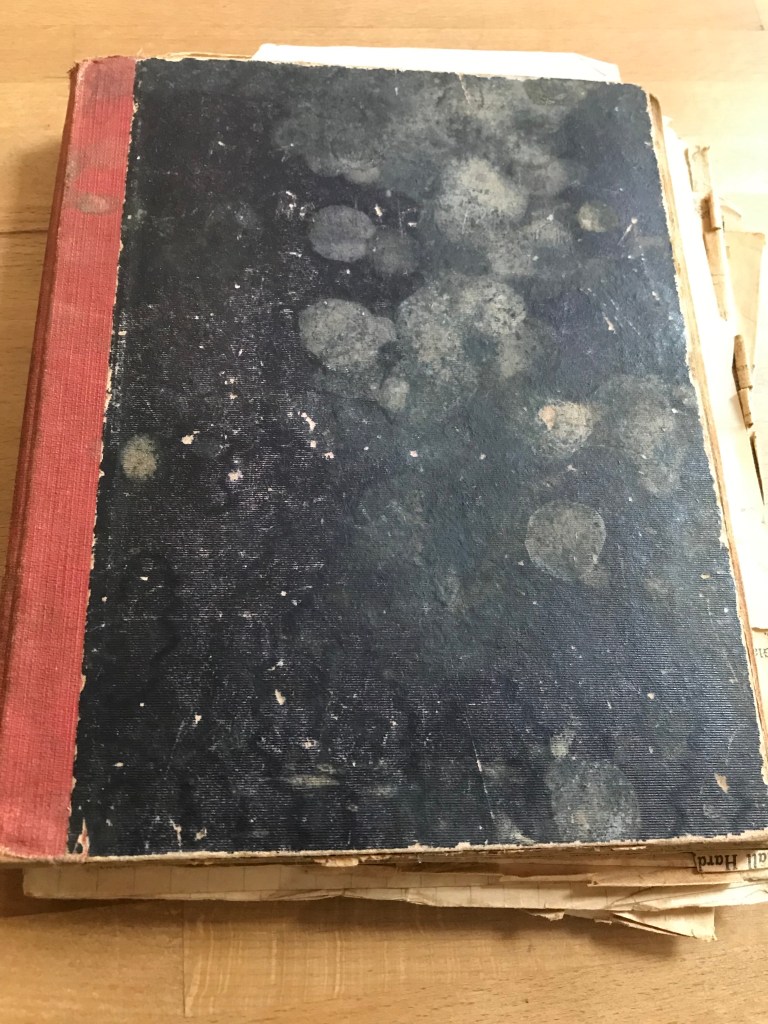
Last week someone donated books from clearing out a family home – her mother’s, parents’, another relative – I am not sure. I was not on ‘duty’ just passing and having a chat with my colleague when she came in so I helped her in with her boxes of donations.

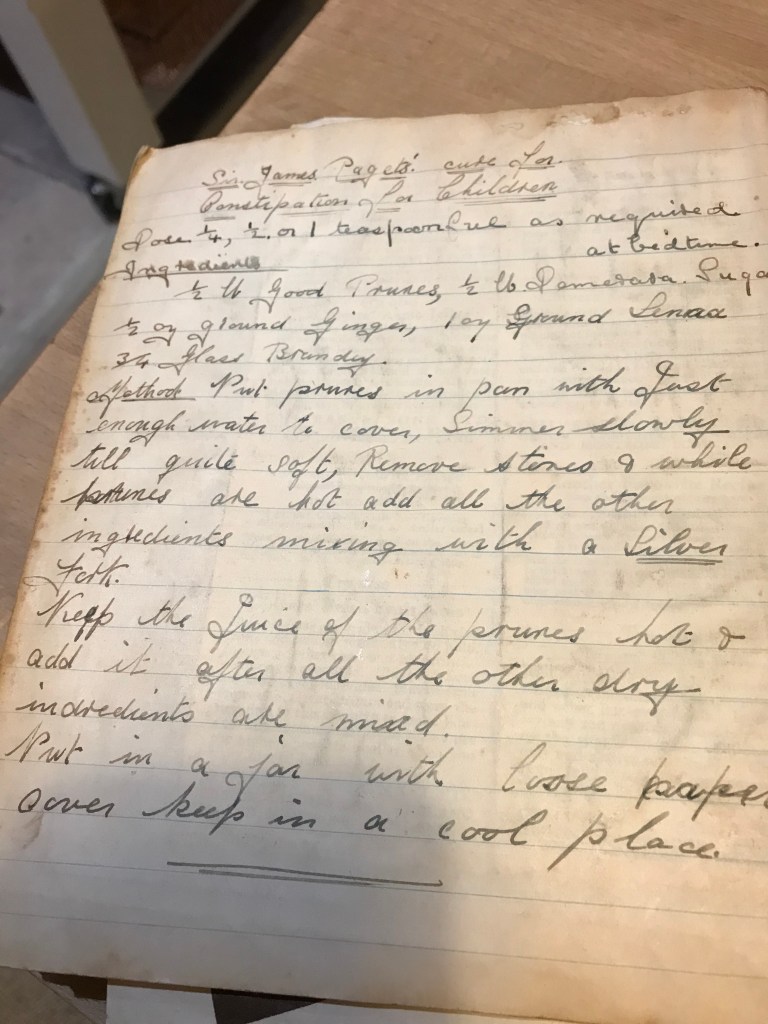
She pointed to a book and said, ‘You should look at the last recipe.’

I put the book aside to have a look at when I was next properly in the shop. ( And, luckily, it was still there when I did.)

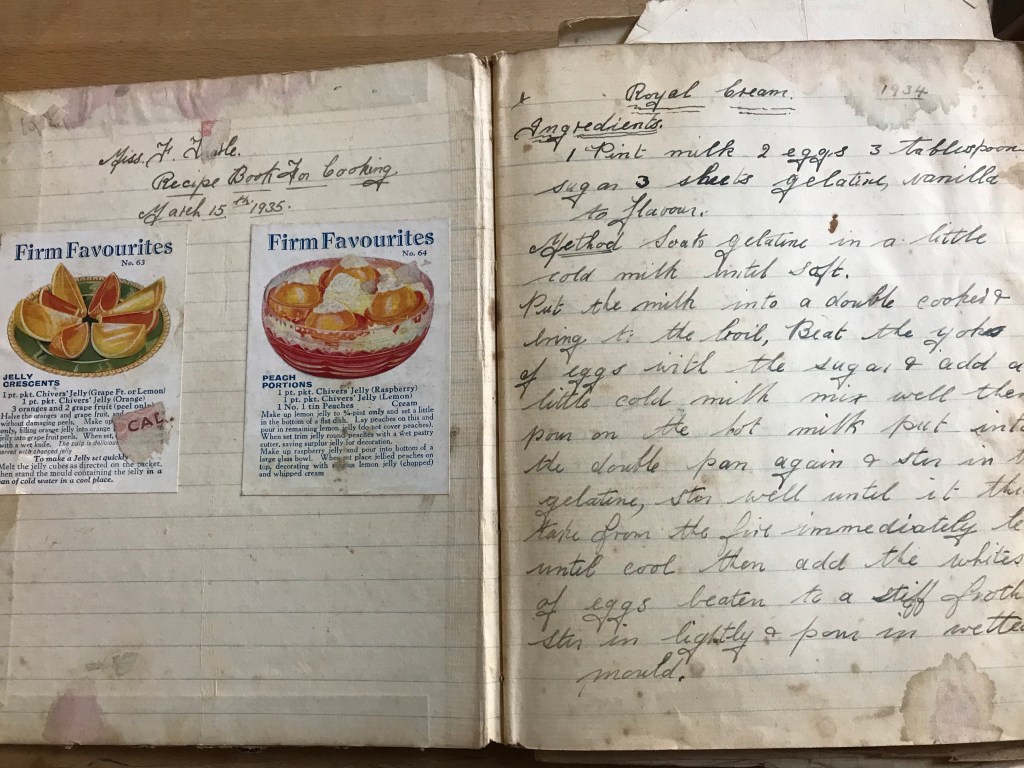
And this is the last recipe:

And yes, I am not sure either whether children loved that teaspoonful and asked for more….

At this point, I should tell you, reader, this book is worth nothing in monetary terms.

It is not old enough to be valuable, it is not a ‘real’ recipe book, it is not written by anyone famous, it is a little bit of social history.

But it is interesting.

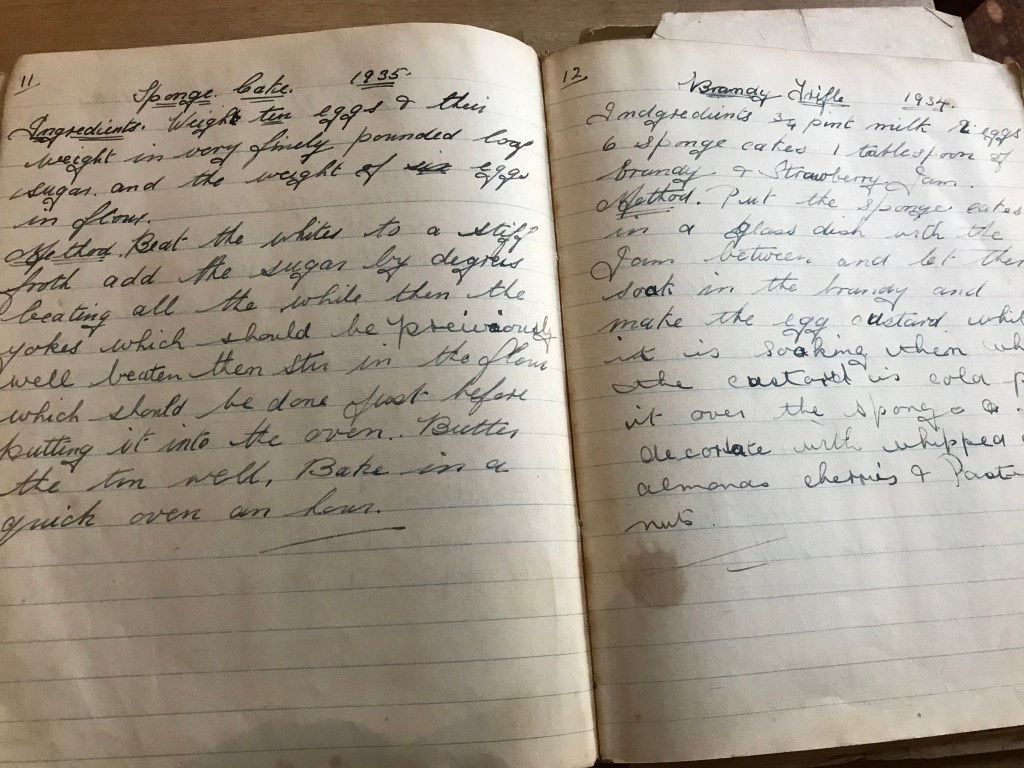
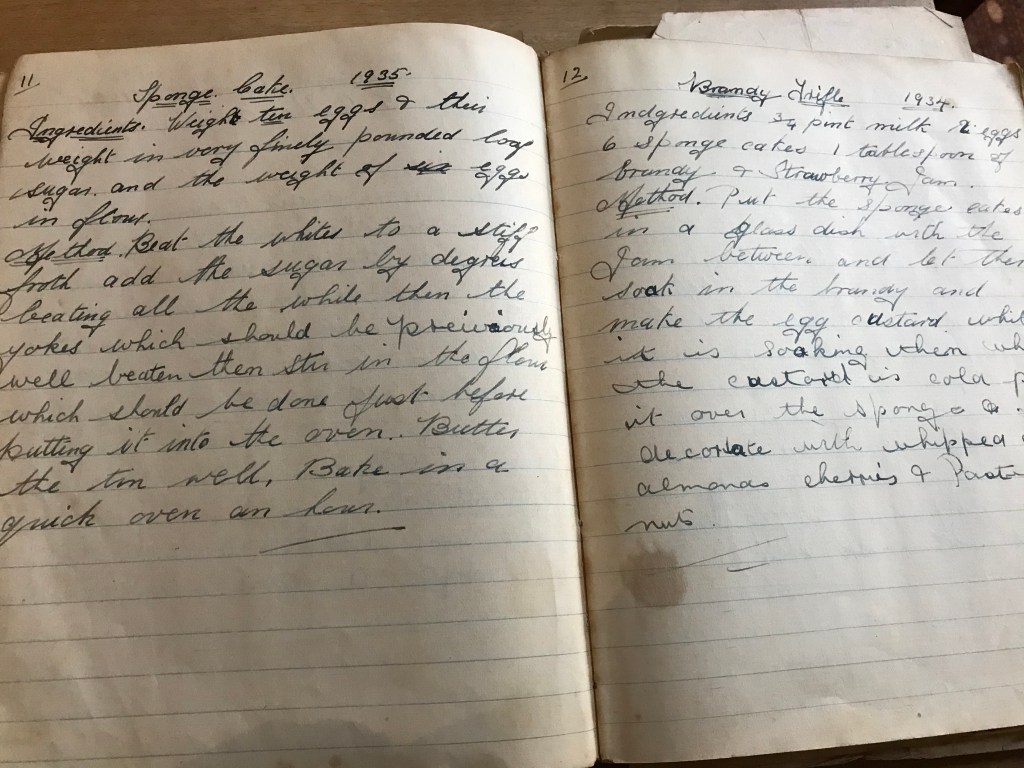
So, how come the ‘Recipe Book For Cooking’ ( and you do have query the possibility of a recipe book not for cooking, but moving on..) by Miss F Tharle dated 1935 has the first recipe dated 1934?

(Clearly, she was a jelly fan.)

In fact you have to go 15 pages to find a recipe dated 1935 and, by the way, except for two recipes – cheese soufflé and cheese straws –  the rest in those pages are all for sweet stuff.

We have Strawberry Soufflé, Coconut Cakes, Eclairs, Lemon Sponge, and more, before we get to Casseroled Chicken.

There are 68 pages before Miss F Tharle stops, and most of those are for anything you might fancy as a pudding, cake, dessert or just to satisfy your sweet tooth.

But what I can’t quite get is why a recipe ( Sponge Cake ) is dated 1935 on the page before one ( Brandy Trifle) dated 1934?

And the handwriting seems to be from different people. 

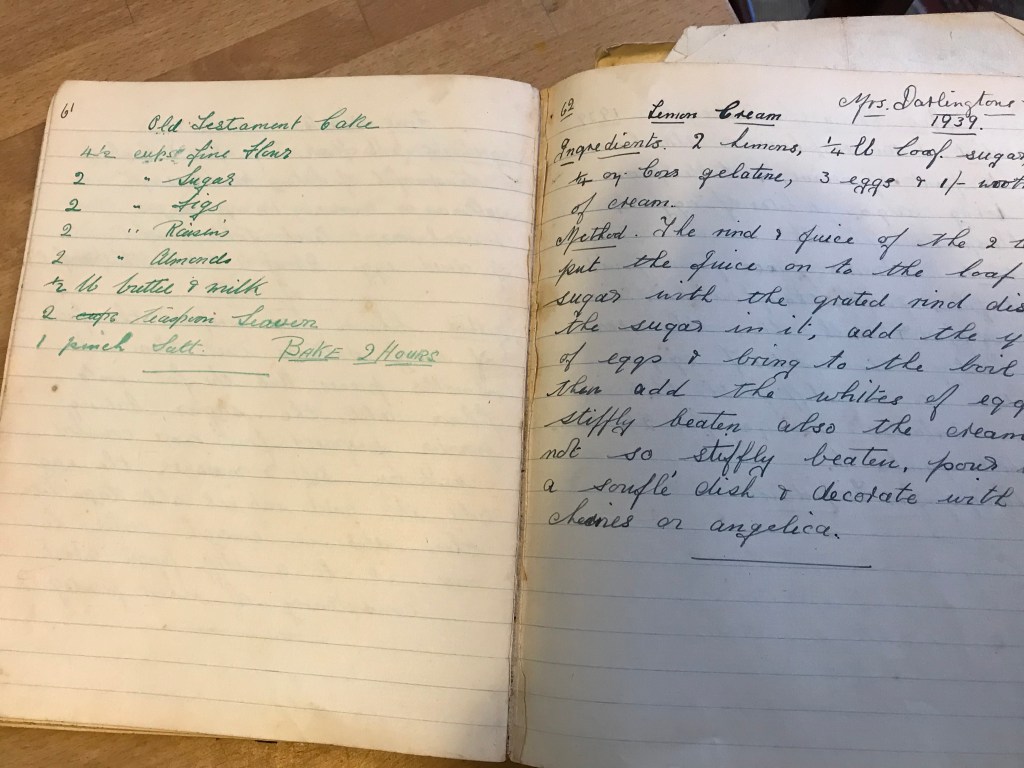
After Casseroled Chicken, the dating of the recipes stops, until Apricot Fancies on page 56 which is dated 1943, then Fruit Biscuits a few pages on, dated 1946, and much to my surprise, over the page, Lemon Cream, dated 1939.

Mind you, the Old Testament Cake on the previous page did catch my eye. No explanation of what to do – is that Biblical or what?

And the penultimate ingredient – 2 cups reduced to 2 teaspoonfuls of something I can’t make out.

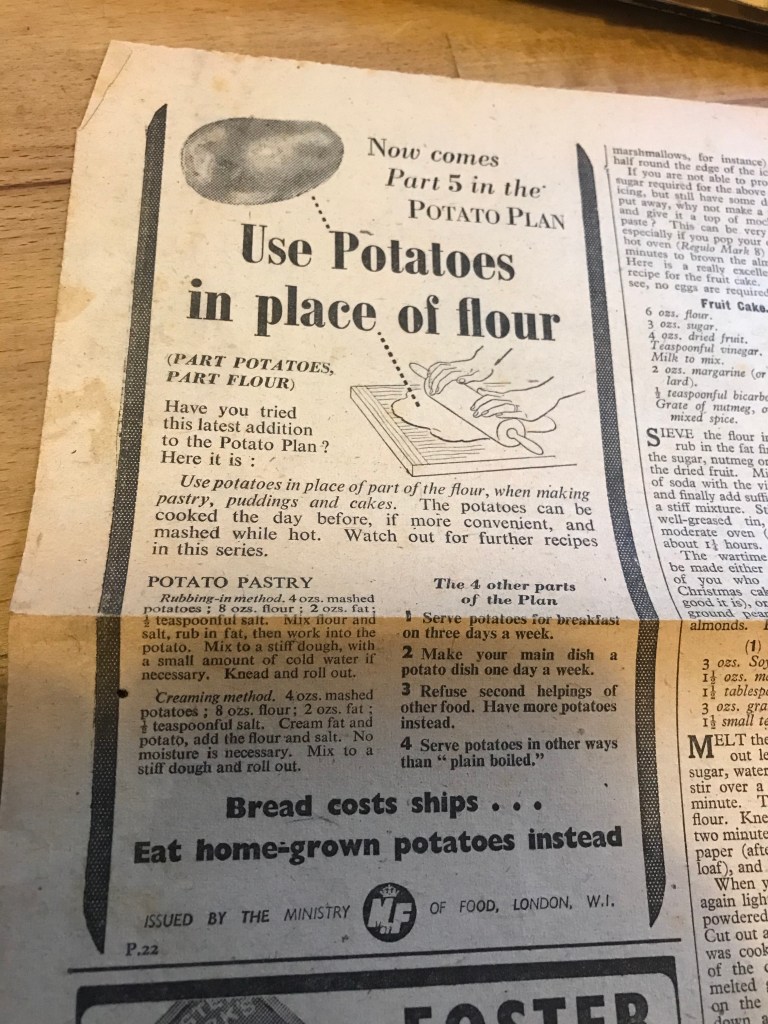
So, from the book’s beginning in 1934/5 nowWorld War II has broken out, has been carrying on, and there are signs of it. 

(Personally potatoes are a big favourite, so points 1 to 4 are fine with me.)

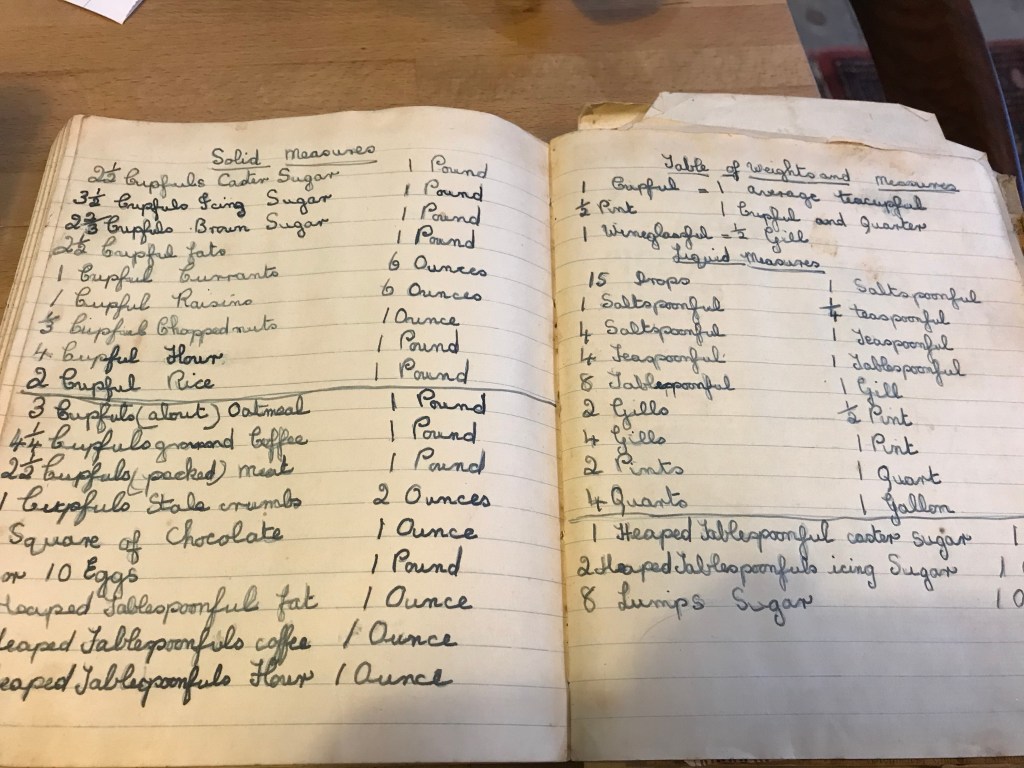
Then the book has blank pages until at the back you come across another’s handwriting and interestingly, a conversion chart from American to British measurements.

And then the recipes are largely cut out from newspapers – ‘Recipes of Quality Collected by Lady Muriel Beckwith’ feature heavily.

Gone are the days of Chocolate and Vanilla Biscuits  and Apricot Fancies (1943), we are now looking at Game Hot-Pot and Canard Aux Olives.

Like all personal recipe books, there are a pile of bits and pieces shoved in at the back and interestingly, there are a number which are labelled NAAFI.

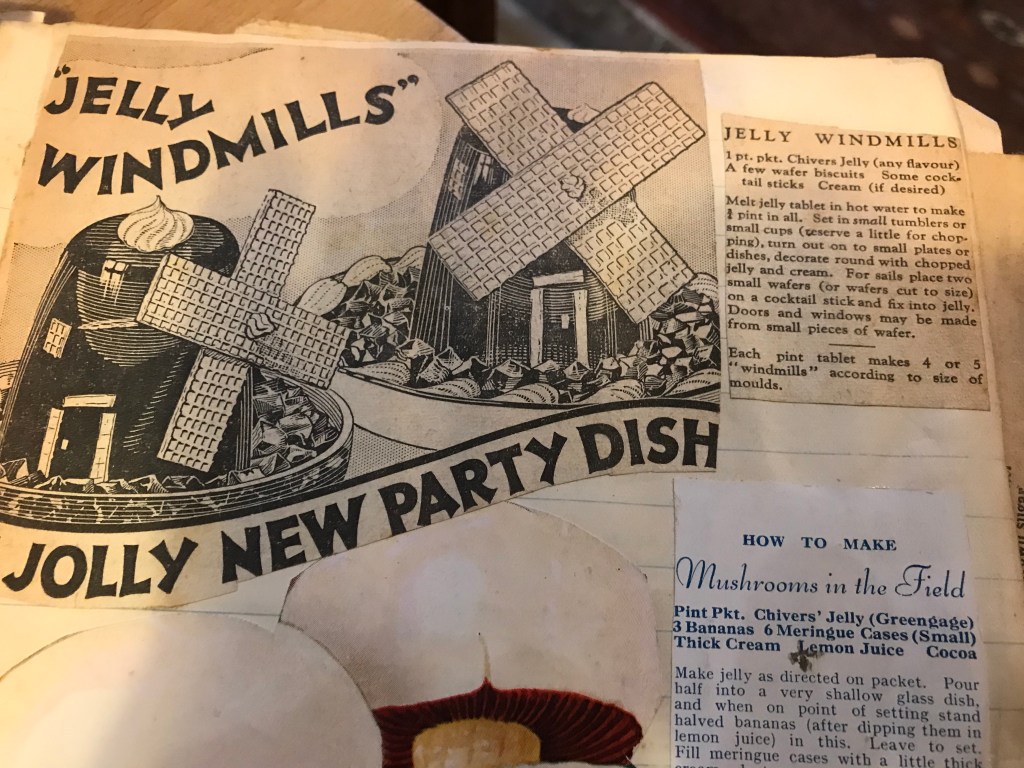
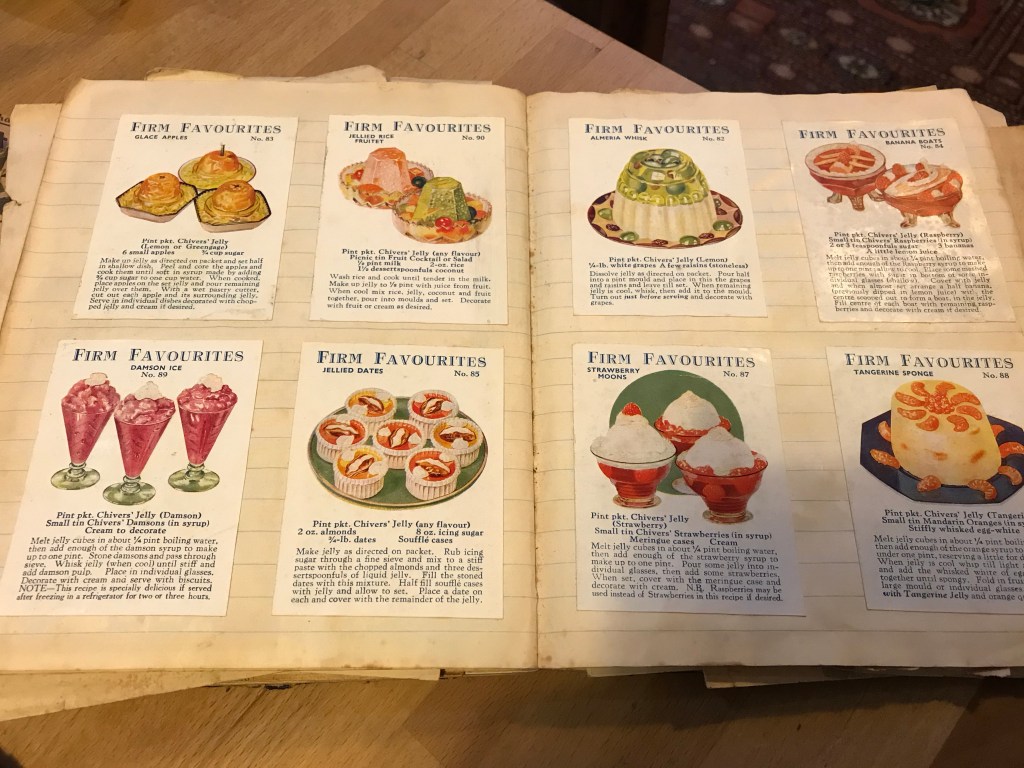
And reminders of the past, and that jelly is something to be enjoyed:

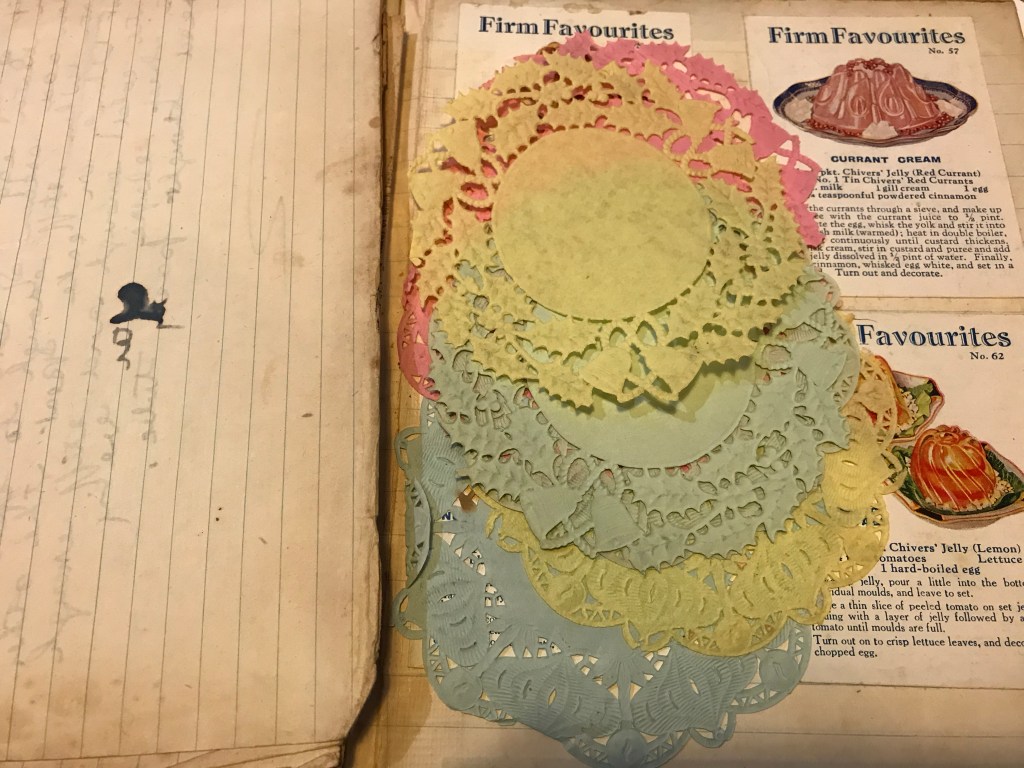
And even these paper doilies ( not a word I expected to be typing in 2019) are in the back – just put there by someone expecting to use them sometime soon…..

I have no idea who the author(s) of this little piece of culinary and social history are.

No doubt they are women. Were they related? How come the book has gone from one to the other?

Did all the people involved have a very sweet tooth?

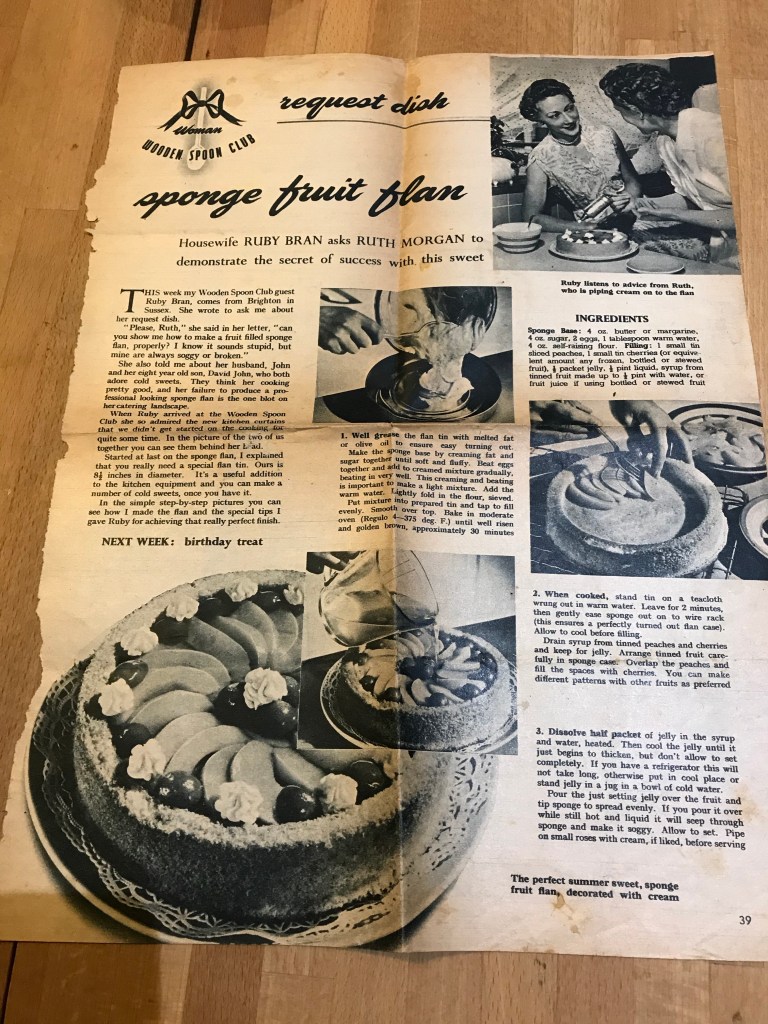
Given that this book has come to us in Petersfield, not 50 miles from Brighton, and is a book of very largely, very sweet recipes, I do just wonder if Ruby Bran has anything to do with this book.

And I do just wonder whether the translation of American and British measurements meant at least one of our authors was a GI bride. If so, she left her cookery book behind and I am very grateful to have seen it.

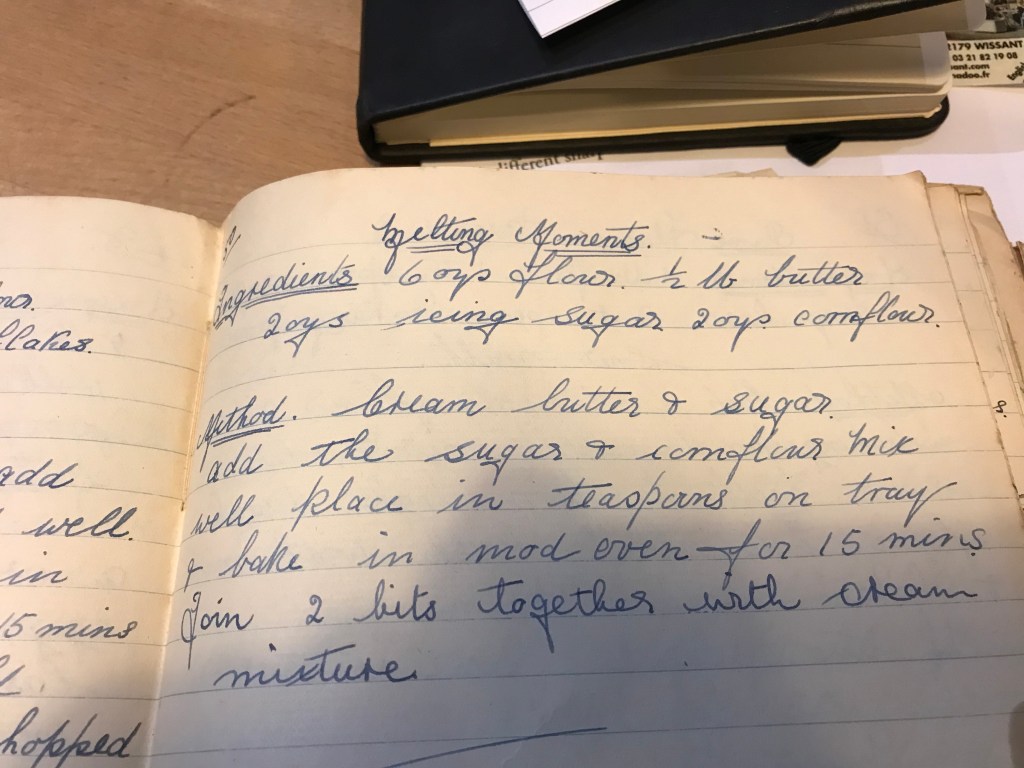
PS Melting Moments:


Chafing with Frank

It has been a while since I sat down to write something which wasn’t an application for money.

Before you think that Deepest Sussex and its reluctant housewife have been plunged into penury, roasting badgers and growing lentils, I would like to say that this is money for a work project.

And that is something I have not been able to say for some years.

So along with all the usual stuff of life I, maybe, just maybe, be about to embark on a lovely, sparkly new work project- but there is many a slip between cup and research funding so will be biding my time and just hoping.

Meanwhile, the Oxfam bookshop carries on and I cook, and the two sometimes come together.

The aga is back on – though the weather has hardly justified it up until the last few days, I don’t care.

And when stuck on how to construct just the right paragraph for the money proposal, I will always go and rustle up a soup, or a supper, and sometimes will rustle among the dead geraniums and prop up a dahlia or two.

I have a lot of cook books and they fall into categories:

Ones I use a lot

Ones I use one recipe from 

Ones I used to use a lot

Ones I would like to cook from but am intimidated by ( see also Yotam Ottalenghi’s Guardian recipes for which buying the ingredients in Petersfield is a hopeless task. Think Odysseus or The Lord of the Rings in terms of difficulty and length of mission.)

Impulse buys from Oxfam – which tend to sit there for a bit then get taken back to the shop and re-sold.

And a grey folder with all those recipes I have ripped out of magazines, sent to be by my mother, scrawled on a envelope by a friend, wrestled from a chef in a restaurant…..

But I am a sucker for a cookery book and a great book title.

This is written by a man, Frank Schloesser, and brought to the public by the delightfully named publishers Gay and Bird in 1905.

( Apparently they published 113 books which included Frank’s other book, The Greedy Book, but also such interesting titles as Japanese Girls and Women, The Arab, The Horse Of The Future, Penelope’s Irish Experience and then her Experiences in Scotland – the mind boggles.

My favourite title is a book by one John Cutler: On Passing Off. The Illegal Substitution Of The Goods Of One Trader For The Goods Of Another Trader. Splendid! )

Back to Frank and his plans to convert the world to cooking with chafing dishes.

( From Wikipedia:

A chafing dish (from the French chauffer, “to make warm”) is a kind of portable grate raised on a tripod, originally heated with charcoal in a brazier, and used for foods that require gentle cooking, away from the “fierce” heat of direct flames. The chafing dish could be used at table or provided with a cover for keeping food warm on a buffet. Double dishes that provide a protective water jacket are known as bains-marie and help keep delicate foods, such as fish, warm while preventing overcooking.)

He explains that a chafing dish means that you have more in the way of tasty morsels than huge helpings of food, and quotes a Chinese proverb which says that ‘most men dig their graves with their teeth, meaning thereby that we all eat too much. This is awfully true and sad and undeniable, and avoidable.’

I have to say it is both undeniable in our house and we haven’t got round to the avoidable bit yet.

He doesn’t take his light suppers lightly and quotes Ruskin ( who knew Ruskin knew anything about domestic cookery.)

There is a chapter on Preliminaries which includes not only the recipe for Jellied Ham but an idea of what you should eat before and after different kinds of theatre experiences:

I am at a loss to know whether and East Room menu might be Indian food? And as for an A.B.C shop, I need a friendly food historian to tell me.

And Frank is a friendly food historian. His recipes are peppered with interesting historical references.

But he is also stern:

‘ By the way, in cooking soups, as indeed in all Chafing-Dish cookery, I cannot too earnestly insist upon the use of wooden spoons for all stirring manipulations. Metal spoons, even silver, are abhorrent to the good cook.’ 

And insists on ‘ the most scrupulous cleanliness…..

‘The Chafist who neglects his apparatuses unworthy of the high mission with which he is charged, and deserves the appellation of the younger son of Archidamus III, King of Sparta.Cleanliness is next to all manner of things in this dusty world of ours, and absolutely nothing conduces more to the enjoyment of a meal that one has cooked oneself than the knowledge that everything is spick and span, and that one has contributed oneself thereto by a little extra care and forethought.’

( And, no I have no idea what Achidamus’s son’s appellation was.)

I have looked through Frank’s recipes and although I am tempted by some including The Alderman’s Walk ‘a very old English delicacy, the most exquisite portions of the most exquisite joint in Cookerydom, and so called because, at City dinners of our grandfather’s times, it is alleged to have been reserved for the Aldermen. ( It is a saddle of Southdown mutton done in a sauce with bread.)

I am less entranced by the idea of eels with nettles though Frank assures me that ‘they give a peculiar zest to the dish which is quite pleasant.’

As for Frank himself, I can find nothing about him. 

I know he went on to the write The Greedy Book and they are both still around in second hand book sites, but of Frank there is nothing in Wikipedia or easily found.

I am sure there are food historians who know all about his Gallimaufrey and Ham in Hades, and love his short essay on the merits and otherwise of sauces, and could tell me everything from his boyhood onwards and if so, could they let me know.

Frank and I are cookery friends though I am not about to invest in a chafing dish however a useful present it would be.


Village Life Part Two

So, if you read the previous blog you will have seen me raise a quizzical eyebrow at the woman who said she was so looking forward to village life where everyone was equal and everyone joined in everything….

More vignettes from the village festivities:

One:

A stallholder arriving and asking where was her chair, her table ( neither of which she had asked for/ordered/paid for) her help to get stuff from her car, and someone to help erect her gazebo ( none of which we have people on hand just waiting to do) and, by the way, where was Tim. 

‘Tim’ I asked, ‘Do you mean Tim running the bookstall? because I think he is sorting books.’ 

‘No,Tim my son’

‘I’m sorry I don’t know your son.’

‘Really? you don’t know Tim. Have you lived here long?’

‘Nine years.’

‘Well, when you see him, please send him to me immediately.’

Two:

Most of the village street has pavements either side but there is a stretch with houses and no pavements, and that makes it difficult to walk into the village without flattening yourself against a wall as posh cars on their way to Goodwood, or indeed many other vehicles on their way somewhere or another, come through.

At 8 am as the street was closed, a man stepped down into the road and stated painting his wall.

‘Nice day for it’ we said as we walked past.

‘The only bloody day for it’ he said.

Three:

A phone call at 9pm a day or two before the festivities.

‘Just checking you can organise me a lift.’

It turned out the caller was a man who sells homemade stuff and lives in the outskirts of the village and is no longer allowed to drive.

I was not sure that organising a pick up was in my remit but the Best Beloved said he’d do it.

Delivered, and set up, and sold out by early afternoon, I decided it was best to get the man home safely.

Called my Best Beloved who was on the Downs with the dog and asked him to come and get the chutney man.

A few minutes later BB called to say he had fallen and badly sprained his ankle so no, he couldn’t do pick ups and deliveries.

So, now I had a man waiting for a lift home, and an injured husband.

I grabbed the son of friends, handily having a nice time at the event and not looking like he was about to do anything important, and asked that he would walk man down the street, wait with him whilst I got my car, and I would collect him, deliver him home and then drive to find my injured BB.

He did that with a lovely good grace and all was done.

Man was delivered hime safely. BB delivered home, bag of peas on his ankle and me back to the festivities.

Now, if I tell you that the badly sprained ankle turned out to be a pretty serious and unusual injury and needed two hours of surgery to fix, there was various and somewhat eccentric other stuff around the homemade stuff man which involved a mysterious bottle of martini, you might begin to think, ‘there is more to running a village festivities than I would have imagined’ and you’d be right.

Inside A Book

One of the things about working in the Oxfam bookshop is that you don’t often get chance to really look at the books.

For a start, there is always a mountain of incoming donations to sort, and sift, assign, and price, and display.

Then there are the collections we need to build up to make a good table or window display – if the title fits put it in the box and keep on going.

And then there is making the shop look good, and then, and then, and then.

So, looking in detail at books is a rare pleasure and often outside the shift hours.

This is the story of one book and the people involved in it – at least as far as I can find out.

The Bridge of San Luis Rey by Thornton Wilder. Not a first edition – that was 1927 – but the 1931 edition illustrated by Clare Leighton (and owned by someone called Leopold Horwood.)

Clare Leighton

I would like to tell you a bit more. Though not about Leopold as I can’t find anything about him…..

This is the American writer’s second novel and he won the Pulitzer Prize for it. (The commercial success he got from the book meant he could give up being a French teacher and concentrate on writing.)

It tells the story of several interrelated people who die in the collapse of an Inca rope bridge in Peru, and the events that lead up to their being on the bridge. A friar, who witnesses the accident , then goes about inquiring into the lives of the victims, seeking some sort of cosmic answer to the question of why each had to die. ( Wikipedia)

Meanwhile, as they say, Clare Leighton was born in 1898 (died in 1989) and lived her early life in the shadow of her older brother – her family’s nickname for her was the bystander. (That must have helped her self confidence.)

(He was Roland Leighton and despite being described as rather cold and conceited by his friends, he fell in love and got engaged to Vera Britten and was immortalised in her Testament of Youth.

He died aged 20 in the World War One and his grave has one of his poems to Vera inscribed on it.

But this is not about him, but his sister. We have one of her woodcuts hanging about our coat rack.

She did her first training at Brighton College of Art – which is the only link I can find to Deepest Sussex but it will get a mention when the book goes on sale as we like a local link.

(Clare Leighton met the radical journalist H. N. Brailsford in 1928,and they lived together for several years because his wife refused him a divorce.

But when the wife died in 1937, leaving the way clear for the couple to marry, he suffered an emotional breakdown, destroying his relationship with Clare Leighton who left for a new life in the US in 1939 and eventually became a naturalised American citizen.She never married. )

She had a fascination with the countryside and her woodcuts are often of rural people and scenes.

One of her most famous books – The Farmer’s Year – was published by Longmans Green which also published The Bridge of San Luis Rey.

And that is the only connection I can find between Leighton and this book. Perhaps she owed them a favour, or was asked by a very nice member of staff or perhaps she did a deal with them.

It is just that if you look at these images they jar slightly and though dark, like most of her woodcuts and clearly by her, they don’t seem to work – at least not for me.