One of my favourite books for dipping into is Brewer’s Dictionary of Phrase and Fable.
My best Beloved introduced me to it and if you too have not come across it, nip into your local Oxfam bookshop and they will have a copy (or several), trust me.
So, it was originally published in 1870 and compiled by the delightfully named and bearded Ebenezer Cobham Brewer.

It is described as a reference book containing definitions and explanations of many famous phrases, allusions, and figures, whether historical or mythical.
The delight is not just the juxtaposition of unrelated phrases, people, sayings etc only brought together by the alphabetical order, but how often you are referred somewhere else when you look up something….


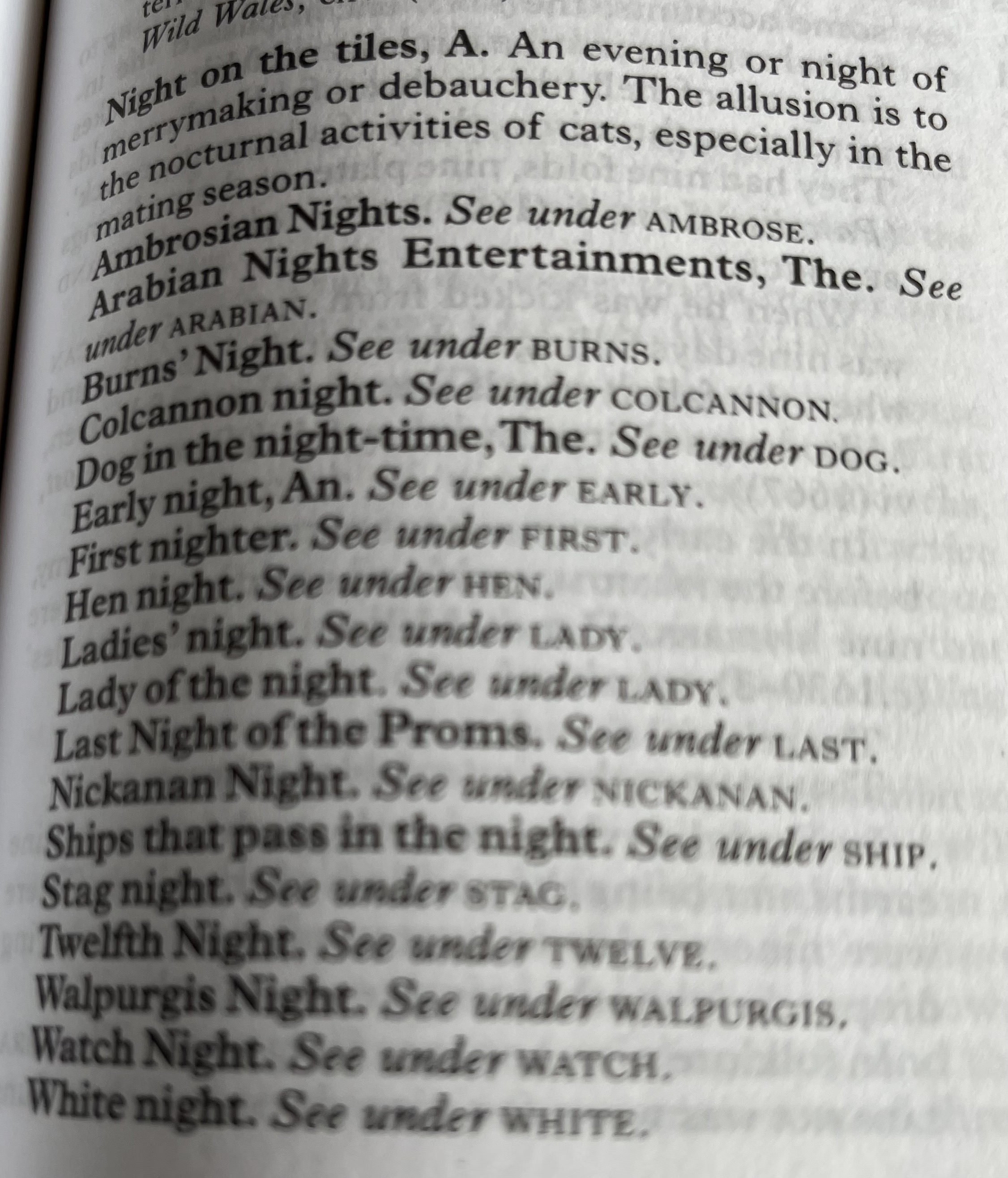
I am not sure why ‘night on the tiles’ gets its explanation and we are not sent off to ‘see tiles’.
Mind you, a page that is Nightingale, followed by Nightmare, followed by Nihilism, followed by Nike ( who, by the way, is the Greek winged goddess of victory – not a trainer.)
I have the edition published in 2001 so it contains some entries I am sure Ebenezer would not have included:
Nicknames of drugs for example. Not being an expert, I am not sure which are still valid but I am pretty sure Brewer would not have recognised Charlie, coke, crack, dust, flake, freebase, leaf, nose, rock, snow.
However, he might have felt more at home with the entry for Niminy-Piminy.
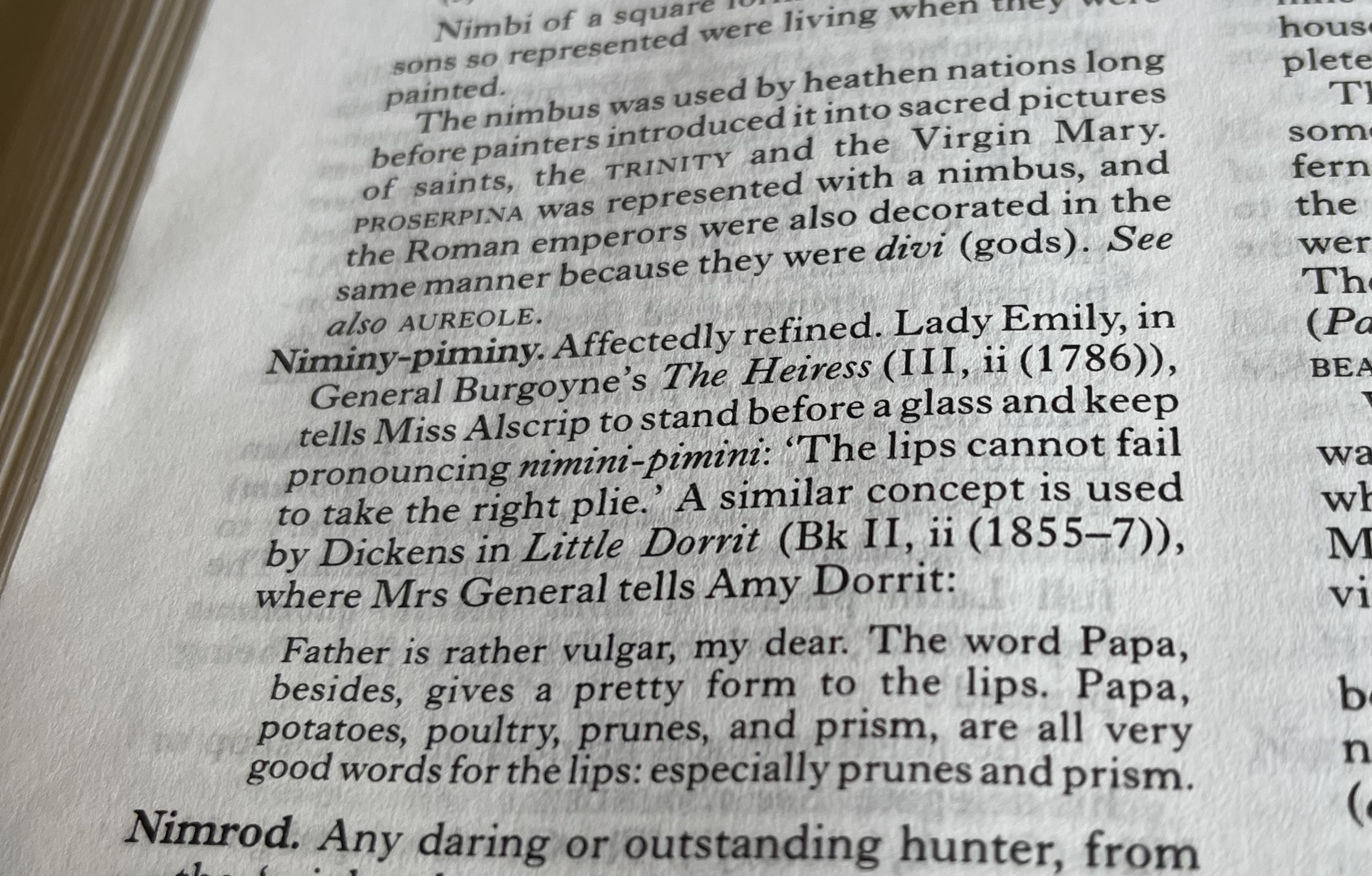
(An explanation to which you are referred should you look up prunes and prism – which of course you might well have been tempted to do.)
There is Pantisocracy, followed by Pantomime, followed by Pants. Ants in one’s pants see under Ants, Hot Pants see under Hot.
Salts of lemon see under misnomers.
And when you get to misnomers, you find that salts of lemon are ‘in reality potassium acid oxalate.’
And that comes before ‘Slow-worm: neither slow nor a worm.’
As you can see, some of the entries are rather sharp and short whilst others are rather more obscure, detailed and lengthier than they might be – for example, four paragraphs on Mise:
“ A word to denote a payment or disbursement, and in particular the payment made by County Palantine of Chester to a new Earl….’ and so on and so on.
When you look up Poison – a word you would think could fairly well use up a few paragraphs of its own – you are referred to Mithridate.
And the entry tells you:

Meanwhile, back to poison, you get definitions of Poison-pen letter, Poisoned Chalice, Poison Pill but then you get to One man’s meat is another man’s poison and you get told to go and look under ‘one.’
For ‘what’s your poison’ you have to thumb through until you get to the entry ‘What.’
Of course you do.
Anyway, I could happily spend hours going backwards and forwards to entries.
But what sparked all this was the appearance in our Oxfam bookshop of a niche little book.

( Yet again proving, if you wait long enough, you will see a book on every subject under the sun.)
Compared to the weighty tome which is my Brewers, John M Senaveratna has produced a very slim volume indeed.
Perhaps he had less to work with, though you might think that a list of subject matter which includes everything from adages to folk tales might have provided more.
Anyway, to make things even more interesting he has included a rather odd bookmark – at least I suppose it is a bookmark.
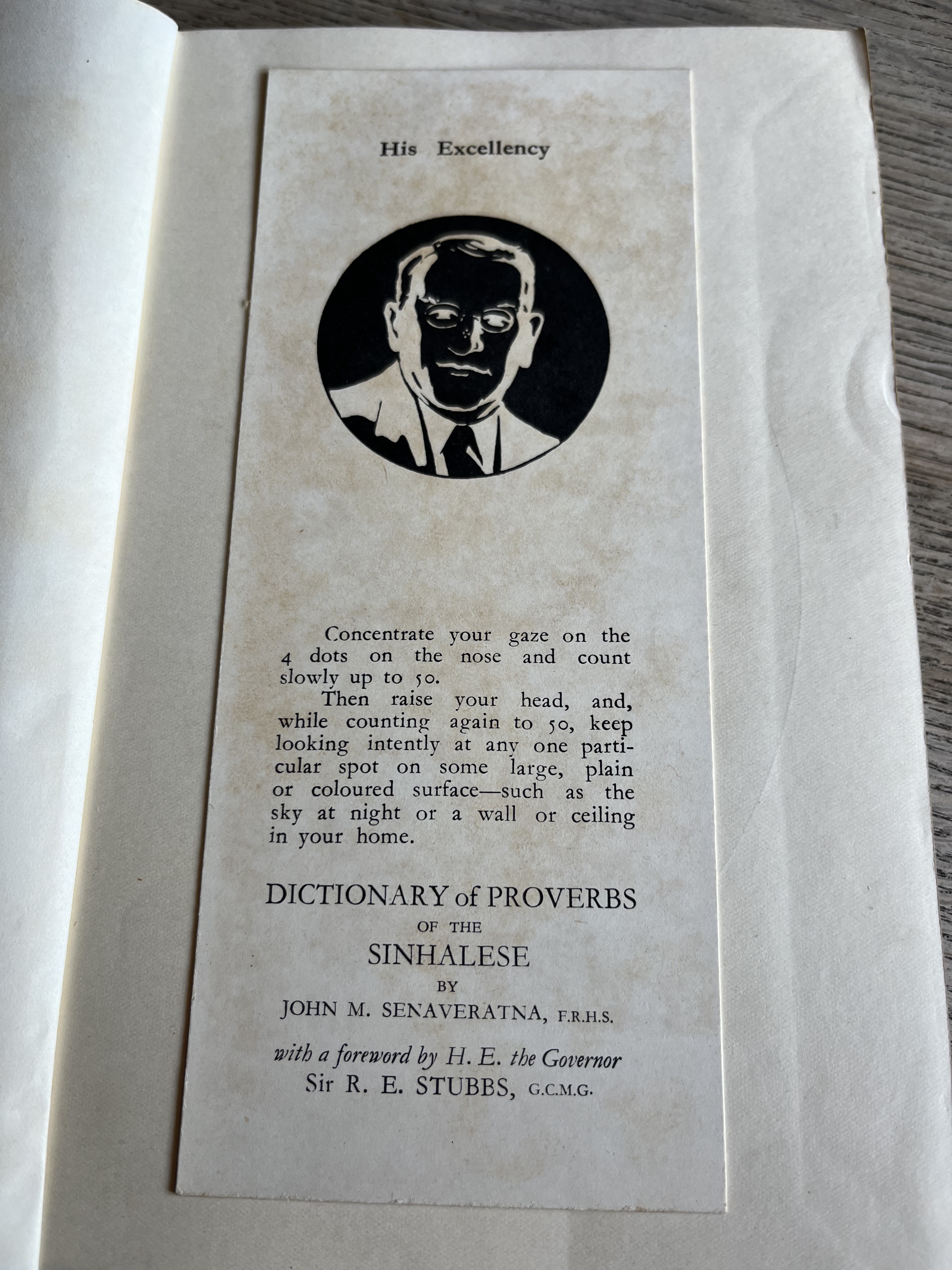
The forward is by the Governor Sir R E Stubbs, who my researches tell me was the British Governor of what was then Ceylon and is now Sri Lanka, from 1933 to 1937.
And he had had a similar role in Jamaica, no doubt explaining his knowledge of cats and prickly pears.
John, ( I am going to call him that as typing out his surname all the time might well become tedious) starts on a very Brewers note with his first entry:
‘Abode.The bat visiting another bat’s abode – see Bat.’
There are plenty of other such referrals:
There are four pages of referrals on Like.

Quite a lot is rather obscure, unclear or downright baffling, even with the explanation:
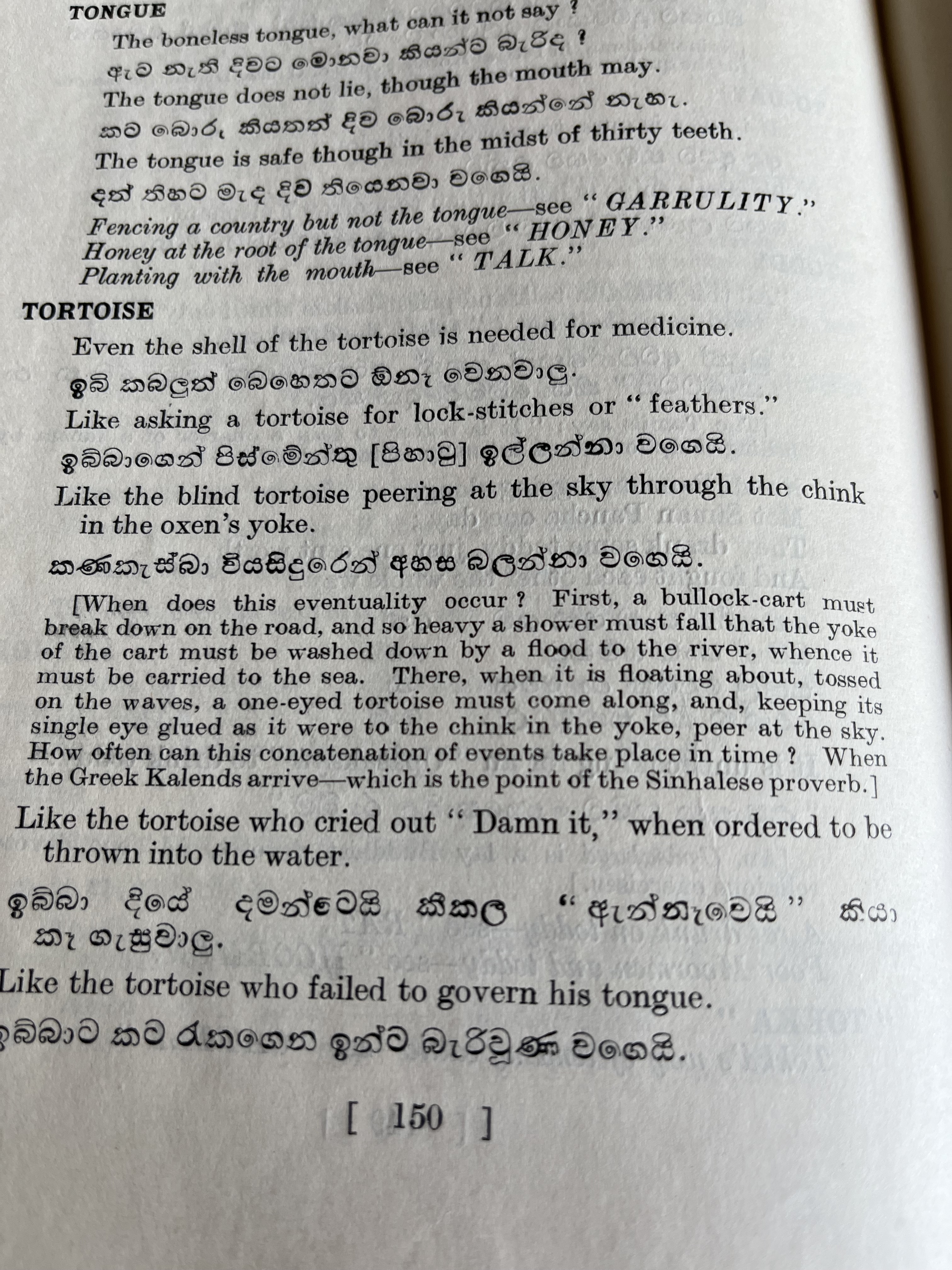

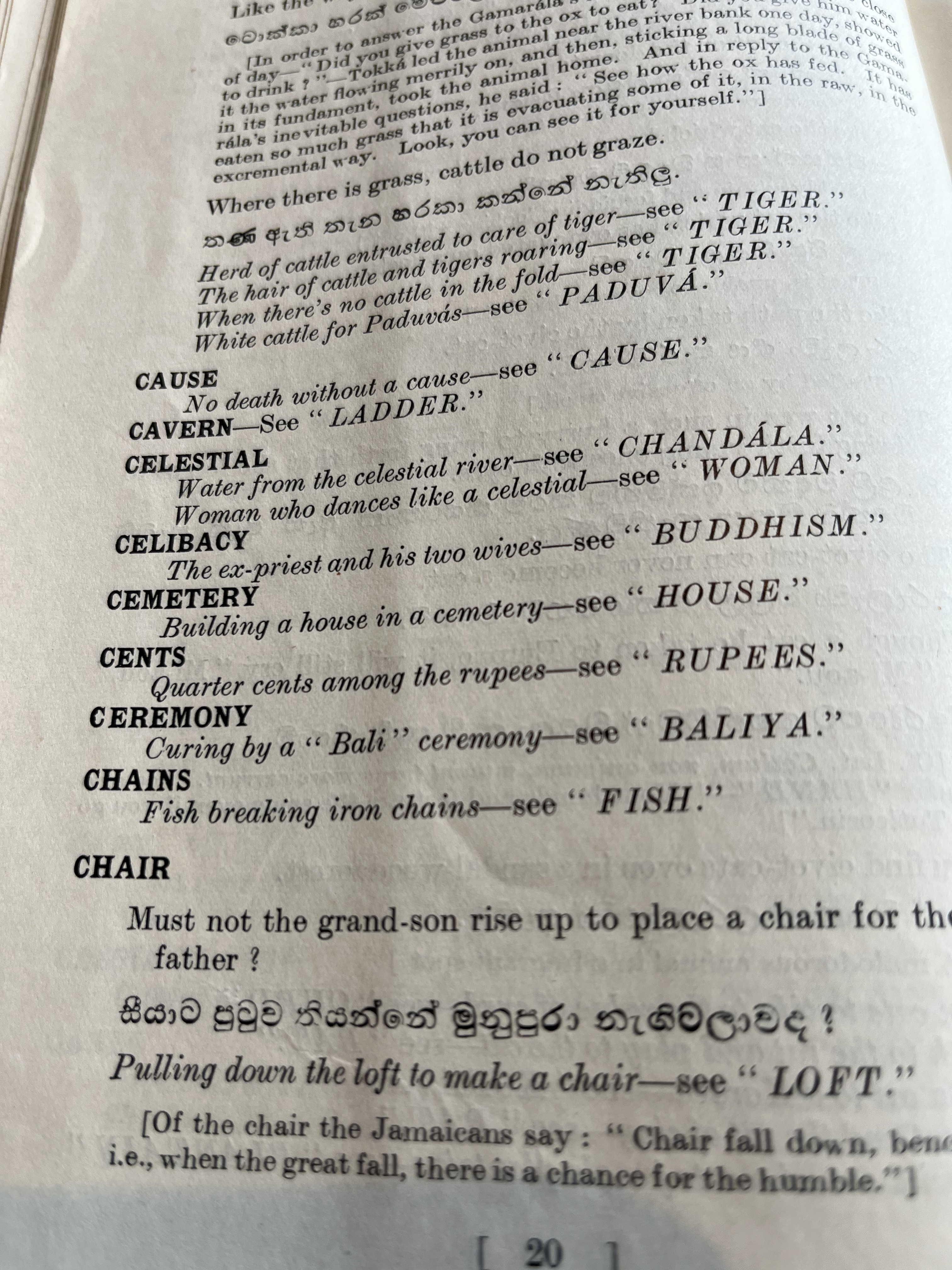
‘The swelling of a finger must be proportioned to its size’ which apparently means ‘cultivate a sense of proportion.’
‘For those who cried standing we should cry standing; for those who cried sitting, we should cry sitting.’
Quite a few of them under Sinner:
‘The sinner will not take up a book, but will carry a load.’
‘What sago congee for sinners?’
‘Wherever the sinner goes there is a hailstorm.’ A variant is apparently, ‘ There is a certain to be a hailstorm when the unlucky man gets his head shaved.’
Some of them are what we might describe as culturally specific:
Slave ‘Better to be born a slave than the youngest in the family.’
‘Mother: Like placing blocks of wood before mothers ( who have borne children.)
( I have no idea, and there is no explanation from John.)
‘Mad: Like the mad woman’s bag of herbs’.
‘Death: When a man with projecting teeth dies, you feel doubtful of his demise.’
Country: In one country you cannot yawn, in another you cannot clear your throat.’
Clearly, some needing a more detailed explanation:
And some just seem to be stating the obvious:
‘Hip Bone. Boxing cannot cure a dislocated hip. see Boxing’
( Mind you if you do go back to Boxing, you find ‘ Can boxing cure a dislocated hip?’ mmm)
Or
‘Horoscope:What is the use of consulting the horoscope when the man is dead.’
Well on that note, and if you have got this far, I hope you be able to impress your friends with a nonchalant dropping in of a Sinhalese proverb or two.
See under ‘dropping’.
 thereluctanthousewife