We recently went to Krakow and that meant – at least for us – we had to go to Auschwitz.
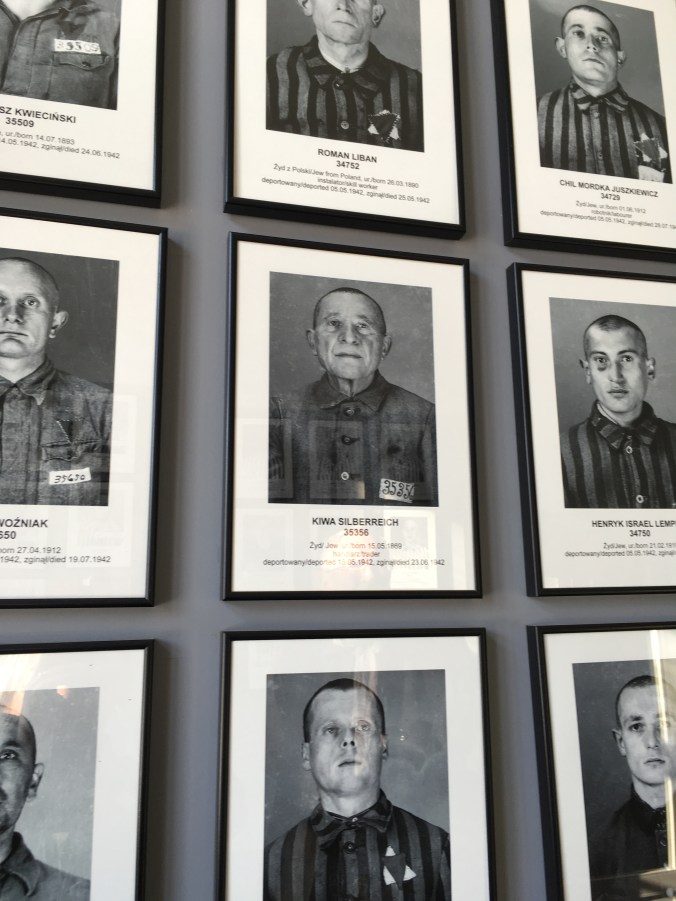
At this point, I am going to tell you that I am not going to write about what I saw and felt there, because I cannot ever match you watching a newsreel from the time, hearing real life accounts, reading a Primo Levi book ……going yourself.
So I am just going to tell you about the bus trip to Auschwitz.
We didn’t do one of the many organised tours and decided to get there and back under our own steam as it were.
We had been advised (via the internet) to get there early to avoid the arrival of massed crowds of people on coaches.
So, we went to the bus station by 7am and got a seat on a minibus – de-regulation of buses has really got going in Poland.
The ‘bus’ took just over an hour to get there and looking out of the windows I noticed, particularly, a couple of things – the houses, and the number of learner drivers.
The houses were larger and more had more space than ever would be the case in Britain unless you were looking at the richer part of an area – and maybe we were.
(Given that we were heading to Auschwitz, I rather hope that the outskirts have not become a des-res area…)
They were mainly detached and large – I mean I looked at them and thought ‘five bedrooms, maybe six even..’
And the Poles ( at least in this area) are not gardeners.
Their gardens were grass (at best) with a boundary demarcated by – and brace yourselves – all too often by leylandii.
Occasionally you would get a bit of topiary…. but where were the kitchen gardens, the fruit, the veg, the stuff that would feed the (I am guessing, given the size of the houses) three generations of the family?
In other (yes, I admit) Mediterranean countries, you could not go anywhere without seeing stuff even in February poking their veggie shoots through the soil – but not in this part of Poland.
And I have no proof, but I am guessing that these gardens did not have flowers in spring and summer – there certainly didn’t have evident flower beds.
Now perhaps if I went back in the summer, there would be an abundance of produce but I have to say I doubt it – no evidence of raised beds, tilled soil, in fact any interest in the outside at all.
The first learner driver I noticed, with mild interest, had an L plate up on the top of the car – signalling for all to see that here was someone who needed to be treated with road care.
And then there was another one, and then another, and by the time we had gone there and back, I had counted more than a dozen learners out and about on the roads between Krakow and Auschwitz.
Is this a learner driver specialist area? Are there a lot more learner drivers in this part of Poland than anywhere else? Is this a particularly good place to learn to drive?
Why don’t the Poles interest themselves in vegetables and flowers in their gardens?
Who knows?
Despite the fact that our driver had spent 13 years living in Bath, I didn’t get the chance to interrogate him – in his very good English – as to why there was a surprising preponderance of learner drivers and no vegetable and flower gardening.
When we got to Auschwitz we were indeed just ahead of the coach arrivals, and had the place more or less to ourselves, but as we were leaving, they were arriving.
As we headed to the bus stop go back, we saw coach arrival after arrival.
One group were Israeli schoolchildren, and all their coats had bright green stickers on them.
Of course it was to make sure they din’t get lost or mixed up with another group but the irony of ‘labelling’ Jews with identifying stickers on their way into Auschwitz stuck with me.

 thereluctanthousewife