We, like the rest of the world it seems, loved The Queen’s Gambit but there is a small, but oh so significant in our house, caveat.
Why would Beth would arrive back from one of her many chess triumphs (during which, especially in Paris,) she was wearing some amazing outfits, was she carrying small – and more importantly – empty suitcases.
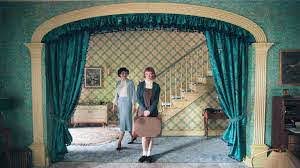
She is not alone, I have to say.
There are empty suitcases being carried by actors in hundreds of films – indeed we rarely watch a film without the Best Beloved harrumphing at a clearly empty suitcase.
Recently, on a wet afternoon diverted from gardening to binge film watching, Helen Hunt and Jack Nicholson played about with empty suitcases in As Good As It Gets.
Previously, in To Catch A Thief when a youthful Leonardo di Caprio, who surely could manage to carry a suitcase with a little bit of stuff in it, swung an empty case as he strode along.
And that is to name but two.
(So, our film watching is punctuated by a combination of who can spot the empty suitcase first and name that actor.
‘Oh, that’s the woman who ran the antiques shop in Three Billboards, isn’t it?’
‘He was in that thing we watched, you know that thing with what’s her name from that thing based on JK Rowling’s book, Strike, that’s what it was – what was she called?’ )
It turns out we are not the only people to note empty suitcases – mentioning this to my good friend on a dog walk this morning, she was, well I can only say, enthused, that the BB was the other sensible soul in the universe who got outraged at an empty suitcase.
So, why when film makers expend a great deal of time, energy, effort, thought and money on making something look so real, do they fail to manage to get even a few clothes in a suitcase?
I stated to google about and looked up the role of continuity. I am no film expert but I would have thought this issue might fall into that bag (or case.)
Apparently, I was wrong and if you want to wade through some of the more arcane/academic explanations of continuity you could go here https://www.ncbi.nlm.nih.gov/pmc/articles/PMC3208769/ where you can find sentences like this:
‘These camera shots are often filmed at different times and locations and may have little feature overlap, and as such, flow of information across shots often bears little resemblance to the perceptual flow of information as we interact in the real world.‘
But just in case you don’t, here is a short version, ‘Continuity in filmmaking is the practice of ensuring that details in a shot are consistent from shot to shot within a film scene. When there is continuity between shots, then audiences have a greater suspension of disbelief and will be more engaged in the film.’
Now, the problem with blaming continuity, is that you don’t get a shot with a proper heavy suitcase and the next time you see it, it is as light as a feather – they are always like that.
Presumably can’t be props as they must just supply the suitcases….
So, who knows who is responsible?
I googled ‘empty suitcases in films.’
It turns out I am not alone in trying to find an answer:
From The Guardian in 2013 in a section described as
‘Readers answer other readers’ questions on subjects ranging from trivial flights of fancy to profound scientific concepts’
John Benseman, from Auckland, New Zealand asked,
‘Given all the care that film-makers take to make things realistic, why do they never seem to put any weight in the bags and suitcases that actors carry?’
I am really hoping that John Benseman got his answer eventually because no one, not one reader answered his question on The Guardian’s site.
(And I am tempted to ask him as I found him on Google too but that, dear reader may be going a step too far….)
Likewise Mavieen Rows asked on her blog ,where she described herself as a spending life watching movies,
‘This drives me crazy. What is so hard about actually putting clothes in them? Hell, even putting pillows in them would give an extra dimension of “full” that doesn’t exist in a sides-caving-in typical Hollywood suitcase. I want answers!’
As far as I know, she didn’t.
The rest of that google page search is full of references to a film called Empty Suitcases by Bette Gordon and should you need a review:
The “empty” suitcases can be inferred as letting go of all the unnecessary thoughts and feelings of a person’s past. After the film was over Bette Gordon talked about her desire to work with the empty spaces of the frame and put in items outside of the frame of view.
Mmmm, well it will have to be a very long wet Sunday afternoon before I pick that over a re-run of The Railway Children.
So, dear reader I would love to be able to answer the question of empty suitcases but I have found out nothing.
But here is a nice ending:
Apparently, it is a tradition in Colombia to carry around an empty suitcase on New Year’s Eve in the hope that the next year is full of travel and excitement and that over the year those cases will be filled with precious memories…….

 thereluctanthousewife