Bread and Pheasants

I have always thought there is a difference between urban and rural poverty – I only know about the rural side.

We lived in a village and we were sometimes broke, rather than always poor.

There were days when bread and eggs were it for an evening meal, my single mother coming in late from her job and the meal up to me and my sister to create. 

There isn’t too much you can do with eggs and bread, but those times taught me how to look in the fridge and make something out of what was there.

And I had been taught by my mother, who loved to cook and my grandmother whose definition of the heart of the home was to have something baking or bubbling.

We didn’t have food waste issues – we couldn’t afford it.

But we did have cooking skills and that made all the difference. If I had been taught to garden as well as I was taught to cook with whatever we could afford, I’d be opening the (currently a lot less than perfect) garden to the public. 

Currently only Steve, our lovely postman sees much of it. I rest my case.

There is a real difference between broke and poor.

If you are broke, it is a temporary situation and the chances are you have some food stocks – and to this day, when I am neither broke or poor, I have a stock of tinned tomatoes on the basis you can always start a meal with a tin of tomatoes.

(Once when I was living in a posh flat overlooking Tower Bridge, my mother came to stay and opened a cupboard to find my tinned tomato stash. Even she, a woman who knew a few things about making ends meet, thought I might have been a bit excessive in my stockpiling.)

If you were rural poor in my youth, you ate a lot of pheasant, apples, runner beans, potatoes.

Pheasants shot by neighbours or friends would be dropped on our step, vegetable gluts were shared around – we weren’t gardeners but looking back, we should have been.

Whilst a roast chicken was a special treat and my mother’s speciality, Viennese Beef, was only for high days and birthdays, pheasant was a regular. 

So, I am now rural and not poor or broke, or just managing, or dealing with loosing may job  but I have held on to my roots, and am now thinking about what to do with stale bread and a pheasant or two.

I have started volunteering at the Free Shop in Petersfield. (You can skip the next bit if you know about it – I have to say I didn’t until recently.

Anyway, we get food from the local supermarkets which is just at its best before date and gluts from gardeners and allotment holders, and people can come in and take what they want/need for free and that means it doesn’t get wasted.)

We get a lot of bread and I have been thinking about what to do with it. 

I made a bread pudding – rather dense and I am not sure that it has received ecstatic reviews but I will re-think the recipe.

This week, I am experimenting with a savoury bread and butter pudding.

Caramelised onions, tomatoes with herbs, bread and butter, eggs, milk, cheese. All layered and baked.

Meanwhile, yesterday, I was on an enjoyable village litter pick up organised by a ‘new’ local, and yes we got stuff out of ditches and hedges – nice rural areas apparently attract people who want to sit in a car, watch the sun go down and throw their empty bottles out of the window.

(Come and sit, chat, watch birds, do other much more exciting things in your car, but can you take your litter home?

Mind you if you did, what would us middle class people have as an excuse to socialise and be outraged at the same time.)

Anyway, I was talking to the man who organised said litter pick and he and his wife are thinking about setting up a project to get the ‘excess’ pheasants to people who needed a helping hand.

Now, I am not sure that the people who come into our Free Food Shop would pick up a pheasant but I bet they would if it was in a pie or a casserole….

So, for that we need a fridge, and I have possibly got to move from hygiene level 2 to 3 – watch this space.

This takes me back to my youth, so I am up for it.

I need to crowd fund a commercial fridge ( £1,000). I need to work it all out but I think it might work.

Anyone know about crowd funding – I’ve never done it before?

And before I forget – urban poverty…

Some years ago, I spent time with the CEO of Lewisham Council. We were talking about nutrition and food.

He told me to think about what it was like to live in a high-rise flat as a single parent, with two young children, to get to the bus stop with them, change buses and get to Tescos with two tetchy kids.

Then you could see that buying in bulk would be cheaper in the long run but you don’t have the money to buy in bulk.

You don’t have the ‘training’ to cook so it is all seriously hard work, and whatever you buy you have to take home on those buses with your kids.

How much easier it is to go to Costcutter and buy a pizza. 

And who could blame that parent.
From books to beans

Looking for an alternative to Oxfam, no one who knows me well will be surprised to learn,  I have turned to food.

My grandmother who taught me, among many other things to make good pastry, and was no mean cook – her meat and potato pie was a legend in our family – was also of the generation who thought food waste was a crime.

My mother was a more adventurous cook – my grandmother thought olive oil should be bought from the chemist, and warmed so cotton wool could be dipped in it and put in your ear to sort out earache. My mother wanted to make an interesting salad dressing.

So, with these inheritances, I am embarking on a new volunteering career campaigning against food waste.

( Living on the cusp of Deepest Sussex and Hampshire, I contacted both county councils and Hampshire won hands down – a phone call a day later and a friendly and welcoming man talking to me about how welcome I would be – Sussex, not a word…)

I know quite a but about rootling around in the back of the fridge and finding a few ingredients which need using up – a poor childhood with a mother and grandmother behind me, worked wonders.

But if I am honest, I waste more food than I would like to.

At the start of lockdown, I was really good.

The fridge ( like the rest of the house) was cleaned and organised within an inch of its life ( that I must add, was a one-off.)

And I couldn’t nip into Waitrose at the end of an Oxfam shift to pick up a little something for supper. No Oxfam, no Waitrose, no driving anywhere….

Getting a few things added to next door’s Occado delivery was a heady delight.

And not a thing went to waste. 

But now, for the moment, things are easier and I am being more free and easy with my stocks.

Neither have I ever learned much about food waste except to know there is a lot of it and it isn’t good.

So, if dear reader, you have got this far and only really read my blog for interesting books stuff, now is the time to (hopefully) regretfully turn away.

Thanks to a friend here is a link which might you stop and think – only read if you are a meat-eater – 

https://www.theguardian.com/world/2020/aug/09/shelf-life-of-21-days-or-more-could-save-red-meat-waste-say-uk-industry-bodies?CMP=Share_AndroidApp_Outlook

Who knew?

I will be talking to my local butcher about this.

Meanwhile, here is a recipe based on a desire not to waste food and the belief that a tin of tomatoes can be the basis of a hundred meals. ( I am lucky and therefore buy good quality Italian tins, but I can see Jack Munroe wincing as I write.)

Since lockdown, I have supplied some friends and neighbours with food – I can cook for four as well as for two and not everything will freeze so they have had my surplus.

I say that because my neighbour loved this.

We have grown french and runner beans this year. I was not a fan of runner beans until I ate them in Greece last year. And we now have a glut and I wanted to make something using them.

The Greeks cook them long and slow in a tomato sauce.

( Yes, garden space to grow veg, shopping in Waitrose, holidays in Greece – they are not a precursor to cooking this but I do realise how privileged it all is.)

Anyway, my friends and neighbours will attest to the fact that I rarely have a recipe so I will just talk you through it.

Aubergine Pie

So this is a pie which uses aubergines instead of pastry. You can fill it with anything you like – I have done lamb and mint, courgettes and lemon, sausages removed from their skins and broken up to cook with mustard and greens…… this version is vegan.

All you need to remember is that you need a tomato sauce and to make the filling thick enough to cut into ( maybe a bit sloppy) slices. Pasta helps with that but so would potatoes, lentils or just a sauce packed with vegetables or meat of whatever kind you fancy.

For four people:

Make a tomato sauce.

Fry some onions slowly for a while ( say a gentle heat for 20 minutes) then add some garlic to taste, some dried oregano to taste, or any other herb you fancy – fresh or dried. The only thing I am sure makes all the difference is a couple of bay leaves.

Add a tin of tomatoes, and keep the tin to one side. Cook, stirring and add some salt and pepper and/or my favourite Marigold bouillon. 

You need a thick sauce but you may need to rinse the tin of its last dregs of tomato-ness with some water to make a sauce not a burnt offering.

Of course you can make or use any tomato sauce you fancy or have.

Take the stringy sides of the runner beans and chop into any size you like, along with chopping up any other green beans you have.

Boil for a few minutes, drain and then put into cold water to keep them nice and green.

( If you have no green beans to hand, think about a tin of butter beans, or any other beans you have in a tin at the back of the cupboard.)

Add to tomato sauce and keep cooking until everything is nice and soft – this is not a recipe for crisp veg and indeed runner beans are not nice like that if you were of a mind to ask me.  

Stir now and then whilst you are doing something else – I have some good book recommendations and you could easily get through a chapter whilst this is cooking.

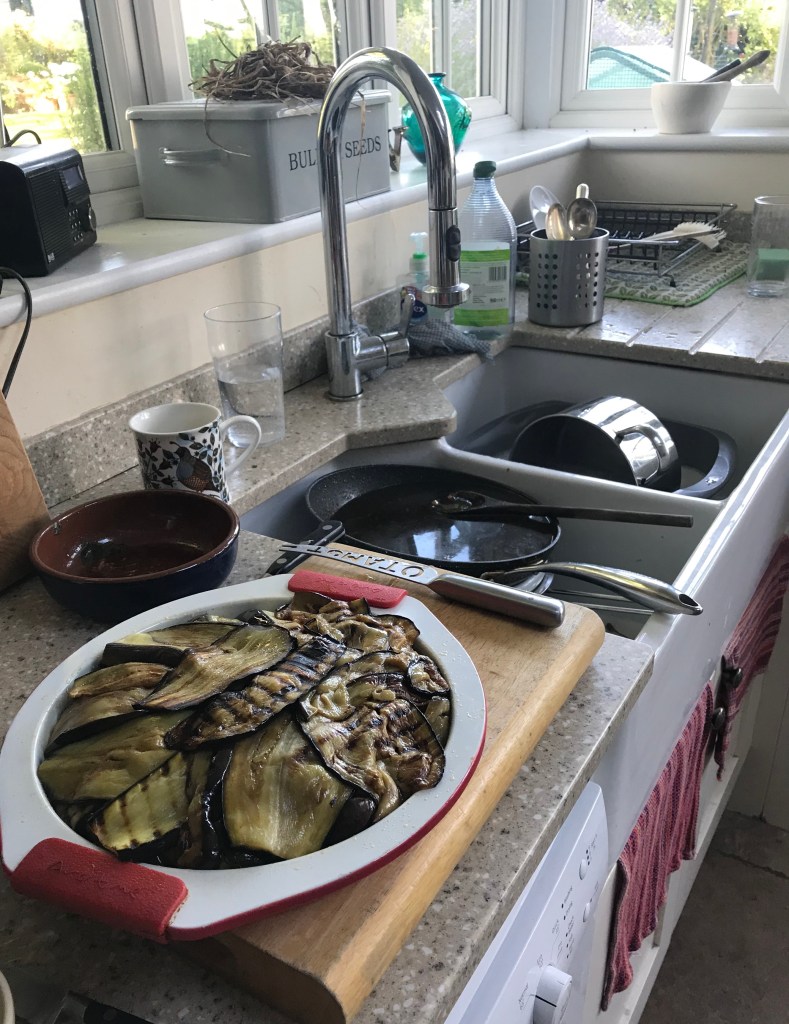
Take four aubergines and slice them lengthways and thinly. Doesn’t matter if they have been in the fridge for a while but is nicer if they are fresher.

Heat a griddle pan on a medium heat for say five minutes if you have one, or a frying pan. Brush one side of the slices with oil.

Put in the pan oil side down. When they are softening and there is not much less good to eat than an undercooked aubergine – brush the dry side with some more oil.

When they are cooked put to one side  and get on with the rest of them.

When they are all cooked get a flan or cake tin or a dish.

Lie some of the aubergines on the bottom – pretend it is the pastry bottom of a pie. If you have a small dish or enough aubergine slices, you can bring them up the sides.

Then cook some pasta – short of any kind, broken up spaghetti, tagliatelle or whatever. 

Pasta/sauce ratio is up to you, but bear in mind you want to be able to cut the finished rest into slices

Add a the pasta to the tomato sauce with a drop of the pasta cooking water if the sauce will take it without turning too runny.

Stir and pile on top of the aubergine slices. 

Cover with the rest of the slices. Drizzle some oil on the top or indeed, if feeling flashy, some grated cheese.

Put in the oven at 180 fan and leave for about 20 minutes or half an hour.

Eat hot or cold and send a slice round to the neighbours and then wait for appreciative comments.

Two things I have learned so far:

Blimey, it is hard to write anything approaching a recipe if you didn’t start with one. 

I am not a food stylist. See below