Another bit on niche books – attractive to my only Vice Admiral (and Sir) reader, I would guess.
So, if you are not into ships/boats/history/niche books, now is the time to walk away.
And after this, I maybe off to a blog on pickles – I bet you can hardly wait.
Right, now we are off to the Falklands.(Or Malvinas if you prefer.)
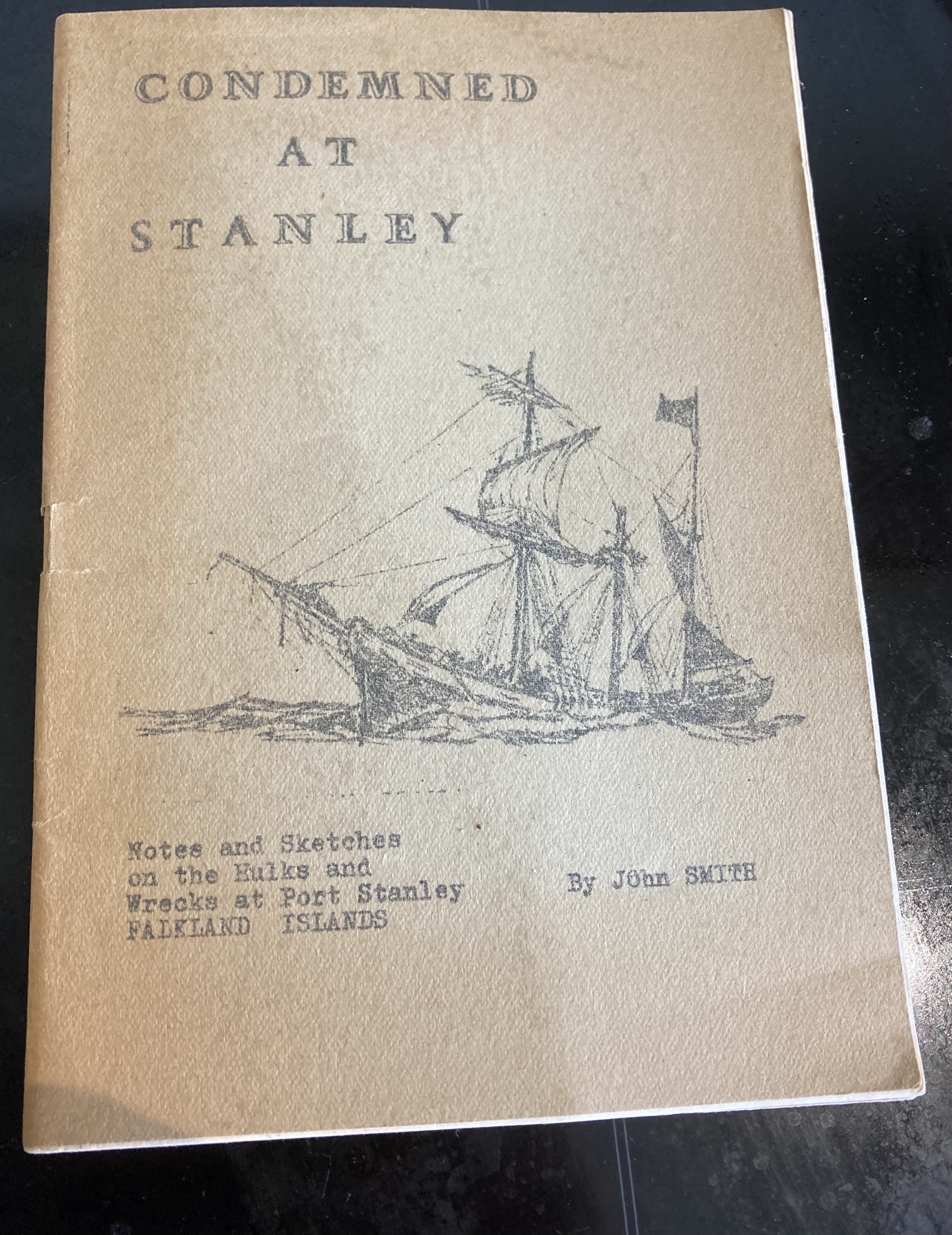
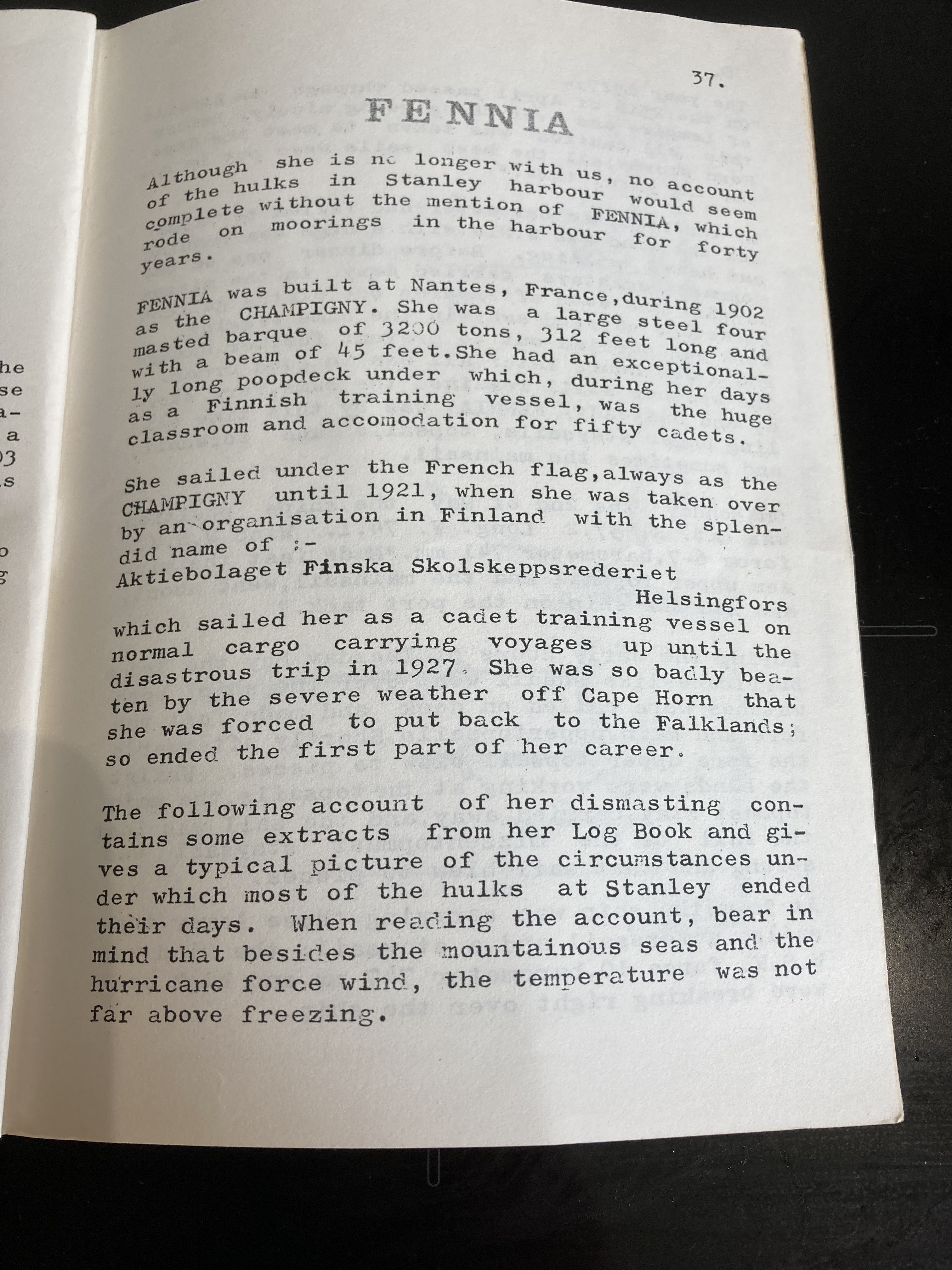
(Before we get onto the content, for those of us who remember bashing away on a typewriter, this little pamphlet was a trip down memory lane – obviously typeset from a typewritten ‘manuscript’ with added sketches – done by the author.
I do like a real, original typewriter typeface.
And presumably he did not print so many that he couldn’t bear the thought of changing the odd mistake by hand – see subsequent photos.)
I am guessing the author was the same John Smith who wrote a memoir called : 74 Days: An Islander’s Diary of the Falklands Occupation. ( No, that has not been donated.)
We have had got two of these pamphlets and one is signed and other has an interesting dedication but more on that later.
So, there are notes and sketches on 14 wrecks in the Falklands harbour – from Capricorn to Fennia.
And indeed the 3-mile long harbour does seem to have an abundance of wrecks.
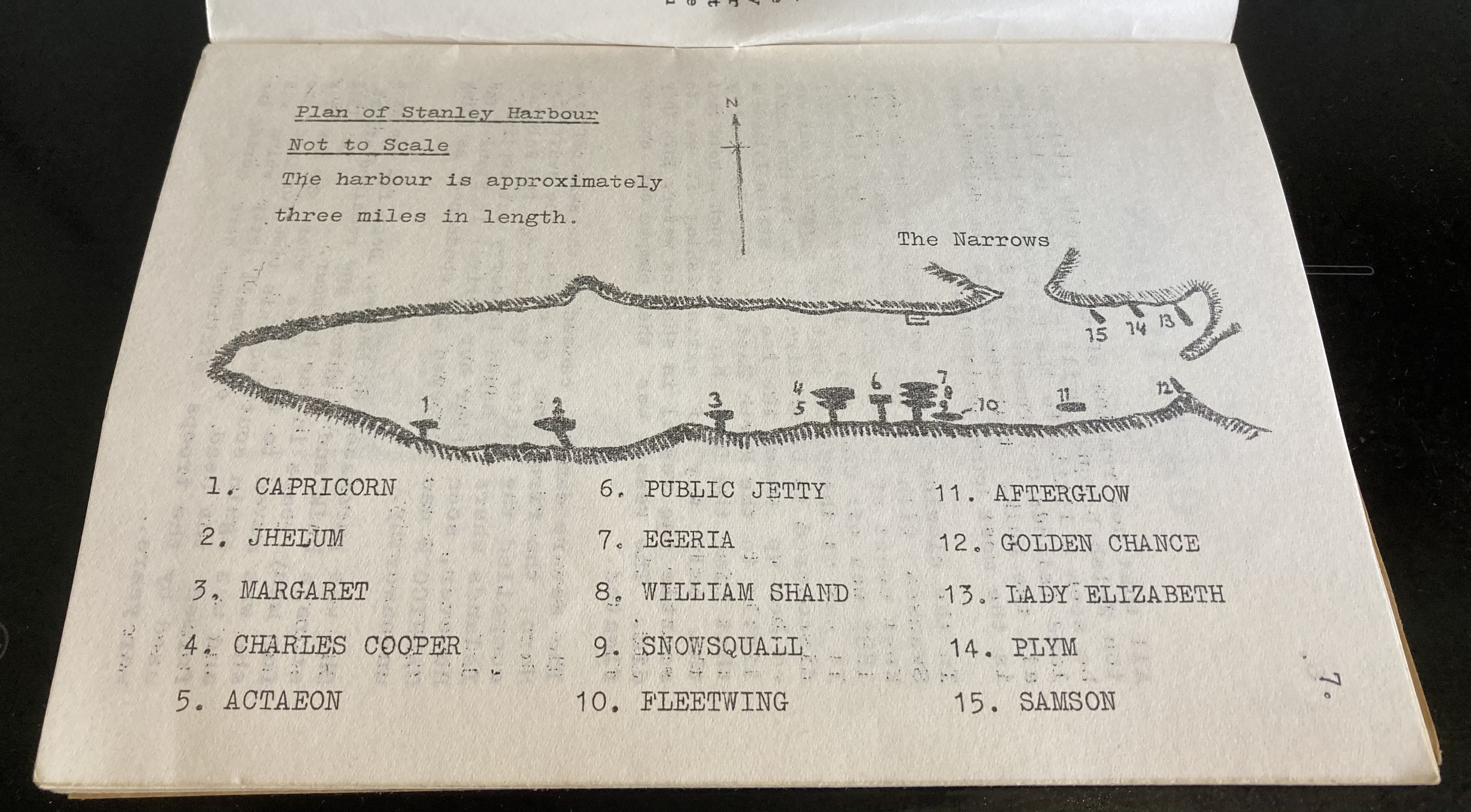
There is a bit of history – and I have to say, well-written interesting stuff which is not inevitably the case with self-published/locally-published books…..
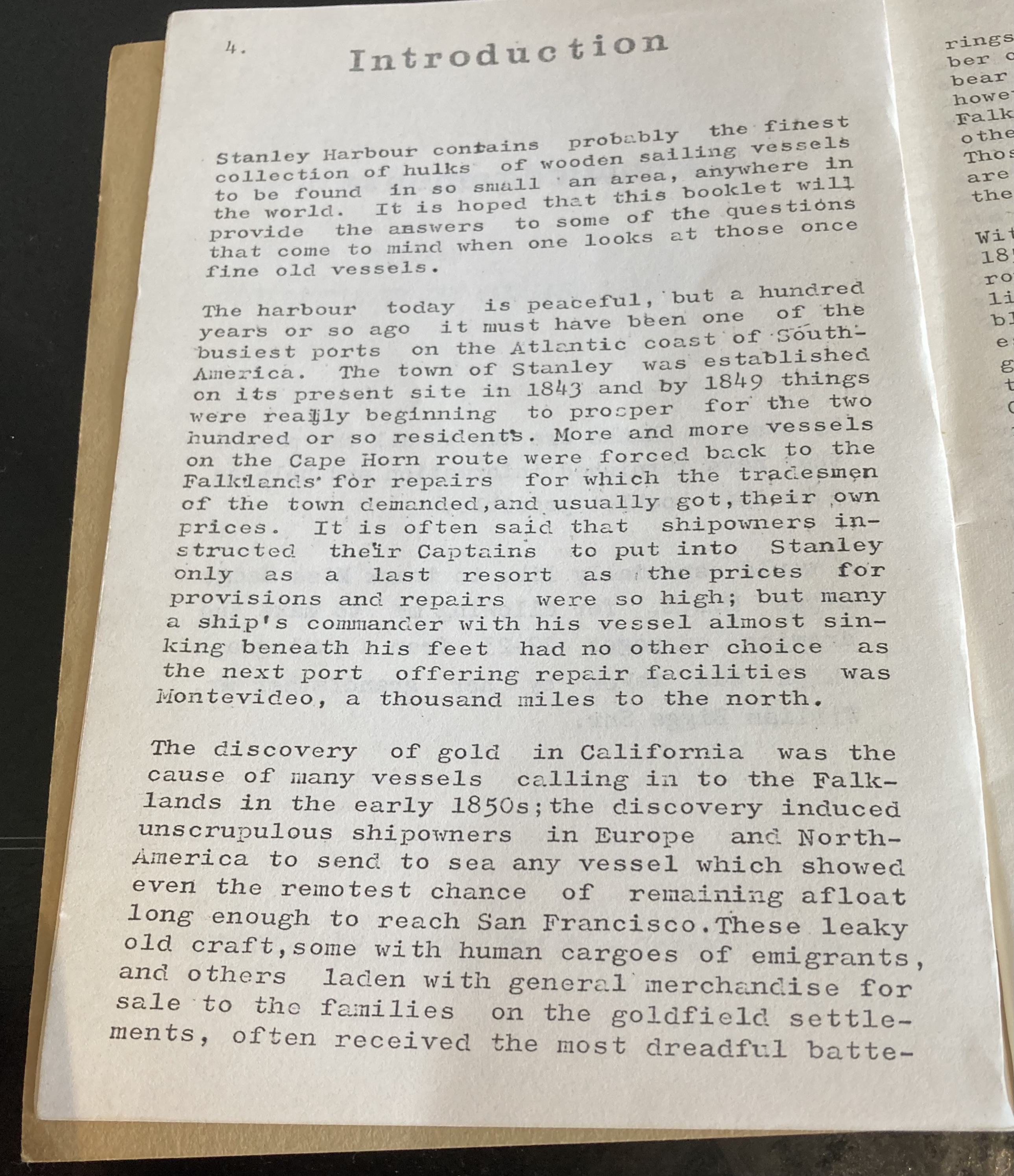

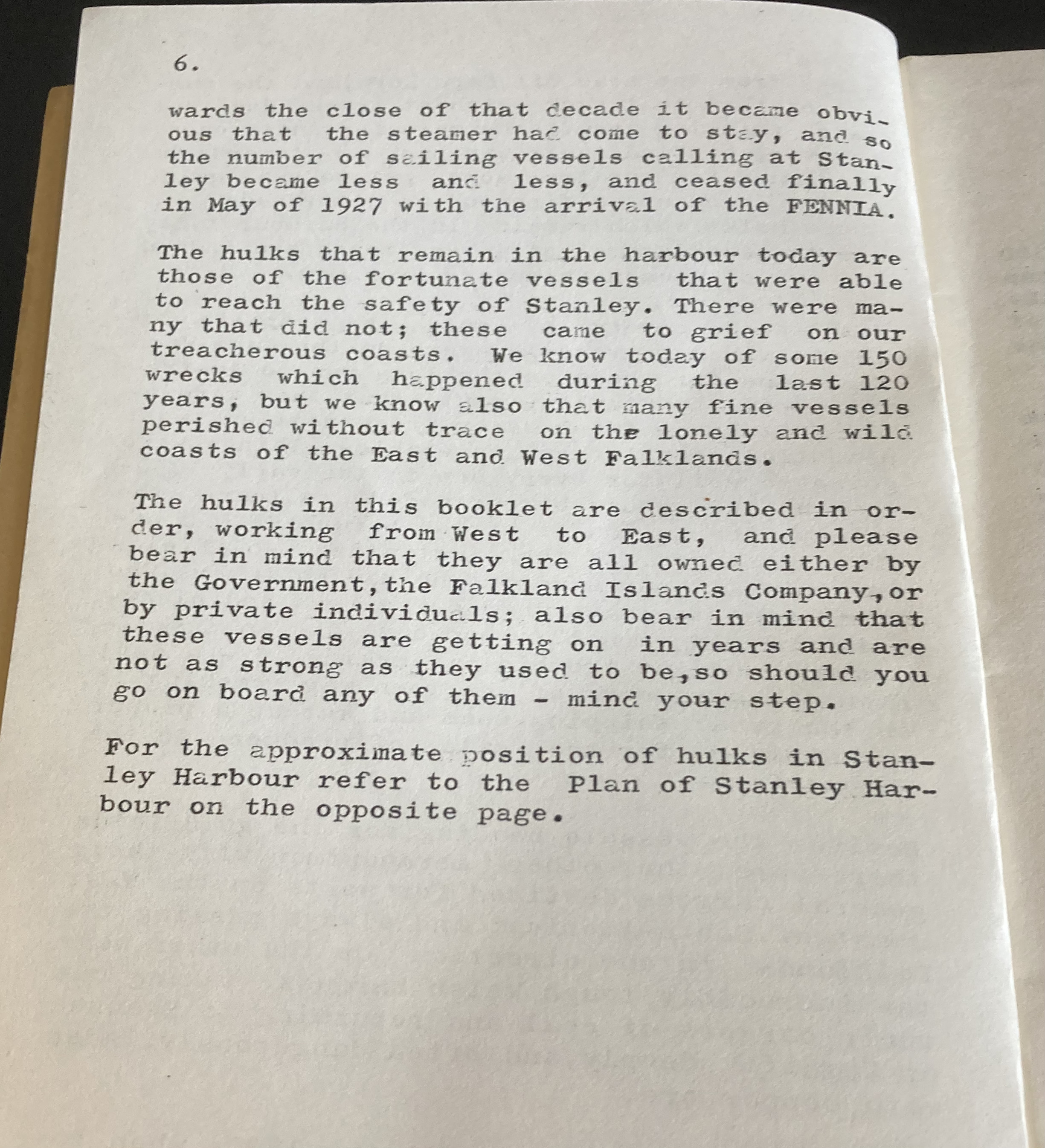
Back to the ships:
Here they are:




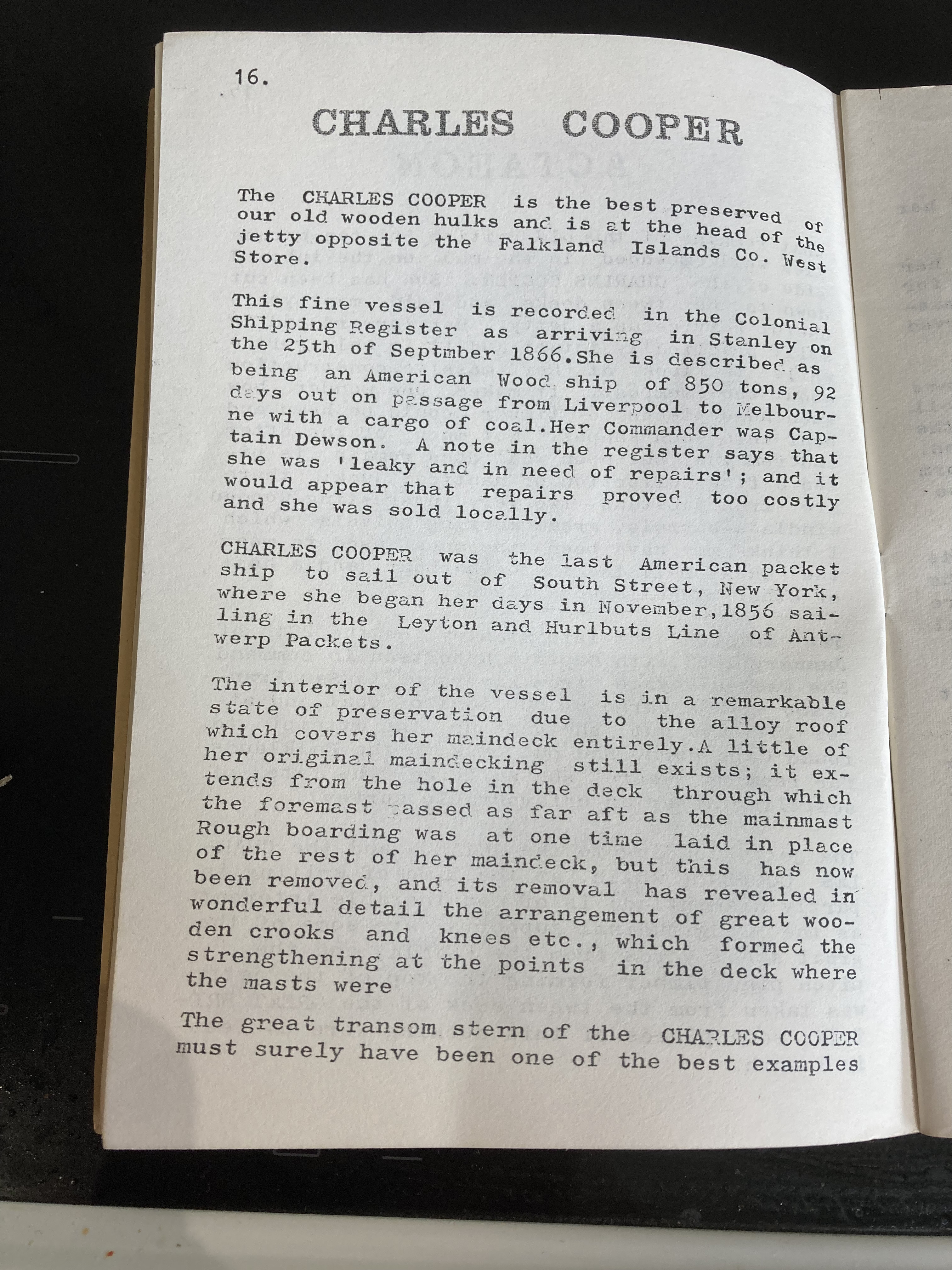
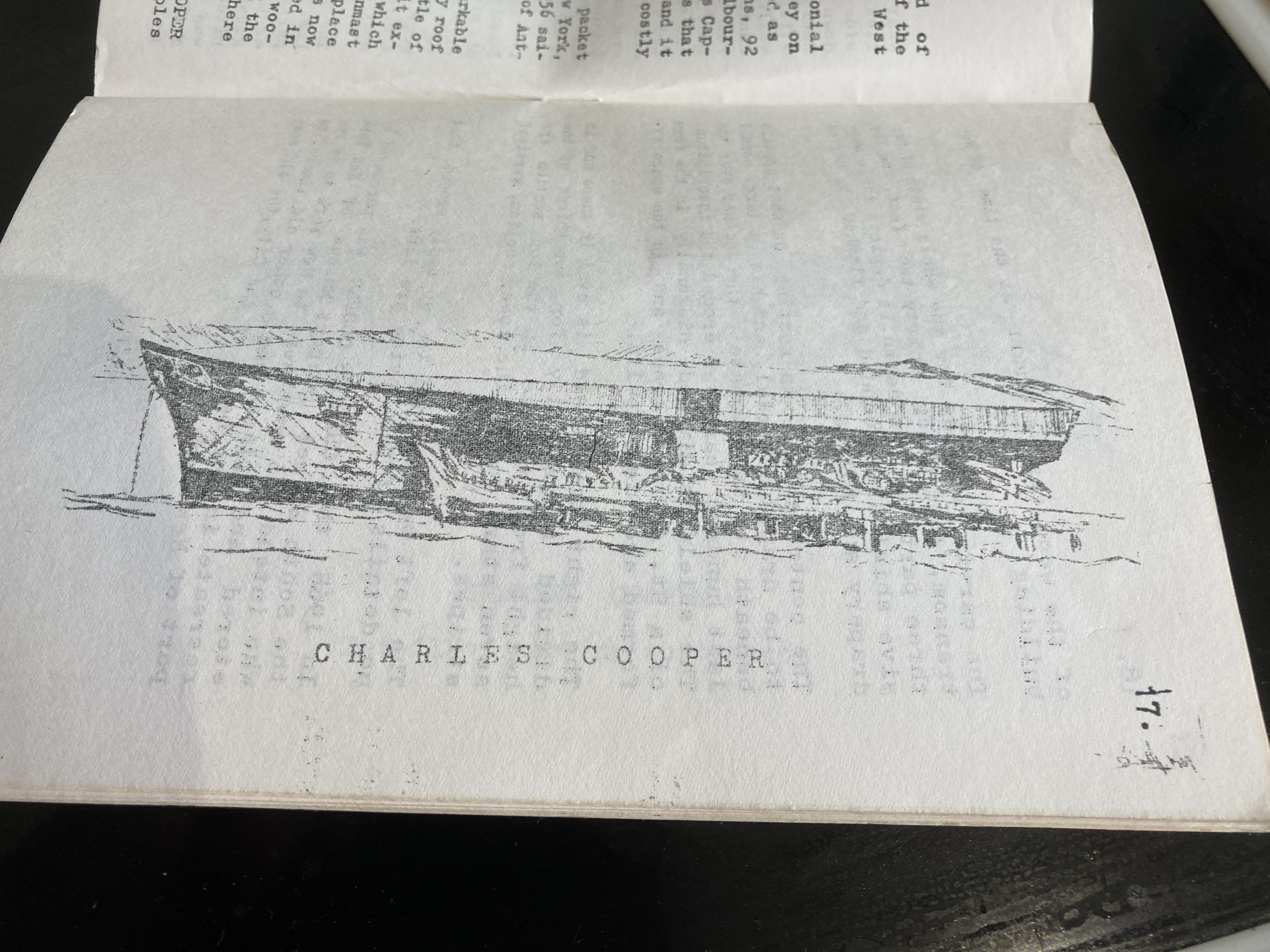

Apparently, it is indeed in the museum and …….
The Charles Cooper was built in Black Rock, Connecticut in 1856 and is the only surviving American ship of its kind in the world. It is the best surviving wooden square-rigged American merchant ship. Built for New York’s South Street packet trade, the vessel voyaged around the world during the golden age of sail, and when it could sail no longer, became a floating warehouse for nearly a hundred years on an island off South America. The ship sailed for a decade from 1856 to 1866. It carried cotton to England, salt to India, gunpowder ingredients to the North during the Civil War, and brought European immigrants seeking economic opportunity and freedom in America. The Charles Cooper began with regular fixed schedules between New York and Antwerp. Then, with the outbreak of the Civil War, it no longer had set published departure times and instead voyaged based on spot demands from America to Europe and Asia.
So, finally to the inscription:
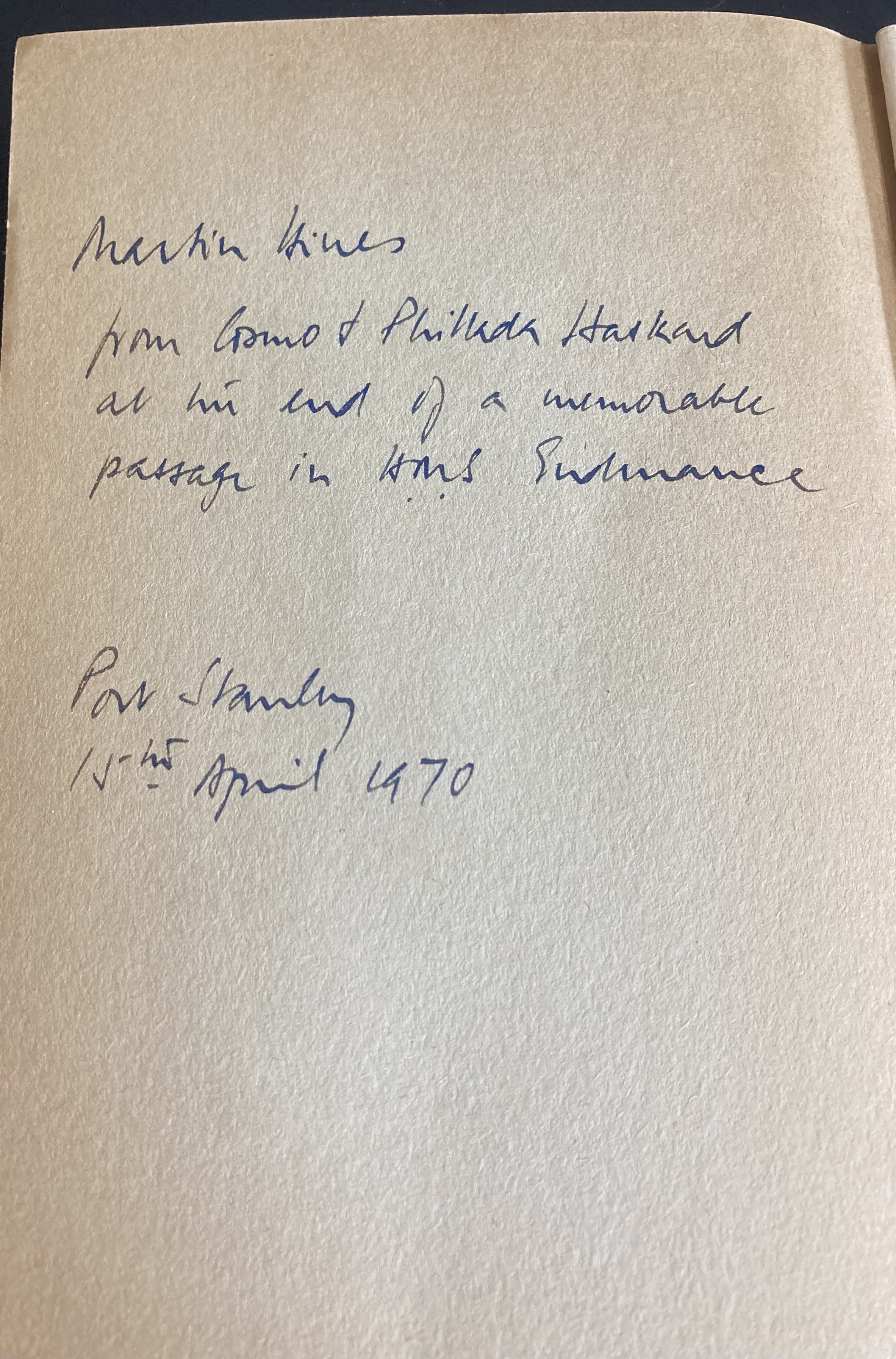
So, it turns out that this pamphlet was given to Martin Kine by Cosmo and Phillida Haskand. Haskard was the Governor General of the Falklands (1964-1970) and who ‘played a key role in defeating plans by Harold Wilson‘s Labour government to cede the sovereignty of the islands to Argentina. ‘
Martin was the HMS Endurance navigator, and dashing he looks too.
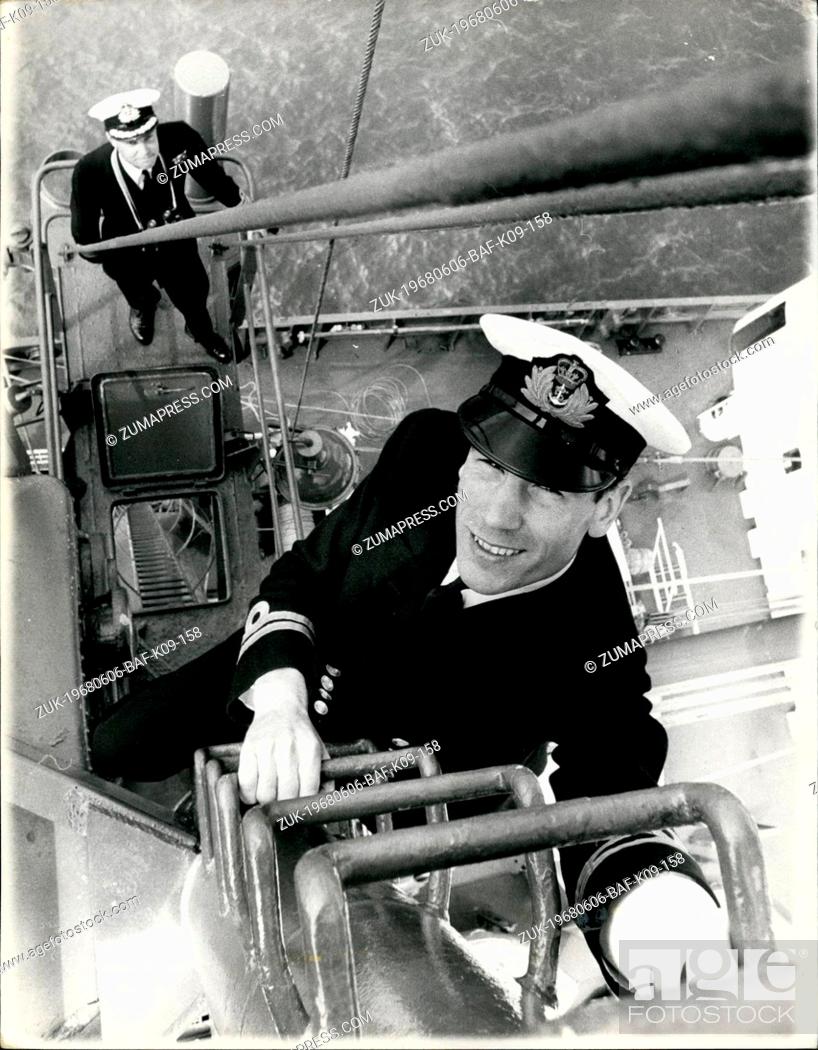
Jun. 06, 1968 – Press visit to H.M.S. Endurance: There was a Press visit to HMS Endurance, the Royal Navy’s new ice patrol ship, at Portsmouth Dockyard today. H.M.S. Endurance is expected to sail for the Antarctic later in the year. She will normally be deployed in the Antarctic, returning each year to the United Kingdom for maintenance and leave. In addition to providing a British naval presence in the area, she will assist the British Antarctic Survey in carrying out its scientific research programmes, and help support the permanent British stations there. HMS Endurance was recently converted for her new role at Harland and Wolff’s yard. Previously known as the Anita Dan. Her conversion has included the installation of special scientific and hydrographic equipment for her work in the Antarctic. One of the features of the ship is that it can be controlled from the crow’s next so as to give her officers view of channels through the ice.Photo shows the Navigating Officer, Lt. Martin Hines (nearest camera) and the Commanding officer, Captain Peter Buchanan seen making their way up to the crow’s nest from where the ship can be controlled. (Credit Image: © Keystone Press Agency/Keystone USA via ZUMAPRESS.com)
Of course, of course, this was not the original HMS Endurance but a later version – originally a German ship bought by the British navy and used as an ice-breaker among other things.
But she had her place in history – she was the ship on which ‘the final surrender of the war, in the South Sandwich Islands, took place.’
Apparently she was known by her sailors as HMS Encumbrance towards the end of her life ‘due to unreliability problems.’
I have no idea why the Haskards had ‘such a memorable passage ‘ on her but it has been a memorable little find in Oxfam.
 thereluctanthousewife