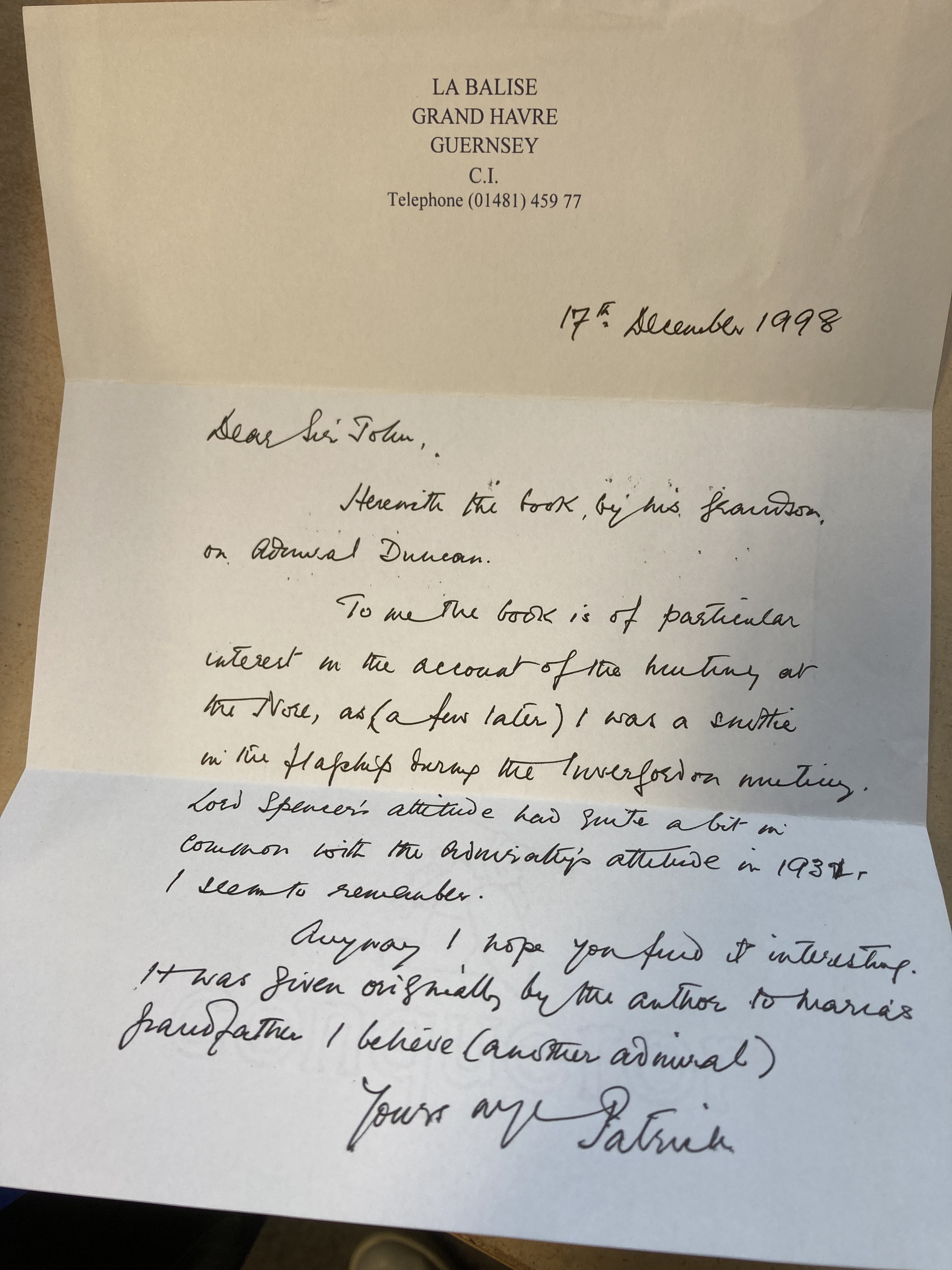
Patrick, Maria and her grandfather

I have been on a search to find the full name and hope the history of a man whose letter was slipped into a book he sent to someone.

And someone else donated to our Oxfam bookshop.

But meanwhile, it being a book about an Admiral, I have fallen into more naval history than I ever thought I would want to know – but it turns out I do.

So, if you have missed previous episodes, we are with a biography of Admiral Duncan (famous in his day for beating the Dutch navy in 1797) written by his grandson and therefore not exactly dispassionate.

As you can see, it was given by the Ear of Camperdown (author) to Maria’s grandfather.

Given that only 100 copies were published it is (hopefully) bound to be worth a bit – always welcome.

But it was the letter inside which was, at least to me, as interesting as the book – admirable though the Admiral no doubt was.

So, I wanted to find out who Patrick was, who Maria was, who her grandfather was and the very longest of shots, who Sir John was.

I have had a lot of help with this sleuthing and first thanks go to a very nice man at Savills estate agents in Guernsey. Let’s call him Richard.

Because with no surnames to go on, the address was my starting point. 

And, what do you know, Savills the estate agents, had sold Patrick and Maria’s house in 2019. Well, I am not sure that it looked just like this when they lived in it, and it was sold some 30 years ago – it was a great lead.

I sent them an email and asked if they knew anything about the people who had lived there and, lets call him Richard, came back to me and said he did.

He gave me Patrick’s surname and told me Maria was a fairly renowned local artist.

What a stroke of luck was that?

Maria first:

Here are some of her paintings – the first was painted in 1995 which was the year she died and if I could be doing something as creative as that in my final year, I would be very pleased.

As mentioned before my Best Beloved’s niece is an ace sleuther and she found a reference in a piece about Patrick which mentioned that he had served in the Navy under Maria’s father, Rear-Admiral ‘Burgoo’ Burges Watson.

And her grandfather, recipient of the book, was also Rear-Admiral Burges Watson.
He was a few posh-sounding things in his career; naval aide-de-camp to Queen Victoria, and Admiral Superintendent of the Malta Dockyard for example.

So, that is Maria and her grandfather and now for Patrick.

He turns out to have quite a history.

He says in the letter that he was a ‘snottie’ (a junior midshipman) ‘in the flagship during the Invergordon mutiny.’ 1931

The flagship was HMS Hood which was later to become famous for all the wrong reasons.

‘In May 1941, Hood and the battleship Prince of Wales were ordered to intercept the German battleship Bismarck and the heavy cruiser Prinz Eugen, which were en route to the Atlantic, where they were to attack convoys. On 24 May 1941, early in the Battle of the Denmark Strait, Hood was struck by several German shells, exploded, and sank with the loss of all but 3 of her crew of 1,418. Due to her publicly perceived invincibility, the loss affected British morale.’ Wikipedia

Now I am no naval historian – though goodness knows I have spent so much more of my time than I had expected trawling through the stuff –  Patrick was actually serving under his (future) father in law on Nelson.

(Perhaps you can have more than one flagship in a gathering of soon-to-be-mutinous ships?)

Anyway, that makes the link, but Patrick had lots more to tell us.

He had to leave the Navy because of poor eyesight and went to join a trading house in Singapore – as you do.

But when war broke out he came home and joined the Royal Navy Reserve Personnel.

This is what the Imperial War Museum cite under the Special Forces Roll of Honour:

SIS (O.C. African Coastal Flotilla (ACF))

  • RANK

Lieutenant

  • NUMBER
  • AWARD

Distinguished Service Cross,Croix de Guerre (Fr)

  • PLACE

Mediterranean 1943-44

  • ADDITIONAL INFORMATION

parent unit Royal Navy Volunteer Reserve

born 5.1.1912 Bolton,Lancashire

educated Dartmouth Naval College

HMS Nelson (Midshipman)

left R.N. as Lt

worked in trading house in Singapore

R.N.V.R. 1939

Assistant Naval Attache,Paris

Directorate of Operations (Irregular)

HMS Fidelity

O.C. African Coastal Flotilla (ACF) 1943-44

Diplomatic Service postwar

retired to Guernsey

married Maria (died 1995) (3 daughters)

author “Corsican Command : A Dramatic First-Hand Account of Clandestine Operations in the Western Mediterranean 1943-44” 1989

died 15.11.2004

But an obituary ( which I am sorry I cannot credit because I have lost the link) adds more dramatic colour to his life.

I have put it in wholesale below.

But before I leave you to read that, I couldn’t find Sir John. It was always going to be a very small needles in the haystack of Sir Johns so I am not so disappointed.

To have found Patrick, Maria and her grandfather has been more than enough. 

Commander Patrick Whinney, who has died aged 92, landed and collected agents from the French and Italian coasts during the Second World War.

Once inside the shipping lanes, he had to navigate with pinpoint accuracy on quietened auxiliary engines towards a rendezvous before rowing ashore in a dinghy; often he would be unsure whether there were passengers to pick up or he was entering a trap.

Though calamity often threatened, no agents were lost in transit. When one important group of Italians, led by a general, were to be collected from a beach near Orbitello, Whinney and his right-hand man, Petty Officer Jim Bates, paddled their dinghies carefully through the surf with Tommy guns cocked; but when he gave the password there was no reply. Bates could see a huddle of men silhouetted up the beach and, fearing that the Italian party was under hostile control, he whispered: “Shall I let ’em have it, sir?” “No, wait,” said Whinney, who repeated the challenge twice more. At last came the response: “Giuseppe”, followed by a question: “English?” When Whinney replied “Yes”, six men flung themselves down the beach and into the dinghies.

As they steamed back to Bastia on Corsica at 40 knots in a USN patrol boat, the general showed Whinney the ancient automatic with which he had been about to shoot him. Their courier had been gone a week, and they suspected a trap themselves. One of the group had thought Whinney sounded German; it was not until the third challenge that the general, whose wife was English, had been convinced that all was well.

Patrick Fife Whinney was born on January 5 1912, the son of an Army officer whose family had the accountancy firm Whinney Smith and Whinney (later part of Ernst and Young). Patrick’s elder brother, Reginald, was awarded the DSC and Bar in destroyers escorting convoys in the North Atlantic.

Patrick Whinney went to Dartmouth in 1925, and as a midshipman served under his future father-in-law, Rear Admiral “Burgoo” Burges Watson, in the battleship Nelson. But poor eyesight forced him to leave the service and join a trading house in Singapore.

On the outbreak of war Whinney immediately returned home and was commissioned in the RNVR. With another young intelligence officer, Steven Mackenzie, he was sent as liaison officer to the French Admiral Darlan’s headquarters outside Paris. At the Fall of France, Whinney escaped in the Canadian destroyer Fraser, and survived when the ship was run down and sunk by the anti-aircraft cruiser Calcutta on the night of June 25 1940.

Back in London, Whinney reported to Ian Fleming, who sent him to the newly-created Directorate of Operations (Irregular), where his early naval training was of great assistance to Captain Frank Slocum, who had neither adequate or trained staff.

On August 3/4 1940 Whinney undertook his first clandestine mission. This was in a commandeered French-built motor dispatch vessel to land agents at Ouistreham, on what would later be famous as Sword Beach. His next mission, to Sein in Brittany, involved escorting Breton fisherman who had taken refuge at Newlyn; Whinney recalled being met off the train in Cornwall by a Russian Grand Duke, also in RNVR uniform.

Early in 1941 Whinney acted as liaison officer on board Le-Rhin, a French cargo vessel being refitted at Barry for special operations; it was no easy task, as the French crew had little knowledge of English or of naval procedures. Despite the opposition of de Gaulle’s Free French in London, the ship was placed under the White Ensign and renamed Fidelity. She sailed from the United Kingdom to land Special Operations Executive agents in southern France and to recover escaped British servicemen. Whinney and Mackenzie were awarded the Croix de Guerre in April 1943.

When Whinney’s loan to SOE was over, he was sent to Gibraltar to organise all irregular naval operations in the Western Mediterranean. After a brief return to London, and a visit to Spain to arrange for the covert purchase of fishing boats to augment his flotilla, he travelled to North Africa to reconnoitre suitable advanced bases and requisition Italian-type local craft for operations to the Italian mainland and islands; his flotilla was known, for cover purposes, as the African Coastal Flotilla.

Whinney spent 1943 at Slocum’s headquarters in London, controlling Mediterranean operations, then was sent to set up an advanced operational base at Bastia, using a mixture of borrowed British, American and Italian craft. Since the same craft were rarely loaned consecutively, Whinney had to train each crew in special operations, while commanding the base and planning and co-ordinating other operations. He personally took charge of the first 18 operations. Shortly afterwards a temporary illness forced him to relinquish his command and return to England where, after sick leave, he was given liaison duties with French special forces, and also awarded the DSC for his gallantry, enthusiasm and devotion to duty in hazardous operations.

After the war Whinney joined the diplomatic service. He spent many years in Athens, and then went into cosmetics business with a wartime colleague. In the 1960s he settled on Guernsey, where he helped his wife to found the Coach House Gallery.

From 1981 he became involved in the Guernsey Cheshire Home. Returning from a committee meeting at which it had been plain that the home faced a six-figure hole in its finances, on a whim Whinney walked into the local television studio where he found Sarah Montague, then a budding journalist, on duty alone. Whinney charmed her into giving him an interview, and held forth so eloquently that, a few days later, an anonymous cheque arrived for the sum required.

Patrick Whinney, who was appointed OBE in 1998, died on November 15, 2004. He married in 1939 Maria Burges Watson, who died in 1995; they are survived by three daughters.

Mutiny 2 Invergordon

If you waded through the last piece on mutiny, you may be feeling as if you have had enough of that aspect of Naval history.

So, now is you chance to turn away quickly because if you decide to stay, you may end up knowing more about the mutiny at Invergordon than you ever wanted to. 

This all started with a book and a letter and trying to find out who the people were mentioned in the letter.

And, I now have a good idea about all of them except Sir John. ( Little thanks to research I have done, but huge thanks to the Best Beloved’s niece who is researcher extraordinaire in her spare time.)

But again, this is about a mutiny and only in the next instalment do we get to know the people in the letter.

So, if you are still with me, here’s the story of the Invergordon mutiny:

‘On Tuesday September 15th, 1931, at 8.00 a.m. most of the stokers of the forenoon watch in the battleship HMS Valiant, under orders to sail from Invergordon for exercises in the North Sea, refused duty and prevented the ship from sailing. In the battleships Rodney and Nelson and the battle-cruiser Hood, all due to follow Valiant out to sea, the crews also refused to turn to. By 9.31 a.m. the admiral commanding the Atlantic Fleet had cancelled the exercises and recalled to Cromarty Firth those ships already at sea. What was to become known as the Invergordon Mutiny had begun.’ Cambridge University

There has been a lot written about this industrial action by about 1,000 sailors but I will spare you the bramble and nettles and keep to the main path.

1931 was The Great Depression in action and there was a governmental push to cut public spending.

Part of that was to cut some sailors’ pay by up to 25%.

Actually, 10% for senior officers and senior ratings and 25% for the juniors who has joined before 1925.. Plus ca change then.

The men on the ships in Invergordon were due to go out on exercises but whilst they were waiting, they heard – not from the Admiralty but for newspaper reports – about the cuts.

They were not happy, and were indeed less happy when they got confirmation from the Admiralty that the reports were indeed accurate and basically a ‘suck-it-up’ communication.

Rear-Admiral Tomkinson, standing in because his boss was in hospital, was sympathetic towards the mens’ grievances apparently and he tried to get the Admiralty to stop ordering orders and deal with the worsening situation.

He cancelled the exercises and warned that things would likely get worse if there was no movement from the powers that be.

This mutiny was short-lived.

The Admiralty waived the 25% cut and ‘just’ cut all pay by 10% and on September 16th

“In the afternoon, the Admiralty ordered the ships of the Fleet to return to their home ports immediately. Tomkinson directed the ships to proceed in their squadrons as soon as possible, and gave officers and crew with family at Invergordon leave to visit the shore and say their goodbyes. That night, all ships sailed from Invergordon as ordered.’ Wikipedia

Meanwhile, the mutiny had caused a panic in the Stock Exchange and forced it off the Gold Standard.

In the aftermath Tomlinson was blamed by the Admiralty for the mutiny claiming he had failed to quickly deal with insubordination and nip the situation in the bud. 

Always useful to have a scapegoat in these situations.

‘A number of the organisers of the strike were jailed, while 200 sailors were discharged from the service. A further 200-odd sailors were purged from elsewhere in the Navy, accused of attempting to incite similar incidents. The Admiralty held Tomkinson accountable for the mutiny, blaming him for failing to punish dissidents after the first protests.There was much attention given at the time of the mutiny to the apparent involvement of the Communist Party.’ Wikipedia

There were reports that a meeting of the mutineers had ended with the singing of the Red Flag but there was a lot of fake reds-under-the-bed news going on at the time and there is no evidence that the CP was behind this mutiny.

Indeed, 

“…it was only in the weeks and months following Invergordon that Wincott’s alleged leadership began to be promoted as the Communist Party laid claim to the mutiny. The party’s identification with it intensified when two prominent Communists, Shepherd and Allison, were arrested on trumped-up charges of inciting ratings to further mutiny and given stiff prison sentences. Comintern attempts to capitalise on this by means of Communist recruiting drives among sailors in the naval towns of Portsmouth, Chatham and Plymouth were now stepped up, but to no avail. As John Gibbons, the party’s organiser for Portsmouth and the South Coast between 1931 and 1935 subsequently admitted, in that period he never managed to recruit a single matelot (Gibbons to Carew, 16 August 1976).

Len Wincott a notable among the mutineers and claiming to be their leader, spoke at many Communist Party meetings after being dismissed from the Navy.

He was put under surveillance by MI5 and in partly, he said, as a result of that he defected to the Soviet Union in 1934.

He survived the Siege of Leningrad from 1941-1944 but in 1948 he was arrested as a British spy and sent to the Gulag where he spent 11 years ( and met and married his wife.)

After his release he became friends with Donal Maclean and died in 1983.

Interestingly, at his request, his ashes were scattered over Devonport Harbour.

Next time, the letter that started me down the rabbit hole of mutinies. I bet you can hardly wait……

Mutinies

So, who knew there were so many mutinies in the Navy? Well I didn’t. Apart from Mutiny on the Bounty, I had heard of not much of the (seemingly) many others.

I am (still) on my research of a book about Admiral Duncan and the letter tucked inside, so if you haven’t read the relevant previous blog, you might find it a bit strange that I am writing about mutinies – don’t feel obliged to go back, after all you might just be interested in Navy ill-discipline.

But just in case you are in for the long haul – and it will be a long one, here is what I found which started this search.

I need to find out about Patrick, his wife Maria, her grandfather and one day perhaps, Sir John.

Meanwhile back to mutinies.

My kind friend who does know about these things sent me this:

‘There were quite a few mutinies over the centuries, usually involving more than one ship when the fleet was at anchor (often for extended periods), and were due to government pay cuts or the state of the victuals as a result of corruption in the Victualling Board or yards – so pesky civilians at fault. 

The more concerning ones from the Admiralty viewpoint were those on individual ships far from home – hence the Naval Discipline Act which unlike the other services allowed captains to award up to 2 years imprisonment. 

Incidentally, WRNs were never subject to that act, and could just walk away. 

The Captain’s safe used to have a confidential reference book on how to deal with mutinies. The only bit I remember was not to try to re-establish order while only wearing underpants. 

Needless to say, we now have a joint Armed Forces Discipline Act and anything serious is handed over to civilian lawyers.’

I have two mutinies I want to investigate – the Nore mutiny for Admiral Duncan and the one Patrick was involved in – Invergordon.

 But first some background to mutinies in 1797 – a big year for mutinies:

‘In September 1797, the crew of Hermione mutinied in the West Indies, killing almost all the officers in revenge for a number of grievances, including throwing into the sea without proper burial, the bodies of three men killed by falling from the rigging in a desperate attempt not to be the last men on deck, which was punishable by flogging.The Hermione was taken by the crew to the Spanish port of La Guaira.

On 27 December, the crew of Marie Antoinette murdered their officers and took their ship into a French port in the West Indies. Other mutinies took place off the coast of Ireland and at the Cape of Good Hope and spread to the fleet under Admiral Jervis off the coast of Spain. ‘ Wikipedia

So, if you are up for this, help yourself to a tot of rum and settle down.

(But given that this series of blogs is all about wandering about the Navy, books and history, here is a digression, and as a digression on a digression, who’d have thought the rum ration was still in action in 1970, and who’d thought it was not available in 1797 when the mutinies in this blog were in action?..)

‘The rum ration, or “tot”, from 1850 to 1970 consisted of one-eighth of an imperial pint (71 ml) of rum at 95.5 proof, given out at midday. 

Senior ratings (petty officers and above) received their rum neat, whilst for junior ratings it was diluted with two parts of water to make three-eighths of an imperial pint (213 ml) of grog. 

Rum, due to its highly flammable nature, was stored in large barrels in a special rum store in the bowels of the ship. The rum ration was served from one particular barrel, known as the “Rum Tub”.

Not all sailors necessarily drew their rum: each had the option to be marked in the ship’s books as “G” (for Grog) or “T” (for Temperance). 

Sailors who opted to be “T” were given threepence (3d) a day instead of the rum ration, although most preferred the rum.

Sailors under 20 were not permitted a rum ration, and were marked on the ship’s books as “UA” (Under Age).’ Wikipedia

So back to mutinies.

In 1797 two mutinies broke out.

One in Portsmouth, the Spithead mutiny, and one in Nore in the Thames Estuary.

Apparently, the Spithead mutiny was more a kind of strike for better conditions whilst the Nore mutiny had more political overtones – and that is the one which involves Admiral Duncan.

When I say ‘apparently’ I am relying on a Wikipedia entry on these mutinies.

Now, I am a big fan of Wikipedia, rely on it frequently and yes, do send money to keep it going.

And all the entries are anonymous but sometimes you get the feel of the person behind what they are writing, and this entry has the whiff of a chap who is rather formal, has a Naval background and is not a fan of leftie politics. ( Of course I could be wrong.)

So, he (I’m assuming) writes (comments in italics are mine):

‘Seamen’s pay rates had been established in 1658, and because of the stability of wages and prices, they were still reasonable as recently as the 1756–1763 Seven Years’ War; however, high inflation during the last decades of the 18th century had severely eroded the real value of the pay. In recent years, pay raises had also been granted to the army, militia, and naval officers. 

You can rather imagine that for people seeing their bosses getting a pay rise when they were told they shouldn’t grumble about the reasonableness of their own more meagre pay, set about 100  years before, during a period of high inflation, might just be just a bit annoying. Nothing like our own times of course.

And, ‘until 19th-century reforms improved conditions, the Royal Navy was additionally known to pay wages up to two years in arrears. 

The Navy always withheld six months’ pay as a standard policy, in order to discourage desertion. 

At the same time, the practice of coppering the submerged part of hulls, which had started in 1761, meant that British warships no longer had to return to port frequently to have their hulls scraped, and the additional time at sea greatly altered the rhythm and difficulty of seamen’s work. 

The Royal Navy had not made adjustments for any of these changes, and was slow to understand their effects on its crews.

If you are still with me when I get onto the Invergordon mutiny (1931 rather than 1797 ) you might well see that little in the way of attitude had changed.

Impressment (a common practice) meant that some of the seamen were onboard ship against their wills. 

That, is press gangs and meant that men between 18 and 55 years old and capable of being seafaring were ‘taken into naval force with, or without, notice.’

The army tried it for two years from 1778 to 1780 and then gave it up. The Navy held onto it for a long time: 1664-1815.

The new wartime quota system meant that crews had many landsmen from inshore (including some convicted criminals sent in lieu of punishment) who did not mix well with the career seamen, leading to discontented ships’ companies.’ Wikipedia

So, you as a well practised sailor, knowing your stuff, your colleagues/mates etc etc then find you are alongside men who know nothing about sailing and have a criminal past. It may be that that criminal past mattered less than the fact those men didn’t know how to hoist a sail….

The Nore mutiny 1797, as promised earlier:

The crew of Sandwich at anchor at Nore, seized control of their ship and several other crews did likewise. Because they were scattered, they set up their own elected delegates to make demands on the Admiralty – or indeed anyone who might listen.

The crews elected Richard Parker as President of Delegates of The Fleet and drew up demands which included pardons, a pay rise and modifications to The Articles Of War.

I will leave you to read them all 

https://en.wikipedia.org/wiki/Articles_of_War

But just to mention article XIX

Mutinous assembly. Uttering words of sedition and mutiny. Contempt to superior officers. If any person in or belonging to the fleet shall make or endeavor to make any mutinous assembly upon any pretence whatsoever, every person offending herein, and being convicted thereof by the sentence of the court martial, shall suffer death: and if any person in or belonging to the fleet shall utter any words of sedition or mutiny, he shall suffer death, or such other punishment as a court martial shall deem him to deserve: and if any officer, mariner, or soldier on or belonging to the fleet, shall behave himself with contempt to his superior officer, being in the execution of his office, he shall be punished according to the nature of his offence by the judgement of a court martial.

Richard Parker became known as the President of the Floating Republic – and this was the time that the French Revolution was stretching its influence. 

Imagine the effort the English establishment were harnessing so they they could ‘manage the disturbance.’

The mutineers extended their demands and partially blockaded London but they couldn’t make it work and the mutiny failed.

Parker was  convicted of treason and piracy and hanged from the yardarm of Sandwich, the vessel where the mutiny had started. 

In the reprisals that followed, 29 were hanged, 29 were imprisoned, and nine were flogged, while others were sentenced to transportation to Australia.

If you have made it here, thank you and yet, and yet, there is more……