A few more bookshop delights and surprises….
Some (actually quite a few if I’m honest) books come into the shop in such bad condition they can’t be sold. Most end up in re-cycling but a few have such lovely plates (pictures) that the Best Beloved can make something of them.
Because we get quite a few donations of paintings – yes I don’t know why they are given to a bookshop either – we have an art sale about twice a year and we will add in these little delights.
And, we also get picture frames donated so the BB had these three to play with…


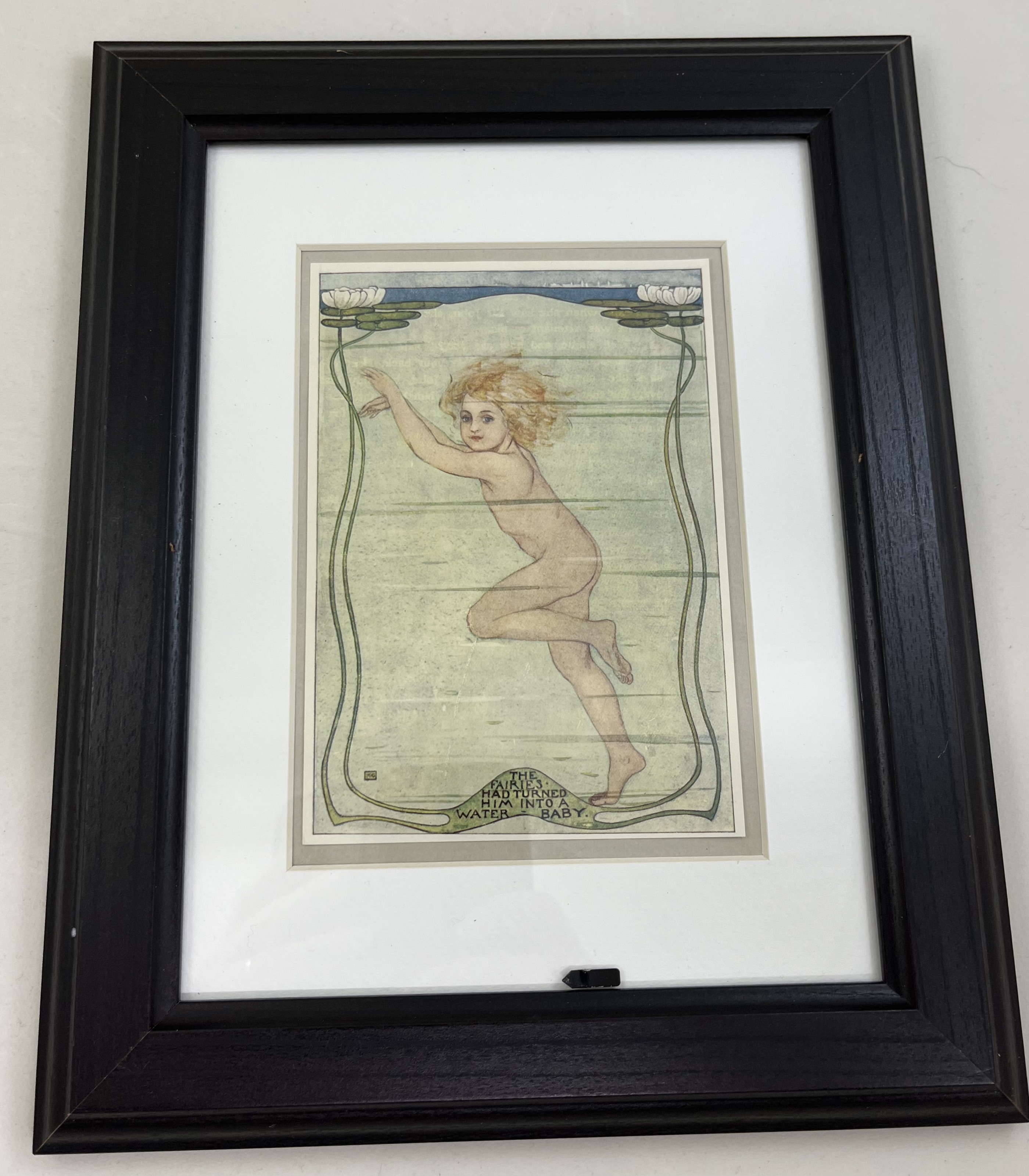
They are from the 1905 edition of The Water Babies and are the work of Katharine Cameron. And it is true that images of naked children were more innocent in those days.

Anyway, you may be interested to know that Katharine Cameron (1874-1965) ‘studied at the Glasgow School of Art where she became part of a group of artist-friends known as ‘The Immortals’, which included sisters Margaret and Frances Macdonald and Charles Rennie Mackintosh. She later attended the Académie Colarossi’s in Paris and made frequent study trips to Italy. She is best known for her sensitive flower and landscape paintings, etchings and book illustrations. Katharine was a member of the Royal Scottish Watercolour Society.’ (National Galleries of Scotland).
She is second on the right of the middle row of this photo of The Immortals.

The next oddity is from lives a lot less rarified than the Scottish artists.
Judging by the stationer’s imprint and the name and address at the back of the book, this was a log of Sheffield workers’ hours and payments kept by a Mr Hunt who lived at 302 Staniforth Road, Attercliffe, Sheffield. This was not a difficult deduction.
It begins in July 1914, and finishes when the book is full in August 1917.
I assumed they were all men and worked in a protected industry which could well have been a related to steel in some way or another, it being Sheffield.
And then I thought, of course I could be wrong and it could be a workforce of women taking over jobs ‘left’ by men fighting in the war.
I liked that idea and conjured up all sorts of mental images of feisty women and their stories, but a more detailed look (by the Best Beloved) ‘unearthed’ this at the back of the book and more references to furnacemen at the front.
Interestingly, as I say at least to me, there is a knife-making company called Samuel Staniforth making knives who say they were established in 1864. I am temped to contact them and see if they are interested in this part of their history. https://www.s-staniforth.co.uk
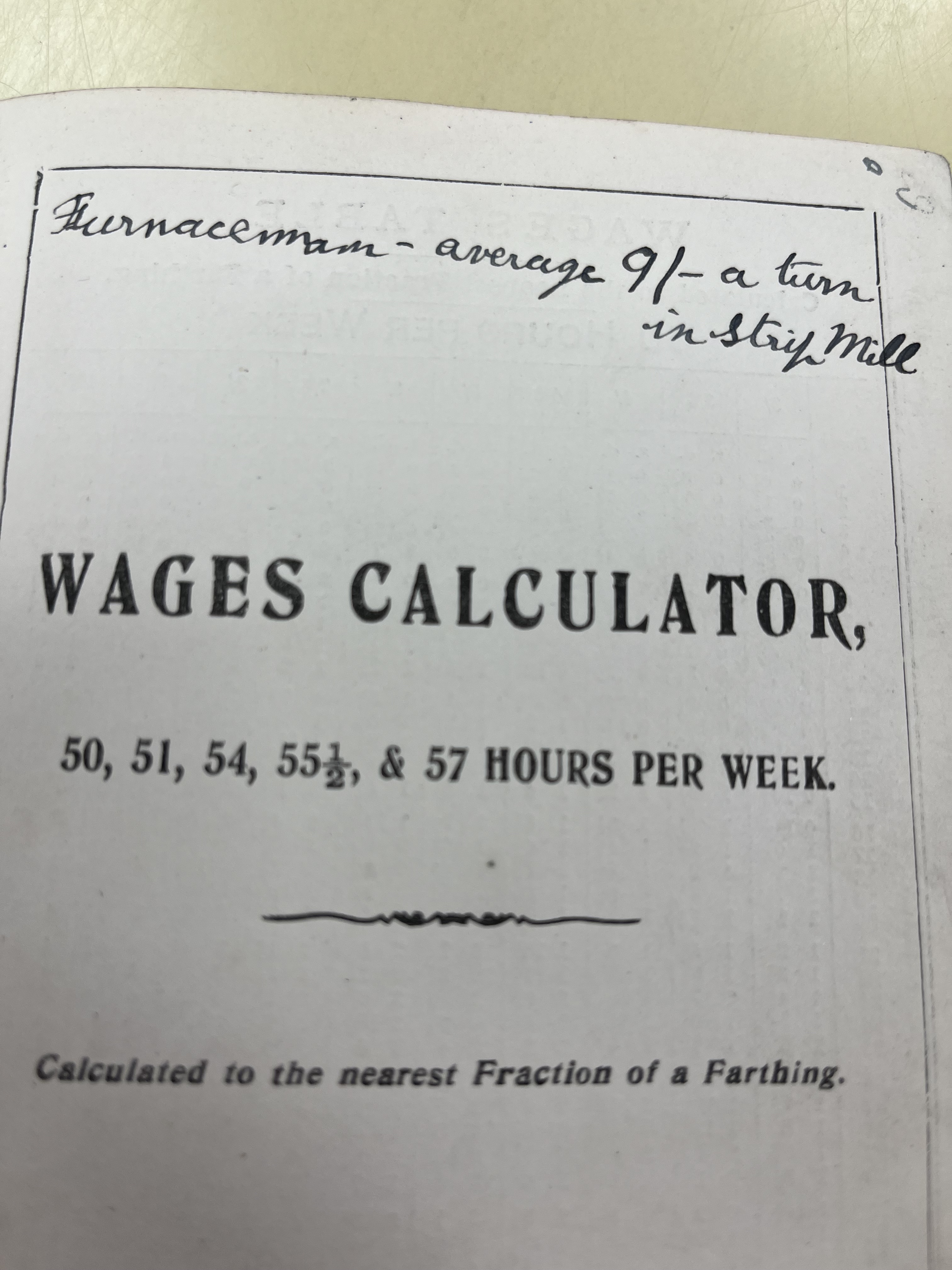

There are some handy wages tables at the back ‘calculated to the nearest fraction of a farthing’ and in terms of hours, go up to 57 hours a week.

Whoever C Wise was, he is present from the beginning to the end. (But W Wise, makes only one entry right at the beginning.
I am speculating of course, but could be father and son….)
In 1914 he was earning £2 and two shillings, but by 1917 was on £3/19/6d.
Interestingly, at least to me, is that although there are smatterings of records advance in wages throughout the book, many of the men took at advance in June 1915, August 1916 and April 1917.


I was thinking that this coincided with Wakes Weeks. A particularly northern tradition which started in the Industrial Revolution and was when the factory/works was closed for a week, quite often for maintenance work.
And they were, certainly originally, unpaid weeks so you would need an advance if you were going anywhere.
As a child I remember Wakes Weeks in the cotton mills in the Lancashire town where I was born – and the tradition was to go to Blackpool.
So popular was it that in the peak of Wakes Weeks in the 1860s (and no, I don’t remember that ) 23,000 holidaymakers left the town of Oldham alone, and headed to Blackpool.
Or, if you were better off, Morecambe Bay.

Should you want to know more https://northernlifemagazine.co.uk/wonderful-wakes-week/
There were some wage advances recorded in the book in the run up to Christmas but were for a lot less money than the holiday demand.
Except, that was my theory until I checked the dates and, no, the factory/works was not closed for the following week, and the same men were recorded as working and for much the same number of hours.
So, it remains a mystery.
Another Oxfam mystery, however, was solved by a very nice auctioneer who helps us out with some of our oddities.
These were donated by a friend and some have ended up in an auction, but one of them was locked.

The nice man brought down his box of keys acquired over the years and I spent a pleasant but fruitless couple of hours trying to find one that worked. ( And indeed, watching the Brummie Lockpicker on YouTube.)
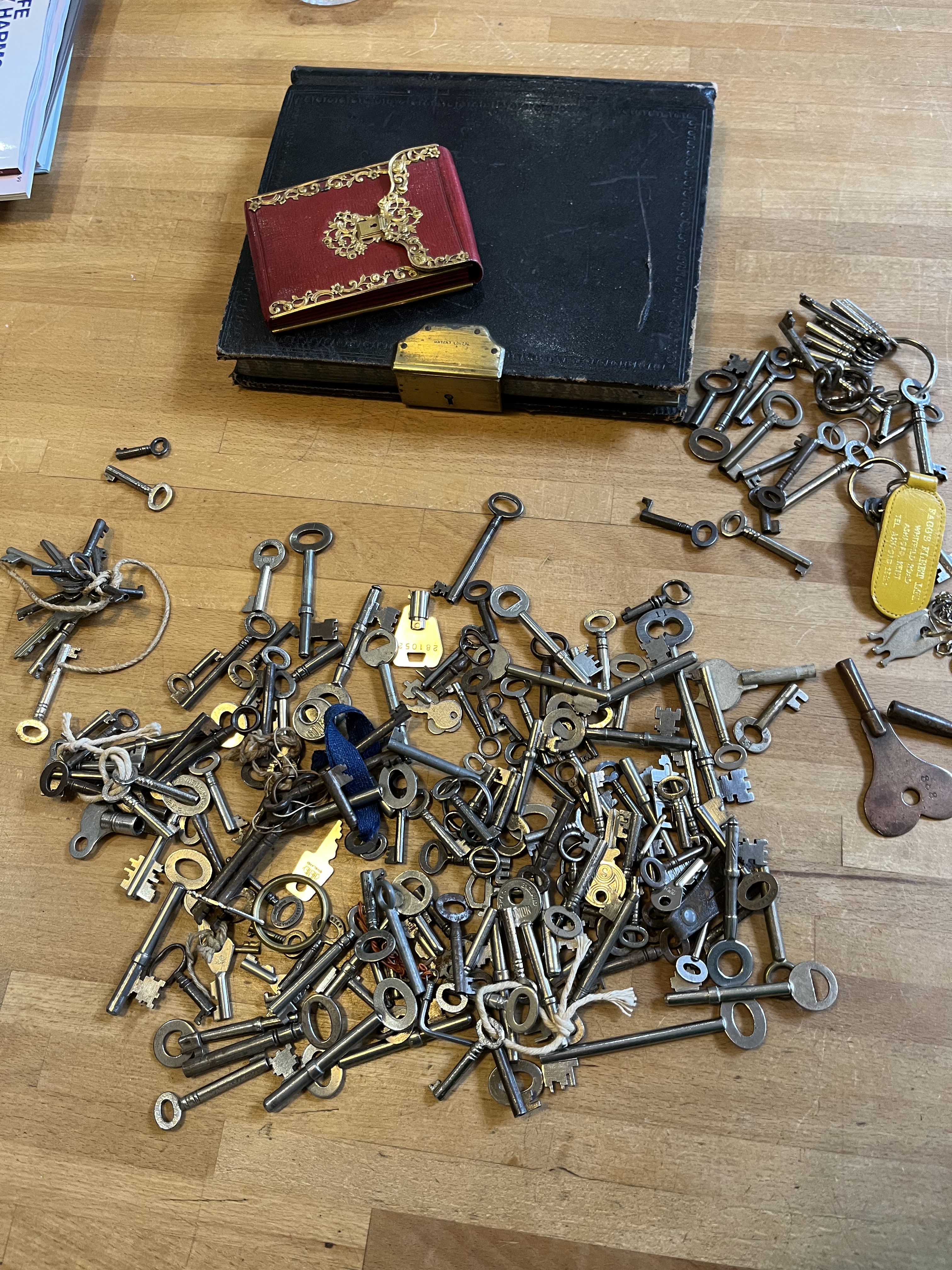
The nice man had said he thought it was a carte de visit holder and took it away to try and sell it for us.
He realised ( as probably I should have) that it wasn’t a lock as such and you could get it open.
And here is what he found:

Apparently,
‘It is a ladies etui case still containing a few of the original implements.
Ivory writing tablet
Pencil
Combined ear scoop and toothpick.
When looking at it under a glass it was evident that the lock does not require a key. The centre pin is on a spring and just needs pushing down to open.’
Rootling around in the bottom of capacious shoulder bags over the years, I’ve all sorts of forgotten things – and indeed notebooks and pencils – but never a, presumably ever-useful, ear scoop and toothpick
 thereluctanthousewife