Recently we had a lovely donation of old natural history books – and so we are off to the countryside, books in hand.
The donation came after someone’s father died and he was clearly someone who had a particular interest in butterflies and moths (more on that another time.)
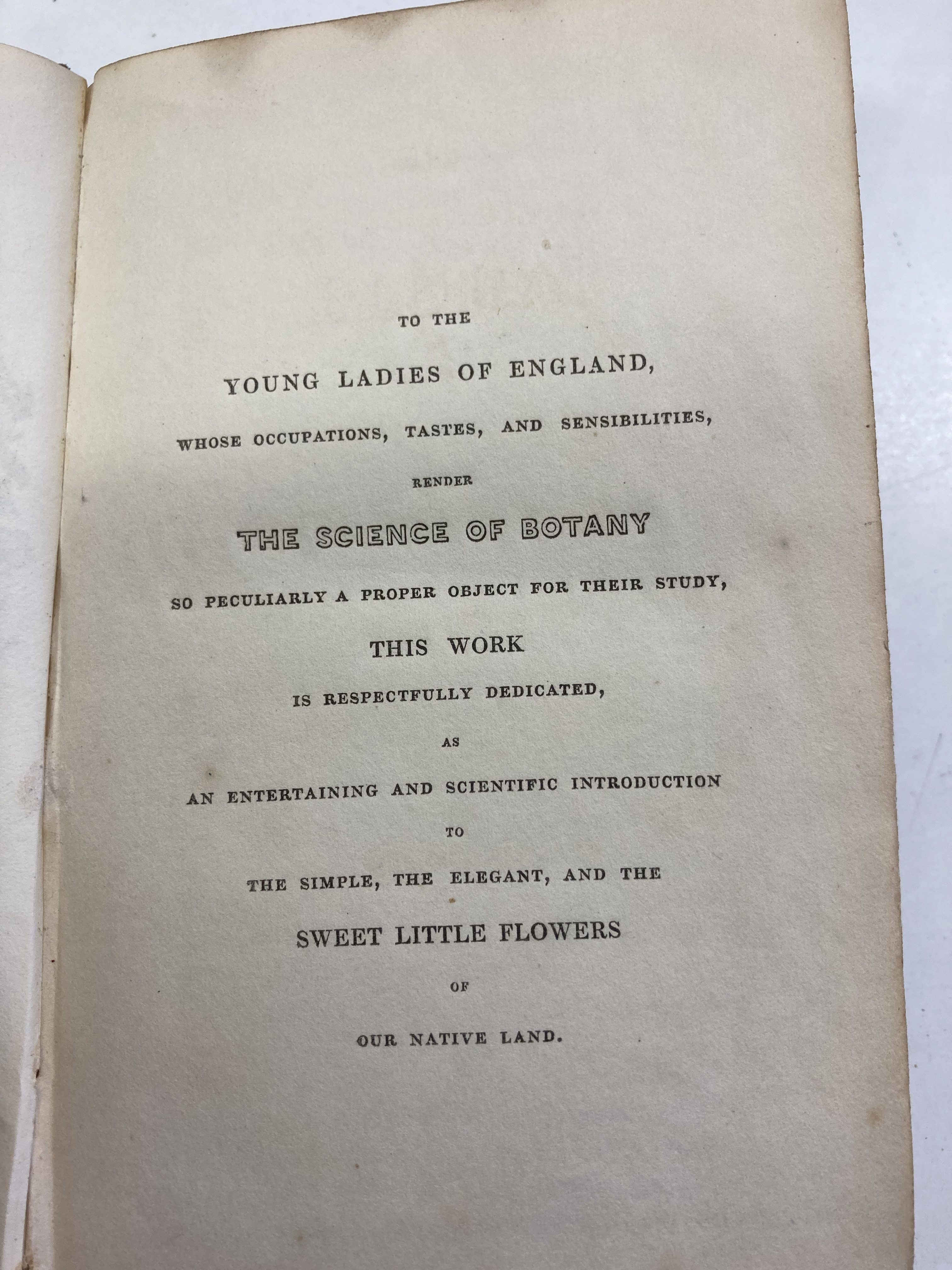
But not exclusively as this little book shows:
It is good to know that the young ladies of England have the appropriate study of botany to keep them from going wild…
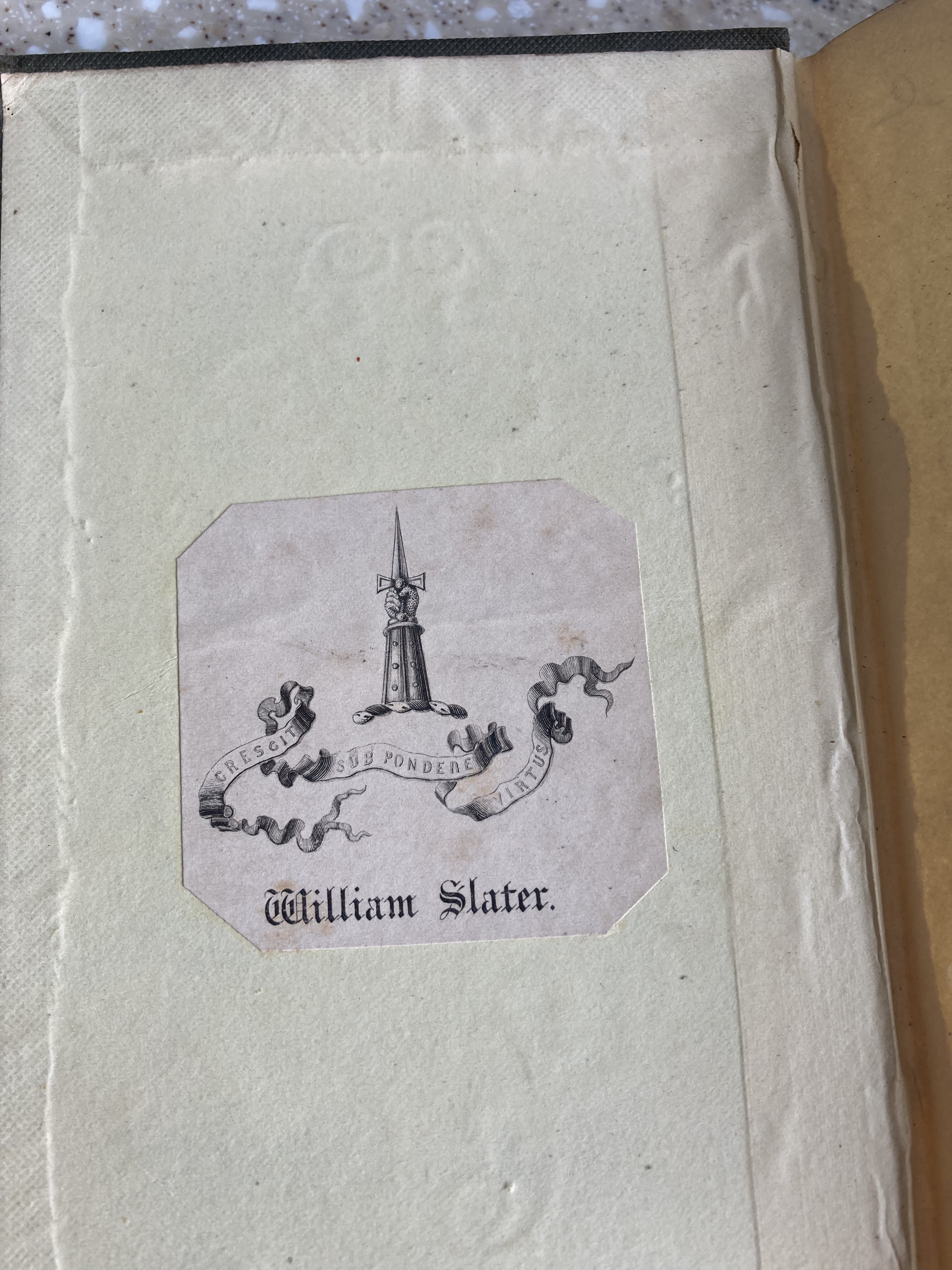
Mind you the book plate suggests that it was rather better used by a (young) man.
Now this one is also clearly intended for the amateur but I do have to question how simple the simple method is….
And then there is this little delight.
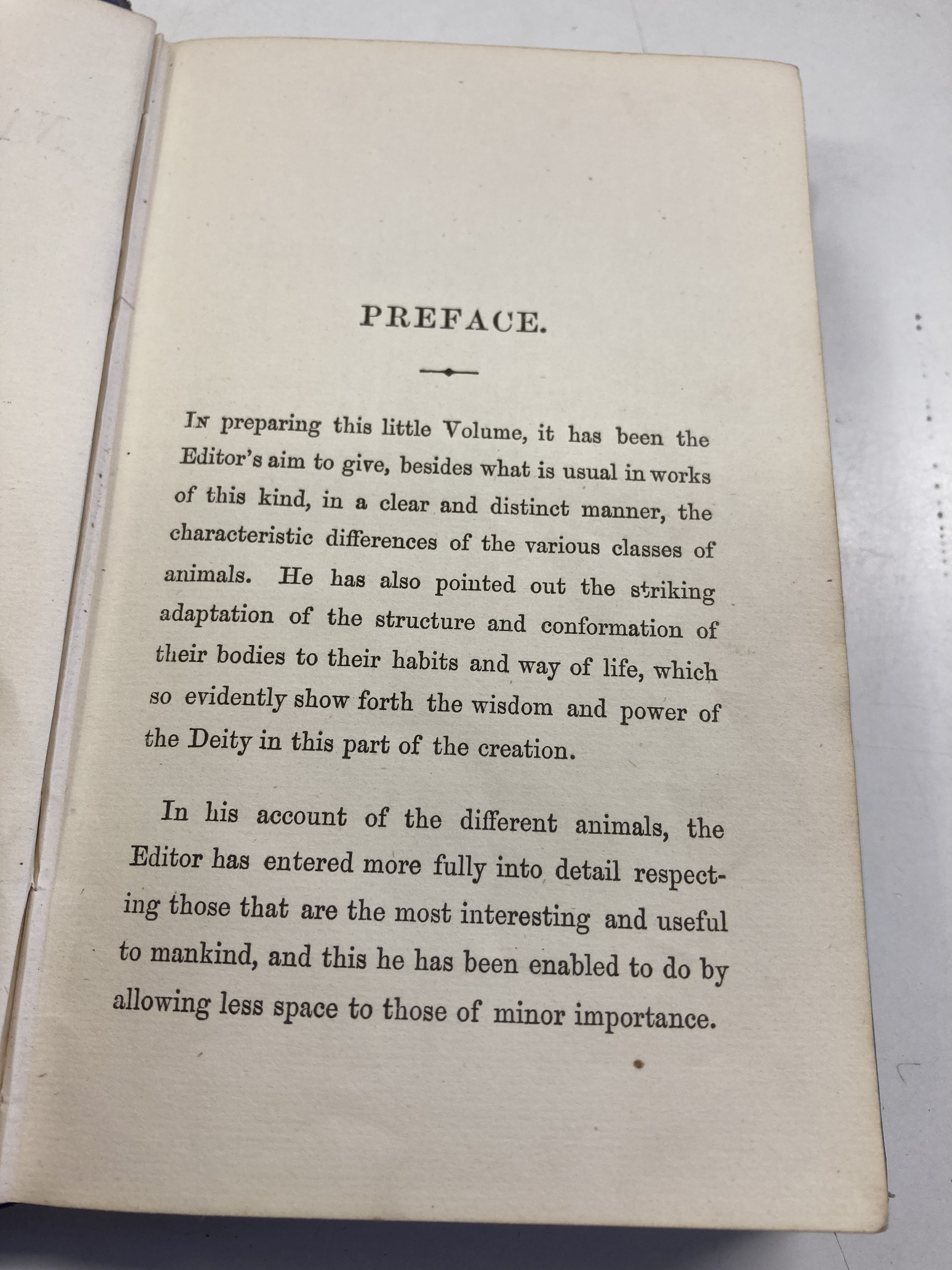
Knowing the difference between a hippo and a rhino, a crane and a heron and a frog and a toad is always handy – not that in the 1800s you were likely to see any hippos or rhinos unless you were a very intrepid traveller.
But what is interesting is the introduction and the owner’s name.
So, it was bought in 1858.
Darwin published Origin Of The Species in 1859.
I wonder if the un-named author/editor would have changed their views on nature being the proof of the wisdom of the Deity….
As you may have gathered by now, I spend most of my time these days (though in my Oxfam ‘youth’ things were different) looking at what we call the Old and Interesting books donated to the shop.
And, as you may have gathered over the years, many of the books I look at might be old but not necessarily very interesting, but there are enough to make my Oxfam life fascinating (sometimes.)
And I’d really like to tell you about some of the more interesting. But some other time.
I could tell you of the work of many another volunteer – from those who sort, wash, iron and put online the clothes we have had donated ( yes, in despite of being a bookshop), those who then pack them up and send them off, the classical music expert already sorting out special stuff to keep back for Christmas ( yes that word is already being mentioned), the sorting out of Oxfam cards into their allotted slots in the spinner, and so much/many more.
But I don’t know what they do as well as I know what I do, so here is my Monday just as an example of what happens behind the scenes :
I arrived at 8am, wrote and distributed the weekly volunteer update – what we took last week in the shop, counting up the online sales of books, jewellery, music and the odd stuff – a pair of gold, fur-lined gloves ( in July?), the treen boot-jack with integrated boot tools which has been on sale for six months and has finally sold etc etc.
I left to do my pilates class – yes I am a Sussex housewife – and got back at about 10.15 by which time everyone had worked up their questions about what felt like a million things, queries about what to do, :
What was happening with the table and the window, plans for the front-facer books (in case you have forgotten, these are books displayed so you can see their front covers and therefore and really, are more attractive and sell better), where to put the latest donations, and was this book especially interesting, could we have tea and coffee, and by the way did you buy some milk? etc etc.
And could I find a few very small jewellery donations which weren’t yet listed online to fill the miniature pirate cask in the window?
By the way, the window looked great thanks to someone who does a great job at making it so – with the help of the manager’s mother who has knitted rats for the pirates display….
But I needed to put not for sale stickers on the inflatable seagulls (yes seagulls and pirates of course) belonging to another volunteer and clear up some of the window display ‘leftovers’.
I found some jewellery.
Could I find some theme of books for the corner display and clear off the previous display – in case you want to know – books about Japan and a few Japanese artefacts.
So, no I couldn’t think of anything on a theme so just brought down (from the semi-organised chaos upstairs) some lovely-looking, interesting books.
(They sold really well and that means there were gaps, and our smart, great manager said she stood and looked at the gaps in the display the next day and tried to work out what the theme was…… today, we re-filled it with great books we had been wondering where to show them off.)
In the meantime, back in Monday, I had asked someone I knew to come in an PAT test ( proving the items are electrically safe) some model railway stuff which we have had buried behind the boxes of vinyl ( yes they have been there for, well, some months.)
(He needed coffee, space, a conversation, thanks and time to be acknowledged.)
So, I have no idea what these things are but apparently they are worth some £20 each. I also have no idea how to describe them but I will wait until next Monday when a volunteer who knows a bit about this stuff, tells me how to write them up for an Oxfam online listing.
Then two other volunteers came in and they had questions, something just to mention, tea requirements, change for the till because there were two ten pound notes – no good if someone buys a £2.49 book with (yet) another.
So, that was a trip to the bank.
And in between all that, there were donations.
Now, we have an amazing volunteer who cuts through donations like a knife through butter – everything sorted into those that need to go to ‘another’ place ( yes that is a euphemism) and those which will sell, are first editions, signed, unusual.
But there is a rule that says five minutes after he leaves, there is another arrival of donations – and they needed to be dealt with.
Suffice it to say, I was a bit tired at the end of my (extended) shift on Monday.
But in all that I found a book which has been a dandy of a research project and might be worth a good deal.
We get a lot of history books into the Oxfam shop, but not many written by hand.
And though perhaps not actually strictly a history book, it is a book which is a part of history.
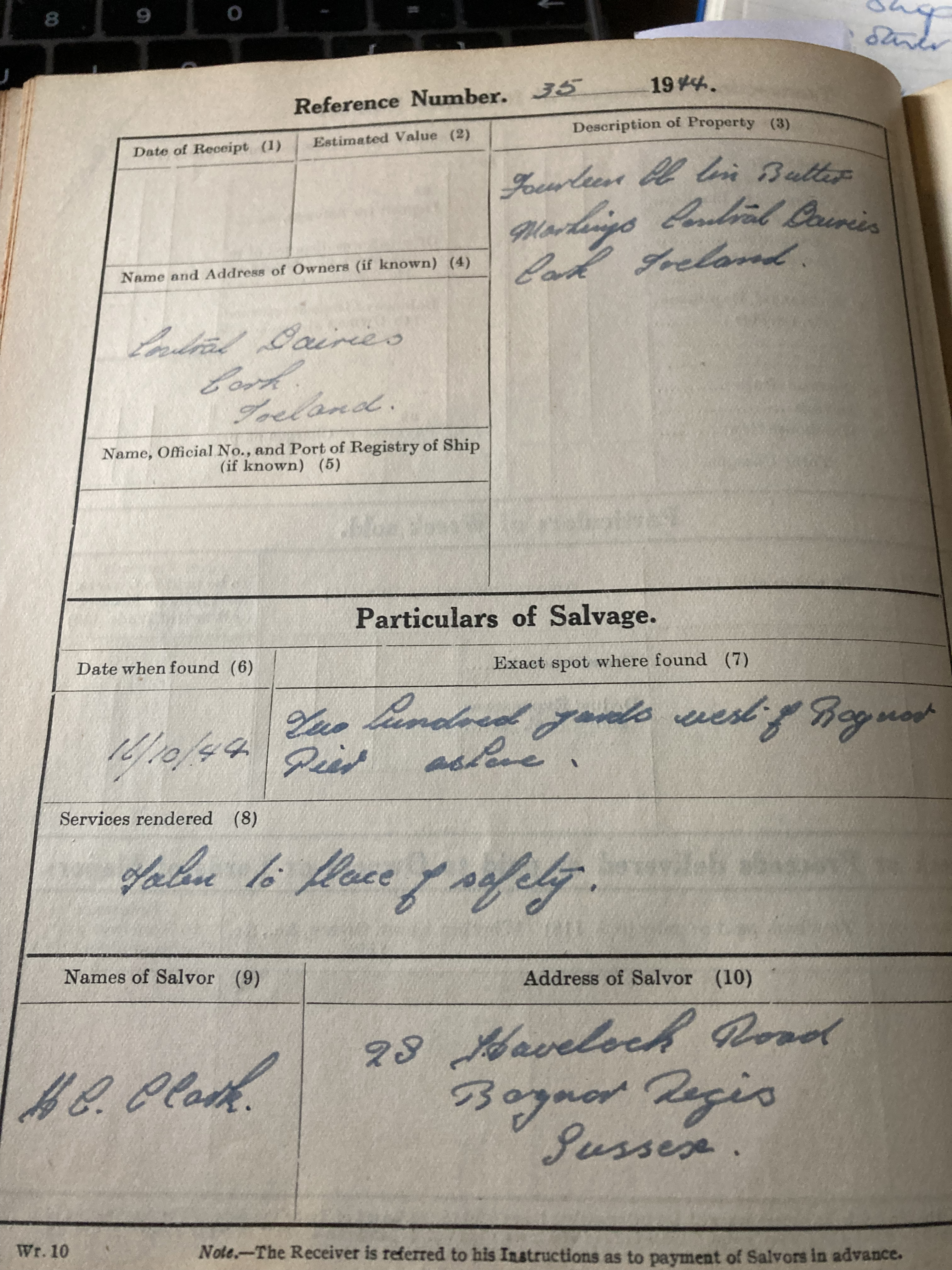
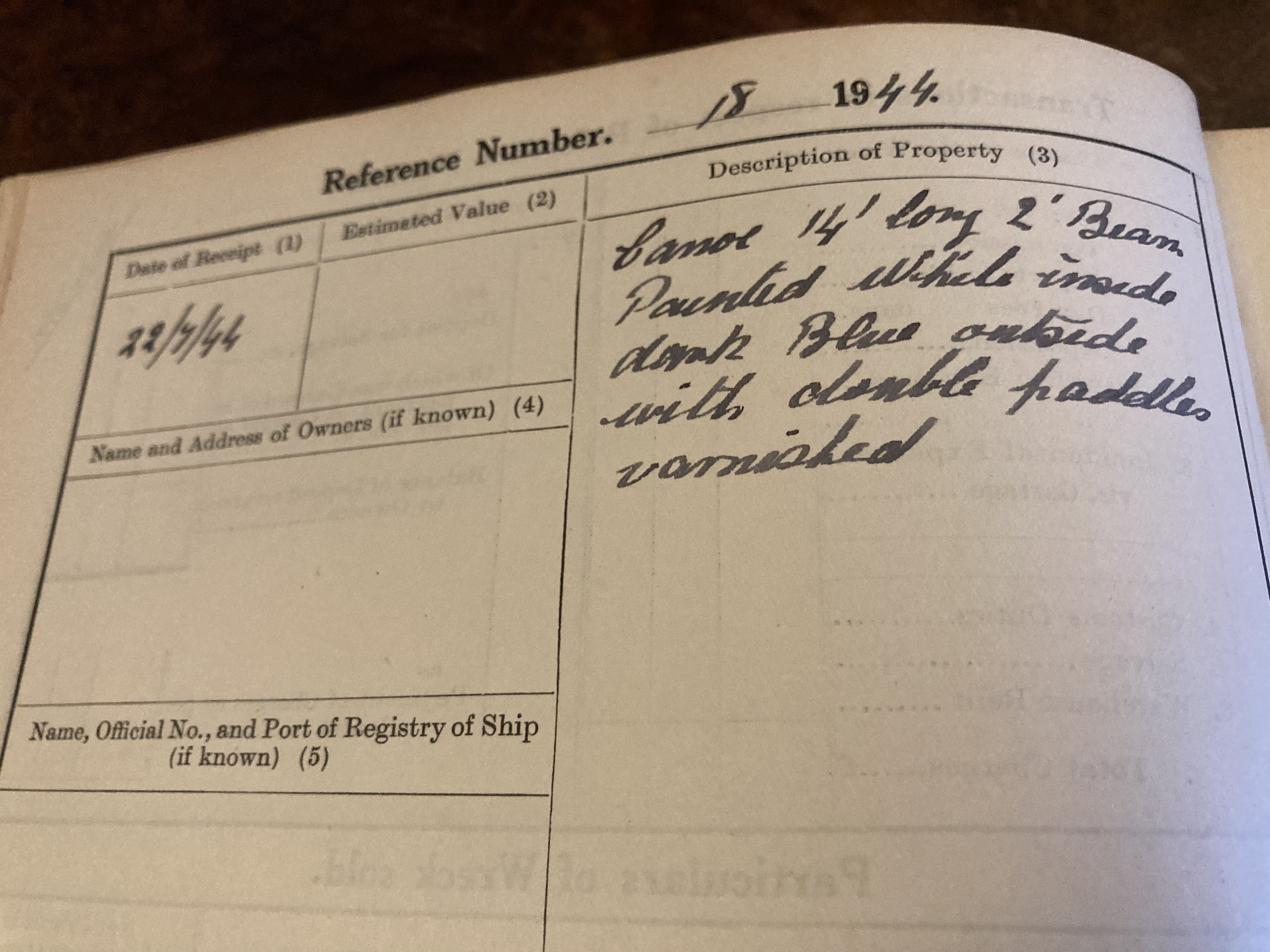
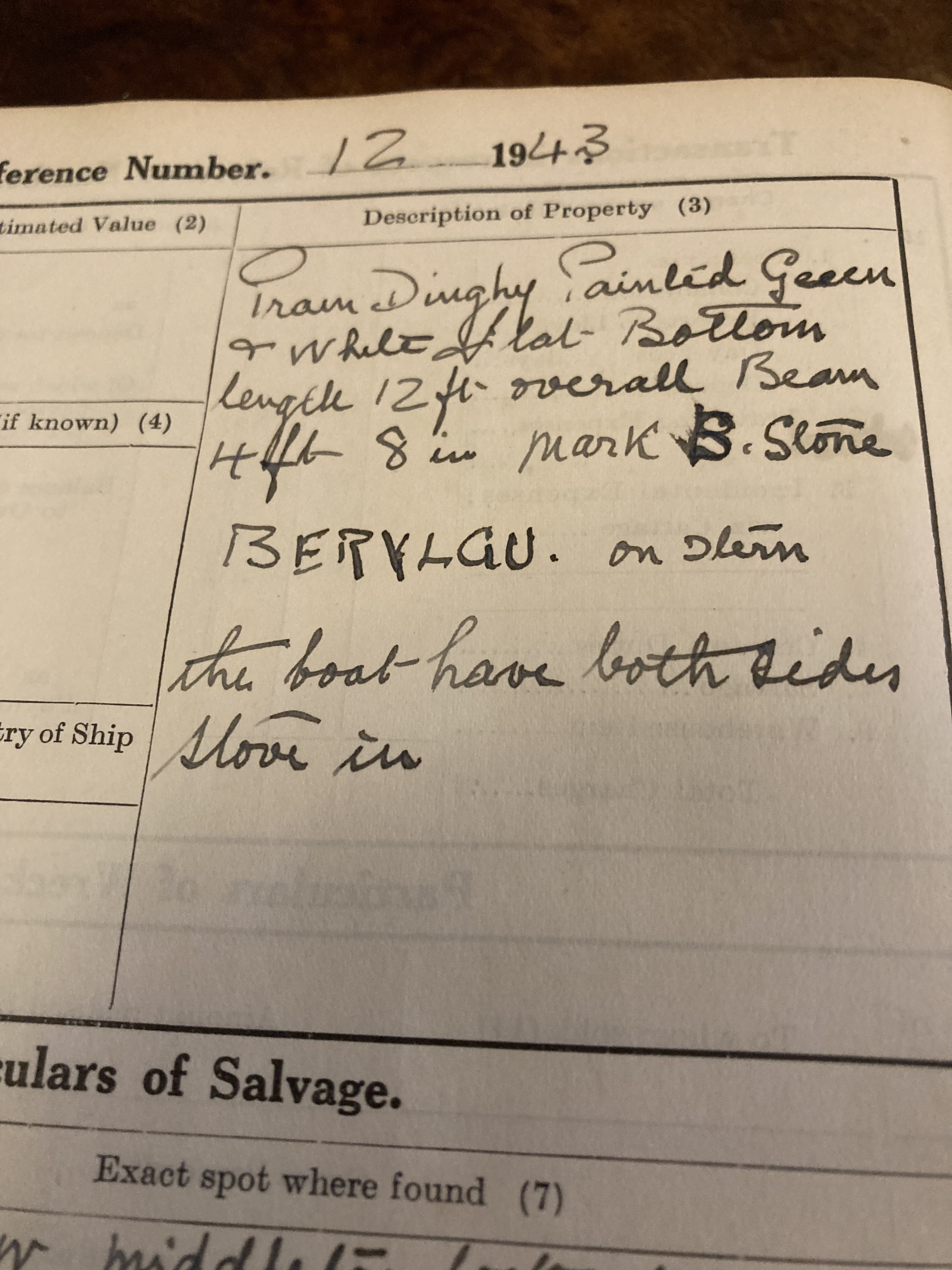
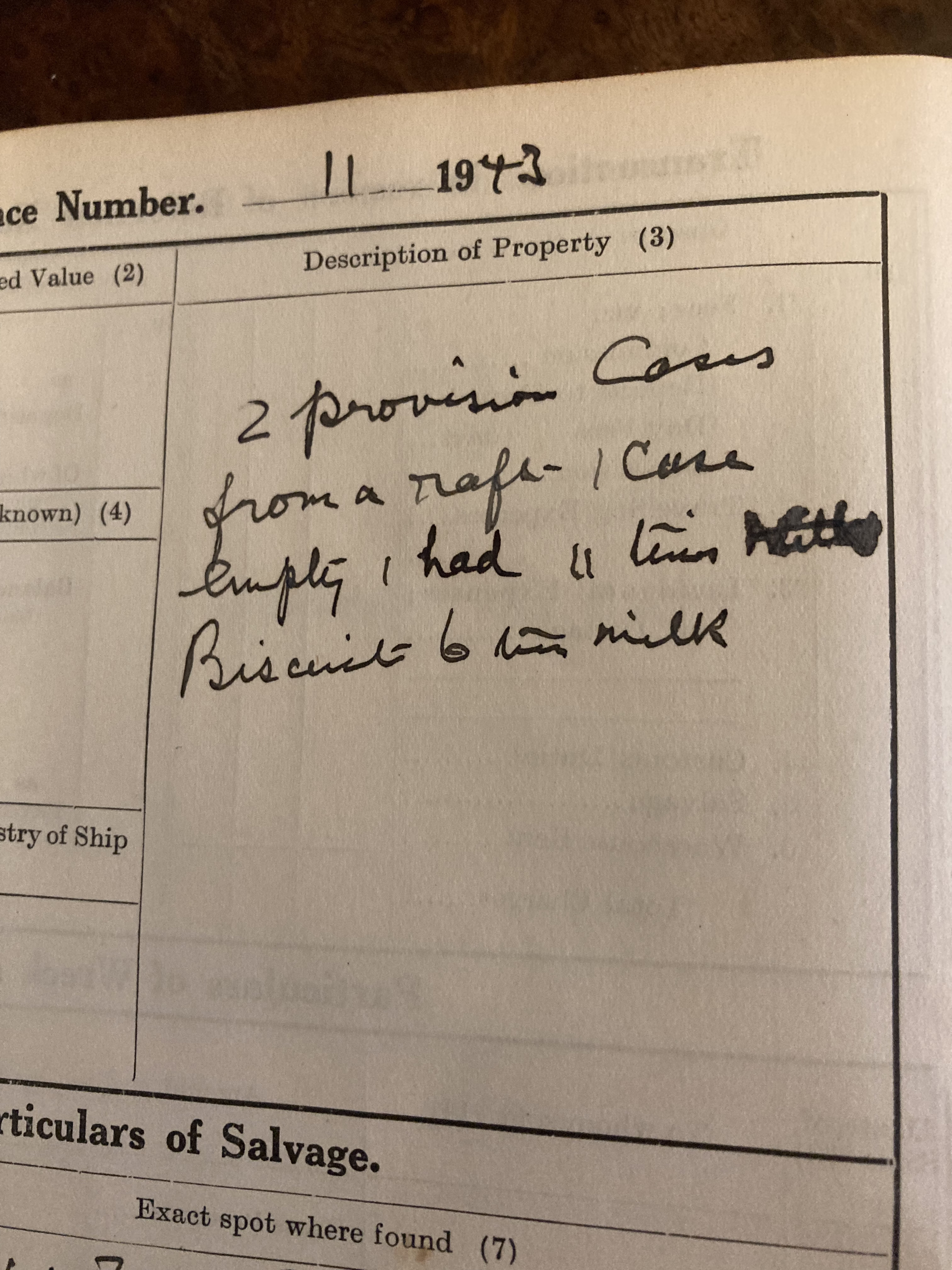
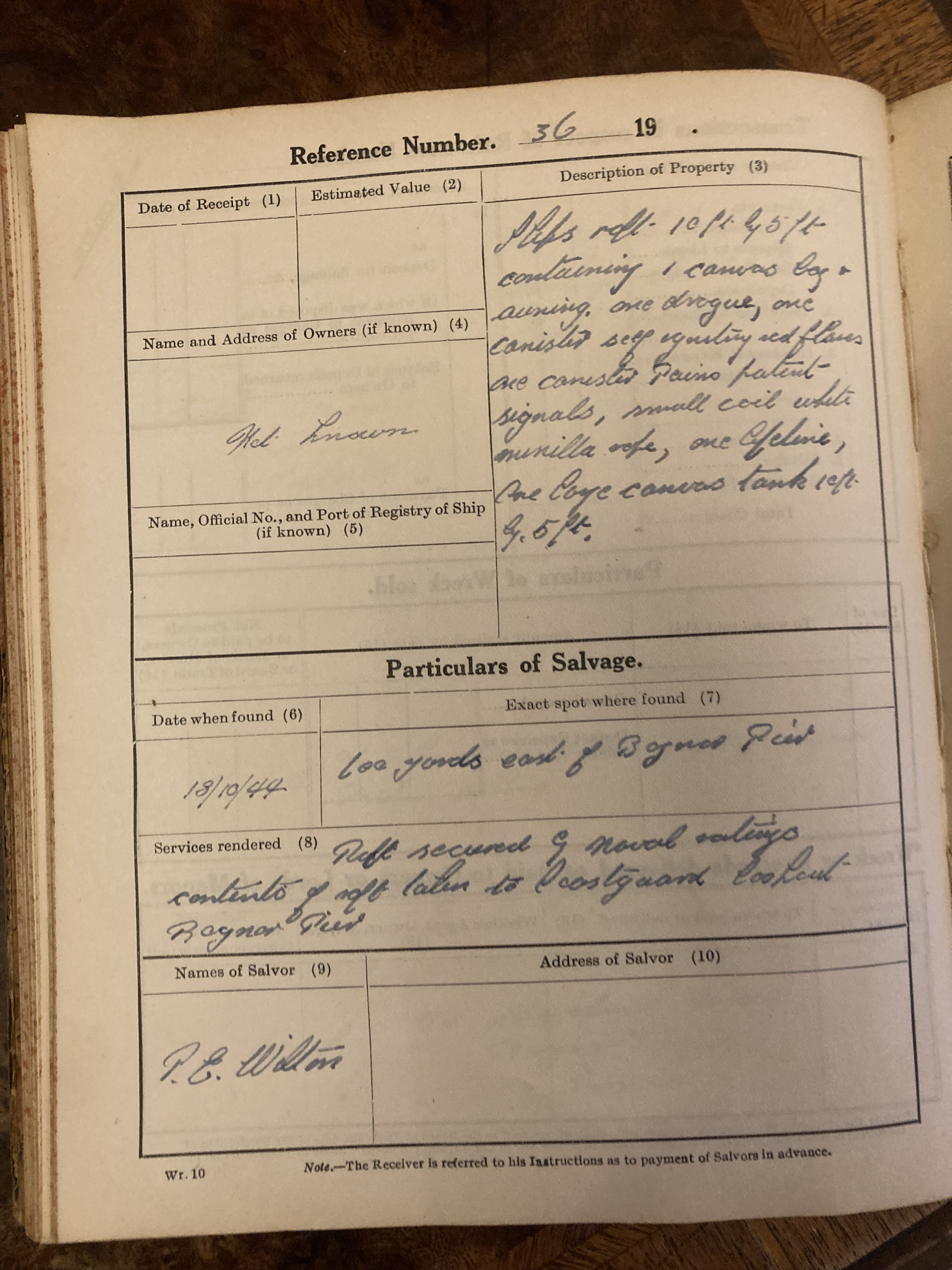
This nicely (but now rubbed and faded on the outside,) marbled book holds a record of wartime salvage off the Sussex coast.
Before your mind wanders to a romantic story of villagers pillaging loot under the cover of darkness as the waves of the channel swish along a hidden slice of coastline, stop it.
This is a series of terse listings of what, where and who from 1943 to 1947.
Written, I am thinking, by men who were charged with creating a log to keep officialdom happy or at least undemanding, or just to have a record of what appeared on ‘their’ shores.
The title page is blank so they ignored the boxes asking who they were – and if you read it carefully, you will see that perhaps officialdom was looking for a few more details.
They knew what was found, where and who carried out the salvage but as to what it was worth, who was paid what as a result or who the owners were – it is all a mystery to us and perhaps them.
There is different handwriting as we move through the book and the years – some more legible and some a fraction less terse, but nowhere are we getting the backstory.
What ship shed its load of rubber? There were various amounts of rubber found at various dates, in places from ‘ bottom of sea lane, Angmering-on-Sea’ to five yards below the High Water Mark outside the Pheonix Club, Alma Hotel, Middleton-on-Sea, and one bale of unmarked rubber on the foreshore of the Craigwell Estate.
I have no idea who was filling in these entries and what official capacity they held, but we do get an idea if who was doing the salvaging.
Quite a number were Canadian soldiers – not entirely surprisingly as there were a lot in Sussex and presumably were allowed onto the fortified beach when ordinary locals weren’t.
But there were salvaging civilians including E W Morris, Lorry Driver, 50 Highfield Road, Bognor Regis.
And, Richard Davie, Police Constable, Police Cottage, East Preston, Sussex.
J O’Connell of Admiralty Road, Felpham salvaged ‘Paraffin Wax approx 150 lbs no marks.’
The names don’t repeat – with the exception of Constable Davie which might point to locals handing stuff over to him whether completely to not – so presumably these were not professional salvagers unless there was a significant number of them vying for stuff all along the Sussex coast.
I am assuming that most of what was found was flotsam (being the stuff that was not deliberately thrown overboard) as opposed to jetsam which was, you won’t be surprised to hear, was jettisoned.
And there are other more interesting finds than rubber or paraffin so, if you have the time and energy to read on.
It seems as if the entries all refer to things which ended up on the shore and indeed quite a lot is listed as being pulled above the high water mark.
But more portable stuff was ‘taken to a place of safety’ and interestingly, that place is rarely identified.
I could run away with the idea that places of safety might include shed, kitchen cupboards, or under counters but there is the official record – however thin and terse – of what arrived on land so presumably the salvagers were an honest lot.
For instance:
There are a number of dinghies, and a canoe complete with oars.
With a couple of exceptions, none of the boats had names. Perhaps that was common in the war, but where did they come from? What happened to the people in them? Why were people out in dinghies, or indeed canoes in the channel during a war?
Finally, perhaps the saddest entries are those of ships’ life rafts
Hopefully, we will find someone who wants to research/appreciate/understand this brief record of an aspect of Sussex coastal wartime history – if we do, I will let you know.
It has rarely been a time when serendipity and coincidence have worked out so well for our Oxfam bookshop.
I have said before, and no doubt will say again, one of the delights of volunteering in an Oxfam shop is serendipity – you can’t order stuff, you can only open a box, delve through a carrier bag, and find what you find, look at something which makes you smile.
This, dear reader, is a long list so don’t say you weren’t warned.
So, where will we start.
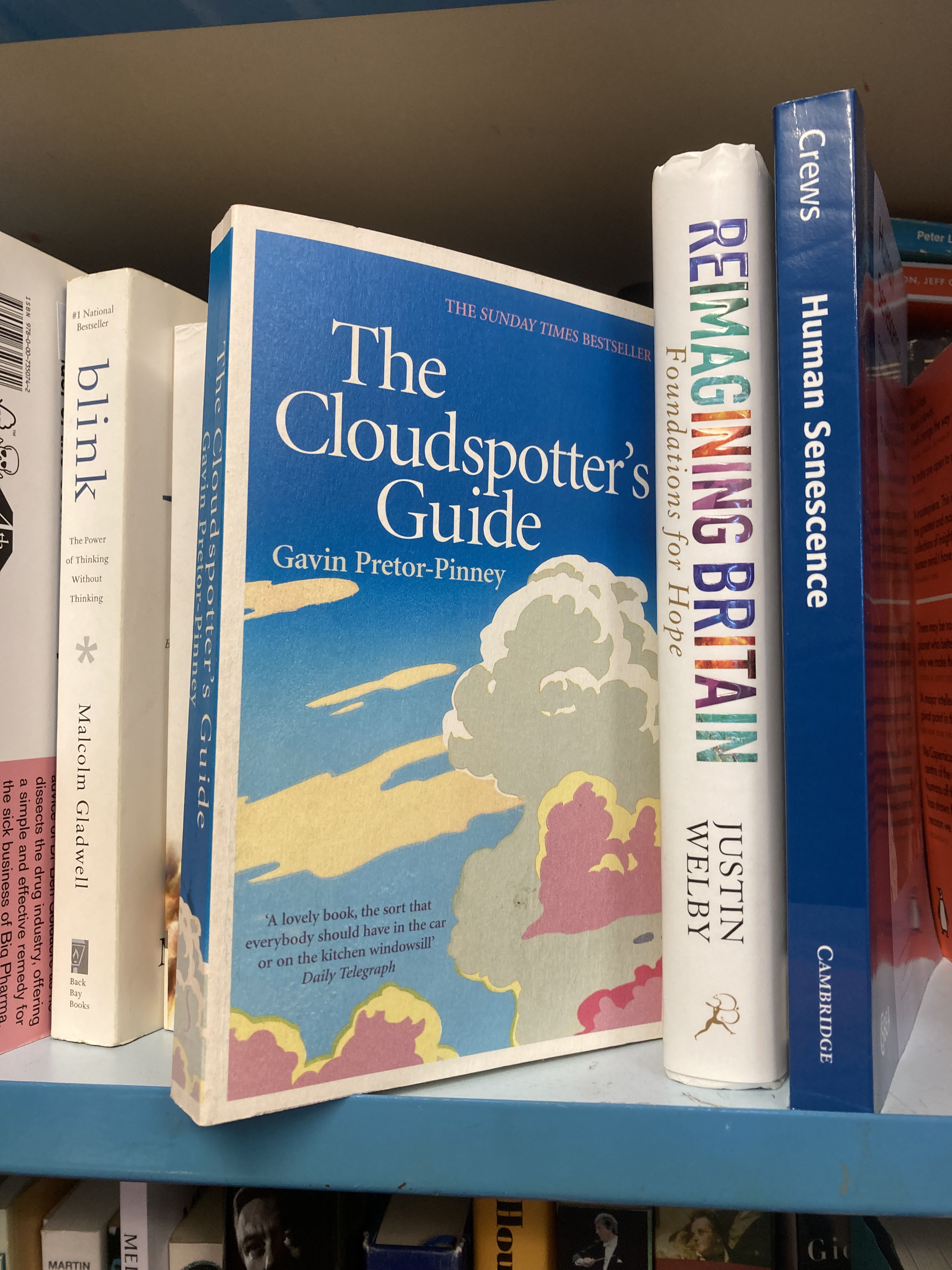
Someone came into the shop and asked for books on weather.
He said his family had decided not only would they shop for Christmas gifts in charity shops, they had a theme – weather.
We we always, always have books on weather – clouds formations, climate change etc etc – but not this time.
Three of us scoured the shop upstairs and down, but nothing.
Of course, after Christmas we have had lots of books which would fit the bill, but nothing at the time – sorry customer.
On the other hand, here is a good news story.
So, a couple came in, the same day, and asked for for an old leather-covered bible. Not a request we get often.
And we often have one.
But not this time.
Apparently, their son had confirmed as a Christian as an adult and he loved second-hand stuff, shopping in charity shops etc.
And, they were not in a great hurry so I took their phone number, and said I would let them know if I found one.
One day, after the planning and work ( bearing in mind we have been doing this since August) and whoo-ha of Christmas, I had time to set out, clear out, rootle through the stash of ‘old and interesting’ books and found a bible dictionary which was not only leather bound, but presentation bound.
(That means, just in case you don’t know, it was bound especially to present to a student with a presentation certificate pasted inside. And it had marbled boards and page ends – no I don’t have a picture so you need to Google what that means if you are interested.)
And, sorry I did not take any photos.
It seemed to me to be a long shot of what the customers wanted ,but called them anyway saying they were under no pressure to buy, just a thought.
They turned up about an hour later, were delighted, paid twice what we had priced it at, and bought a coffee-table book (we had had for a very long time) on the most beautiful bibles in the world.
Later he sent me a text message saying how delighted they were and how much they had appreciated the ‘effort’ we had made to get what they wanted.
As ever, there is something special about uniting a book with someone who is going to really appreciate it.
Next, serendipity and coincidence is more prosaic.
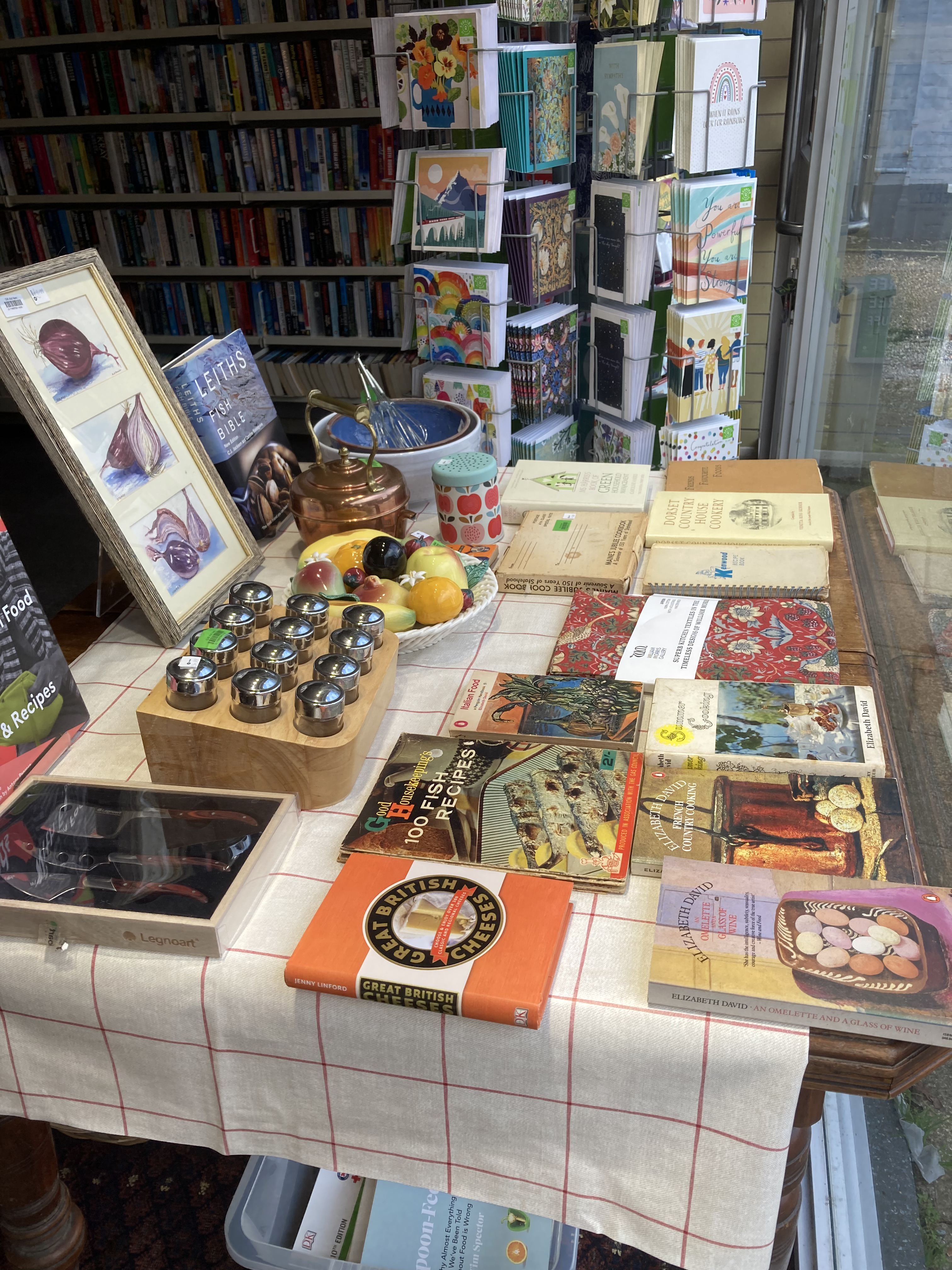
So, after Christmas I was thinking about that table to out out and I thought of cookery – what a surprise, my friends might say – and had a few old books and magazines relating to cookery which I thought might make a (slightly) interesting table.
I was upstairs sorting all this stuff out to fill a table when the volunteer downstairs let me know there had been a(another) donation.
When I abandoned my task and went downstairs, I found the donation included a copper kettle, a kitchen bowl, a set of cheese knives.
Sorted.
Finally, and thank you for keeping going this far, the end is nigh.
Sometimes I have a plan weeks in advance about table displays but sometimes I come in on a Monday and wonder how I am going to make it work.
On one of these Mondays recently, I decided to put out books that were set in different countries.
Of course there were a few travel books, but also novels, history, etc etc.
Now, there is nothing as useful as signalling your rather arcane theme than a prop and hey ho, someone, about twenty minutes later, donated a globe and some foreign coins. Thank you whoever you are.
And on the same day that it was announced Ronald Blythe had died at the age of 100 – most famously the author of Akenfield. Guess what I found stashed behind a pile of Jane Austen and John Betjamin…..
This is nearly the end.
Sometimes you have a donation which is not so much a delightful, serendipitous addition to your plan, as something you have to take a deep breath and think how on earth are we going to make this work.
A horse’s saddle.
Well, yes that was a bit of a surprise as a donation because it is not often we, as a book and music shop, get a saddle as a donation.
Apparently, someone brought it in and said her mother, a rider, had died and asked her daughter to give one each of her saddles to three charity shops in the town. (have to say, I have not seen saddles popping up all over town…)
So, instead of getting a bonus for a pre-planned display, we have had to build one around it. We have a lovely display of countryside and the saddle is front and centre.
God only knows what we do with it if it doesn’t sell – us volunteers, are so fed up of moving it out of the way in order to go to the loo.
And just as we thought we had sorted one large, in the way, unusual donation, we got a guitar.
One of our great volunteers was called in to tell us what it was worth. Some calling around and he came up with a price – £175 – a big deal for us.
So, my plans for the table were jettisoned smartly and here’s hoping it will sell before we have to drill holes in the wall and ‘erect’ a guitar holder.
Fingers crossed we have a guitar playing horse rider shopping in Petersfield this week…..
Serendipity is part of the charm of working in the Oxfam bookshop. Usually it as about books but yesterday, it was about a remarkable you man, coins and stamps.
Now I don’t often work a Saturday afternoon but I have to say it is always interesting – a different demographic from a weekday, and busier – less time to do the titivating, tidying, sorting stuff that you can do Monday to Friday.
( As ever, a long-read warning but it is a heartening story so you might want to carry on at least for a bit.)
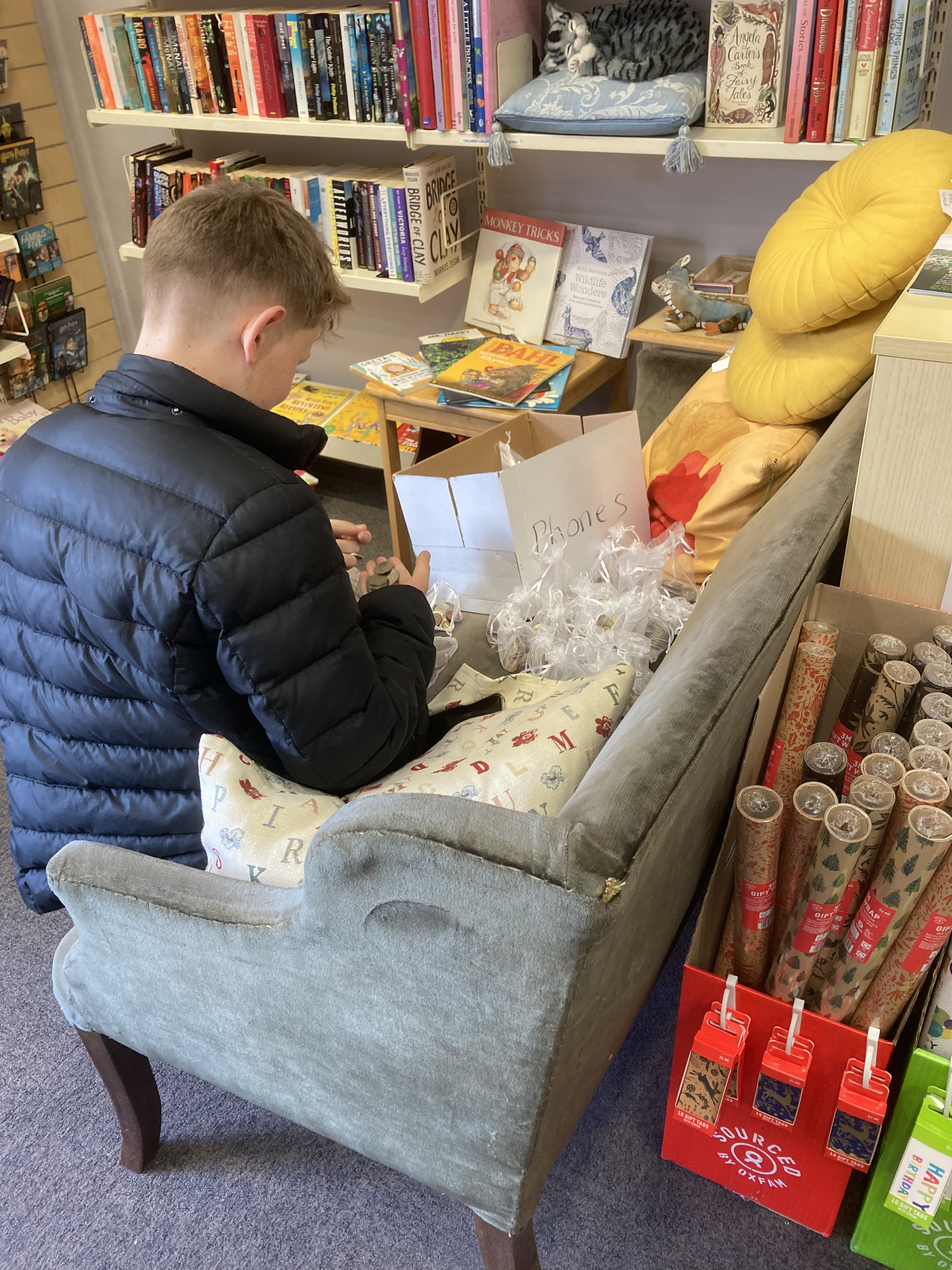
Anyway, there I am at the till with two Duke of Edinburgh Award young people doing their volunteering stints when in walks a young person of say 13 years old. ( I am surrounded by young people and it is making me feel old….)
The DofE young women are doing books, but he is not interested in books, he asks me if we have any pre-decimal coins, foreign coins and/or stamps.
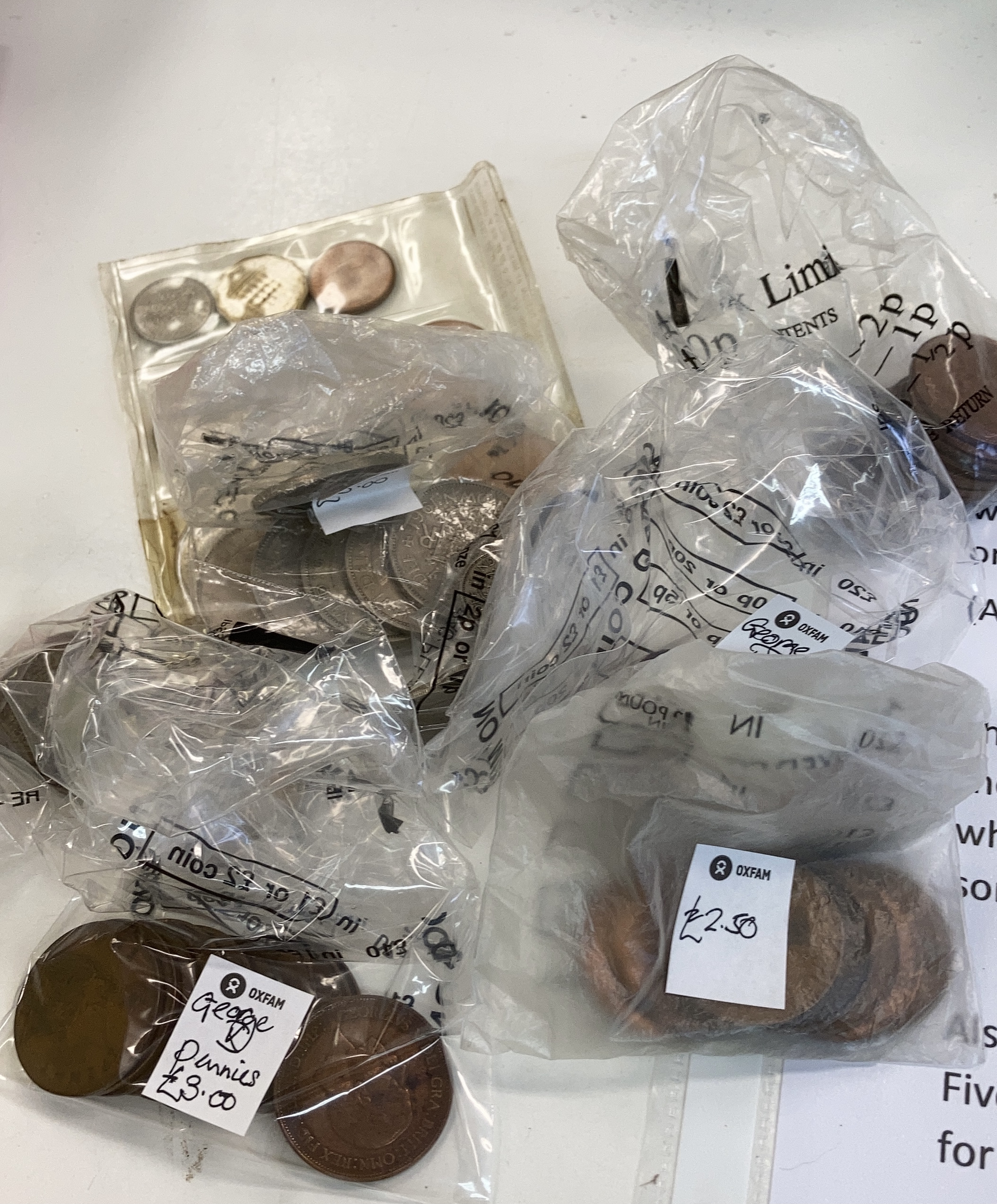
Well, as it happens we did have a load of coins which a lovely volunteer ( at the other end of the age spectrum) had sorted into organza bags.
Last year we had unearthed a stash shoved under a workbench in the shop and which had been there for some years – and we sold them in aforementioned bags.
People bought them to put sixpences or threepences into their Christmas puddings, or bags of old pennies to ‘amaze’ their grandchildren, or foreign banknotes to play Monopoly with. We did well.
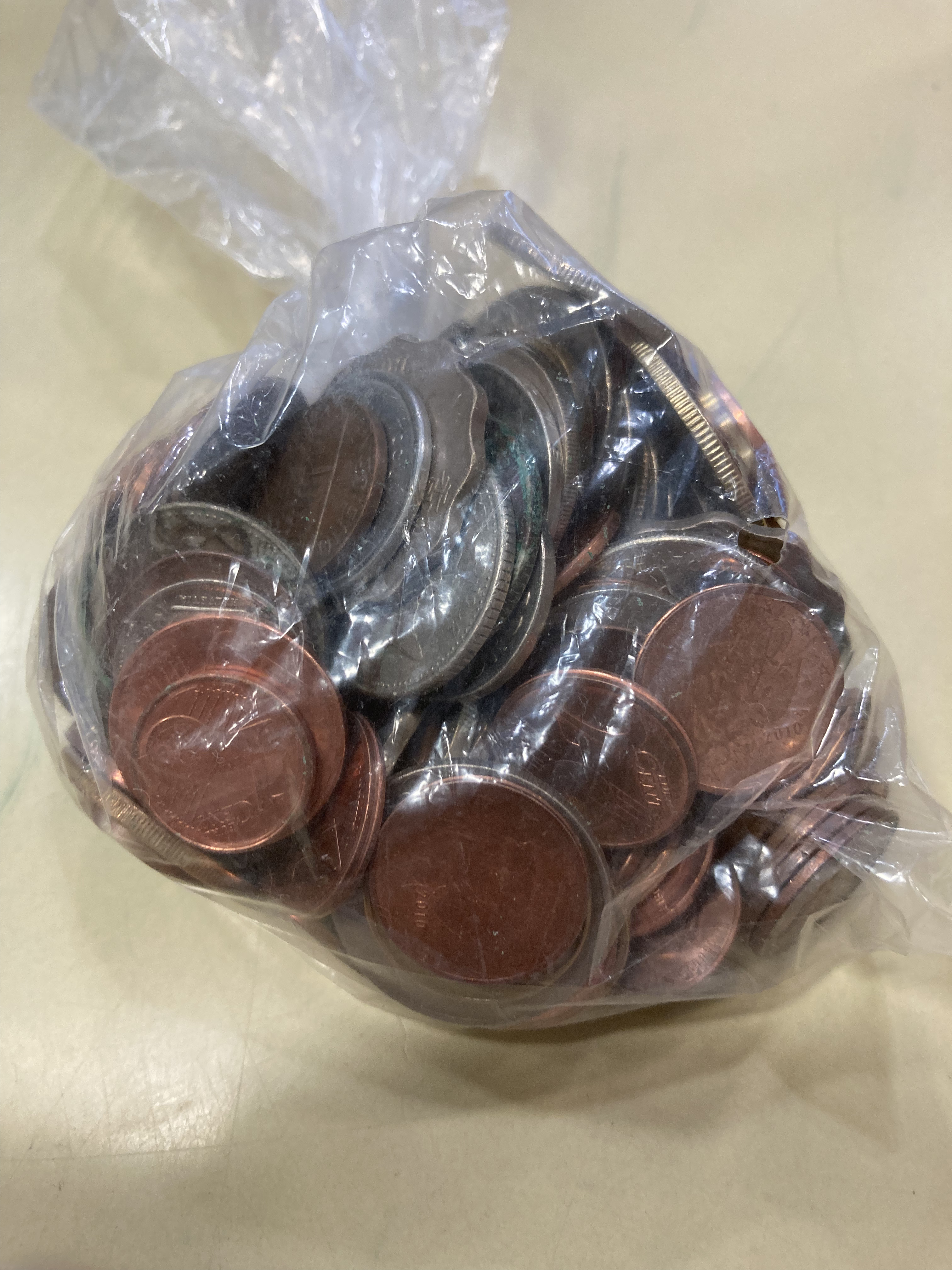
In case you need to see what the pences are:
So, she and I had decided to do the same this year and she waded through bags and bags and sorted them into pre-decimal British coins, foreign coins, silver coloured, brass coloured, etc etc. They were in a box upstairs.
‘Well,’ I said to the young man I will call Tom, ‘ We do have some. Do you want to have a look?’
He did and spent more than an hour sitting on our shop sofa, riffling through and telling me – and indeed customers – about when silver sixpences were phased out (1947), what the print runs of Penny Red stamps meant in terms of value, pulling out the incredibly light ( probably made from Aluminium) coins from Romania and much more.
He told me/us that his grandfather was a coin and stamp dealers and left Tom his collection – now stored in a large container – which is now working through.
Some of the stamps are now at Gibbons, he has sold some of his own and his grandfather’s collection and used the first money to buy a dog – but, he admitted, his Mum does most of the dog walking and feeding. Well what a surprise.
Customers came and went and Tom carried on, still telling me stuff in between me taking money from book buyers.
At one point, there was him, me and just one customer who said, ‘ I have a bag of old coins and I have never know what to do with it. Could I bring it here and and if there is anything valuable, I am sure you will identify it and Oxfam can benefit?’
‘Yes,’ said Tom and I together.
So, he eventually left taking some stamps and coins to research, and coins he had bought.
‘Thank you so much for trusting me with these,’ he said.
‘Well, I have your phone number and I do trust you. And thank you for an interesting afternoon,’ I said.
‘I’ll be back,’ he said – and I am sure he will.
Book buyers kept me busy until almost closing time when a young woman came in and said,’ This is a long shot but do you take old and foreign coins?”
‘Yes, we do’ I said and she gave me the last donation of the day.
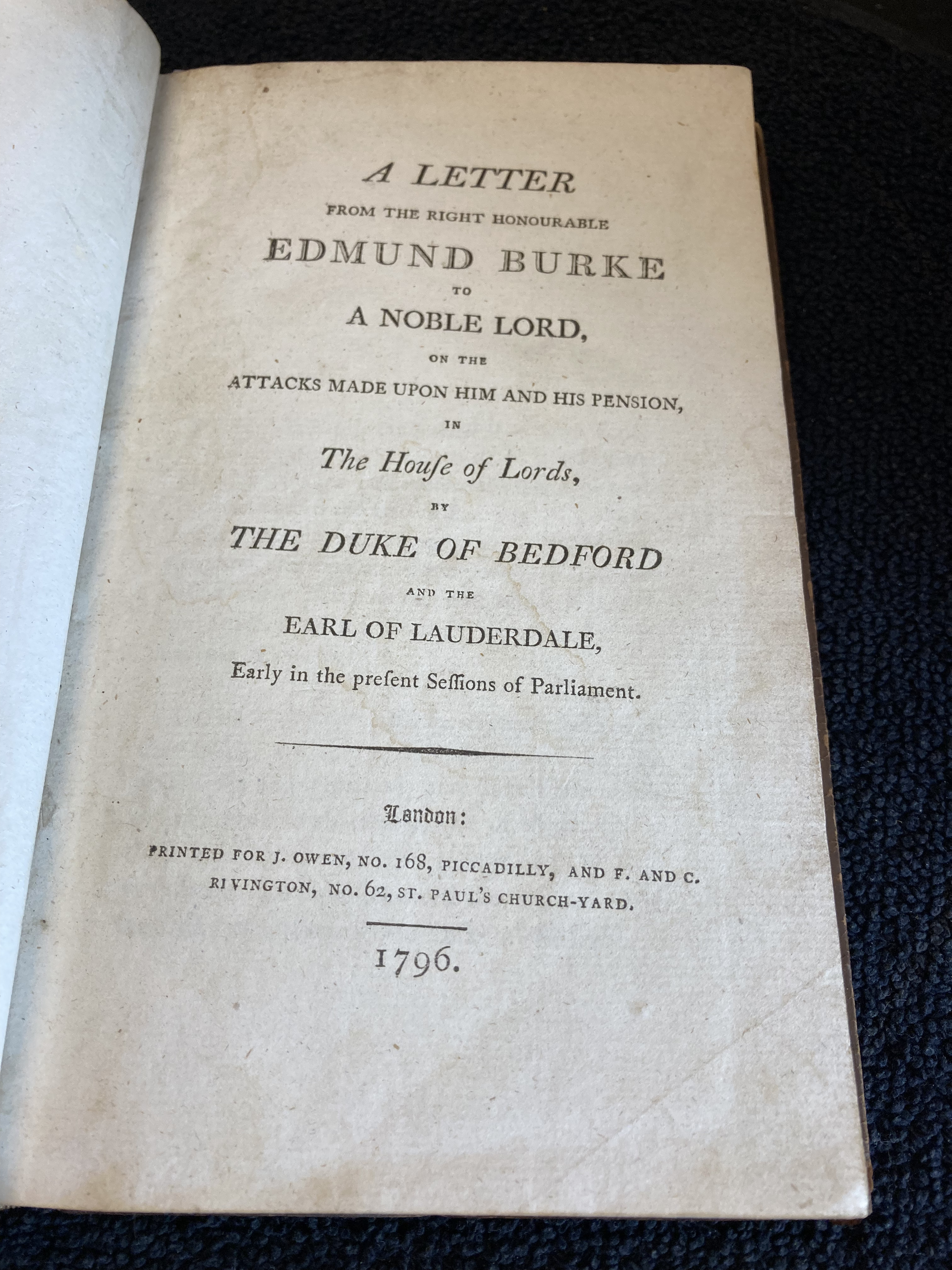
This is about a book from 1796 which has arrived in Oxfam Petersfield in 2022.
And about a coincidence.
Be warned, there is a lot of this – I got a mild dose of Covid so was at home with time….
But at least this time there are some pictures.
Ignorance of the provenance of book is the lot of a charity bookshop. Indeed, I am not even clear which of our volunteers, put it aside for me to look at.
Anyway, we have it, and what an interesting book it is. (Value, you Antiques Roadshow aficionados, will come later.)
So this is a bound volume of three letters by Edmund Burke and for those of you who think who? Here is some info – actually, quite a lot of info.
‘The only thing necessary for the triumph of evil is for good men to do nothing.’
And:
‘Nobody made a greater mistake than he would did nothing because he could do only a little.’
Obviously, he was no feminist, but apparently he was anti-slavery.
He was also, depending on who you read, a founder of Conservatism and/or ‘a wet and a Eurosceptic’ according to the Beaconsfield Historical Society.
He wanted to be the Earl Of Beaconsfield and George III wanted him to be, but Burke’s son died so he couldn’t have a peerage. Life peers were only introduced in 1958 so if you didn’t have a male line to take it on, you didn’t get it.
What he did get was a handsome pension which was criticised by the Earls of Bedford and Lauderdale hence this:
His argument was that at least he had earned his pension by unstinting public service whereas the earls got their money by inheritance alone.
‘I was not, like his Grace of Bedford, swaddled, and rocked and dandled into a Legislator’
And he wrote in one of our letters, ‘Loose libels ought to be passed by silence and contempt.’
Meanwhile in a 1771 letter to the Duke of Richmond, Burke wrote that ‘persons in your station of life ought to have long views. You people of great families and hereditary trusts and fortunes are not like such as I am … we are but annual plants that perish with our season and leave no sort of trace behind.’
Oh yes, he had a good turn of phrase.
And according to Martin Greenberg, who also has a good turn of phrase:
In Letter to a Noble Lord (1796), Burke replied with a crushing force to two whippersnapper peers, obscenely rich enthusiasts of the philosophes and the French Revolution, who had attacked him for accepting a pension from the crown. He set his lifetime of accomplishments against the nothing of their juvenile efforts, his defense of their inherited rank and acres against their coquetting with a power whose universal ambition, if it were able to reach across the water, would have swept away all that they were and owned with a grin. Burke’s prose–sober-paced, weighty, powerful to the point of being overbearing–has always close behind its argumentation a reserve of poetic energy which now gleams, now flashes, and now, as in this letter, explodes in a fireworks of dazzling metaphors, a storm of epical-satirical language that tosses around the duke and earl, great galleons of the nobility, like little cockboats. ‘
Now I am not directly making any comparisons with current British politics but if you want to, be my guest.
Our book was published in 1796, the year before Burke died.
Other things that were happening in 1796 include:
Jane Austen starts writing Pride and Prejudice,
George Washington gave his farewell address warning against partisan politics ( that worked then),
The British government began work on a 40 acre site at Norman Cross near Peterborough to become the world’s first prisoner of war camp,( who knew, and might need some more investigation)
At Christmas 1796, the French Navy nearly landed an army of 15,000 troops at Bantry Bay in Ireland.
And Napoleon was appointed head of the French Army in Italy which was to have some significant ramifications….
Hence:
Breathe easier, I am not going to give you a history of the Napoleonic Wars (though my Best Beloved can if you are interested.)
Burke wasn’t a fan of the French Revolution on the grounds because of its ‘origins and the class of people who were the driving force behind the Revolution’.
Basically, he didn’t believe that the French urban working class, or the peasantry, could be trusted with legislative or political powers.
He had the view that only the ‘educated’ could be reliably left to run any country.
So, you can get the text of these letters online and you can buy them in the original but very rarely, infact, very, very rarely can you buy one from 1796 printed on such good quality paper – and in an original binding. Most of them have lost their binding or were never bound at all – just get them out there, the printers must have said.
The paper is impressive. Very little foxing ( that’s the brown spots on the pages of old books) and it feels strong and thick and well cut, and well bound – impressive for such an old book.
We looked for a paper watermark but there wasn’t one. And I found out that this ‘book’ went into 11 editions in 1796. That is a lot of editions, and though the print run would have been the kind of print run were are used to, that is a lot of books.
And there are five raised gilt bands with gilt titling on the spine and gilt banding on the front and back boards.
Interestingly, at the bottom of each page there is the first word, or part of the word, of the next page. I have not seen this before, but maybe that is my ignorance.
It is also justified which means that the left and right margins are the same – and means that words are sometime broken up, or spaces are stretched to make the text fit the margins.
(That can make reading hard on the eye because different spacing seems disjointed. Our book, I have to say had a very good typesetter because it is easy to read.)
Is it about making sure the pages are in the right order? Possibly, but they are numbered.
Well, now you know a bit about how books are described online…..
And all that has been taught to me by someone who knows amore about books than I will ever do and who is the man who comes in ( when called up) and tells me what to look at, what to reasearch, what to learn…. and teaches me to expand what I know from the back of a postage stamp’s worth to, oh maybe a small postcard.
Waiting for the valuation? Well because it is bound and in great condition we are hoping for £275.
Maybe it will be sold asap or maybe it will take some time and be less than that – that’s the way it works.
Now, if you have got to the end of this and still have a memory of a mention of a coincidence….
So, Burke got his pension (I gather £2,500) in no small part for his work as Chairman of the Commons Select Committee on East India Company Affairs.
And he impeached Warren Hastings.
So when I went into the box of books that have been put aside for me to look at, under the Burke letters I found a handsome book – a biography of Warren Hastings….
I have no idea whether they were donated together or this is one of those coincidences that happen in the life of a bookshop when no providence can be found.
More of that next time.
And, we have another book from 1796, The History of America – perhaps more on that too.
There is a hinterland to the bookshop not visible to the customers’ naked eye and if you have never volunteered in a charity shop, I am sure you also remain blissfully unaware of what it takes to make the wheels run smoothly.
I am here to enlighten you, just a little bit.
Next door-but-one to our shop is the HSBC and although Oxfam doesn’t bank with them, the counter staff are always happy to give us change – we go in there most days with a £20 notes asking for pound coins, or looking for 50 pennies.
Life on this front got a lot easier when almost everyone used a card to pay, but now cash is creeping back and you would be surprised just how many people want to pay for a £2.49 book with a ten pound note. ( Mostly they want change for car parking.)
We buy them posh biscuits at Christmas as a thank you. ( That’s the bank, not change-hungry customers.)
Next door on the other side is an estate agents and – they hold the shop key for us.
For all the obvious reasons we do not have a key for every volunteer, so we need somewhere for the afternoon volunteer to leave it at the end of the day, and another volunteer to collect it the next morning.
They get thank you biscuits too.
Bet that little bit of administration had not crossed your mind…..
Sometimes we get books donated which fall into the loose ( sometimes very loose) category of erotica.
I know enough about this genre to know that old erotica can be very valuable but most of the time it is not, ( though sometimes rather ‘interesting’) and we can’t/don’t sell it in the shop.
So I collect it, suitably on a top shelf, and when I have a decent pile, I call John who runs the second hand bookshop in town and has fewer qualms than Oxfam, and he gives me a tenner for the lot.
Every little helps…….
We have a jeweller in town who will take our broken gold bracelets and odd silver earrings and give us the scrap value and look at stuff we don’t know how to price and tell us what to do.
Then there is the model railway enthusiast recommended by my hairdresser – see a previous blog – and now needed to work out the latest unearthed bit of models railwaying.
And then there are the volunteers.
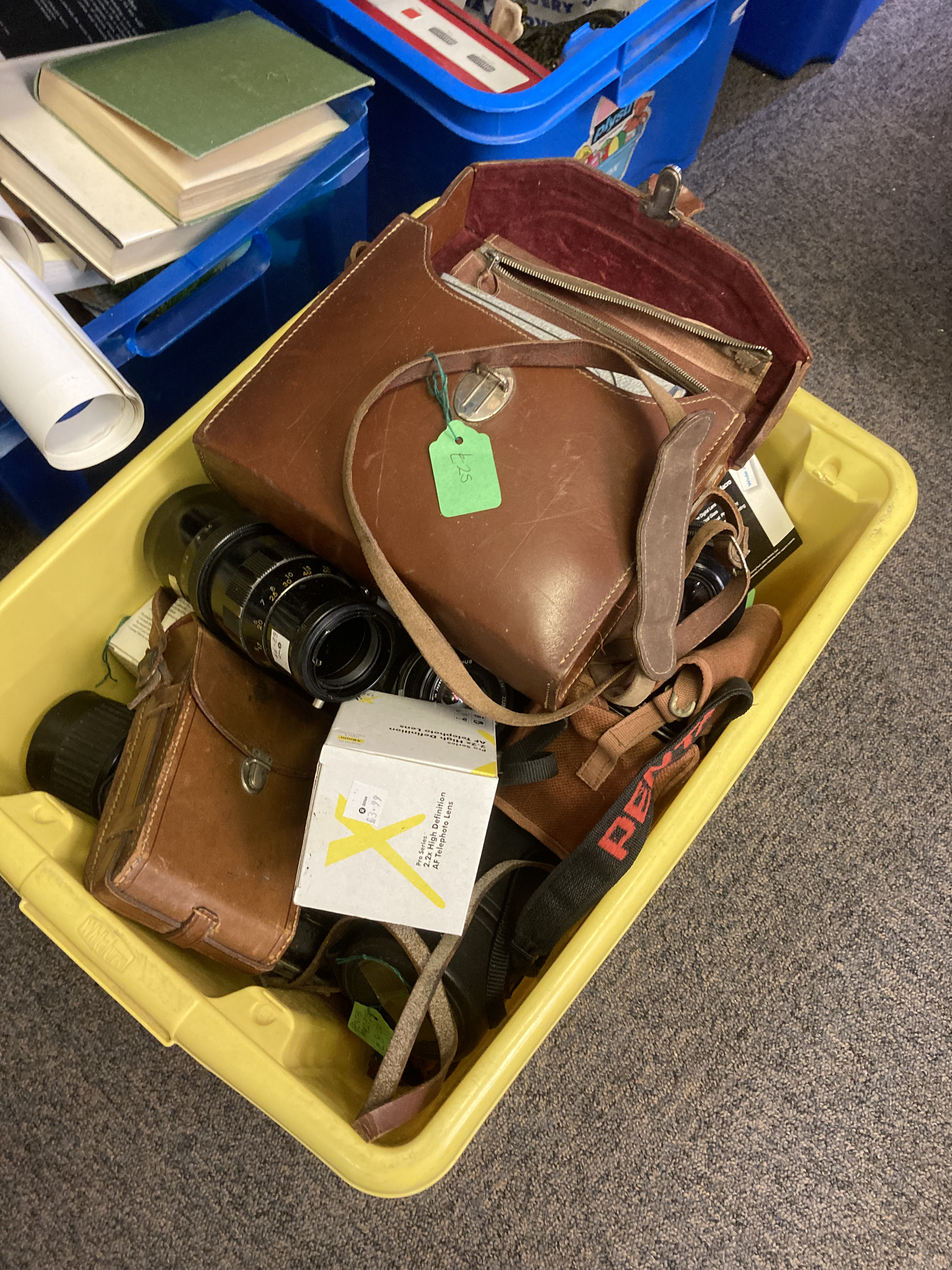
One priced all the cameras and camera equipment we unearthed from under a pricing bench.
We sold nearly everything.
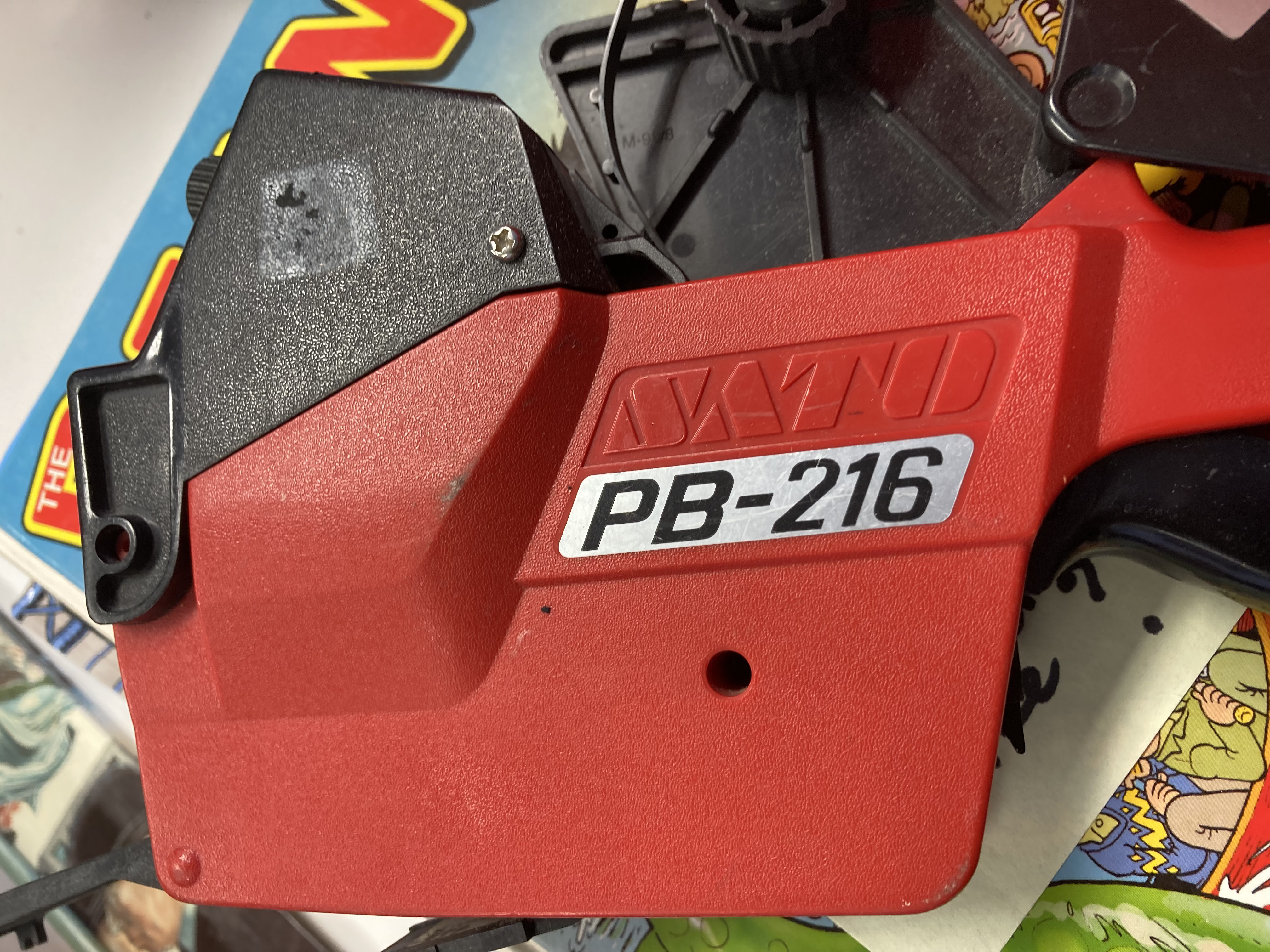
He is the man who also refills the pricing guns.
Now this may not sound like much but these bits of dated technology are the way we get a price on the back of every book.
I am sure there must be a a more up-to-date equivalent, but if so they haven’t reached Oxfam yet.
Everyone I know at the shop has had a go a refilling these things with the rolls of blank labels and, with one or two exceptions, have failed.
David gets them sorted in about five minutes. Part of his hinterland was working for a labelling company once in his past – so that was lucky.
We have a couple of volunteers who are/were engineers and that helps with mantling and dismantling things, and making this bit of kit work with that bit of kit.
The Best Beloved has been know to frame the contents of books falling apart and therefore not saleable but with lovely plates/illustrations.
(And we have a pile of old prints so I need to check whether we can get mounts and cellophane and posh them up a bit so we can sell them.
We could do with someone donating a v-shaped print holder – so if you are having a clear out…)
We have a volunteer ( and her husband) who have made a diorama, a fireplace, wallpapered our whole window with wrapping paper…..
We have a few other creative people and one of them has designed some bookmarks.
We had unearthed a load of bookmarks but have used them all up.
And it seems to me that a bookshop should have bookmarks – and some designed by our volunteer and printed at cost by the local printer ( who is very kind) will be a bonus.
We hope to sell them otherwise we will be £100 down ( even at cost). That same nice printer will give me not one invoice for £100, but 10 of £10 so that the takings don’t take one big hit.
Then there was the key man who came to and fro to our shop refining the key cutting so that we didn’t have to change the whole lock. I nod to him and his bulldogs every time I walk past.
And most recent addition to our helpful hinterland is someone who has a hinterland of his own inhabited by coins, banknotes and old maps experts.
For anyone (at all) still with me on this, now for the models railway and typewriter – not a sentence I would have expected to write.
I knew nothing about model railways but an Oxfam instinct made me say yes when someone donating boxes of books said, ‘By the way, do you want some model railway stuff?’
And, I have watched enough (actually more than enough) Antiques Roadshow to know that can be valuable stuff.
It came in four large boxes and an old suitcase, and I went to get my haircut.
‘Don’t suppose you know anyone who knows about model railways?’ I said.
‘Strange you should say that,’ said my hairdresser, ‘ One of my kid’s godfather is a model railway enthusiast.’
So, the lovely model railway enthusiast and ex-real-train-driver came to help and spent an afternoon looking at what we had.
Lots of it is not of much value but will make a lovely display on the table.
Some of it, we might be able to sell online.
We have track by the plenty – straight and curved; we have signal boxes and signals; we have a suspension bridge; we have old 125 carriages; we have freight wagons; we have christmas trees; we have grass coloured stuff and pink stuff for putting blossom on your model trees….
(And that is more semi colons than I have used in a long time.)
And, I now know considerably more about model railway stuff than I ever thought I would.
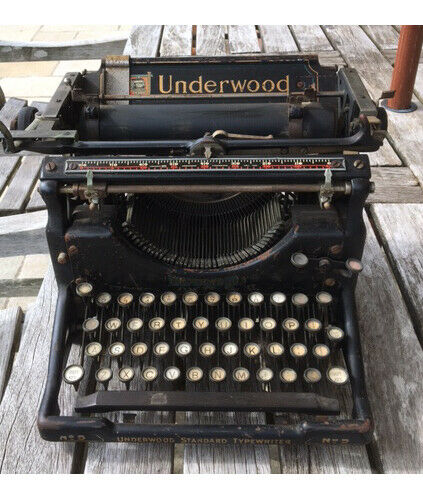
I do know quite a bit about typewriters.
When I was a young journalist, shortly after the Boer War, we had never heard of desktop computers.
We had shared or communal typewriters – never quite enough to go round if we were all in newsroom at once.
And indeed, one of the (shared) typewriters was a really old ‘upright’ one which probably explains why I bash the keys of my Mac too hard indeed.
not quite as old as this but a very close cousin
When you were on the day shift you went into the newsroom and grabbed a typewriter and hoped to get a half way decent one.
One of them, I remember, was so well used the ‘e’ had worn out. So, once you had typed your story, you had to go back through it pencilling in all the ‘e’s missing from your deathless prose.
For every story we wrote, we had two sheets of very thin, poor paper and sandwiched inside was a sheet of carbon paper so we had a copy of what we wrote in case the newspaper got sued and needed to prove what we had written.
Some (indeed sometimes, most) of what we wrote ended up on the spike – literally a sharp spike on the news editor’s desk on which he (and it was always a he) impaled stories that were not going to make it into the next day’s paper.
If you wanted to look up some background to a story, you would go to the librarian and ask for the relevant packet.
And it was a cardboard packet of newspaper clippings and sometimes spiked copy which he ( and it always was a he) had thought to save and file under that particular packet heading – it was sometimes (often) a lottery as to what was in any packet and how relevant its contents might be to what you wanted to research.
We would have thanked any god for Google.
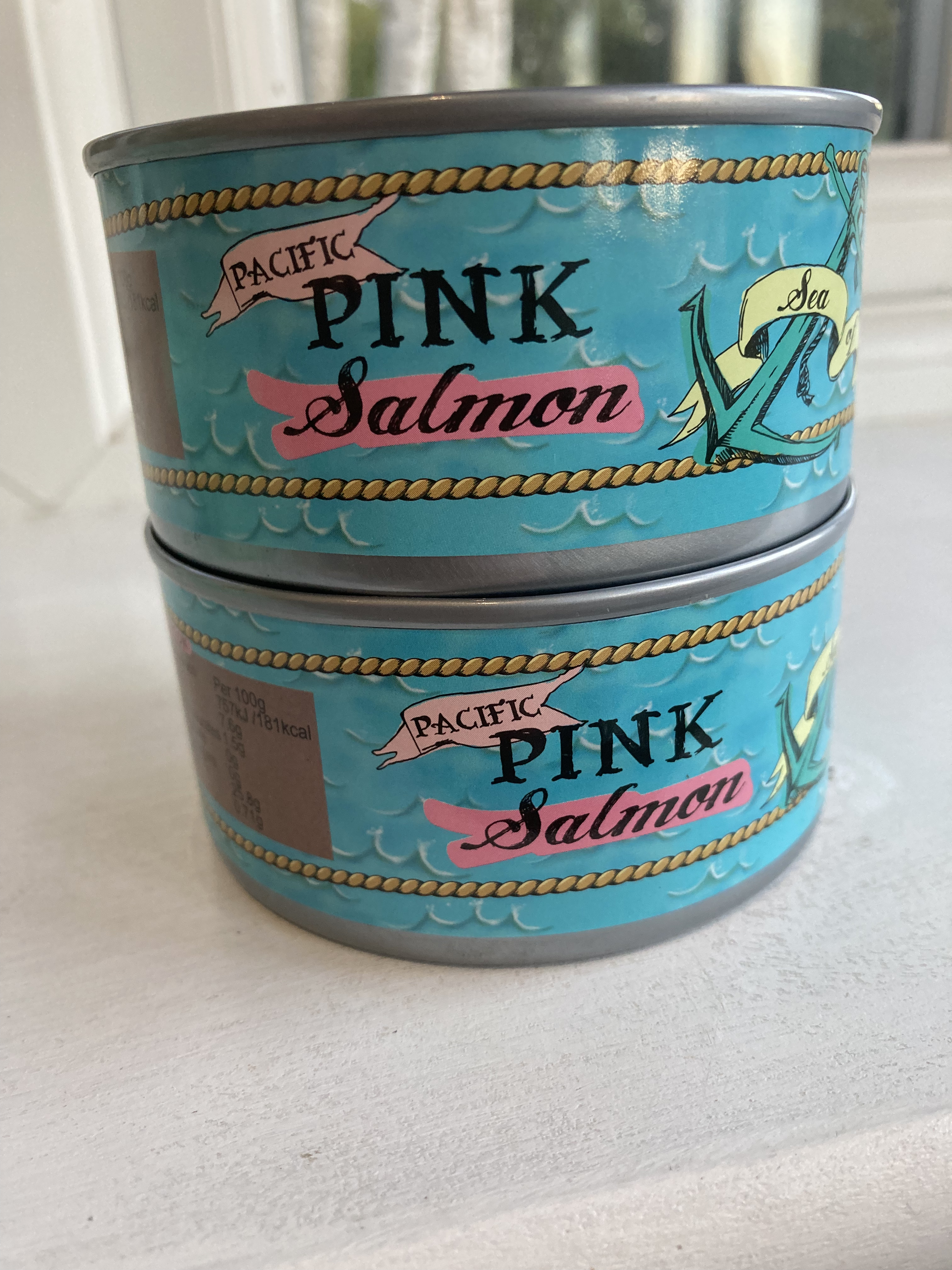
So, after the rinse aid and tins of salmon, I was very gratified to find this.
It turns out to be worth £50. ( Thanks to those very same gods for eBay.)
We will put it on the table with books that would (probably) have been written on a typewriter – not a quill, or fountain pen or a laptop.
So, Hemmingway, Enid Blyton, F Scott Fitzgerald, E E Nesbit, George Orwell, John Steinbeck, James Joyce, C S Lewis, Sylvia Plath and any others I can rootle around and find.
The danger of this plan is that the typewriter sells immediately and customers look rather bemused at the random collection of books – but for £50 I am willing to risk that.
In the greater scheme of things, see also the climate crisis, a week of full-on stuff in an Oxfam shop is small beer.
But for those of us doing that week, it adds up.
And it is another week of unearthing stuff. It seems we have not (just yet) plumbed the depths of ignored treasures in the shop.
And fishcakes.
For those (few) who are following this closely, a bit of an update.
Though it is not absolutely certain, it looks like the cat is not coming back so the mice have a few things up our sleeves – remember the green sofa? it maybe happening – but more of that another time.
So, we have billiard cues, an 18th century large map, some more coins, a book or two, and a vintage typewriter to come.
So, let’s start.
In the corner next to the back door are some poles propped up and among them I spotted something which I thought might be a large and ancient telescope.
Now, dear reader, you might think that I should have looked closely at such a potential treasure but a customer needed serving and I got distracted and anyway it had been there for years and years so wasn’t going anywhere fast.
I mentioned it to the volunteer on the till and then went upstairs to do something, hopefully something important and useful.
A while later, he told me it was a billiard cue and he thought it was Edwardian.
Mmmm, interesting.
Next day, he tells me it is made by Riley so classy stuff and I make a mental note to do some research.
Again, I went upstairs to do something urgent/important/I meant to do last week but ran out of time.
Half an hour later, he buzzed up on the ‘intercom’ to tell me someone had just donated another one.
What? The original cue had been standing there for years and the week we start to look at it, another one comes in….
The other volunteer is now volunteering to take them both to the local snooker club to get some idea of what they are worth.
I am not sure how we would sell online as how do you send something which is nearly as tall as I am…….
Meanwhile, we have more coins and notes.
There is a rule, at least in our shop, if you put something in the window or on the table you get more of them.
History books, cookery books, jigsaws, military history, paintings etc – and in this case coins and notes.
So, if you are an assiduous reader, you will recall that we have had a money tree in the window and alongside we have had bags of old British coins – farthings, pennies, shillings, florins, half crowns, threepenny bits, silver sixpences.
And they have sold – not least to people who want ‘real’ coins in their Christmas puddings.
Anyway, a large ice-cream box of coins duly arrived.
I went in early to see if I could make up some more bags of coins we could sell then before the table changes theme – and then send the rest off to Guildford Oxfam where they have a numismatist who can value them.
Though we don’t get the value attributed to our shop.
Yes I know, I know, it is money for Oxfam so who cares which shop it comes from?
Well with a bit of embarrassment at this confession, I do.
So, of course I sent some off to Guildford, but I have kept back the George II and George III coins, the coins with Jewish symbols which look too old to be Israeli, commemorative Victoria coin/medal to celebrate the laying of the first stone of the Birmingham courts building and so on.
I rang our antiquarian expert to ask if he new any coin experts and whilst I was at it, did he want a look at our old map (more of that later) and he said, ‘Well no, but I know a bit about coins, I will come and have a look.’
At this point, I need to tell you he hasn’t been in yet so there is not immediate resolution to this story but I will keep you up-dated.
And likewise with the map and the model railway. But you will get fishcakes.
So the map was found by another volunteer.
I had been clearing out yet another stuffed set of filing trays when she asked me to stop.
OK I thought, she doesn’t feel it is appropriate to clear out the manager’s filing whilst he is away.
But I was wrong.
‘I love clearing out stuff, so can I do it.’
Last week she got round to it and, among the endless stuff to be thrown away, she found a couple of maps and an old guide to London.
One of the maps was a 1907 Post Office issued map of London – but it had come apart into two pieces and is probably worth only about £20 to someone who has a big wall to fill.
The guide is nice but not worth much either.
The other map, however, is as big as our kitchen table, dated 1777, a map of the 25 miles around Windsor, original and a real delight.
Now, and here is another coincidence ( remember the billiard cues?)
I went down onto the shop floor and was talking to the volunteer (the same volunteer who had spotted the cues) and told him about the discovery of the map.
The only customer in the shop was a young man of about 20.
‘I know a bit about maps,’ he said,’ Could I have a look?’
Of course he could.
He said it was not a copy and it was made in a time when turnpike roads were becoming more common and King George III had held a competition to get maps made – and of course, George lived in Windsor.
There was a flurry of map-makers doing their stuff and some were apparently more fast than accurate.
And indeed, though we have not looked for inaccuracies, it is certainly keen to be nice to the king.
Want to see it?
I will get a better photo when we can lay it out on the floor and get a wide-angled shot from up a ladder, but this will have to do for now.
I am not sure what counts as a remarkable hill…. but clearly the turnpike roads and cross roads were counted as important.
A similar map is for sale in a posh shop in Curzon Street for £750. Whether ours will be of that value remains to be seen.
Now to fishcakes.
So, I have finally finished clearing out our stockroom.
It is not big. Think very small prison cell or reasonably sized pantry.
It has been ‘home’ to a lot of stuff which really needed to be cleared out – a lot.
Getting to the final stretch of clearing out I uncovered a vintage typewriter (but you will have to wait for that story), and a small bin.
In it was some rinse aid, a packet of pegs, some Gaviscon and three tins of pink salmon.
Really?
I presume it was some shopping that someone left behind and the manager put it in the stockroom and then, as with so much other stuff, promptly forgot it and/or ignored it.
I used on for our supper before I took the photo
I bought the cans – still in date I hasten to add.
So, to make fishcakes for you and the neighbours, take a can or two of ‘uncovered’ pink salmon.
Cook and mash ( coarsely) some potatoes with a good ‘dollop’ of butter – but no milk.
Add them together with some nice capers, finely chopped parsley or coriander if you have that instead, and some dill if you have it – dill is really good.
Make into cakes with your hands – not too big – and put in the fridge for a while/overnight…
Lightly beat and egg ( or two if you are doing lots.)
On a plate put some plain flour or panko breadcrumbs.
Dip each fishcake in egg and then coat with four or breadcrumbs.
Fry in oil on moderate heat and serve with salad and the story of the day to your Best Beloved – and even he was a bit surprised to find Oxfam had provided supper.
I have an Oxfam plan – but it may well not work out in practice so I am putting it out to you to imagine – because there will be only one photo.
(Of course if it works, there will be lots more photos in another blog, or several….)
Assiduous reader, if you are still with me, you may well know that we have a window and table display to sort out.
The window lasts for two weeks but the table needs changing every week – you need books and extra supplies to keep them both filled when pesky customers start buying your display.
But this idea needs only one, or two, or a few books.
So, you walk into the shop and see a slightly battered old green Edwardian sofa.
It would be cleaner than it is now – but still not a pristine sofa.
Now, every week you would see a tableau.
Someone has just got up to make a cup of tea, go to the loo, answer the door, or whatever.
Their ‘life’ is left behind on the the sofa with room for a customer(s) to sit down if they need to.
( Our still-away cat has always refused to have sitting opportunities in the shop – one of the reasons why this might not work – but we have a demographic which appreciates the chance to rest while looking at books.)
You need to know that all the books mentioned are open and laid down – the sofa sitter has just put them down when called away.
So, back to your view of the sofa. These area few of the tableaus you might see.
You see some knitting, a cardigan and a pile of 1950s magazines.
There is a dog lead, a winter jacket, a bag of dog treats and a book on dog training.
Some wrapped Christmas presents, some sellotape, some Christmas cards and ’Twas The Night Before Christmas book or Its A Wonderful Life DVD.
And while I am on the festive theme, a dinner jacket and women’s sparkly bolero thrown over the back of the sofa, with her shoes discarded too. You could have a book on hangover cures…
A basket of clothes needing ironing, an iron (we still have four for those of you who have been reading for a while) and a copy of 50 Shades of Grey or The Handmaid’s Tale or The Female Eunuch.
A pair of binoculars, muddy boots on a newspaper sheet, a camera, a notebook and a book on bird-watching.
An Oxfam throw, a mug, packet of lemsip, a hot water bottle and a copy of Cold Comfort Farm.
Another Oxfam throw and some chocolate. DVDs such as when Harry Met Sally, Brief Encounter, or other ‘love’ films, and a copy of Graeme Green’s The End of the Affair.
A pile of old leather-bound books, a pair of slippers and a pipe.
A waistcoat and posh walking stick, maybe a hat, and a copy of a P G Wodehouse.
Laptop, notebook and phone and a novel – should have been working from home but got a bit distracted….
Cookery book, pinafore, shopping list, table plan, some napkins, and a note saying, ‘ You can’t get Yotam Ottolenghi ingredients in Petersfield.’
I think that is enough for now, but I have a longer list. Of course, I do.
We shall see if this ever works but I really hope it does.






















 thereluctanthousewife