Money Grows On Trees

If you have enough information in your life about the inside workings of the Oxfam bookshop, now is the time to look away. 

This is all about money.

So, I may have mentioned before that our manager (aka as the cat) is away (aka off on long-term sick leave) and we (aka the mice) have been playing – actually not just playing but putting on a full theatre spectacle.

As I also mentioned before, we have been clearing out the boxes of ‘stuff’ which had been shoved under chairs or pricing benches/left/ignored etc.

And the latest (of many) were the two large plastic storage containers labelled  ‘foreign coins’.

They had been there for years and donations were added, and added, and added and nothing was done with them.

Well, us mice had better ideas.

A lovely mouse who had left the shop, came back to sort them out. This was someone who was a former assistant postmistress – so who better to put in charge.

She sorted. Found the UK money and put it through the till. She sorted the the foreign coins into bags to be sent off to Guildford where ( hopefully/presumably) they have a an expert.

She found farthings, pennies, a couple of florins, a few threepenny bits ( pronounced if you are young, or not from here, threpunny – just in case  you needed to know) and much more.

There were also foreign banknotes and I asked that she put them to one side on the basis that they were probably worth less than 2/6d (that is 2 shillings and 6 old pence – which of course if you are old, and British, you will know is a saying which means not much.)

But worthless but attractive notes could be made into a table display of some sort, I thought.

So she and I were looking through bags of farthings (which was 1/4d which means I/4 of an old penny and the name comes from Old English word fēorðing) and pennies which are much larger than current pennies and, and and…

And, I was also looking at the notes she had put aside and they were really interesting.

And here is Fernando Antonio Pessoa who it turns out was a poet, writer, literary critic, translator publisher,  philosopher and one of the most significant Portuguese figures of the 20th century.

When I first saw him, he looked like a unamused  Poirot to me – shows what I know.

Here is a lovely Seychelles note – just so pretty.
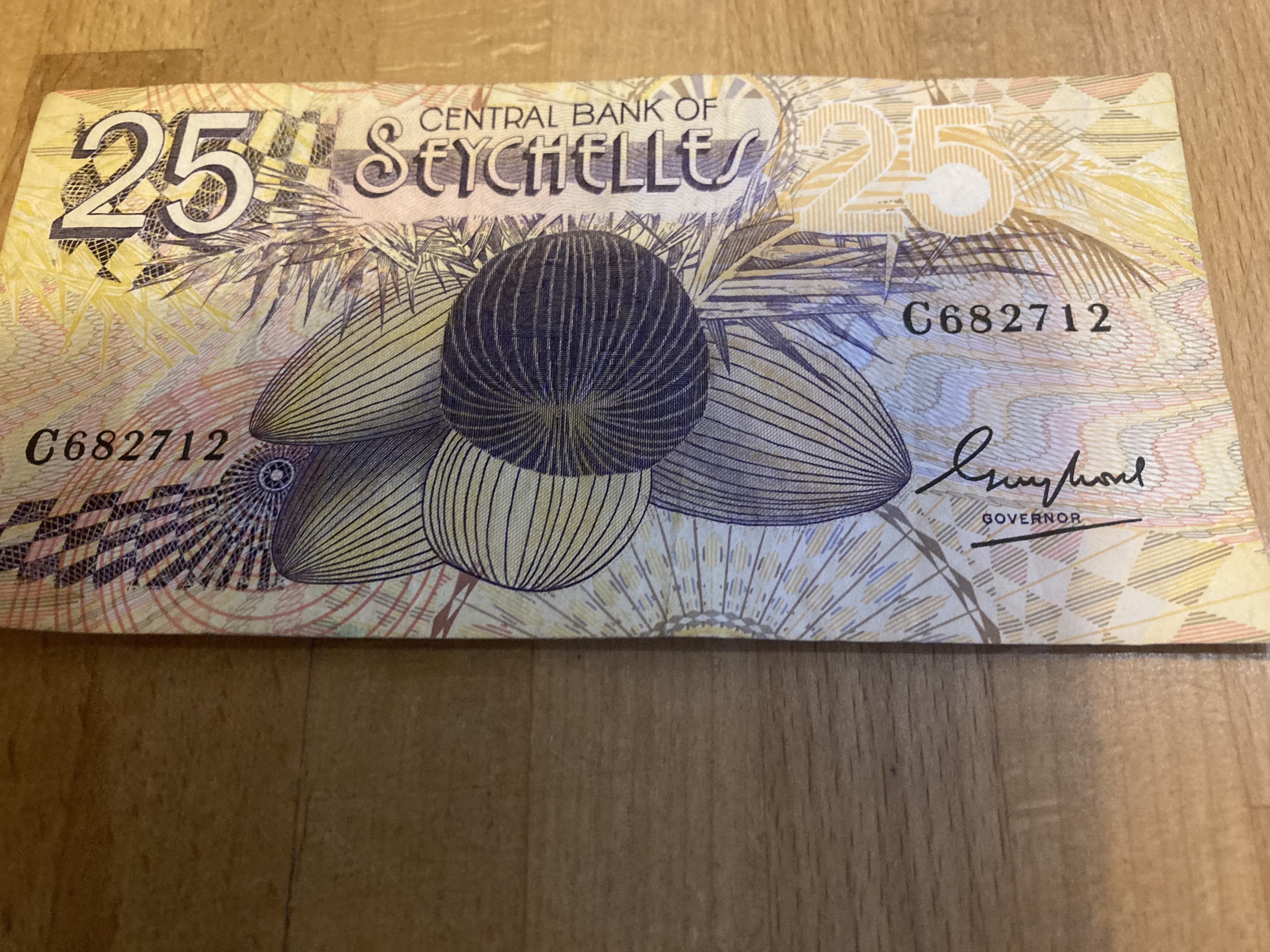
There were a lot to look through and I am no, no expert on how to value them but I have been learning a little bit.

Apparently what you want are uncirculated notes as in, in pristine condition. Mmm we don’t have any of those.

I am sure there are notes which even if previously circulated, are still worth a fortune but I am not sure we do.

And another thing, like books, prices you find from America, are not trustworthy, they always try and charge too much.

So, back to the story.

I was musing on how to display these notes and leafing through them whilst my ex-postmistress was painstakingly and cheerfully sorting through the coins and other stuff, when a passing volunteer stopped.

He said, I have one of those metal tree things and I clip notes and stuff that are mementos of my travels and some of them are notes.

I said, we could do with something like that.

And he said, I can make that.

We had a defunct stool ( the cat had said that despite the fact that it was missing a strut and dangerous to sit on, we could not thrown it away because it was Oxfam property. That was about three years ago and it had been sitting there – excuse the pun – and whilst he was away, it was going to the bin) and our volunteer book it up and took the seat as a base.

He also took one of our many donated/left walking sticks, and I got him some wire coat hangers from the local dry cleaners.

And hour or two later he re-appeared with a money tree.

He had drilled holes in the walking stick, bought some pegs, unwound the coat hangers and made us this.

So, I have put aside the notes which I think might have some value and they will go off to Guildford but in the meantime we will display a money tree with the ‘valueless’ notes .

Rarely does it happen that money grows on trees.

But on a good day, us mice are on a roll.

Leaving Oxfam 1

My days at the Oxfam bookshop in Petersfield are currently over. 

Here is my long, and rather self-indulgent, elegy to those days so do feel free to get on with other important things in your day. 

But if you stay with me on this, next time you go into a charity shop, a bookshop or indeed any local – and please shop local – shop, have a thought about the work and thinking that goes into making it happen.

People are it.

You might think that people who volunteer in a charity shop are all ageing women who have led sheltered, domestic, rather boring lives and –  of course – you would be wrong. For a start, not all our volunteers are women – but that is just the start……

I have worked alongside someone who has sheltered children during the Biafran War.

Someone who has survived, and dealt with, two brain tumours and gone on to spend a lot of time out and about and at the theatre, been a stalwart of Oxfam, and who gently manages all of us who are in her orbit.

Someone who spends her other time dealing with disadvantaged kids and refugees as well as her children and grandchildren and will call to say she is a bit late because she is juggling all those things.

The book sorter who races through sorting donations as quick as he (apparently) cycles, the other book sorter who  deals with ageing and indeed dying parents and a business selling bee homes, and has chats with the DVD volunteer, who by the way is a film-maker.

A volunteer who made, among many other creative stuff, a street of snowy houses as a backdrop for the table in winter and has more creative ideas of how to make the table look good than you can shake a stick at.

The expert in old books who taught me all I know about every old book – binding marks, pagination, half-calf, the importance of maps at the back, the delight of period adverts …. and who always got a cup of tea, and sometimes a chocolate biscuit.

People with illness, disability, difficulties of all sorts going on in their lives.

People who have moved on from death or divorce, dealt with cancer whilst still coming into the shop, and people who are willing to be (sometimes) bossed into doing extra stuff.

An artist, a full time environmental worker who gives up her Saturdays, two vinyl addicts, a classical music expert, an immigrant over here to be near grandchildren, an engineer, a brilliant ex-teacher who taught me so much in my early days and who makes the shop a lot of money by putting clothes online – yes even a bookshop takes clothes and makes money out of them for Oxfam, the woman who has children in school and had a bored brain and wanted to give something back, a friend roped in to come and help, and the volunteer who (very surprisingly) introduced me to the books of Game of Thrones. 

I hope I have covered everyone but a sure I have missed someone(s).

Volunteers do everything from being at the till and dealing with difficult regulars, taking the towels home to wash, tackling a huge pile of donated books, pricing, shelving, re-arranging the books front-facing, re-stocking the shelves, moving stock to create space for new goods, checking off barcoded goods, looking up the value of a donated dress, measuring the inside leg of a pair of donated trousers, putting on the gift aid stickers (which bring in an extra 25% of the value of a sale), making sure the paperback fiction is in proper alphabetical order, spending an evening searching for the value of a donated book from the 18th century, putting out a display of special classical music and much more.

And that was all before Covid, So, now their brilliant contributions, thoughts ideas of this might work should all be brought together to make the shop work. 

And not for money, just for appreciation, a thank you, and of course for a very good cause. 

A Very Good Day

As you know, there are good and not so good days ‘working’ at the Oxfam bookshop in Petersfield – and today was a good day.

I am going to save the best bits to last, so you are welcome to skip.

Volunteers are always a scarce resource but we have a few, valuable, new ones and they are making such a difference.

They make my life a whole lot easier because they do things I mean to do but just haven’t time and, of course, the more volunteers, the less the chance we have to shut the shop when someone goes on holiday, or is ill, or has a better offer for an afternoon.

Today one volunteer did a sterling job of putting in date order the five crates books of the Institute of Naval Architects from 1940 to 2004 and logging the missing volumes so I can list them on the internet. (Should you be interested, £200 and buyer collects.)

Another volunteer said she liked sorting things out so I asked her to sort out the jumble upstairs on two shelves of travel books, natural history books and transport books – Steam Railways Past and Present should not be in natural history…..

After that I walked her round the shop and explained what was what on each shelf.

Now, dear reader, you might think that the shelves would be like a supermarket – here is history/baking goods, here is academic/canned vegetables, here is crafts/cheese, but it is rarely that simple.

We have no control over what is donated and we cannot have empty shelves so we are always juggling shelf-fillers and categories.

(Who’d have thought we needed to fill two shelves with books on mathematics and maths puzzles – but that is what we did when the Christmas goods were over and removed.)

I was worried that she would be overwhelmed and put off but at the end of her afternoon, she said, ‘I feel as if I have only been here 5 minutes and it has been hours, and there is so much left to do, this is  great.’

That’s what I like to hear – someone who has found what they like doing in the complex business of running a bookshop and is planning on putting more money on their car parking ticket next week so she has longer to sort things out.

So, now to the bits that added a good feeling to the day.

Readers with a good memory will recall that some time ago at the bottom of a box of rubbish books, I found a book called The Square Book of Animals – a children’s book with lovely illustrations and which sold on the internet for £450.

Well guess what, at the bottom of another box of books a few days ago, I found something called The Rabbit Book by Charles Pettafor, and again I thought this might be worth something.

img_0269

(Children’s books of some age that are not wrecked, scrawled on, and in one piece are often worth a bit – just because they have survived relatively intact.)

I looked it up on Bookfinder and Abebooks but couldn’t find any for sale. I looked it up on Google and found it mentioned, but non for sale.

Now that makes it rare.

So I called our excellent book specialist and said I had a tasty treat for him – I don’t ask him to come in all the time, just when I have something(s) I can’t price.

Usually, he can find its price and, usually, I am disappointed, but I am learning from his tuition and this time I thought it was a good find.

He came in and we looked at it. ‘It is pre Beatrix Potter,’ he said, ‘It is about a rabbit and look at the illustrations. Could he have influenced her? Could this rabbit have sparked her?’

Not according to Google – he was not listed as an influence in her.

But still, we had a book that people were looking for. We had a book which we thought had a small print run. We had a book which was a children’s book from about or pre 1900 in great condition with lovely illustrations.

We decided to put it on the internet for £500. I will let you know if it sells for that.

And, finally.

Some time ago I found a small glass vase and I mean very small, on the shelf out the back and it was very light.

I happened to be meeting that very same book specialist and he is also an archeologist and a trustee of the local museum and so I asked him whether it might be old.

(I love the idea of old glass – how can it have survived? How lovely that it was blown by hand as it were…)

Last time I rang him, I asked whether it had got information on whether indeed it was indeed old and he said –  he couldn’t find it.

‘What,’ I cried, “ I wanted to buy that!’

‘OK, I will bring you another Roman glass vase instead’ he said.

And he did – how amazing is that….?

img_0275

I can’t tell you how delighted I am with this.

It turns out that the local museum has the original and if that turns out to be real rather than a good fake, I will buy that too.

A good day or what?