Books & Covers

So, if you are still with me, lets’ go to Warren Hastings.

He who went through an impeachment trial brought on by Edmund Burke and whose biography appeared in our shop.

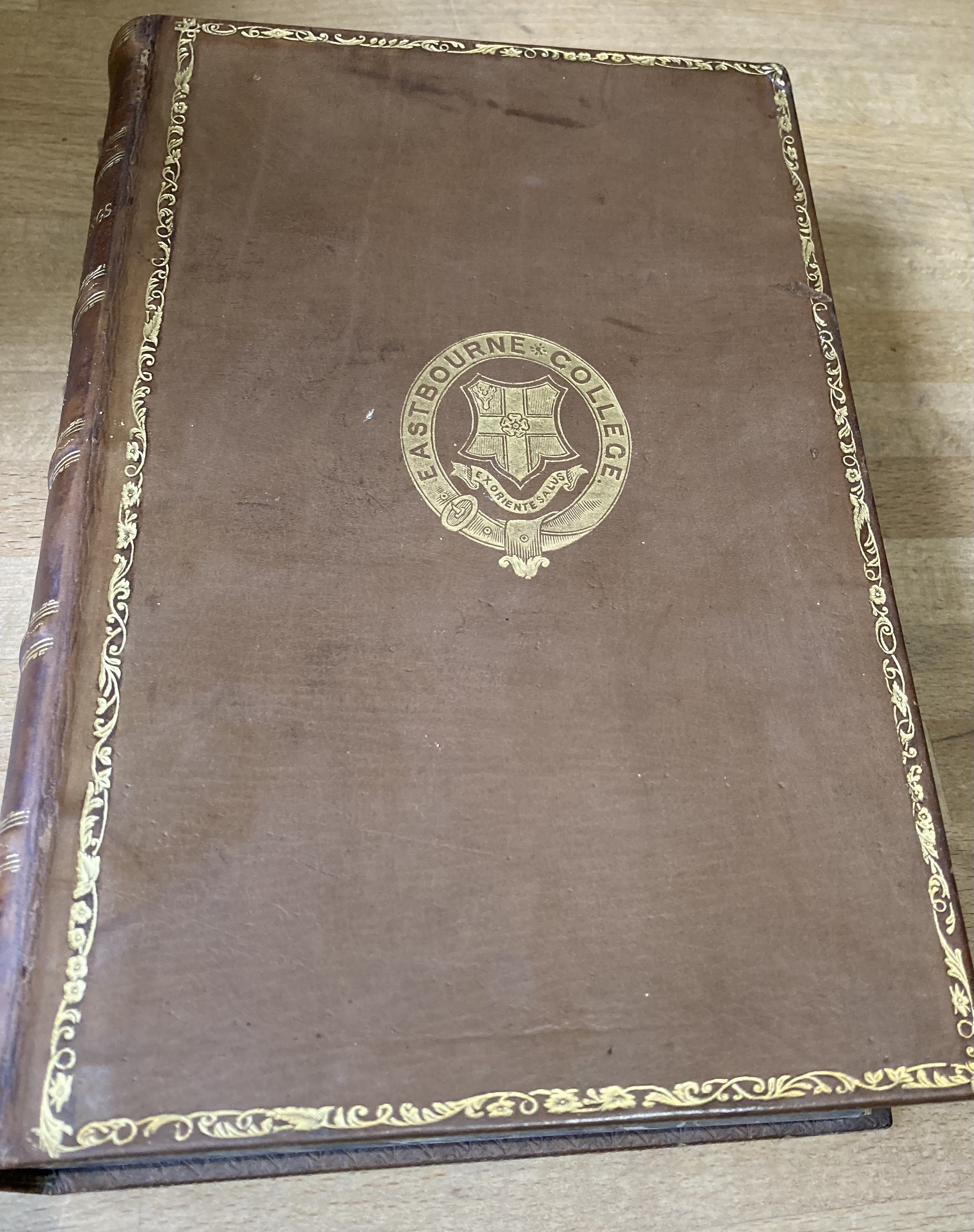
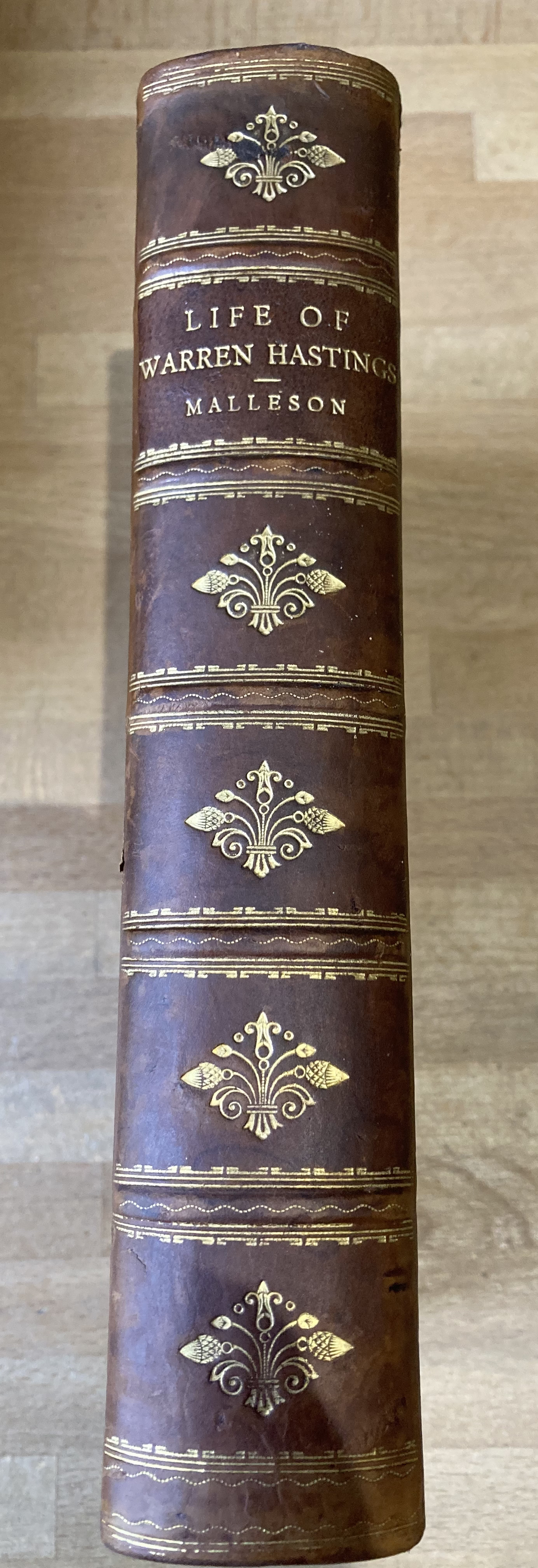
Malleson’s Life of Warren Hastings bound by the Relfe Brothers with a presentation binding but no presentation certificate.
If you want a translation of that paragraph let me tell you a bit more.

Usually with a binding like this, you would usually get a printed presentation certificate pasted inside with teacher handwriting saying something like ‘to George Robertson for excellent marks in history.’

Now, the Refle Brothers are really well known quality book-binders but can you find their story/history on Google? – well actually no.
No Wikipedia page – and yes I do give Jimmy Wales some money for all the use I make of his site.

So, if you look you can find books for sale with Relfe bidding and they are pricey, but you can’t find out anything about them – or at least, I haven’t yet.

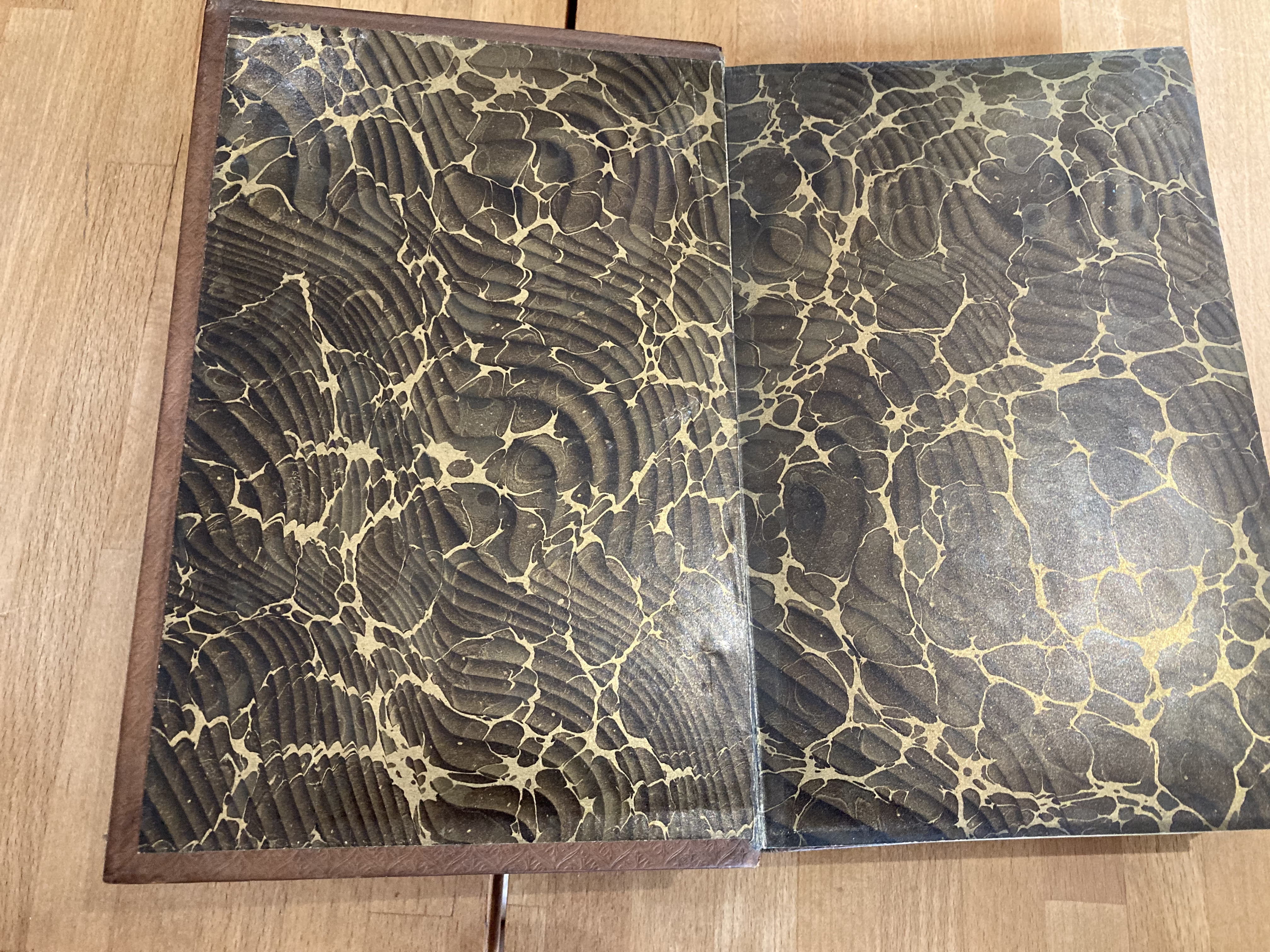
The page edges are marbled and I have flicked them to see if you do that a picture appears. If that was the case we would have a while lot more money to look forward to. 
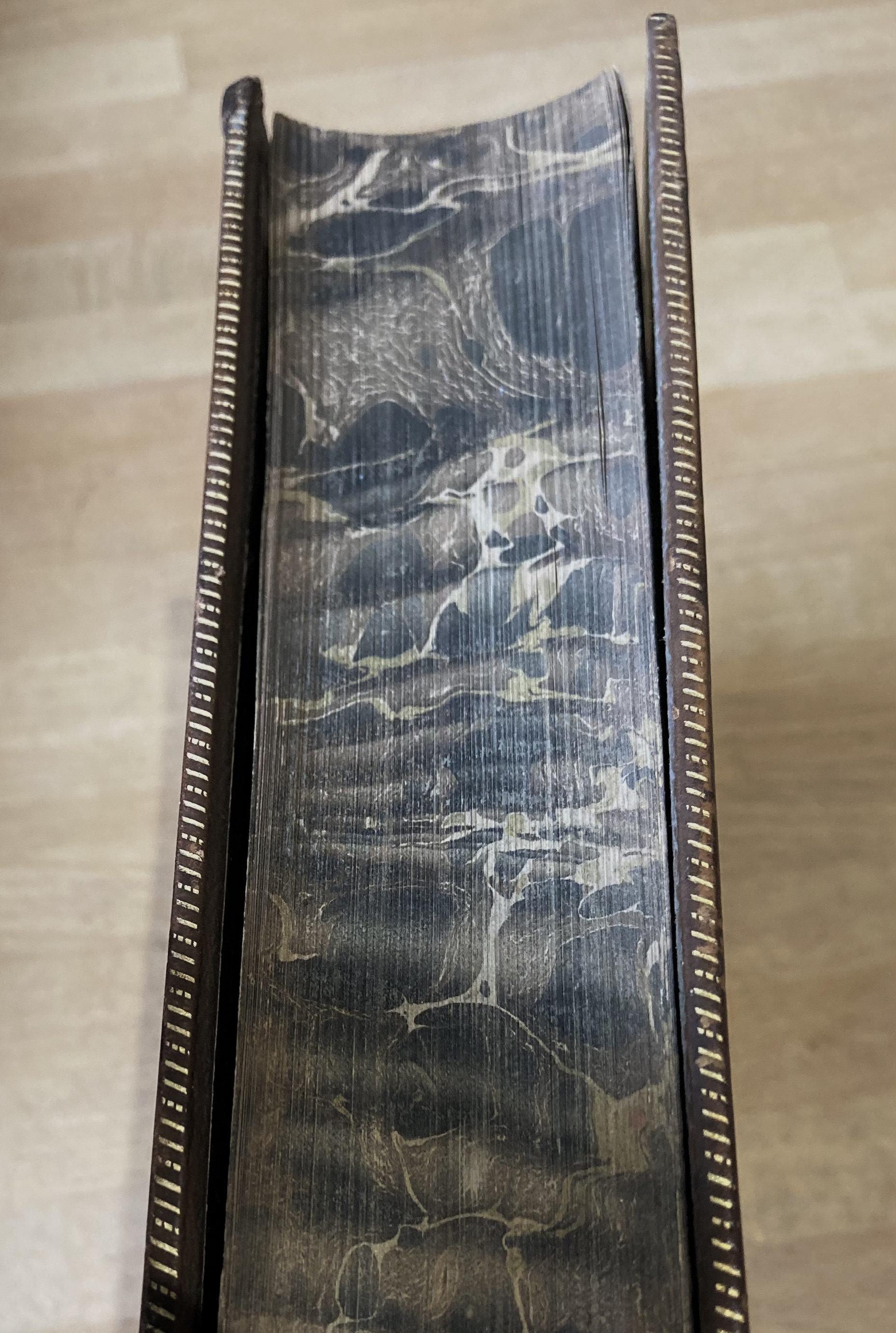
So next time you see a book in a charity shop with marbled edges, just give them a flick and happily pay the money they are asking.

Now, you often get good bindings on really boring books and I am not sure that the boy ( usually) who got it was terribly excited about reading it.

Indeed the copy we have looks pretty much unread….

But see the hand-tooled gilt and the spine bands and the original marbled insides. Nice, very nice.

Now back to Warren Hastings.

So Edmund Burke took two days to read the charges in Hastings’ impeachment. Mainly they were related to embezzlement, extortion and coercion.

The House of Commons sat for 148 days over seven years to hear this case.

In 1795 the House of Lords acquitted him and the East India Company, for whom Hastings worked, gave him a pension of £4,000 per year backdated to when he arrived back in England.

Hastings said the legal fees had pretty much bankrupted him but then he had lived in ‘considerable style’ in his London house throughout the trial……

And in 1788 he bought an estate in Gloucestershire for £54,000 had the house remodelled classical and Indian decoration, and gardens landscaped, and re-built its Norman church……not that living on lentils and no heating then. ( See also Rushi Sunak, again.)

Meanwhile, the East India Company was not just about trading.

Originally chartered as the “Governor and Company of Merchants of London Trading into the East-Indies”,the company rose to account for half of the world’s trade during the mid-1700s and early 1800s, particularly in basic commodities including cotton, silk, indigo dye, sugar, salt, spices, saltpetre, tea, and opium

The company also ruled the beginnings of the British Empire in India. (Wikipedia)

(Should you need to know more see my Best Beloved’s one-day-to-be-published history of Europe book.)

The EIC was either the beginnings of the glorious British Empire on which the sun never set, or the rapacious company implying all sorts of greedy, coercive, pseudo-rulers who imposed, stole, acted with impunity and had little interest in recognising they were not in charge – and indeed they became in charge.

I leave you to decide.

According to a site called History Reclaimed, ‘The impeachment of Warren Hastings was an act of imperial soul-searching unparalleled in history. Although Hastings was eventually acquitted, his trial was a warning to all future imperial proconsuls that they too could be called to account by the British Parliament. 

He was the first British Governor-General who launched India’s cultural renaissance way back in the 1780s.  Of all Britain’s imperial proconsuls, Warren Hastings was undoubtedly the most curious and learned about Indian culture and famously declared: “I love India a little more than my own country”.  

He became fluent in Bengali and had a good working knowledge of Urdu and Persian, the languages of the Mughal elite.  One of his most enlightened acts as Governor-General was to promote the founding of the Calcutta Asiatic Society in 1784.’

And, according to Wikipedia, ‘He and Robert Clive are credited with laying the foundation of the British Empire in India.

Getting a bit of an idea where Malleson is coming from.
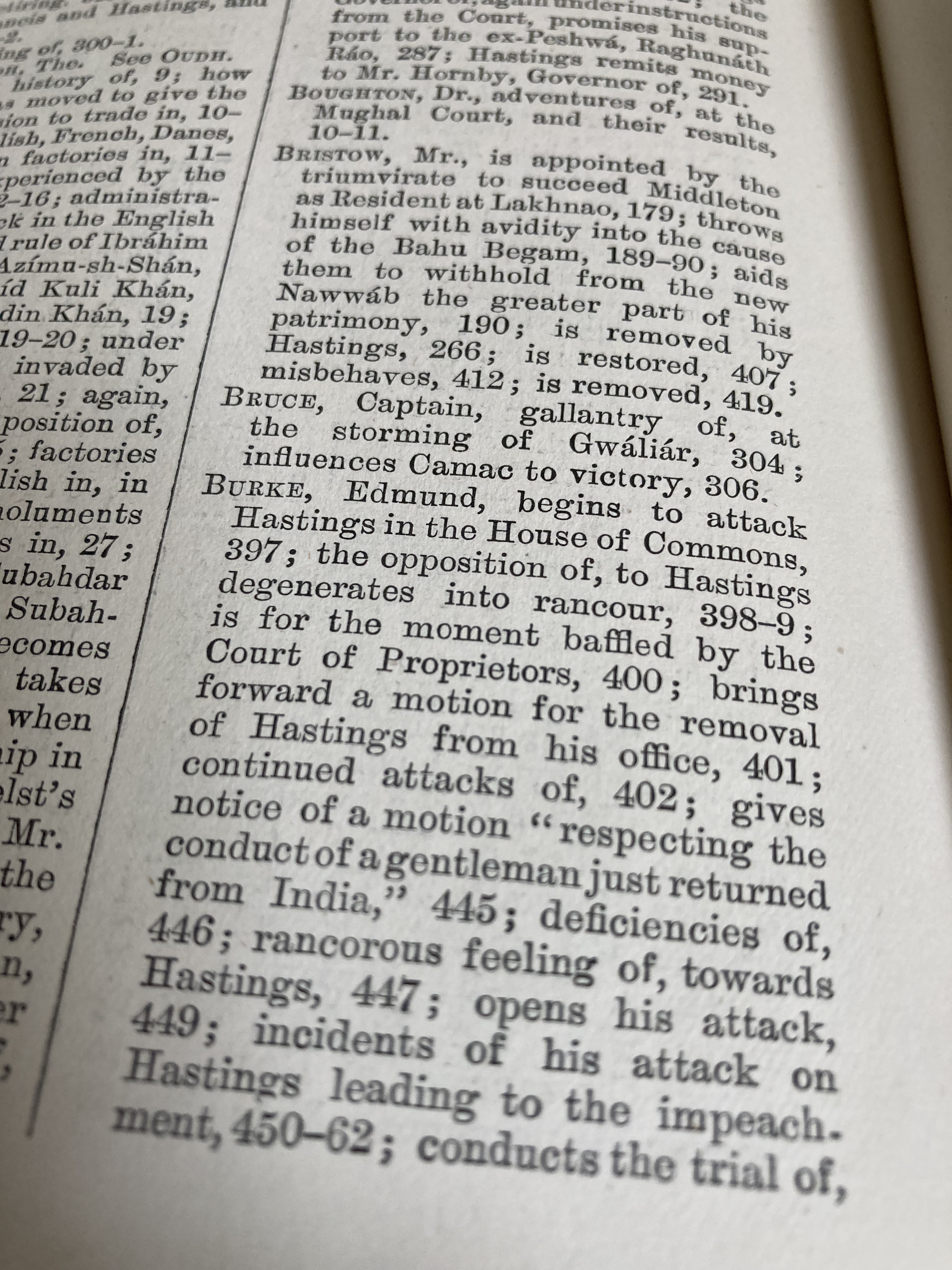
Malleson was certainly on his side – a hagiography I would suggest but then with a Relfe binding, someone is going to buy this book because they have judged it by its cover.

A lot of time to research

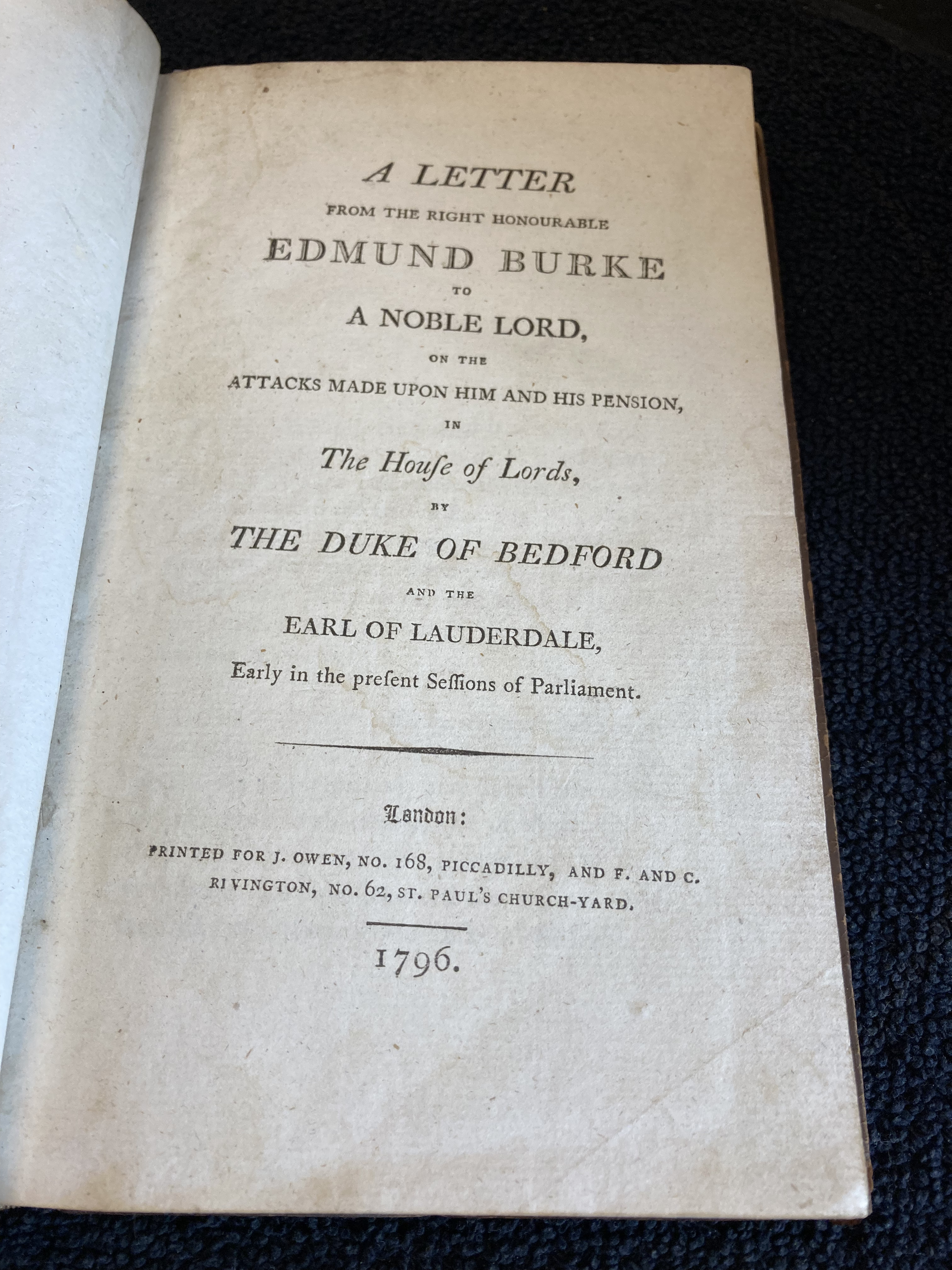
This is about a book from 1796 which has arrived in Oxfam Petersfield in 2022.

And about a coincidence.

Be warned, there is a lot of this – I got a mild dose of Covid so was at home with time….

But at least this time there are some pictures.

Ignorance of the provenance of book is the lot of a charity bookshop. Indeed, I am not even clear which of our volunteers, put it aside for me to look at.

Anyway, we have it, and what an interesting book it is. (Value, you Antiques Roadshow aficionados, will come later.)

So this is a bound volume of three letters by Edmund Burke and for those of you who think who? Here is some info – actually, quite a lot of info.

https://en.wikipedia.org/wiki/Edmund_Burke#Later_life

And here are a couple of quotes which may chime:

‘The only thing necessary for the triumph of evil is for good men to do nothing.’

And:

‘Nobody made a greater mistake than he would did nothing because he could do only a little.’

Obviously, he was no feminist, but apparently he was anti-slavery.

He was also, depending on who you read, a founder of Conservatism and/or ‘a wet and a Eurosceptic’ according to the Beaconsfield Historical Society.

He wanted to be the Earl Of Beaconsfield and George III wanted him to be, but Burke’s son died so he couldn’t have a peerage. Life peers were only introduced in 1958 so if you didn’t have a male line to take it on, you didn’t get it.

What he did get was a handsome pension which was criticised by the Earls of Bedford and Lauderdale hence this:

His argument was that at least he had earned his pension by unstinting public service whereas the earls got their money by inheritance alone.

‘I was not, like his Grace of Bedford, swaddled, and rocked and dandled into a Legislator’

And he wrote in one of our letters, ‘Loose libels ought to be passed by silence and contempt.’ 

Meanwhile in a 1771 letter to the Duke of Richmond, Burke wrote that ‘persons in your station of life ought to have long views. You people of great families and hereditary trusts and fortunes are not like such as I am … we are but annual plants that perish with our season and leave no sort of trace behind.’

Oh yes, he had a good turn of phrase.

And according to Martin Greenberg, who also has a good turn of phrase:

In Letter to a Noble Lord (1796), Burke replied with a crushing force to two whippersnapper peers, obscenely rich enthusiasts of the philosophes and the French Revolution, who had attacked him for accepting a pension from the crown. He set his lifetime of accomplishments against the nothing of their juvenile efforts, his defense of their inherited rank and acres against their coquetting with a power whose universal ambition, if it were able to reach across the water, would have swept away all that they were and owned with a grin. Burke’s prose–sober-paced, weighty, powerful to the point of being overbearing–has always close behind its argumentation a reserve of poetic energy which now gleams, now flashes, and now, as in this letter, explodes in a fireworks of dazzling metaphors, a storm of epical-satirical language that tosses around the duke and earl, great galleons of the nobility, like little cockboats. ‘

Now I am not directly making any comparisons with current British politics but if you want to, be my guest.

Our book was published in 1796, the year before Burke died. 

Other things that were happening in 1796 include:

Jane Austen starts writing Pride and Prejudice, 

George Washington gave his farewell address warning against partisan politics ( that worked then), 

The British government began work on a 40 acre site at Norman Cross near Peterborough to become the world’s first prisoner of war camp,( who knew, and might need some more investigation)

At Christmas 1796, the French Navy nearly landed an army of 15,000 troops at Bantry Bay in Ireland. 

And Napoleon was appointed head of the French Army in Italy which was to have some significant ramifications….

Hence: 

Breathe easier, I am not going to give you a history of the Napoleonic Wars (though my Best Beloved can if you are interested.)

Burke wasn’t a fan of the French Revolution on the grounds because of its ‘origins and the class of people who were the driving force behind the Revolution’. 

Basically, he didn’t believe that the French urban working class, or the peasantry, could be trusted with legislative or political powers.

He had the view that only the ‘educated’ could be reliably left to run any country.

So, you can get the text of these letters online and you can buy them in the original but very rarely, infact, very, very rarely can you buy one from 1796 printed on such good quality paper – and in an original  binding. Most of them have lost their binding or were never bound at all – just get them out there, the printers must have said.

The paper is impressive. Very little foxing ( that’s the brown spots on the pages of old books) and it feels strong and thick and well cut, and well bound – impressive for such an old book.

We looked for a paper watermark but there wasn’t one. And I found out that this ‘book’ went into 11 editions in 1796. That is a lot of editions, and though the print run would have been the kind of print run were are used to, that is a lot of books.

And there are five raised gilt bands with gilt titling on the spine and gilt banding on the front and back boards.

Interestingly, at the bottom of each page there is the first word, or part of the word, of the next page. I have not seen this before, but maybe that is my ignorance.

It is also justified which means that the left and right margins are the same – and means that words are sometime broken up, or spaces are stretched to make the text fit the margins.

(That can make reading hard on the eye because different spacing seems disjointed. Our book, I have to say had a very good typesetter because it is easy to read.)

Is it about making sure the pages are in the right order? Possibly, but they are numbered.

Well, now you know a bit about how books are described online…..

And all that has been taught to me by someone who knows amore about books than I will ever do and who is the man who comes in ( when called up) and tells me what to look at, what to reasearch, what to learn…. and teaches me to expand what I know from the back of a postage stamp’s worth to, oh maybe a small postcard.

Waiting for the valuation? Well because it is bound and in great condition we are hoping for £275.

Maybe it will be sold asap or maybe it will take some time and be less than that – that’s the way it works.

Now, if you have got to the end of this and still have a memory of a mention of a coincidence….

So, Burke got his pension (I gather £2,500) in no small part for his work as Chairman of the Commons Select Committee on East India Company Affairs.

And he impeached Warren Hastings.

So when I went into the box of books that have been put aside for me to look at, under the Burke letters I found a handsome book – a biography of Warren Hastings….

I have no idea whether they were donated together or this is one of those coincidences that happen in the life of a bookshop when no providence can be found.

More of that next time.

And, we have another book from 1796, The History of America – perhaps more on that too.