A Few More Oddities

A few more bookshop delights and surprises….

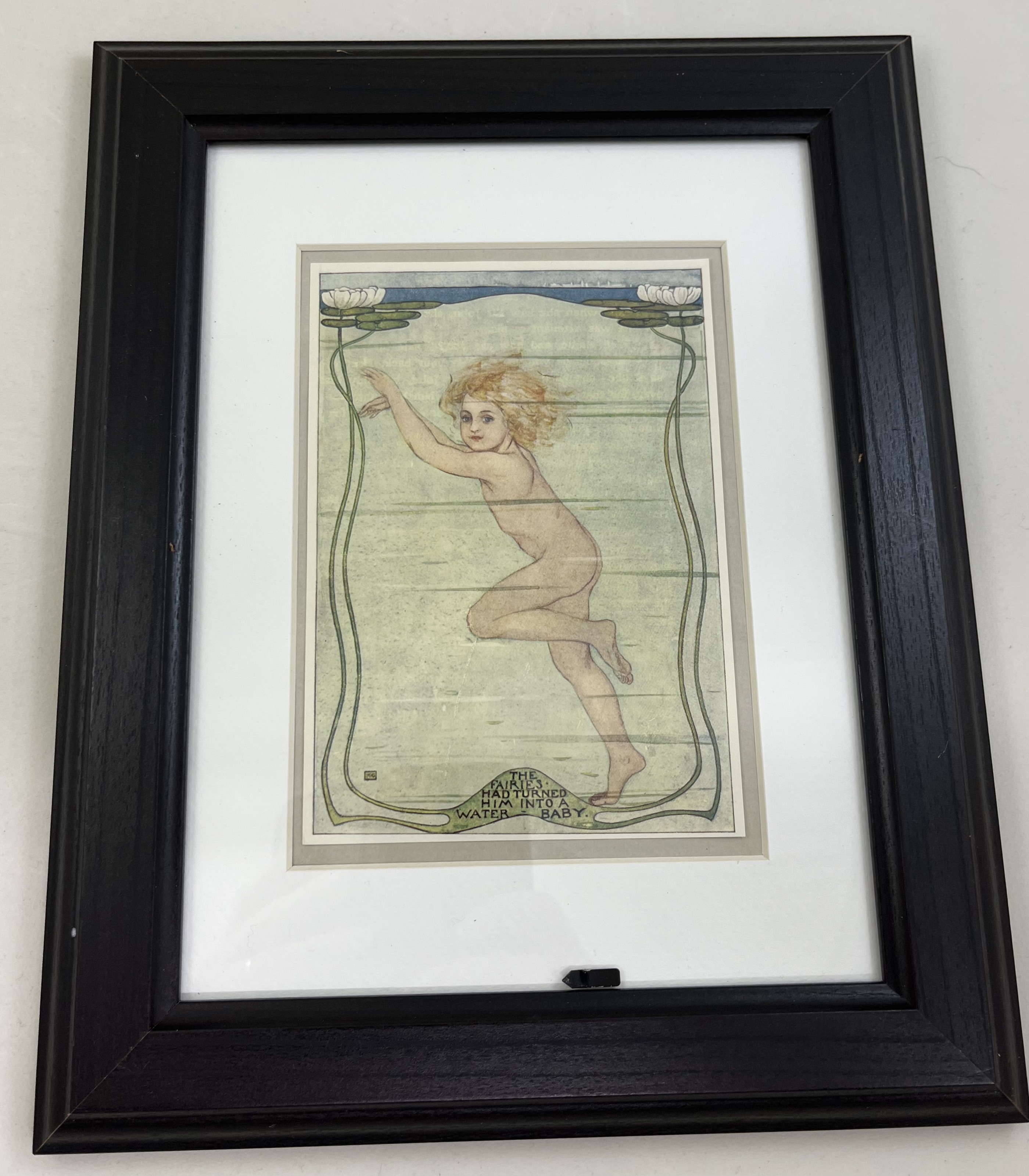
Some (actually quite a few if I’m honest) books come into the shop in such bad condition they can’t be sold. Most end up in re-cycling but a few have such lovely plates (pictures) that the Best Beloved can make something of them.

Because we get quite a few donations of paintings – yes I don’t know why they are given to a bookshop either – we have an art sale about twice a year and we will add in these little delights.

And, we also get picture frames donated so the BB had these three to play with…

They are from the 1905 edition of The Water Babies and are the work of Katharine Cameron. And it is true that images of naked children were more innocent in those days.

Anyway, you may be interested to know that Katharine Cameron (1874-1965) ‘studied at the Glasgow School of Art where she became part of a group of artist-friends known as ‘The Immortals’, which included sisters Margaret and Frances Macdonald and Charles Rennie Mackintosh. She later attended the Académie Colarossi’s in Paris and made frequent study trips to Italy. She is best known for her sensitive flower and landscape paintings, etchings and book illustrations. Katharine was a member of the Royal Scottish Watercolour Society.’ (National Galleries of Scotland).

She is second on the right of the middle row of this photo of The Immortals.

The next oddity is from lives a lot less rarified than the Scottish artists.

Judging by the stationer’s imprint and the name and address at the back of the book, this was a log of Sheffield workers’ hours and payments kept by a Mr Hunt who lived at 302 Staniforth Road, Attercliffe, Sheffield. This was not a difficult deduction.

It begins in July 1914, and finishes when the book is full in August 1917.

I assumed they were all men and worked in a protected industry which could well have been a related to steel in some way or another, it being Sheffield.

And then I thought, of course I could be wrong and it could be a workforce of women taking over jobs ‘left’ by men fighting in the war.

I liked that idea and conjured up all sorts of mental images of feisty women and their stories, but a more detailed look (by the Best Beloved) ‘unearthed’ this at the back of the book and more references to furnacemen at the front.

Interestingly, as I say at least to me, there is a knife-making company called Samuel Staniforth making knives who say they were established in 1864. I am temped to contact them and see if they are interested in this part of their history. https://www.s-staniforth.co.uk
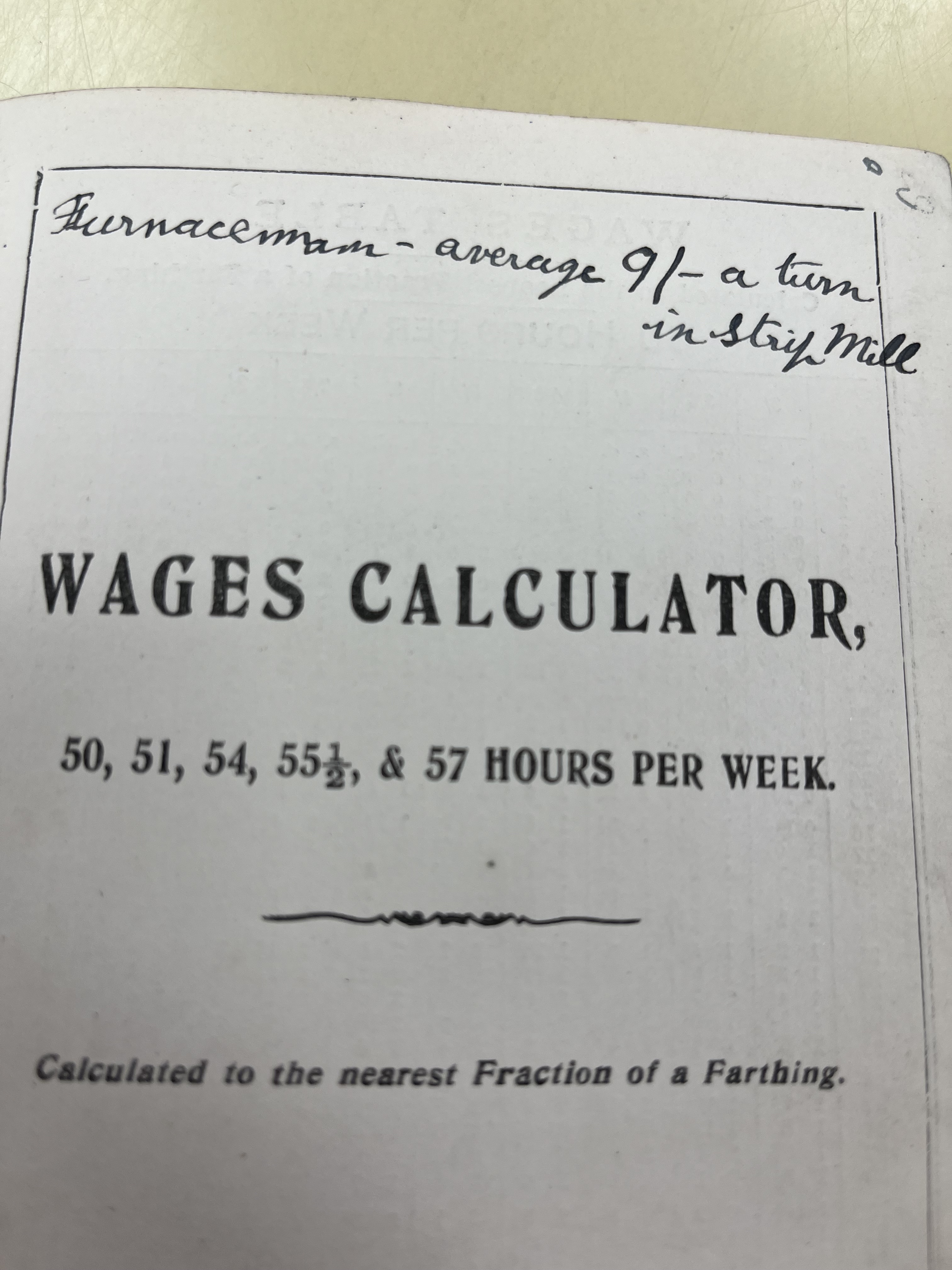
There are some handy wages tables at the back ‘calculated to the nearest fraction of a farthing’ and in terms of hours, go up to 57 hours a week.

Whoever C Wise was, he is present from the beginning to the end. (But W Wise, makes only one entry right at the beginning. 

I am speculating of course, but could be father and son….)

In 1914 he was earning £2 and two shillings, but by 1917 was on £3/19/6d.

Interestingly, at least to me, is that although there are smatterings of records advance in wages throughout the book, many of the men took at advance in June 1915, August 1916 and April 1917.

I was thinking that this coincided with Wakes Weeks. A particularly northern tradition which started in the Industrial Revolution and was when the factory/works was closed for a week, quite often for maintenance work.

And they were, certainly originally, unpaid weeks so you would need an advance if you were going anywhere.

As a child I remember Wakes Weeks in the cotton mills in the Lancashire town where I was born – and the tradition was to go to Blackpool.

So popular was it that in the peak of Wakes Weeks in the 1860s (and no, I don’t remember that ) 23,000 holidaymakers left the town of Oldham alone, and headed to Blackpool.

Or, if you were better off, Morecambe Bay.

Wakes Week in Blackpool with the tower in the background

Should you want to know more https://northernlifemagazine.co.uk/wonderful-wakes-week/

There were some wage advances recorded in the book in the run up to Christmas but were for a lot less money than the holiday demand.

Except, that was my theory until I checked the dates and, no, the factory/works was not closed for the following week, and the same men were recorded as working and for much the same number of hours.

So, it remains a mystery.

Another Oxfam mystery, however, was solved by a very nice auctioneer who helps us out with some of our oddities.

These were donated by a friend and some have ended up in an auction, but one of them was locked.

The nice man brought down his box of keys acquired over the years and I spent a pleasant but fruitless couple of hours trying to find one that worked. ( And indeed, watching the Brummie Lockpicker on YouTube.)
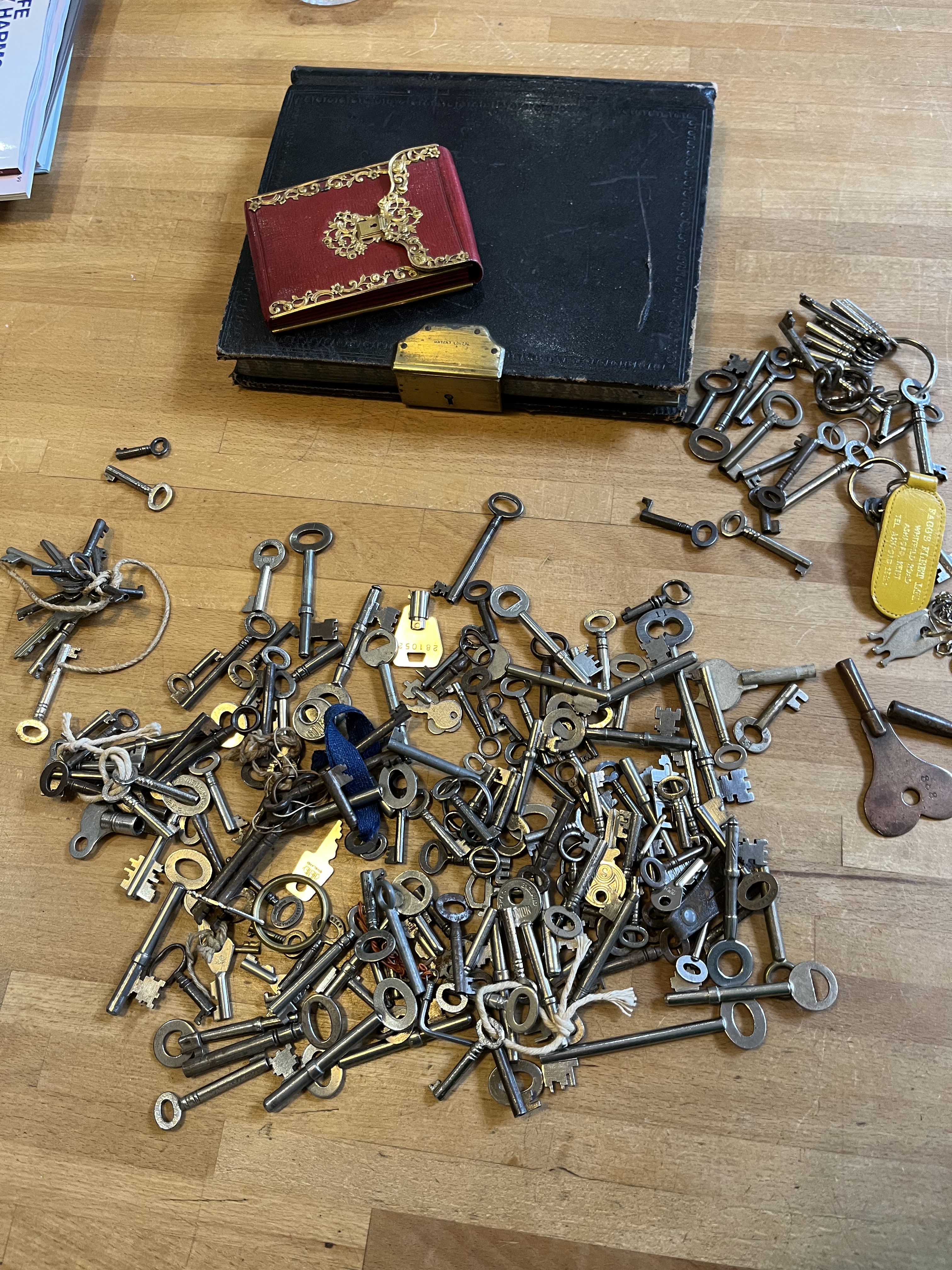
The nice man had said he thought it was a carte de visit holder and took it away to try and sell it for us.

He realised ( as probably I should have) that it wasn’t a lock as such and you could get it open.

And here is what he found:

Apparently,

‘It is a ladies etui case still containing a few of the original implements. 
Ivory writing tablet
Pencil
Combined ear scoop and toothpick.

When looking at it under a glass it was evident that the lock does not require a key. The centre pin is on a spring and just needs pushing down to open.’

Rootling around in the bottom of capacious shoulder bags over the years, I’ve all sorts of forgotten things – and indeed notebooks and pencils – but never a, presumably ever-useful, ear scoop and toothpick
More than books

There are all sorts of strange things donated to Oxfam bookshops and recently we seem to have had our fair share. 

I have covered this theme before but do you know what, it still keeps happening. All these were donated in the last week.

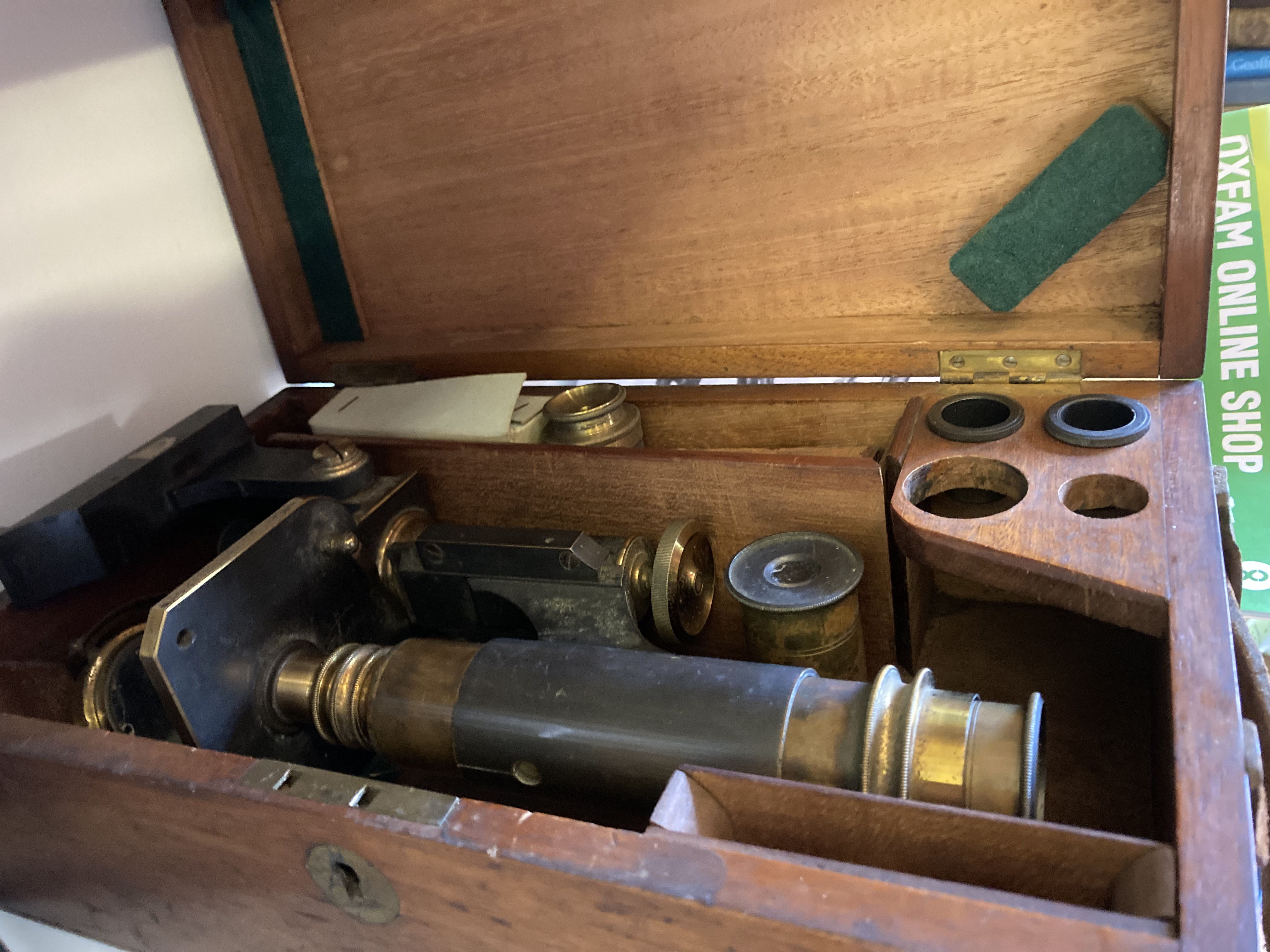
Here is a microscope, from we think, the mid to late 1800s.

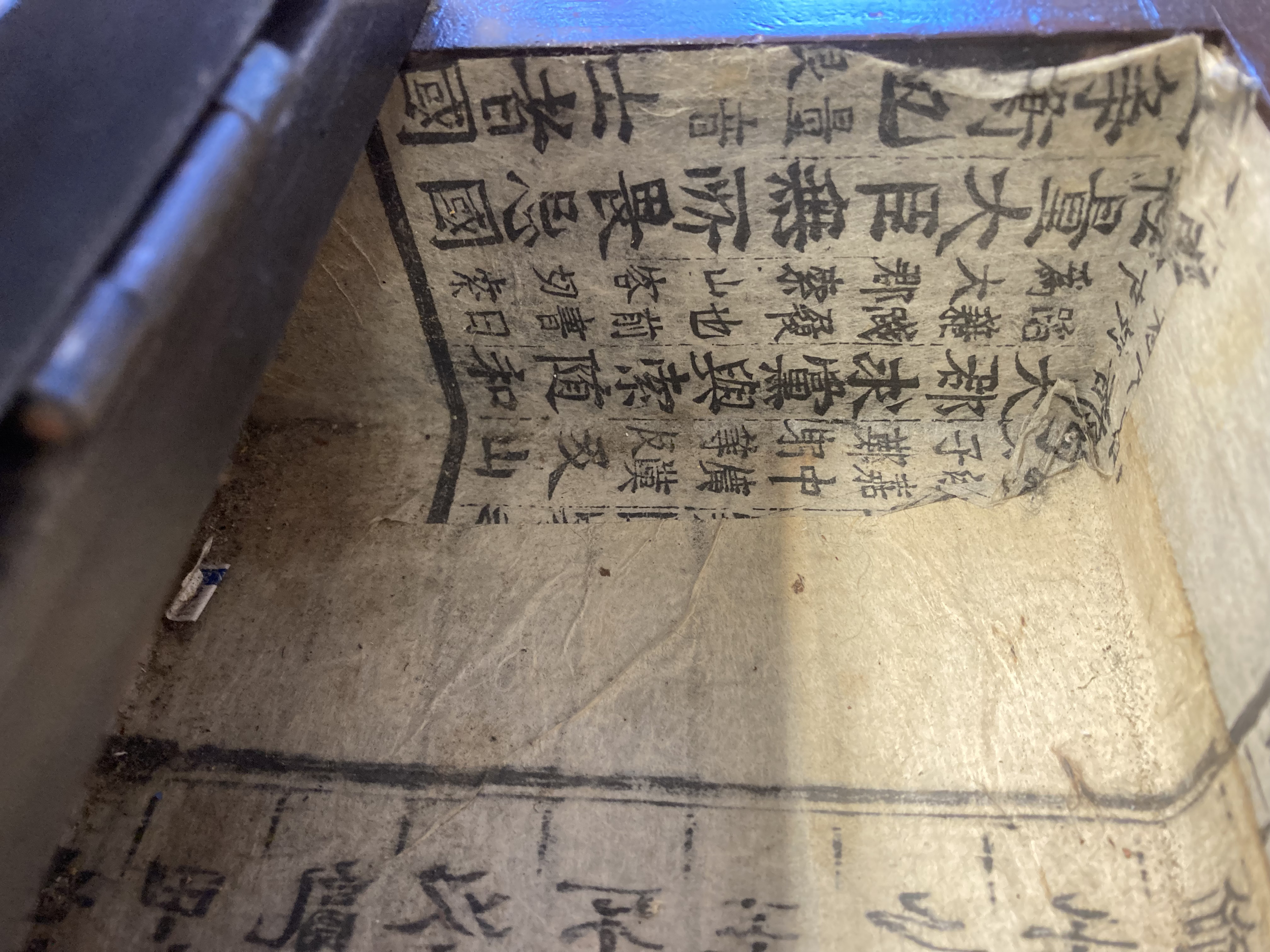
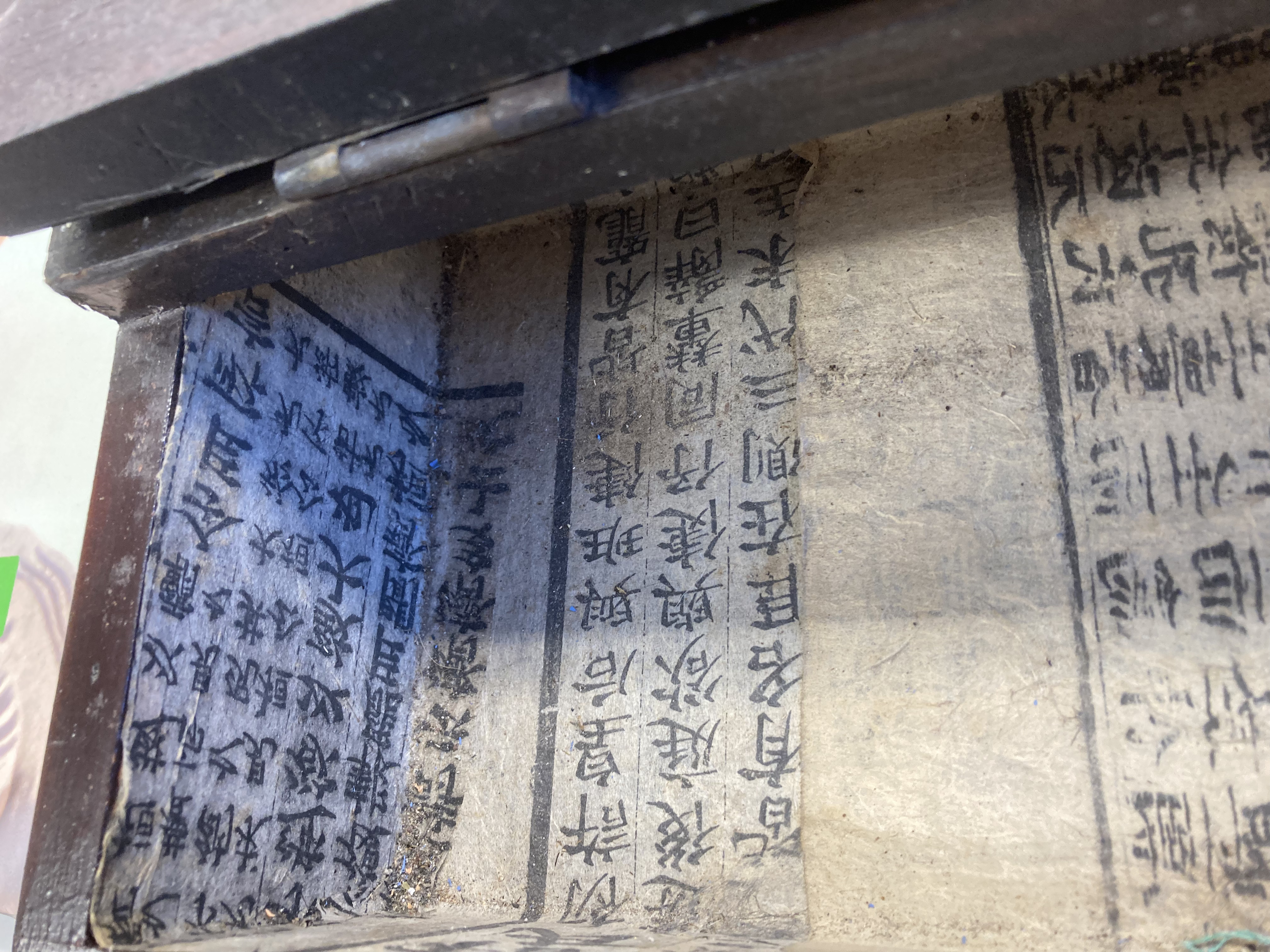
Here is a box lined with what I think (but don’t know) is Japanese script/newspaper – but from what era? 

A pair of shell casings from WW1 – not trench art, just casings, presumably brought home and you have to wonder what was the story behind bringing them back.

The box was donated by a fellow volunteer who won it at an auction at the Australian High Commissioner’s event in Singapore many years ago – as you do.

He (the volunteer, not the commissioner) told me it was the box that had held the surrender papers from the Japanese navy at the end of WWII – but he was joking. 

He had no idea what/when/why it was.

I would like to know what the script says – it is the classified adds from the Tokyo Times in September 1970 or a confirmation this was owned by the under secretary to the under secretary of the Emperor sending out a secret message to Matthew Perry – the first foreigner ‘allowed” into Japan for 200 years?

So, what to do with them?

‘You can do a Japanese table display,’ said my manager.

But we would need Japanese books…

And yes, the next donation she sorted was a bag full of Japanese books – there are some book gods out there….

As for the microscope. It has no name on it so not an absolute treasure, but a volunteer who knows about cameras (close enough) was called in to check it out. 

It was probably a school microscope dating from the mid to late 1800s. Brass, solid, in a box, used and re-used by schoolboys (no doubt, no girls) and who knows whether it inspired a child into science where he (undoubtedly) did some good science work which is benefiting us today….

And, our volunteer found out one like it – for sale on E-bay. Ours has ‘ original patina’ as they say on Antiques Roadshow, but that one was all polished up.

He was sneery about the polishing and thought the original condition would please someone who wanted the original/ripe for rescue microscope –  and very sure that ours will make more than the £94 the other one went for on E-bay.

By serendipitous coincidence, we had already been gathering books to do a window on science and technology and now we have a star artefact/prop.

The microscope will be in an Oxfam window near me in the next few weeks and there will be a lot of fingers crossed hoping that a microscope restorer looking for a new project will be walking around Petersfield…….

Well, we will see and I will tell you.

In the serendipity of an Oxfam bookshop, we had already been collecting books for a window of science and technology through the ages – so the microscope will be out star (non-book) performer.

As for the shell casings.

Well they are not crafted into trench art and so our best hope is that the metal might be worth something – or/and, fingers crossed people, there is someone out there ( book-shopping in Petersfield) who wants some undecorated WW1 memorabilia.

And some William Morris Sanderson fabrics and a pair of curtains.I thought they’d gone out, in and back out of fashion, but turns out they are still worth a bit.

Arts and Crafts, I thought. 

Well, of course, I hear you saying.

But what I plan/hope/can to do with them is for another time.

Frederick Cecil Banes Walker

When I am sorting through the thousands of books donated to the village festivities, there are always some I hoick out because I think they might be worth something.

We sell all the paperbacks for 50p and the hardbacks for £2 – whatever the subject or size of the book.

Well, some books are just worth more than that and I am not going to let them go for next to nothing.

(Which reminds me, we have a woman and her mother who come every year to the bookstall and they, every year, complain that we charge too much. ‘Give over and don’t come next year’ are the polite end of what I want to say to her.)

As you will know if you have read the previous blog, donations of books come in thick and fast and we don’t keep track of who donated what so we take it as it comes.

Anyway, I had a pile of books which needed checking and indeed the rather rare Heath Robinson book is worth about £60 and my ever-so-slightly eagle eye for the niche books which are only printed in small quantities and are therefore valuable, paid off when I discovered that ‘Four Centuries of Liege Gunmaking’ is worth about £75.

A rare early guide book to Palma was also worth a bit and ‘The Mechanical World Pocket Diary and Year Book 1914’ is also worth a darn sight more than £2.

But it was the  book called ‘The Roll of Honour 1916’ that this story is about. Everyone killed in the war that year was listed with their photograph and a small biography (and there was one such book  produced for eery year of WWI.)

WWI memorabilia is very popular and it being the 100th year, I thought I would easily sell it on eBay and split the proceeds between the village festivities and Oxfam.

So, I listed it and I have to admit that I listed it wrongly, so instead of starting the bidding at £10 and hoping to make £30 or £40, I mistakenly listed it as ‘buy it now’. Indeed, someone did – within about 10 minutes.

But, dear patient reader, this is just the preamble to the real story here – so please bear with me.

Whilst I was flicking through the Roll of Honour book to check it was intact, no internal markings or pages ripped out, some paperwork fell out.

As usual I was cooking supper, making a list of things to do, checking emails etc etc and so I handed the bits of paper to my best beloved and asked him to check what they were.

He said, one was the commission for a soldier as a 2nd lieutenant. When I looked later, the next was a letter from the War Office saying where he was buried. The third was a postcard with a sketch on the front of the cemetery, and a description of the grave and its surroundings on the back.

It really makes you stop and think when you find something like that and I was wondering who it was who had made their way to the cemetery where ‘ The big grave under the apple tree is Captain Taylor, Scots Guards & is the only marble cross at present in the cemetery and is a good guide. ‘

The X on the drawing ‘Is his grave directly inside the little gate. The three near trees are all apple trees.’

I then looked at the commission which is a large and formal document which says,’ You are therefore carefully and diligently to discharge your Duty as such in the Rank of 2nd Lieutentant or in such higher Rank as We may from time to time hereafter be pleased to promote or appoint you to, of which notification will be made in the London Gazette and you are at all times to exercise and well discipline in Arms the inferior Officers and Men serving under you and use your best endeavours to keep them in good Order and Discipline. And We do hereby Command them to Obey you as their superior Officer and you to observe and follow such Orders and Directions as from time to time you shall receive from Us or any superior Officer according to the Rules and Discipline of War in pursuance of the Trust hereby reposed in you.’

It is dated October 3rd 1914.

He died on May 9th 1915

On November 20th 1916, his father was sent a letter saying he was buried at ‘ Le Trou, about two miles south of Fluerbaix. The grave has been registered in this office, and is marked by a durable wooden cross bearing full particulars.’

This 2nd lieutenant played test cricket for Somerset. Also, he played rugby and hockey. The has a Wikkipedia page. He had no links with Sussex and lived in Somerset all his life.

His name was Frederick Cecil Banes Walker.

Not a common name.

My neighbour is called Banes Walker.

So, of course, I went round with the commission, and my neighbour said Frederick Cecil Banes Walker was his uncle.

I have no idea who donated the book with these pieces of paper tucked inside.

No idea why they were here in Sussex.