I have been on a search to find the full name and hope the history of a man whose letter was slipped into a book he sent to someone.

And someone else donated to our Oxfam bookshop.
But meanwhile, it being a book about an Admiral, I have fallen into more naval history than I ever thought I would want to know – but it turns out I do.
So, if you have missed previous episodes, we are with a biography of Admiral Duncan (famous in his day for beating the Dutch navy in 1797) written by his grandson and therefore not exactly dispassionate.
As you can see, it was given by the Ear of Camperdown (author) to Maria’s grandfather.
Given that only 100 copies were published it is (hopefully) bound to be worth a bit – always welcome.

But it was the letter inside which was, at least to me, as interesting as the book – admirable though the Admiral no doubt was.
So, I wanted to find out who Patrick was, who Maria was, who her grandfather was and the very longest of shots, who Sir John was.
I have had a lot of help with this sleuthing and first thanks go to a very nice man at Savills estate agents in Guernsey. Let’s call him Richard.
Because with no surnames to go on, the address was my starting point.
And, what do you know, Savills the estate agents, had sold Patrick and Maria’s house in 2019. Well, I am not sure that it looked just like this when they lived in it, and it was sold some 30 years ago – it was a great lead.
I sent them an email and asked if they knew anything about the people who had lived there and, lets call him Richard, came back to me and said he did.
He gave me Patrick’s surname and told me Maria was a fairly renowned local artist.
What a stroke of luck was that?
Maria first:
Here are some of her paintings – the first was painted in 1995 which was the year she died and if I could be doing something as creative as that in my final year, I would be very pleased.
As mentioned before my Best Beloved’s niece is an ace sleuther and she found a reference in a piece about Patrick which mentioned that he had served in the Navy under Maria’s father, Rear-Admiral ‘Burgoo’ Burges Watson.
And her grandfather, recipient of the book, was also Rear-Admiral Burges Watson.
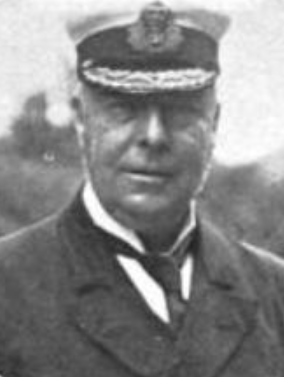
He was a few posh-sounding things in his career; naval aide-de-camp to Queen Victoria, and Admiral Superintendent of the Malta Dockyard for example.
So, that is Maria and her grandfather and now for Patrick.

He turns out to have quite a history.
He says in the letter that he was a ‘snottie’ (a junior midshipman) ‘in the flagship during the Invergordon mutiny.’ 1931
The flagship was HMS Hood which was later to become famous for all the wrong reasons.
‘In May 1941, Hood and the battleship Prince of Wales were ordered to intercept the German battleship Bismarck and the heavy cruiser Prinz Eugen, which were en route to the Atlantic, where they were to attack convoys. On 24 May 1941, early in the Battle of the Denmark Strait, Hood was struck by several German shells, exploded, and sank with the loss of all but 3 of her crew of 1,418. Due to her publicly perceived invincibility, the loss affected British morale.’ Wikipedia
Now I am no naval historian – though goodness knows I have spent so much more of my time than I had expected trawling through the stuff – Patrick was actually serving under his (future) father in law on Nelson.
(Perhaps you can have more than one flagship in a gathering of soon-to-be-mutinous ships?)
Anyway, that makes the link, but Patrick had lots more to tell us.
He had to leave the Navy because of poor eyesight and went to join a trading house in Singapore – as you do.
But when war broke out he came home and joined the Royal Navy Reserve Personnel.
This is what the Imperial War Museum cite under the Special Forces Roll of Honour:
SIS (O.C. African Coastal Flotilla (ACF))
- RANK
Lieutenant
- NUMBER
- AWARD
Distinguished Service Cross,Croix de Guerre (Fr)
- PLACE
Mediterranean 1943-44
- ADDITIONAL INFORMATION
parent unit Royal Navy Volunteer Reserve
born 5.1.1912 Bolton,Lancashire
educated Dartmouth Naval College
HMS Nelson (Midshipman)
left R.N. as Lt
worked in trading house in Singapore
R.N.V.R. 1939
Assistant Naval Attache,Paris
Directorate of Operations (Irregular)
HMS Fidelity
O.C. African Coastal Flotilla (ACF) 1943-44
Diplomatic Service postwar
retired to Guernsey
married Maria (died 1995) (3 daughters)
author “Corsican Command : A Dramatic First-Hand Account of Clandestine Operations in the Western Mediterranean 1943-44” 1989
died 15.11.2004
But an obituary ( which I am sorry I cannot credit because I have lost the link) adds more dramatic colour to his life.
I have put it in wholesale below.
But before I leave you to read that, I couldn’t find Sir John. It was always going to be a very small needles in the haystack of Sir Johns so I am not so disappointed.
To have found Patrick, Maria and her grandfather has been more than enough.
Commander Patrick Whinney, who has died aged 92, landed and collected agents from the French and Italian coasts during the Second World War.
Once inside the shipping lanes, he had to navigate with pinpoint accuracy on quietened auxiliary engines towards a rendezvous before rowing ashore in a dinghy; often he would be unsure whether there were passengers to pick up or he was entering a trap.
Though calamity often threatened, no agents were lost in transit. When one important group of Italians, led by a general, were to be collected from a beach near Orbitello, Whinney and his right-hand man, Petty Officer Jim Bates, paddled their dinghies carefully through the surf with Tommy guns cocked; but when he gave the password there was no reply. Bates could see a huddle of men silhouetted up the beach and, fearing that the Italian party was under hostile control, he whispered: “Shall I let ’em have it, sir?” “No, wait,” said Whinney, who repeated the challenge twice more. At last came the response: “Giuseppe”, followed by a question: “English?” When Whinney replied “Yes”, six men flung themselves down the beach and into the dinghies.
As they steamed back to Bastia on Corsica at 40 knots in a USN patrol boat, the general showed Whinney the ancient automatic with which he had been about to shoot him. Their courier had been gone a week, and they suspected a trap themselves. One of the group had thought Whinney sounded German; it was not until the third challenge that the general, whose wife was English, had been convinced that all was well.
Patrick Fife Whinney was born on January 5 1912, the son of an Army officer whose family had the accountancy firm Whinney Smith and Whinney (later part of Ernst and Young). Patrick’s elder brother, Reginald, was awarded the DSC and Bar in destroyers escorting convoys in the North Atlantic.
Patrick Whinney went to Dartmouth in 1925, and as a midshipman served under his future father-in-law, Rear Admiral “Burgoo” Burges Watson, in the battleship Nelson. But poor eyesight forced him to leave the service and join a trading house in Singapore.
On the outbreak of war Whinney immediately returned home and was commissioned in the RNVR. With another young intelligence officer, Steven Mackenzie, he was sent as liaison officer to the French Admiral Darlan’s headquarters outside Paris. At the Fall of France, Whinney escaped in the Canadian destroyer Fraser, and survived when the ship was run down and sunk by the anti-aircraft cruiser Calcutta on the night of June 25 1940.
Back in London, Whinney reported to Ian Fleming, who sent him to the newly-created Directorate of Operations (Irregular), where his early naval training was of great assistance to Captain Frank Slocum, who had neither adequate or trained staff.
On August 3/4 1940 Whinney undertook his first clandestine mission. This was in a commandeered French-built motor dispatch vessel to land agents at Ouistreham, on what would later be famous as Sword Beach. His next mission, to Sein in Brittany, involved escorting Breton fisherman who had taken refuge at Newlyn; Whinney recalled being met off the train in Cornwall by a Russian Grand Duke, also in RNVR uniform.
Early in 1941 Whinney acted as liaison officer on board Le-Rhin, a French cargo vessel being refitted at Barry for special operations; it was no easy task, as the French crew had little knowledge of English or of naval procedures. Despite the opposition of de Gaulle’s Free French in London, the ship was placed under the White Ensign and renamed Fidelity. She sailed from the United Kingdom to land Special Operations Executive agents in southern France and to recover escaped British servicemen. Whinney and Mackenzie were awarded the Croix de Guerre in April 1943.
When Whinney’s loan to SOE was over, he was sent to Gibraltar to organise all irregular naval operations in the Western Mediterranean. After a brief return to London, and a visit to Spain to arrange for the covert purchase of fishing boats to augment his flotilla, he travelled to North Africa to reconnoitre suitable advanced bases and requisition Italian-type local craft for operations to the Italian mainland and islands; his flotilla was known, for cover purposes, as the African Coastal Flotilla.
Whinney spent 1943 at Slocum’s headquarters in London, controlling Mediterranean operations, then was sent to set up an advanced operational base at Bastia, using a mixture of borrowed British, American and Italian craft. Since the same craft were rarely loaned consecutively, Whinney had to train each crew in special operations, while commanding the base and planning and co-ordinating other operations. He personally took charge of the first 18 operations. Shortly afterwards a temporary illness forced him to relinquish his command and return to England where, after sick leave, he was given liaison duties with French special forces, and also awarded the DSC for his gallantry, enthusiasm and devotion to duty in hazardous operations.
After the war Whinney joined the diplomatic service. He spent many years in Athens, and then went into cosmetics business with a wartime colleague. In the 1960s he settled on Guernsey, where he helped his wife to found the Coach House Gallery.
From 1981 he became involved in the Guernsey Cheshire Home. Returning from a committee meeting at which it had been plain that the home faced a six-figure hole in its finances, on a whim Whinney walked into the local television studio where he found Sarah Montague, then a budding journalist, on duty alone. Whinney charmed her into giving him an interview, and held forth so eloquently that, a few days later, an anonymous cheque arrived for the sum required.
Patrick Whinney, who was appointed OBE in 1998, died on November 15, 2004. He married in 1939 Maria Burges Watson, who died in 1995; they are survived by three daughters.


Hello from New Zealand. I have subscribed to this site. I married a Watson. My wife’s, father was the late Lieutenant Commander Rowley Watson RN. His father was Commander Rundel Watson RN, whos brother was Rear Admiral Fischer Burges Watson, the same Watson who was previously the Captain of HMS Nelson whom Patrick served under at the mutiny at Invergordon. After Invergordon, Captain Fischer Burges Watson was promoted to Commodore & was the first commisioned officer to run the New Zealand Navy in the early 1930’s. Rundel & Fischer’s father was the late Rear Admiral Burges Watson RN, Superintendant of Malta, the one in your photo. Their father was Captain Rundle Burges Watson RN who’s father was Captain Joshua Rowley Watson RN whos father was Captain Thomas Watson RN killed in action. Thomas’s wife Maria Burges was the sister of Captain Rundle Burges RN killed in action at the battle of Camperdown. Watson history goes back to Captain William Watson 1643 London trained bands. Is this helpful to you?
LikeLike
Hello, thank you so much and it is always interesting to hear about family history and this adds so much to what I could find out. It is very kind of you to make the effort to contact me. I will try and update the blog and the listing of the book on Oxfam online. Thanks again, Lucy
LikeLike
Hi Lucy, my humble apologies for not getting back to you sooner. My wife fell ill with Hodgkin’s lymphoma stage 4 cancer. We are still battling this today & remain positive. You would find information on the Watson’s but you would not find the other information connected to the Watsons , as only family members know in detail with proof. A descendant ( Ensign Watson ) of Captain William Watson 1643 carried His flag colour’s of the day before King William III of Orange. That same flag handed down from father to son since 1643. Ensign Watson 1690 became the King’s Standard Bearer & carried the flag ahead of the King of England, (William of Orange )at the battle of the Boyne in 1690. The flag was then named the Boyne Standard. The flag remained in Watson’s hands. In 1912 the existence of the Standard was known to Admiral Lord Charles Beresford, who was a close friend Mrs Burges Watson, wife of the late Admiral Burges Watson. Admiral Beresford a passionate opponent of Home Rule persuaded Mrs Watson to lend the famous Standard to Ulster. 1ST Viscount CraigAvon James Craig had heard of the existence of the flag in July 1912 & at the beginning of September 1912 the definite clarification came. The Standard was smuggled into Ireland & given to The Viscount on the 2 September 1912. Beresford letter to CraigAvon had strict instructions from Mrs Watson, nothing need be said on who owns it now or where you got it ” I have told her that it would be in complete safety in your charge & when out, you are sure to have a strong Colour Guard to protect it, & that you are sure to send it back to her as you received it. On completion on the ceremony the Standard was smuggled out of Ireland. On the 28 September 1912 the faded yellow silk flag was unfurled in the Ulster Hall & hung at the back of the famous signing, the Ulster covenant of 1912. The flag was displayed & known as William Of Orange”s Standard from the Battle Of The Boyne. The details were recorded in a book by St.John Ervine called CRAIGAVON Ulsterman.
LikeLike
Hi Lucy 1 last gem. The Battle of the Boyne Standard of 1690 was in service one last time in 1850, after a long service of history from 1643. In the’ Exeter Flying Post December 05,1850 the banner was given by M Watson , a heir-loom of Captain Rowley Burges Watson & placed in the bow of the first barge “Ranger’ in the opening of the Canal Basin in Exeter.
LikeLike
Hi Lucy wait there’s more. lol Going back to the letter that Patrick Whinney wrote & his wife Maria Burges Whinney nee Watson the artist. Maria Burges Whinney was also known as Mary. A daughter of the late Rear Admiral Fischer Burges Watson or Rear Admiral F B Watson RN . Fischer went by his second name Burges not his first given name because it was German. Maria’s grandfather was the late Rear Admiral Burges Watson RN ( 1846-1902 ). This Burges married Marie Therese Fischer who was born in Auckland New Zealand 1857 & died in Hampton Court Palace England in 1918. Marie’s father was Dr Carl Frank Fischer ( Dr of medicine & Homeopathy ) of German & Austrian origin & her mother Prudence Florentine De latter of French origin & settled in New Zealand in 1853. In 1869 the Fischer’s went to Sydney for 3 years then onto Europe.
Marie’s mother Prudence passed away in London & the family returned to Sydney.
In September 1882 Marie married Commander Burges Watson RN in the church of St Mark Darling Point Australia. Burges was promoted to Captain 1885 & Rear Admiral in 1899 & died in 1902 in Malta from pneumonia.
Burges & Marie had 2 son’s . Fischer in 1884 & Rundle in 1889. Both entered the RN on age. Maria Burges Whinney nee Watson married Patrick Whinney. Patrick”s father-in -law ,Maria’s father was Captain FB Watson or Captain Burges Watson of the HMS Nelson. Promoted to Commodore & Commander -In -Chief of the New Zealand station 1932 then promoted to Rear Admiral. Rundle his brother ended up a Commander in the RN, who’s son also RN became Lieutenant Commander Rowley Burges Watson, my wife’s father who also had Burges as her 3rd name. Patrick Whinney did indeed report to Lieutenant Commander Ian Fleming Naval Intelligence Division. Fleming wrote the novels of the James bond books that went on to become movies.
LikeLike