Strange Ships

I don’t regularly work a Saturday afternoon in our Oxfam bookshop, and it is a rare ( but a very nice time) when a book is united with someone who really wanted/needed/appreciated it.

Mostly instead it is nice customers who have been recommended a good paperback fiction book by a friend or a sister, or who has read one of the author’s books and wants to read more – or indeed never tells me why they are buying the book.

But this afternoon was a bit different.

We have a glass cabinet ( I have to say rather thrust upon us by a previous area manager) into which we put ‘specially attractive books.’

I put books in there that I really hope will sell because they are delightful/interesting/unusual – but often the book-buying public of Petersfield finds them less so…..

Anyway, the one I put in a few days before my Saturday shift was not really a book.

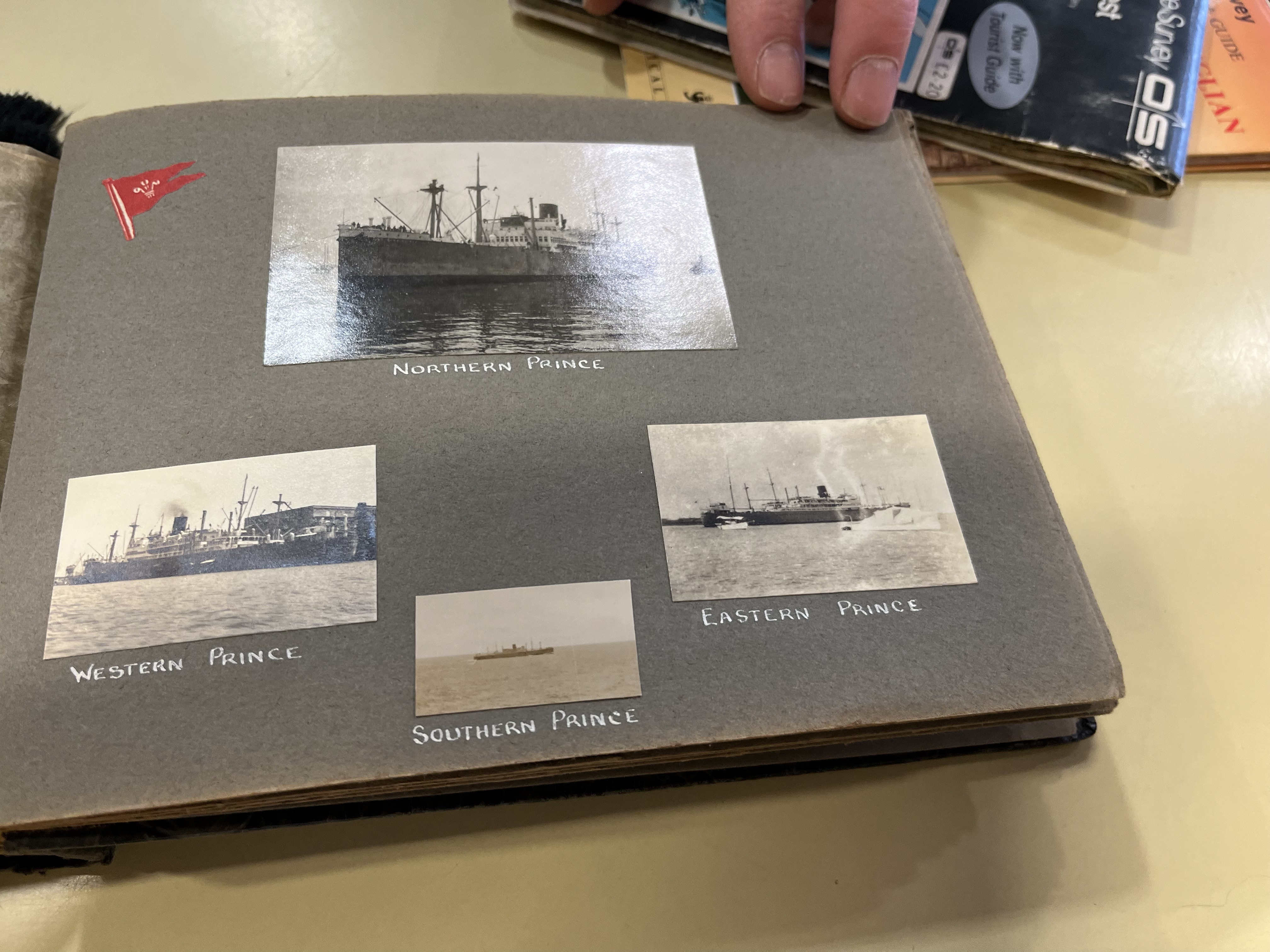
It was a photograph album of ships.

It was donated by who knows who. 

It had no name of the ‘author.’

Every page was completed and every page had a tissue guard – that, just in case you didn’t know, means a bit of photographic tissue paper to protect the photographs.

Except, I am not sure they were photos – some were the size of old-fashioned cigarette cards, some the size of postcards, some bigger.

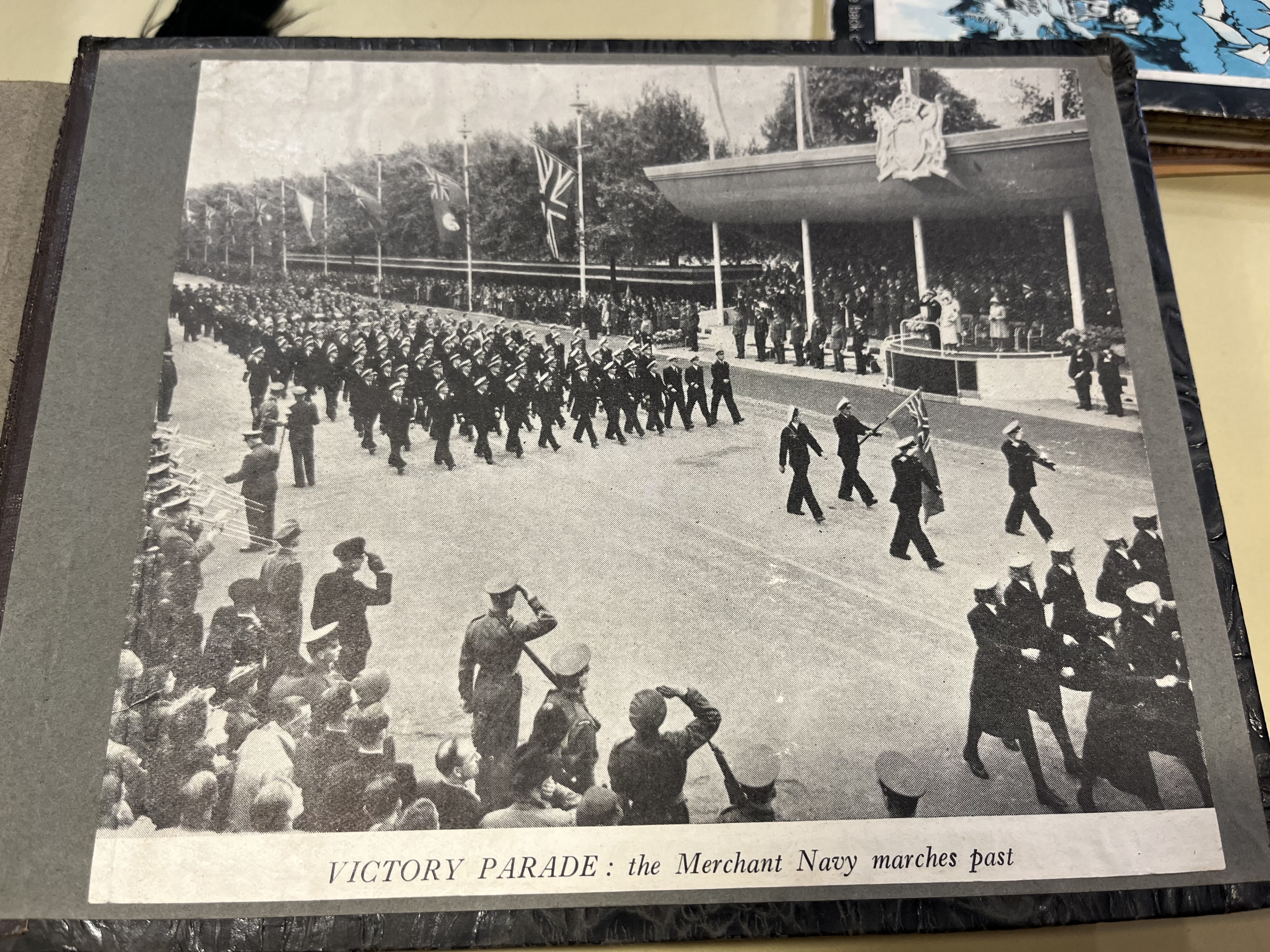
Most of the images, it seemed to me, with a relatively cursory look, were merchant shipping vessels and at the end of the book was an image of the merchant navy victory parade at the end of World War II.

I had looked at this and wondered who as the person who put it together?

But assiduous readers of this blog ( and that must be just me ) will remember I disappeared down a rabbit hole of naval mutinies a while ago and so I decided not to take on any research into this album.

I steeled my heart, as the best beloved would say, picked a figure out of the air and put it in the cabinet for £20.

So, there I am on a busy Saturday afternoon and someone asks if he might take it out and have a look at it.

Of course. And just then the shop was not too busy so we started talking about it.

Then customers started wanting to pay for books, asking for books we might have not on display, wanting to know whether the book they had seen ‘about two weeks ago and it was about, well I am not really sure but something to do with… have you still got it?’

So I left the man and his wife leafing through the album until the shop went a bit quieter again, and he said something along the lines of:

‘I am going to buy this and try and find out who he was. There must be ways of finding out the crew on all these ships and if there is a name which appears on all of them or at least some of them.’

A man after my own heart.

I asked him if he would let me know what he found out, if he ever does. 

I have given him my name and phone number and one of these fine days I might find out what he has found out.

‘It is amazing and rather sad,’ he said, ‘that a family have let this history go.’

But he doesn’t work in an Oxfam shop where you get all sorts of donations and think why did you let that go?

But, as someone donating the other day said, ‘ I hope you can find someone who likes old stuff because we don’t.’

Retired Holidays

I remember my mother saying, once retired, she had no idea how she had managed to fit in a full time job.

Being in my 30s at the time, I was just a bit sceptical and had always worked on the basis of ‘if you need something doing, ask a busy person.’

But now I find myself agreeing with her – and I am sure if she was still around to hear that, she would be sporting a rather self-satisfied smile.

Over the years, I have slipped from employment, into self-employment, into less self-employment and since the pandemic, no real paid work – and never actually retiring in the sense of ‘ Ok that is it, work over, retirement here we go.’

It turns out, I have plenty to occupy my time.

And what a heady mix of ‘plenty’ that turns out to be; Oxfam, upholstery classes and a bit of hammering and banging, re-stuffing and hand-stitching on the side at home, dog-walking fixtures, lunch outings for an elderly relative, gardening, cleaning out the fridge now and then……

Not exactly running from pillar to post, I hear you say, and indeed I was feeling guilty about being so ready for a holiday and relishing the thought of waking up and not having a list of things to do, places to be, over and above when to go for the first dip in the sea, and where to eat that evening.

Meanwhile, there is something very nice about sitting with the Best Beloved on our terrace watching the yachts coming into the bay and sorting out where and how to anchor.

This was always a tense time for us on sailing holidays ( actually one of quite a lot of tense times) and remind me one day to tell you about our anchor coming loose and our boat bumping (gently) around and into all the other boats in the bay.
So there is a lazily delicious schadenfreude in watching the oh so usually competent Swedes (among others) spending an anxious hour going backwards and forwards to the prow and peering down to check their anchor is still laid.

obviously some boats are easier to anchor than others

We have two weeks of time to spend pretty much like this and I have a feeling that much though I was very, very keen to get here, there will be a bit of me itching to get back, get busy, and do the Oxfam window display.

The window theme is travel, so no irony there then.

A Reminder Of Where We Live

Some years ago, when we moved to Deepest Sussex, I said to the then village shop owner, ‘ I am going to stand outside your shop and ask everyone who comes out with The Guardian to be my friend.’

‘ Mmm well you won’t have many friends Lucy,’ he said.

As it happens, we have found people who spiritually, if not literally, do buy The Guardian.

But an exchange in the village shop this week reminded my that it is the case that the piles of The Daily Mail, The Telegraph, The Times, even The Express go down a lot more quickly than The Guardian.

I stopped on the way home from my upholstery class ( of course I did, Sussex housewife as I am) and asked the lovely woman at the counter whether my husband had been in for his Guardian.

‘I don’t know,’ she said, ‘ I am not sure who he is. Describe him?’

‘Tall, wears glasses, can’t walk very well, Oxbridge accent’’

‘That would cover about half our male customers, so not much of a clue.’ she said.

A fellow upholsterer, in the shop too, said,’ If I was asked to describe my husband, I’d have just said grumpy.’

Lovely woman at the counter said, ‘ I would say fuck knows since the last 15 years and that is just fine by me.’

‘He would have had a voucher to buy The Guardian,’ I said.

‘Ah well, he hasn’t been in. No Guardians sold so far today. Here, have one – bring in the voucher when you next pass – I am pretty sure we won’t run out.’ 

On And Off

Following on from the last piece, remember the ‘modern proverb’ If at first you don’t succeed, try turning it off and on again?

Well, the Best beloved needed (another) spine operation and, as is usual, he went for the obligatory check ups before.

They found he had a slow heartbeat.

This was not a surprise as for every other operation he has had in our however many years together, every time the medics have commentated on his slow heartbeat.

No worries, we said.

Mmm, they said.

And then they said, Go home with a monitor strapped to your chest for a night or two and we shall see.

He did.

They were not impressed.

You need a pacemaker, they said.

Now here was the rub, the surgeon doing the operation ( privately, I have to say) was going on sabbatical so we had to get the pacemaker in before he left.

A privately funded pacemaker cost nearly as much as the spine operation – really you ask, yes indeed.

So I spent a lot of time on the phone with medical secretaries – secretaries/assistants/receptionists are always the route through a problem.

Eventually after a lot of chasing around the NHS to try and get this done in time, the private/NHS heart doctor who had first had said  said, Do you know what, just add him to the end of my list and I’ll get it bloody well done.

And I close quotes.

So, it is a quick in and out to get something put in the size of say a 50 pence piece and yes it is visible under the skin and it takes about 40 minutes under local anaesthetic.

We were very grateful and relieved. 

And when it is done they strap you up to a monitor to make sure all is well and leave you on a bed for an hour or so.

So, all is well.

The monitor is behind the BB’s sightlines but visible to me as I sat solicitously (and rather impressed by my own ability to get this done in time with the help of several great women).

I could see that his heartbeat was registering not so much rather high as alarmingly high.

But he was chatting away and offering crossword clues.

In the end I asked a nurse to come in and check things.

She took one look at the monitor and called in someone else.

But he is fine, I said.

Mmm, she said.

She took his pulse in the old fashioned way.

And said, Mmm….

I’d better call the technicians but that may take some while.

I said, Shall we just try the turning off and on again trick? After all it is only a monitor not something keeping his heart going.

Mmm, she said.

But we did.

And do you know what – all was just fine.

It’s a great proverb and, along with the 80/20 rule, one that I swear by.

Queer Proverbs

There are books with titles which would probably not be used today.

But in 1886, things were a bit different.

Anyway, Edwin Hodder writing as ‘Old Merry’ had indeed some rather odd proverbs as well as some still very familiar – and his discourses are nothing if not a little idiosyncratic.

You know how some sayings get embedded in your family?

Well, the one I remember from my mother was, “ What the eye doesn’t see gathers no moss.’

I am not sure exactly what she meant by eliding those two proverbs but generally, I think she used it when she wanted to sidestep something awkward, and get away with it.

Anyway back to Old Merry.

‘The cat in gloves catches no mice’ 

And there is a picture.

As well as a moral ‘sermon’ to children from the ‘pulpit.’

I won’t bore you with the several pages of Victorian ‘humour’ and moralising on all the proverbs. 

‘Phew,’ I hear you cry – and in the hope I can detain you just a little longer, here are just a few more snippets.

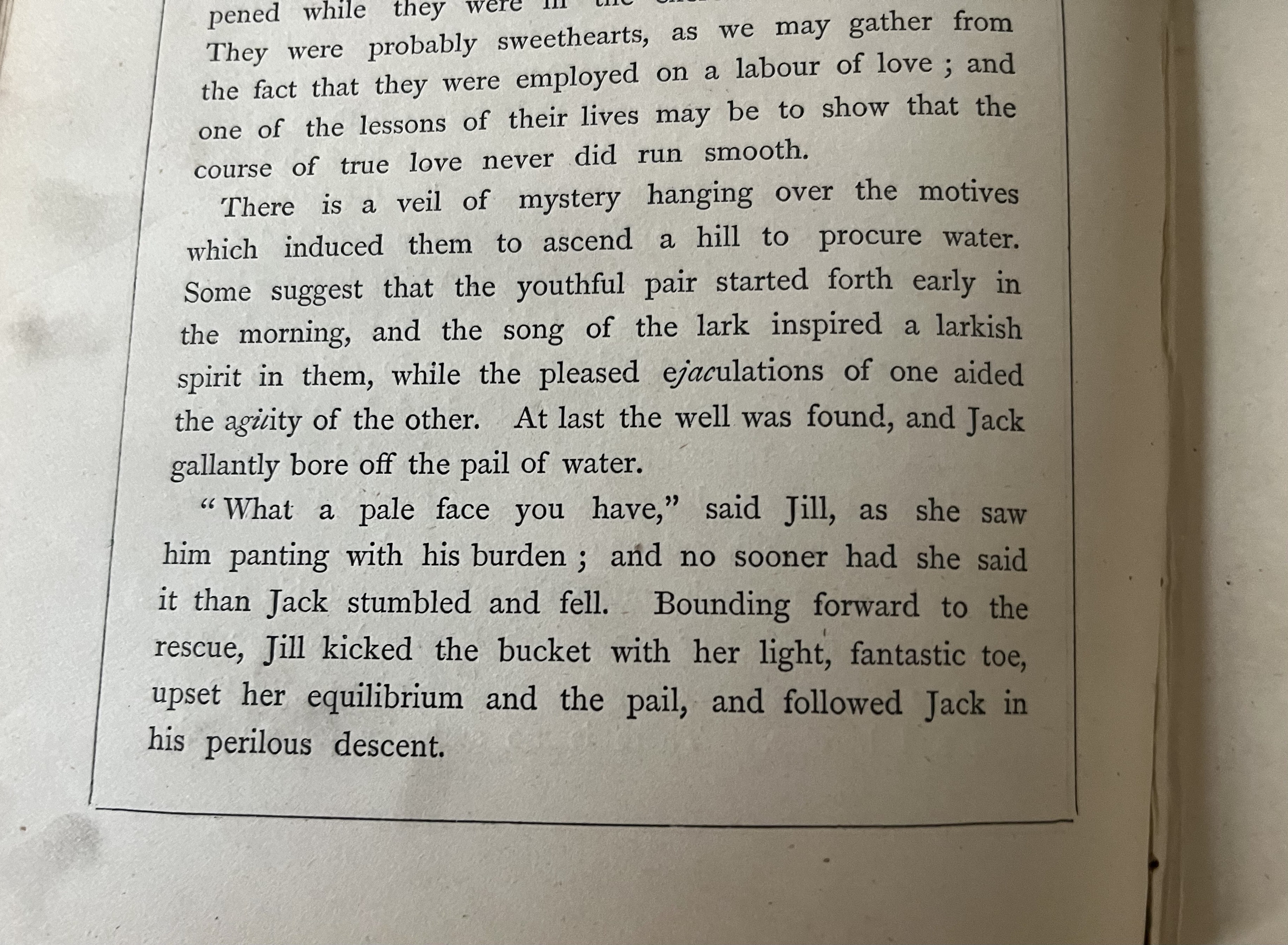
Jack and Jill

Interestingly, though he says later, addressing the rapt Victorian children I assume, there are two lessons, only No 1 seems to be identified. 

Perhaps he needs the same proverb as I do – something about attention to detail.

The Best Beloved says I need to be followed around by a tame pedant.

And, he says, my life is like an impressionist painting, all looking good from a distance but up close, it is a mess of random dots.

As for attention to detail ‘proverb’, I am going with “ Look after the (non-financial) pennies and the pounds will look after themselves.’ 

Doesn’t trip off the tongue I know, but will work on it.

I also like the quote:

‘Success in any endeavour requires single-minded attention to detail and total concentration.’

Willie Sutton (aka, “Slick Willie, the famous bank robber)

Well, back to Old Merry and 

‘Every ass likes to hear himself bray.’

Is it too cheap a shot to want to have that projected onto the walls of parliament?

Old Merry however, makes no such comments, instead he writes five pages in defence of the donkey and says,

‘I confess I have respect for donkeys and should like to join a crusade for the vindication of their rights.’

‘ Costermongers are now the greatest donkey holders in the land, and we have not to walk far to see how brutally the poor things are used, what cruel work they have to do, and what horrid society they have to mix with.’

So, here are a few more Old Merry’s to leave you with:

‘It is not the cowl that makes the monk.’

‘He that is afraid of wagging feathers must keep from among the wildfowl.’ No, I have not much idea either though I gather it is a Scottish proverb, so all Scottish ideas welcome. 

‘ Fools make feasts, and wise men eat them.’ As a happy cook, I rather resent this one. And I am not sure Old Merry clears up the meaning of this proverb as he witters on about the difference between a simple person and ‘ a simpleton’. Just saying

‘Keeping from falling down is better than helping up.’ 

And finally from Old Merry

‘Merry Christmas.’ 

Now that to me is not a proverb, and reading through Old Merry’s take on this I feel that he might just have read Pickwick Papers published in 1837.

No Scrooge as a repenting ‘sinner’ but a contrast between idyllic Victorian Christmas full of joy and candles and good food, and Nelly trying to read to her parents by the light of a meagre fire, the dead son Tom…..

But to make things a bit lighter I give you some modern proverbs:

If at first you don’t succeed, try turning it off and on again. Neil Whyte. ( One I put into action all the time – remember me to tell you about the BB’s heart monitor sometime.)

You Brexit, you fixit.” Alistair May

You only find out who is swimming naked when the tide goes out. Warren Buffet

The problem is between the keyboard and the chair. ( no attribuation)

One ought to try everything once except incest and folk dancing. Arnold Bax

Never wrestle a pig; you will both get dirty, and the pig likes it. Richard Calhoun

From Cave Man to Serif

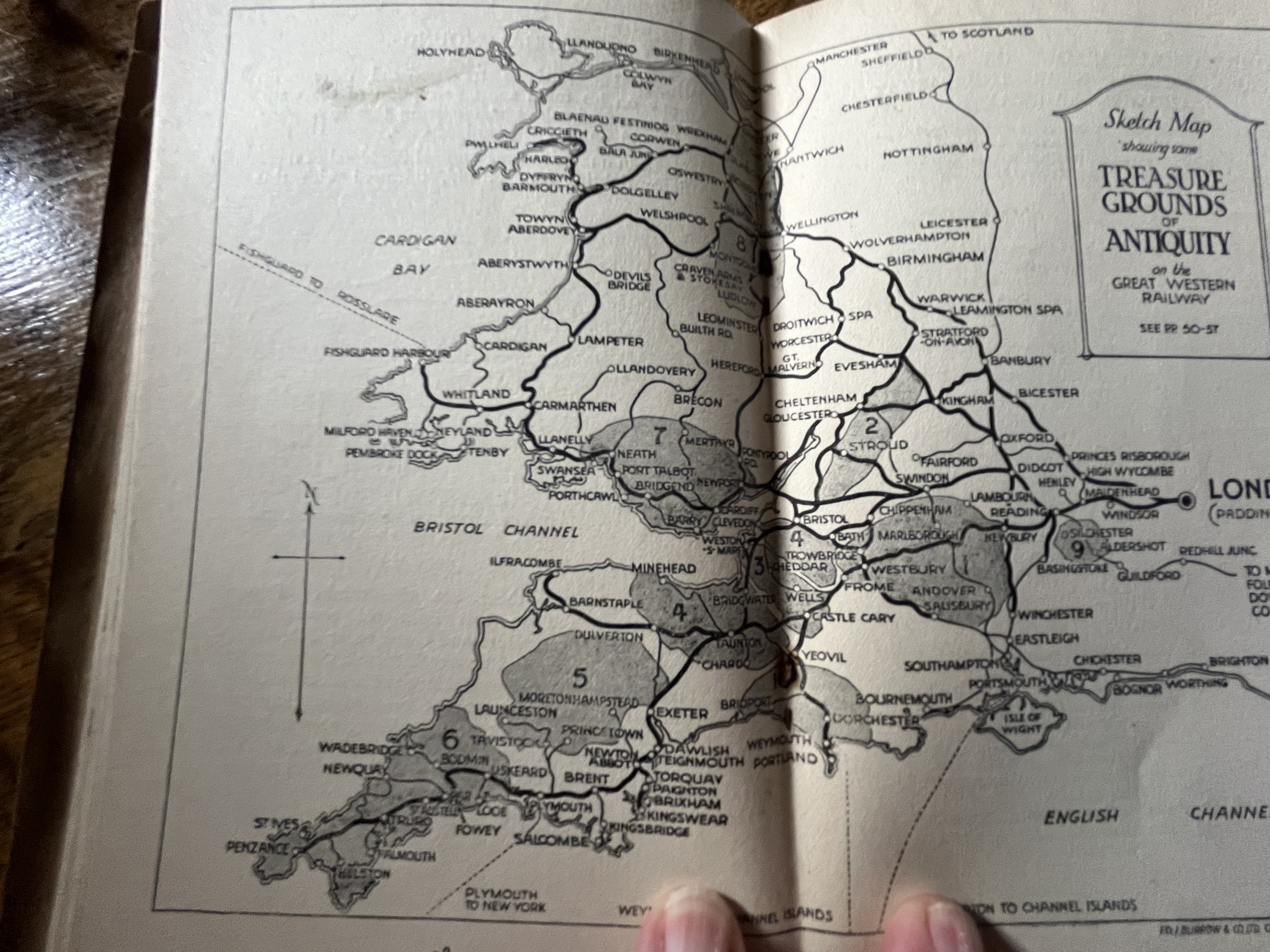
‘It is a far cry from the Age of Flint and Neolithic Man to the Age of Steel when the Great Western Expresses thunder from the East to the extreme West in less than 6 hours.’

Well it takes even less time now (sometimes), but no doubt costs a lot more.

This is about a delightful little paperback guide from, I think, 1926 to where you can get off from the Great Western Railways expresses and get to, by whatever other means, see ancient sites.

George Burrow, the author and illustrator was clearly a man for who ancient sites held particular thrall.

According to Wikipedia:

Edward J. Burrow (8 June 1869, Wellington, Somerset – 19 September 1934, Cheltenham) was a prodigious engraver and founder of Edward J. Burrow and Co., a printing and publishing firm.[1]

Beginning in the years before the First World War Burrow published more than 500 travel guides in a series titled The “Borough” Pocket Guides (also known as The “Borough” Guides) to various localities of the British Isles and some parts of the Continent.[2] In the 1920s he published a book series titled Burrow’s “RAC” Guides,[3] which were issued under the auspices of the Royal Automobile Club Touring Department. In the 1930s he issued another series named Burrow’s Grey Guides.[4]

Until the 1960s Burrow was the most prolific publishers of local authority official guidebooks in the UK, from booklets covering small rural districts to large civic handbooks for London metropolitan boroughs.

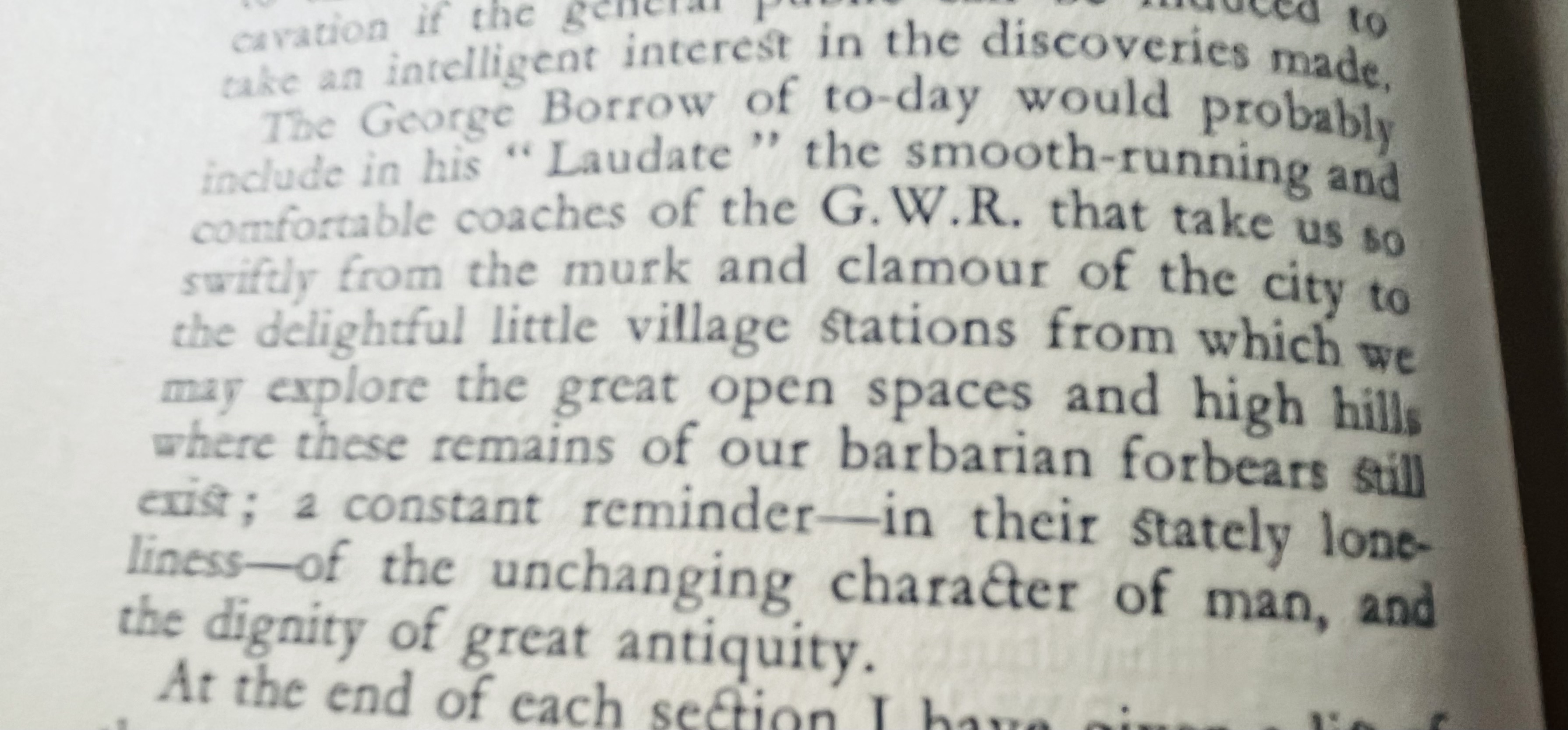
So, our little book is hardly a rarity but it is nevertheless rather charming in lots of ways including the rather nice typeface.

There was a lot of GWR inn those days

I have not the time to do the research but would love to know what typeface it is. 

I tried a gentle tootle around to see if I could get a link to the Cheltenham Press who printed the booklet but nothing – it was not a rigorous and thorough search.

The serif links st, ts,  and ct. 

It looks a but Arts and Crafts to me but what do I know. Would like to though, so when it is raining and when isn’t it these days, I might spend an afternoon searching old typefaces unless anyone can get their quicker…….

Life in the USSR

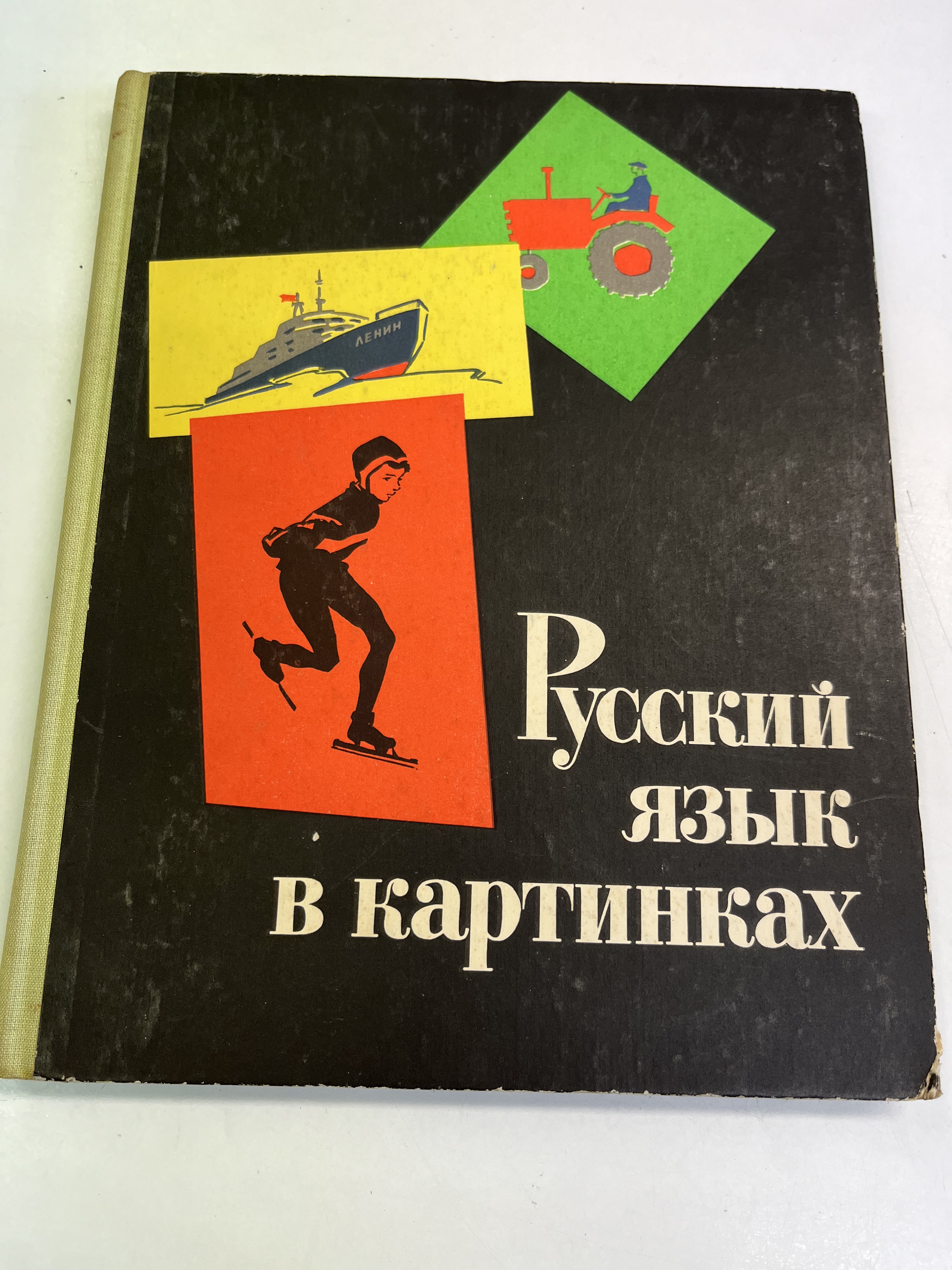
So, this book came into the shop and luckily I knew someone who was a Russian linguist – at least I knew his mother and two degrees of separation is just fine with me.

He told me the title is ‘Russian Language in Pictures’.

Published in Moscow in 1960, it is the images which are so redolent of the Soviet art of the era and a portrayl of life as it not count wasn’t, but the authorities wanted to say it was.

I leave you with the pictures.

A boat hunt

Something rather nasty happened in our Oxfam bookshop the other day.

And that is not a sentence I would have imagined having to write.

I had been charged with decorating the window and had amassed a lot of books on water, the shipping forecast, books on the sea, how to make model sailing boats, you get the idea.

Well, I decided to boost the attractiveness of the window by using a Dufy print which I remember as a child and therefore dates back to the 60s.

And I decided to include the lovely little model metal boat we bought in Corfu town a few years ago.

‘I wouldn’t,’ said the Best Beloved, ‘ It will get nicked.’

But I didn’t listen. I carefully made sure it had a not for sale sign on it as over enthusiastic volunteers have been known to sell unpriced things for less than they are worth or indeed, are on loan to the shop and not for sale.

It was stolen and I was gutted.

The BB, I have to say was gracious about it given that it was really his boat and he had of course warned me.

But in my defence, we have never had anything like that happen before. I am sure a few paperbacks have been slipped into bags, but nothing stolen from the window.

We bought it from a jewellery shop in old Corfu town during a dark thunderstorm with torrential rain.

I had seen a pair of earrings I really liked whilst out on a wander earlier in the day and the lovely BB said he would buy them for me and I said he should come and see the amazing model boats.

We sheltered from the storm, quite literally and bought both earrings and out boat.

So last Saturday I Googled about looking for jewellery shops that would fit the bill of my memory.

( I did by way of a sidetrack, think how i would have gone about this search in the days of my youth when Google was not so much as a software glimmer in Larry Page’s eye.

( Well I would have found the expat and therefore English language newspaper/magazine and asked them for help. It is not a big town so I would be willing to bet it would be an easy hunt for them and they could get a story out of it.

Or called the tourist office, or called one of the hotels in the town. I towels have been more of a treasure hunt but possible.)

Anyway, I found one with a phone number and called it. I asked the man on the other end about the boats and he said though it wasn’t his shop we had visited, he did know the boat maker who had retired but he thought he might have a few left.

I sent Kostas a picture of my boat and explained it had been stolen and I wanted to replace it.

But that was Saturday and this is now Wednesday, and I haven’t heard anything back.

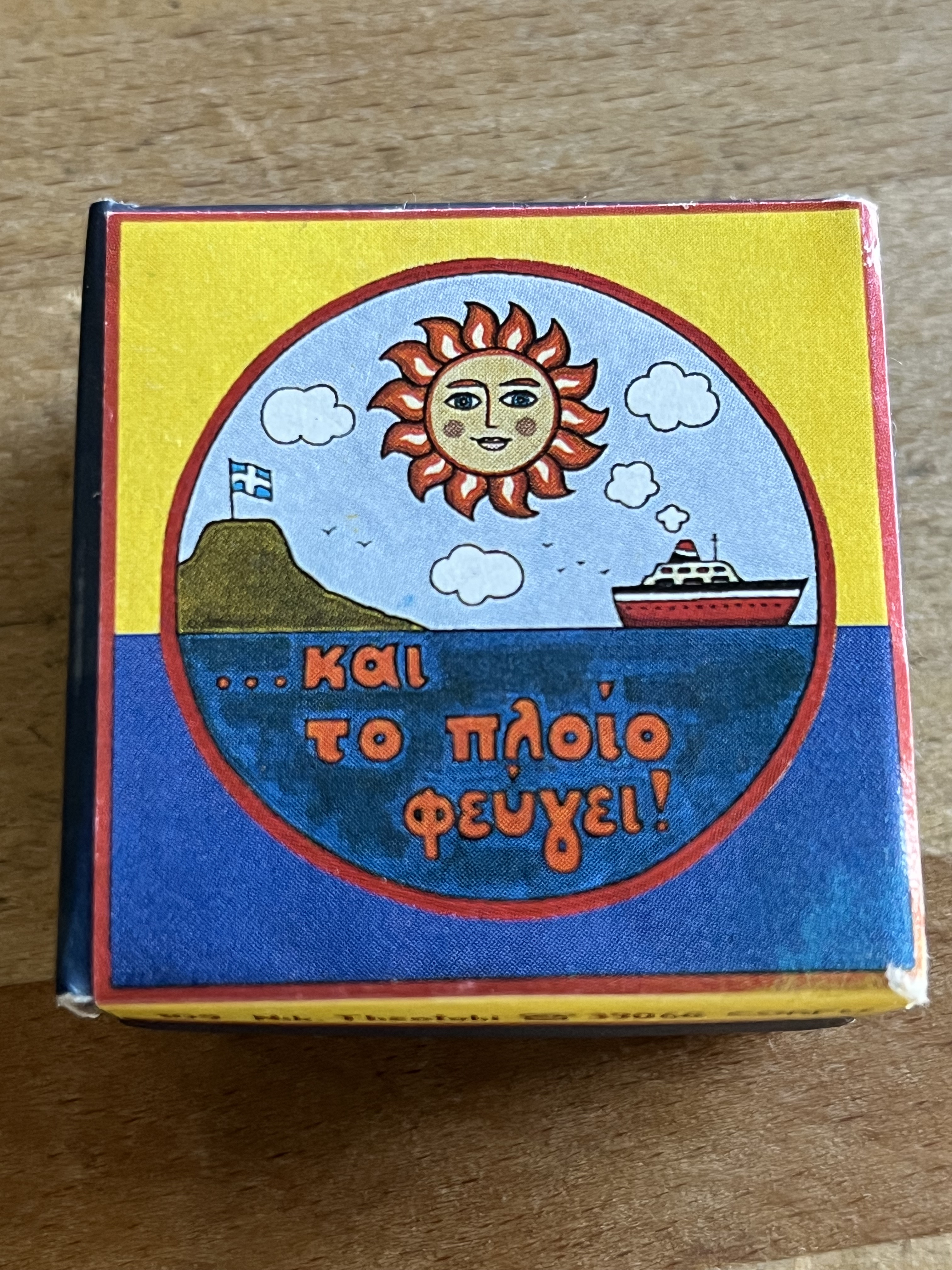
Meanwhile though I thought I would take a picture of the earrings to illustrate the blog and surprisingly for me, I had kept them in their little box. 

Lo and behold, there was the phone number of the shop on the side of the box.

As I sit here, I am plucking the courage to ring them and I am keeping everything crossed that the shop is still there, the boat maker is to be found, that he does indeed have a few boats left, and if so, I can afford to buy one and get it shipped over to me.

It seems to me that is a lot of ifs, and I know I am prevaricating on the basis that I don’t want to be disappointed.

I will be living in hope for a few hours yet – and I will let you know.

Frank and Chaffinda

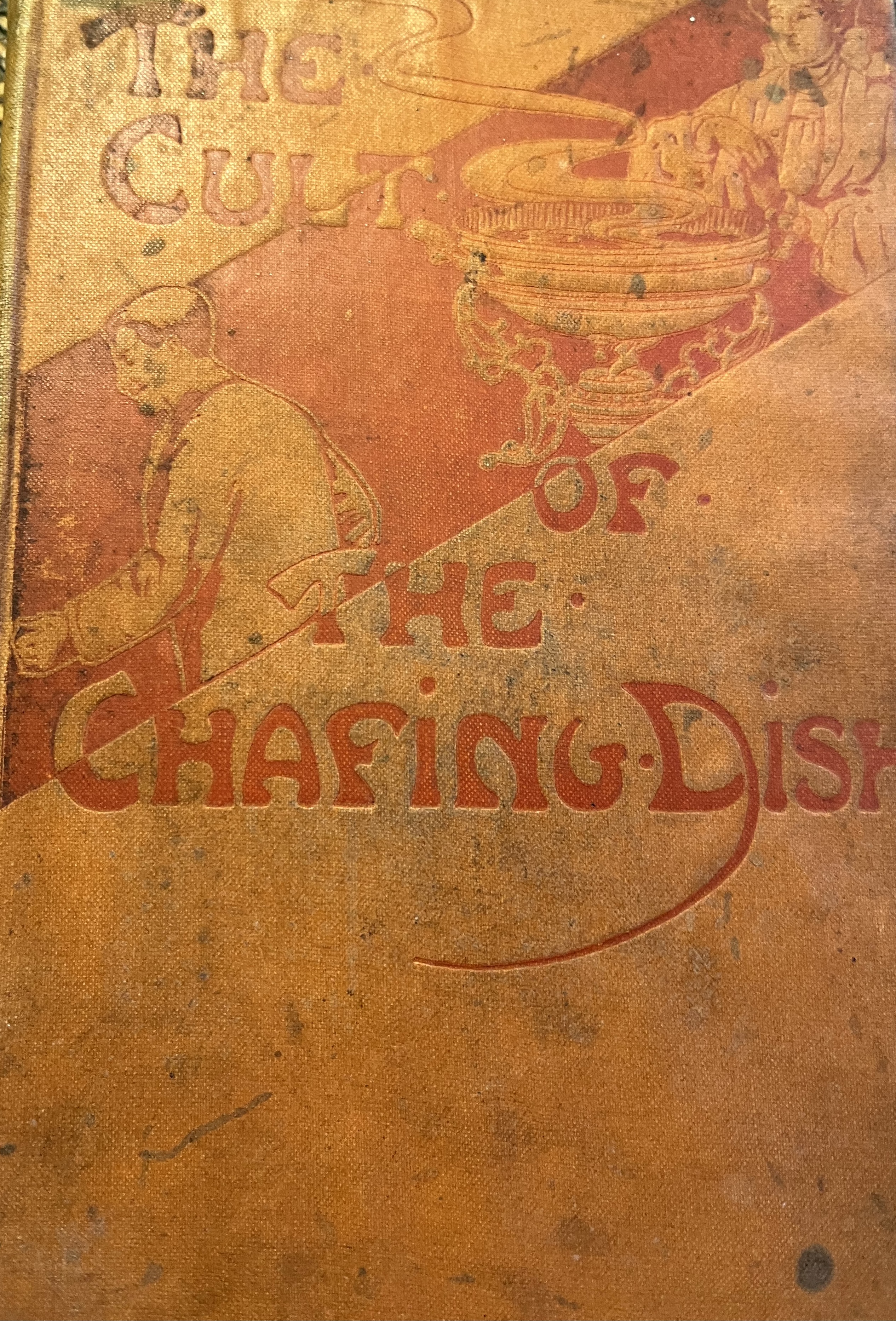
So, dear reader, this is another old and interesting, and surprisingly funny, cookery book – and it is long read of what the author wrote, so dip in and out – think stealing a leftover out of the fridge now and then, a snack to return to.

Well it was interesting to me anyway. But if you are about to heat up a Waitrose’s curry for Friday night’s supper, or make yourself a fish finger sandwich (nothing wrong with either of those), you might want to get on with that.

If you are still with me, and in case you need reminding/informing, a chafing dish is basically a metal dish which has a mechanism to keep food warm.

If you are old enough, think predecessor to the hostess trolly – and who isn’t ( if you are old enough) now thinking Alison Steadman in Abigail’s Party – start hearing Demis Roussos everyone.

Anyway, this is well before any of that.

But back to basics.

Modern chafing dishes are for keeping cooked food warm. They are not going to reach a temperature to cook, nor should food be kept at lukewarm temperatures for too long lest bugs start breeding and poison you and your guests.

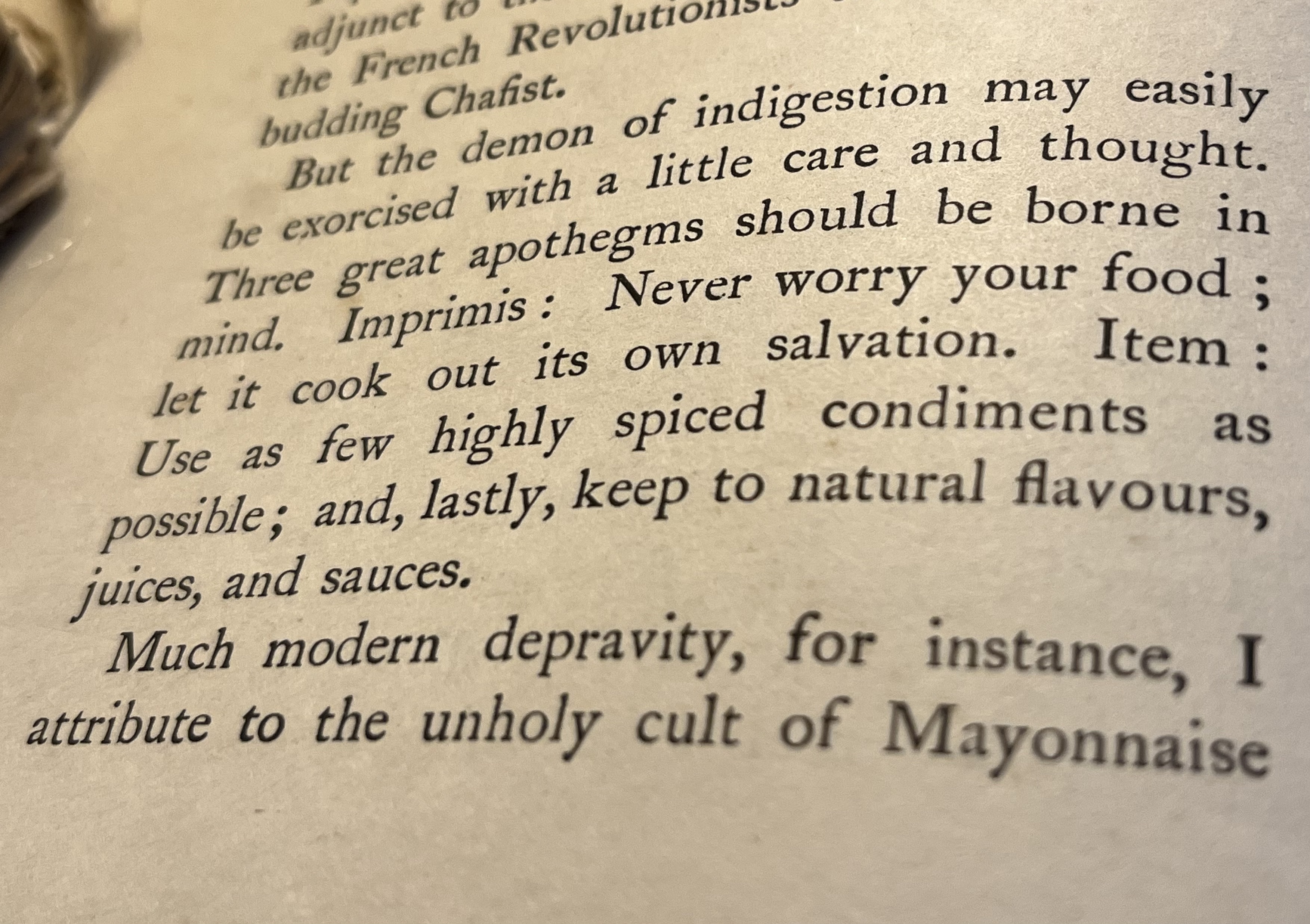
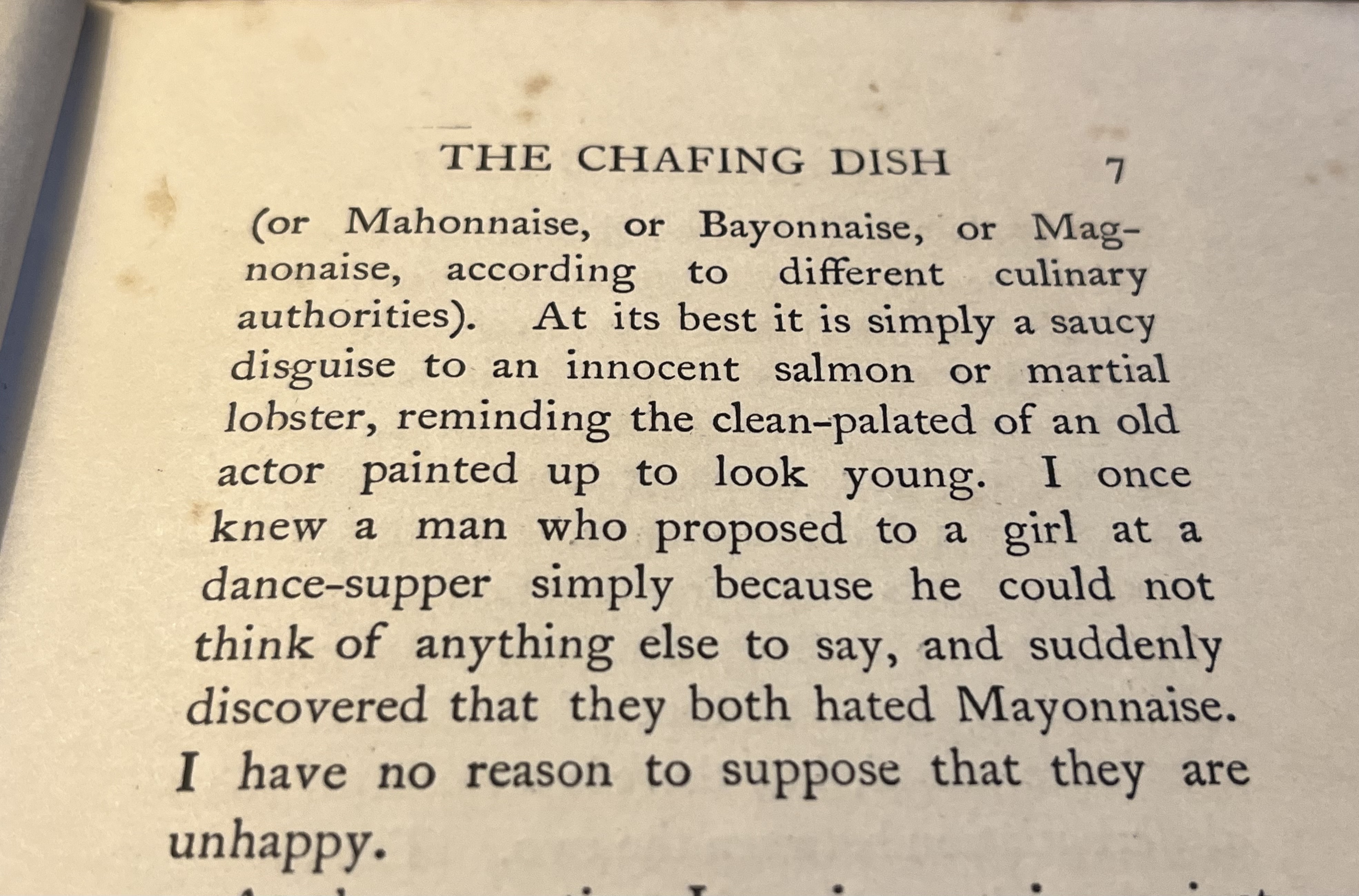
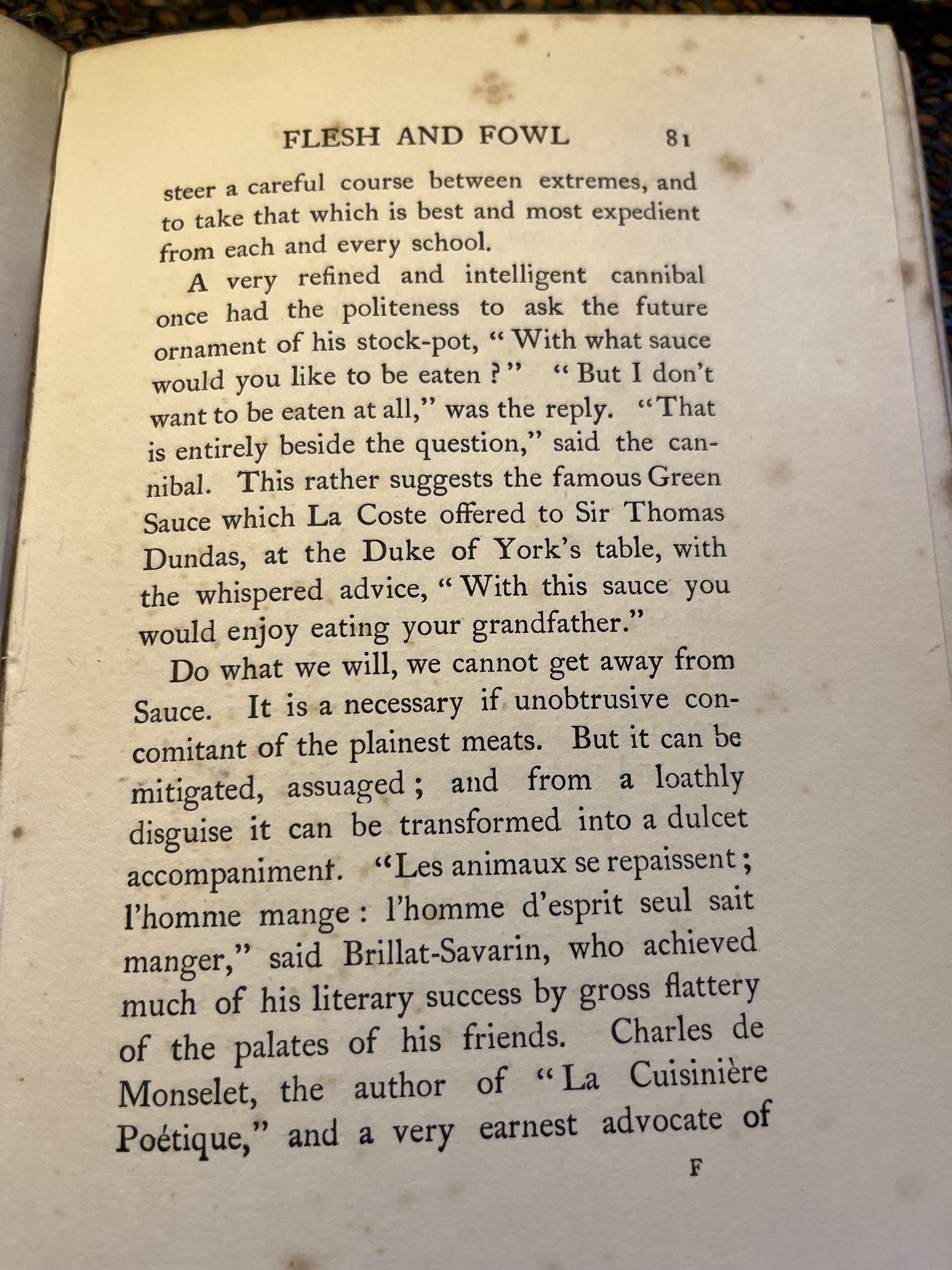
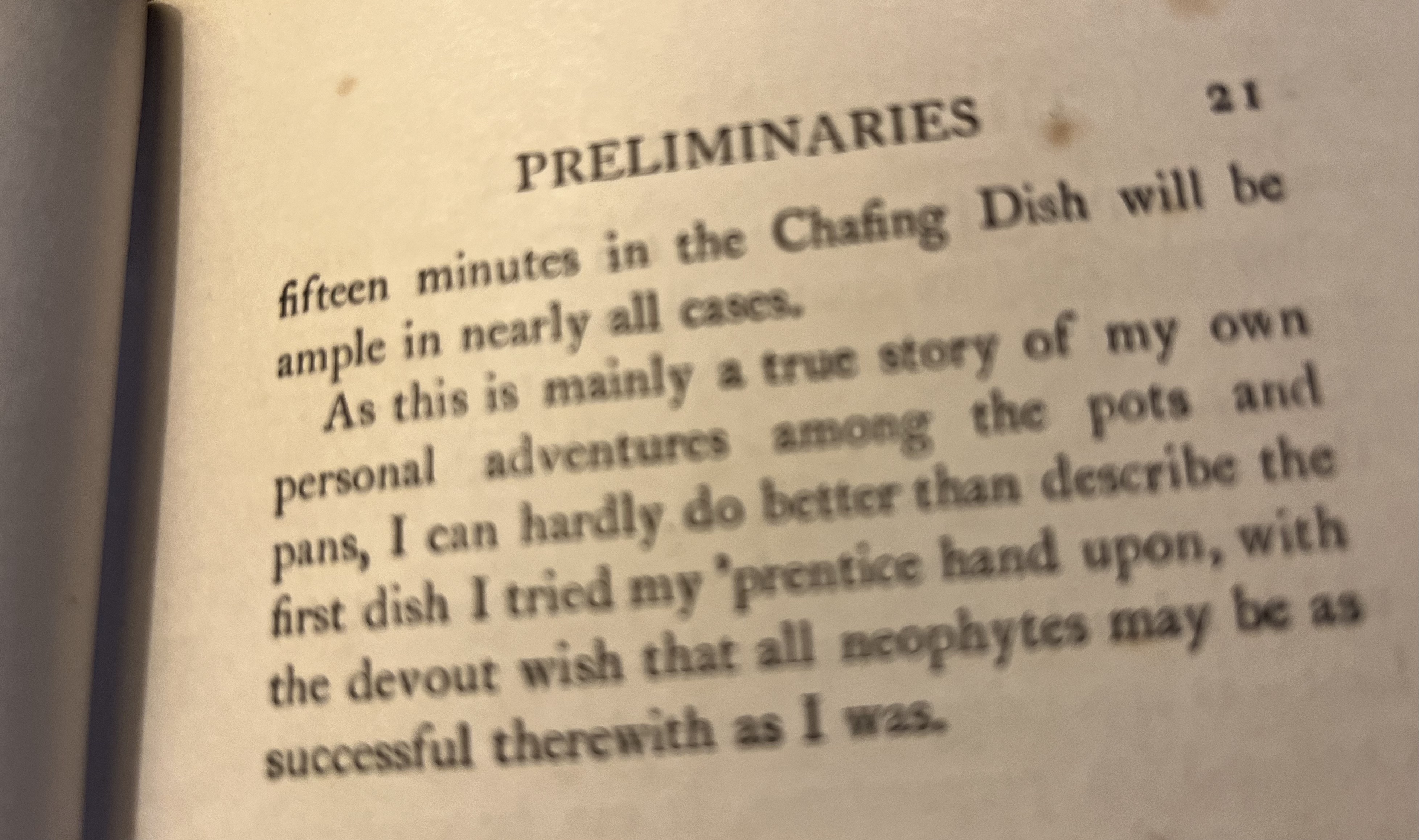
But the very jolly cookery writer of 1905, Frank Schloesser had other ideas and to be fair, what he describes might be a chafing dish with knobs on.

Just to make things clear, he has a name for his, Chaffinda:

Though, again in the spirit of making sure that any reader doesn’t get the wrong idea, using an asbestos tray over a chafing dish flame to make toast is really not a good idea.

It turns out on close inspection, that even for enthusiast Frank, the chafing dish is not always an alternative to cooking. Quite a lot of the recipes require you to have pre-cooked meat, vegetables and other stuff.

So, think of it this way – as he does. When you are returning from the theatre with your friends, here is a way to have something ‘cooked’, on the table, for a late supper, relying on what you (or someone in your pay) has cooked before and you can heat up into a tasty, light morsel.

It is rare that a cookery book makes me laugh but this one did.

He is a man who thinks eating less is good, some condiments (mayonnaise) are an abomination in the sight of some god or another, and things should be done in precise and small quantities – a walnut of butter, three chives, three drops of tabasco……

He is not a man to think that a recipe unlike the food, plain and simple, needs nothing more – Frank is a man with history and anecdote as garnishes.

I will just leave you with some more tasty morsels…….

A History Lesson

I educated myself ( a bit ) on holiday but there is no need for you to do the same and, of course, indeed you may not need educating as much as I did.

There is not much I can promise in terms of levity, it turns out this part of the world doesn’t have much of that.

So, we went on an excursion from our luxury bubble of a hotel resort, to see ‘the mosques, churches and old town of Sharm.’

Well….

Sharm el Sheik dates from the 1980s and its history and politics explain why.

Suffice it to say that the excursion meant we saw a large but I have to say ugly, church finished in 2010, and a mosque finished in 2017 with an ‘outdoor’ market which was a series of tacky tourist shops overlooked by a fake waterfall.

Enough said on that.

We also saw kilometres of low level apartment blocks which are there to house the some 70,000 workers from all over Egypt who make life so easy for the tourist.

Now, according to Wikipedia the population of the city is about 73,000 and we were told this immigrant workforce numbered 70,000 – yes, that leaves 3,000 locals.

And the tourist numbers?

‘In 1976, tourism was a focal point of the Five Year Plan of the Egyptian government, and 12% of the national budget was allocated to upgrading state-owned hotels, establishing a loan fund for private hotels, and upgrading infrastructure (including road, rail, and air connectivity) for major tourist centres along with the coastal areas.’ Wikipedia

Things moved on apace and the number of hotel/resorts increased from three in 1982 to ninety-one in 2000 and, we were told, just over 300 in 2023.

Between 1982 and 2000 ‘guest nights’ went from 16,000 to 5.1m.

In 2010, the then peak tourist number, there were 14.7 million tourists in Egypt as a whole.

But revolution, a few terrorist attacks and of course Covid did huge damage to the tourist industry with numbers in 2020 down to just 3.5 million.

In 2023, 14.9m tourists visited the country.

Enough statistics.

So, I was wondering how Sharm El Sheik came into existence as such and overwhelmingly tourist place.

Nothing here dates back before the 1980s and precious little is even that old. It is all geared around us visitors.

The six lane highways, the airport, the immaculate compounds/resorts with desert rubble everywhere else.

Sitting in the minibus I wondered how this unprepossessing bit of land ( the sea mind you, is blue and turquoise and very lovely) came to be such a massive tourist town.

See sentence above, I can hear you say.

But this wasn’t a lovely little fishing village around which tourism grew, this was boom development.

And boom development on traditional Bedouin land. Now, I may not see it as very attractive but I am pretty sure the Bedouin may beg to differ.

So, Sharm ( as we get to call it) is at the bottom of Sinai – which is turn is the non-African bit of Egypt, bordered, not least, by Israel, also Syria and Saudi Arabia.

Its strategic importance meant a small fishing outpost was transformed into an Egyptian naval base.

In 1956 during the Suez Crisis, it was conquered by Israel and then returned to the Egyptians in 1957 with an added UN peacekeeping force in place.

Ten years later President Nasser ordered them to leave and that triggered the Six Day War with Israel who again occupied the peninsular.

In 1982 there was a peace treaty and Israel withdrew, dismantling all their settlements except the one in Sharm El Sheik.

So, the Egyptian government who already had its eye on tourist dollars, pounds, roubles, and more ,started making life easy for developers.

In 2017, the first group of Israelis visited the more popular tourist attractions with the aid of strong security. It had been 18 months since any group of Israeli tourists had visited Egypt. Wikipedia ( I am not sure when that was written but you can bet your bottom shekel, there aren’t Israeli tourists here now.

You can and many millions do, spend a very pleasant time on holiday in Sharm El Sheik without knowing any of this, without thinking about any of it. 

And I wouldn’t blame you but there is a bit of me thinking there should be just a smattering of knowledge about the historical and human hinterland which makes it all possible.

Lesson over.