My Christmas – yes a bit late

When we, in the Oxfam bookshop, began planning Christmas it was a) August/September and b) I had reasonable expectations there would be just me and the Best Beloved with a smattering of scrambled eggs and salmon, sone lovely fizz, and watching the traditional-for-us’ All Aboard The Sleigh Ride’.
(I know this is breaking into the narrative but I need to tell you that All Aboard is the mesmerising, no-narrative film of Sami women (and a few men) and their reindeer, and their snowy landscape.  BBC 4 for anyone reading this who can get it.

Worth watching on all sorts of levels – not least for the amazing swingy reindeer-hide coats and leggings – just saying.)

So, as it turned out, in December, a deux turned into a neuf.

My offer to work every weekend in the run up because I would not have much to do, and others would, turned into a rather rash promise.

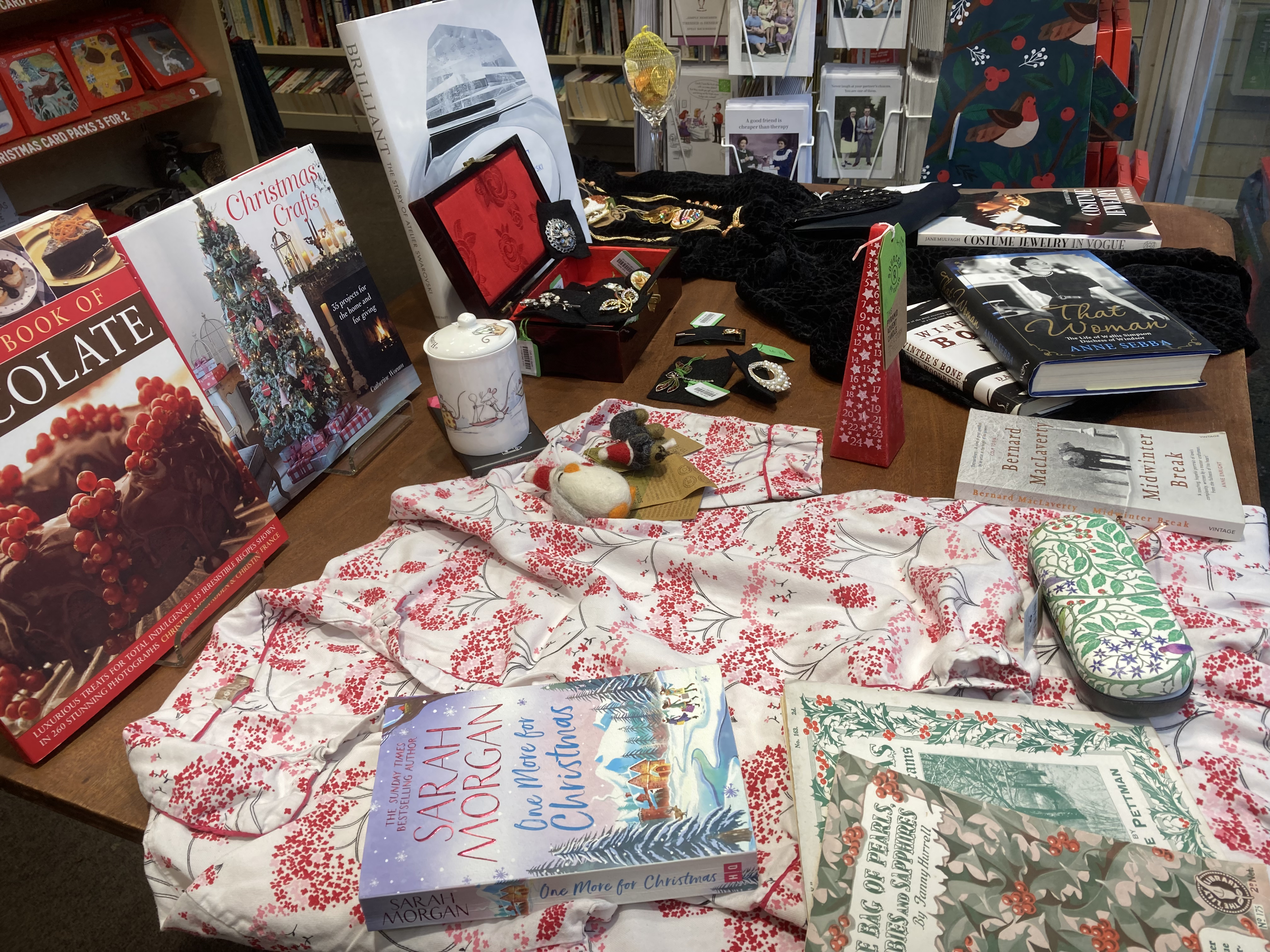
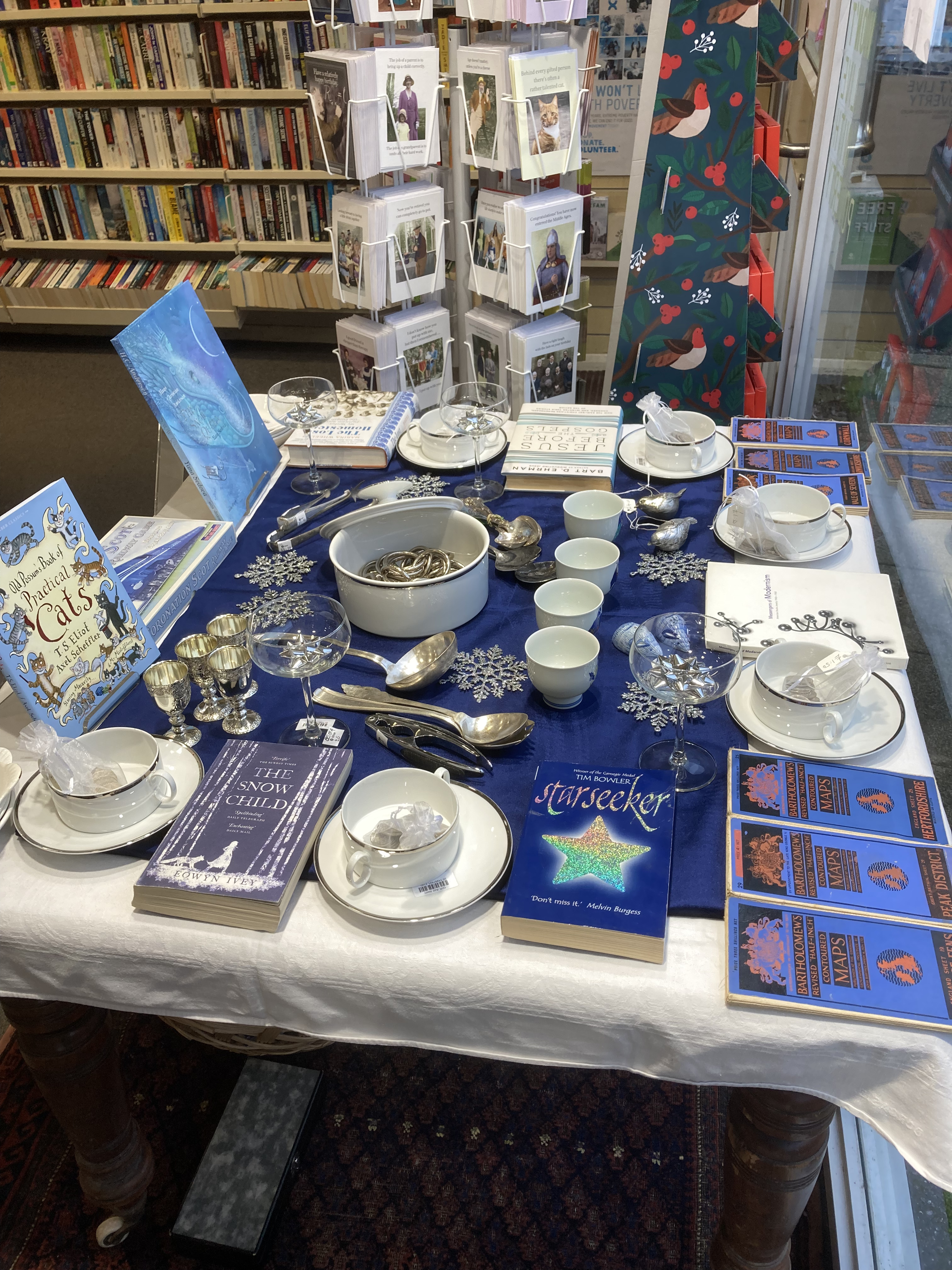
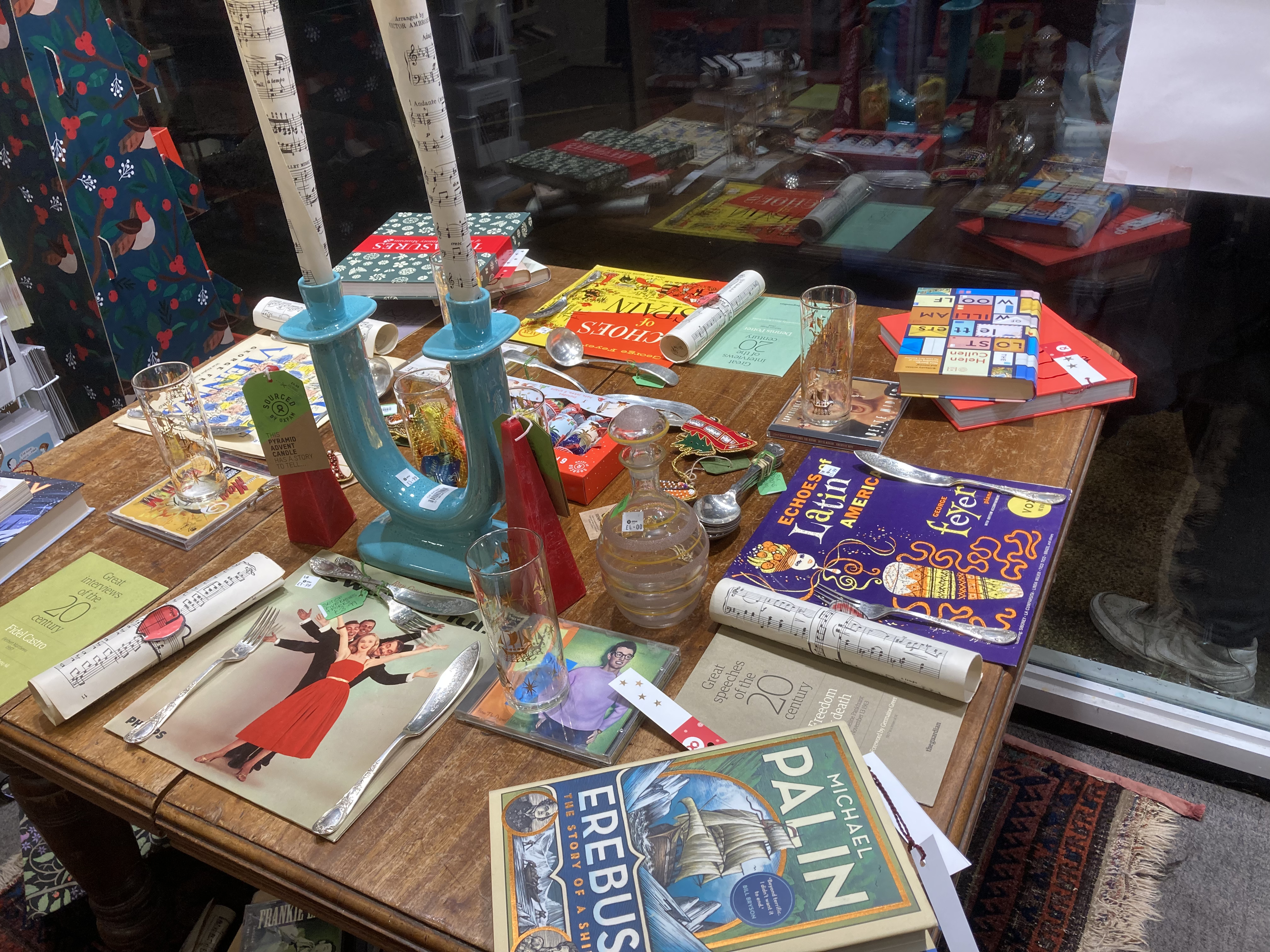
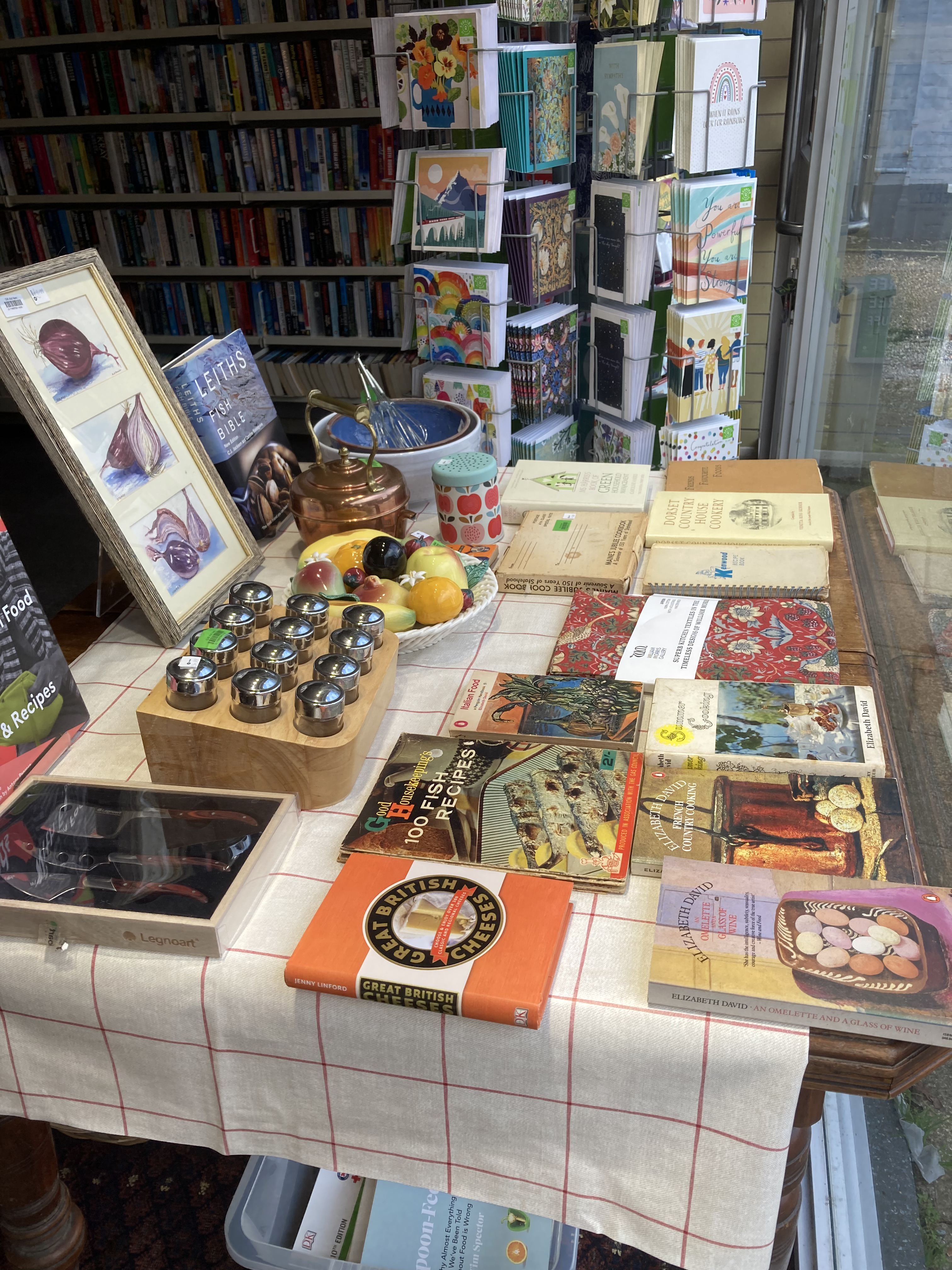
Just thought I might intersperse this with some photos of the tables we did in the run up to Christmas – all in the planning you might recall started in September….

Now, here is the thing. I prepped and planned on my days off – bread sauce, cranberry sauce, stuffing x2 – one vegetarian, one sausage meat – mushroom and cheese wellington, mackerel pate, cream cheese and blue cheese pate, of course ordering a turkey….

Well, enough showing off.

So, I thought, I would be relaxed and have masses of time on the day to watch the children opening presents, chat about life with the grown-ups, dog-walking and generally looking like a relaxed host.

After all, the furniture had been re-arranged to make sure there was table space ( thanks to a table rescued from the shed to add to kitchen-table length.)

And we had bought four extra dining chairs at a house clearance place to make sure we had something more than an awkward mish-mash of ill-fitting chairs.

( Dear reader, they are now for sale on facebook and e-bay and seem to have sold for £10 more than we paid for them – Christmas bargain.)

Somehow, the relaxed me never quite appeared. 

I realised – far too (bloody, excuse the language,) belatedly that they would all have been happy with something other than turkey and all the trimmings – and I would have not had to repeatedly say afterwards that they were all welcome again, but the full Christmas dinner was not happening again.

Everyone was just happy to spend time with siblings, cousins, family….

I had suggested to the BB that I would serve everything in the foil dishes in which they could be cooked but he, ( a rare event on kitchen matters) said no – and that everyone would be keen to help with the washing up of proper serving dishes, rather than throwing foil away.

Thank you dishwasher designers/manufacturers is all I can say…. and everyone else in the room thought it had been a good-enough idea….

After the Christmas day(s) there is the lunch with stepfather and his ‘lady-friend’, lots of bed changing, Christmas decorations to be taken down and boxed up for next year ( house and shop), long dog-walking to catch up on and opening the bottom of the dresser ( to put away said serving dishes) – to find the crackers I bought and completely forgotten about.

The BB says keep them for next year – can you pull crackers if you are serving cottage pie? 

Watch this space.

Serendipity and Coincidence

It has rarely been a time when serendipity and coincidence have worked out so well for our Oxfam bookshop.

I have said before, and no doubt will say again, one of the delights of volunteering in an Oxfam shop is serendipity – you can’t order stuff, you can only open a box, delve through a carrier bag, and find what you find, look at something which makes you smile.

This, dear reader, is a long list so don’t say you weren’t warned.

So, where will we start.

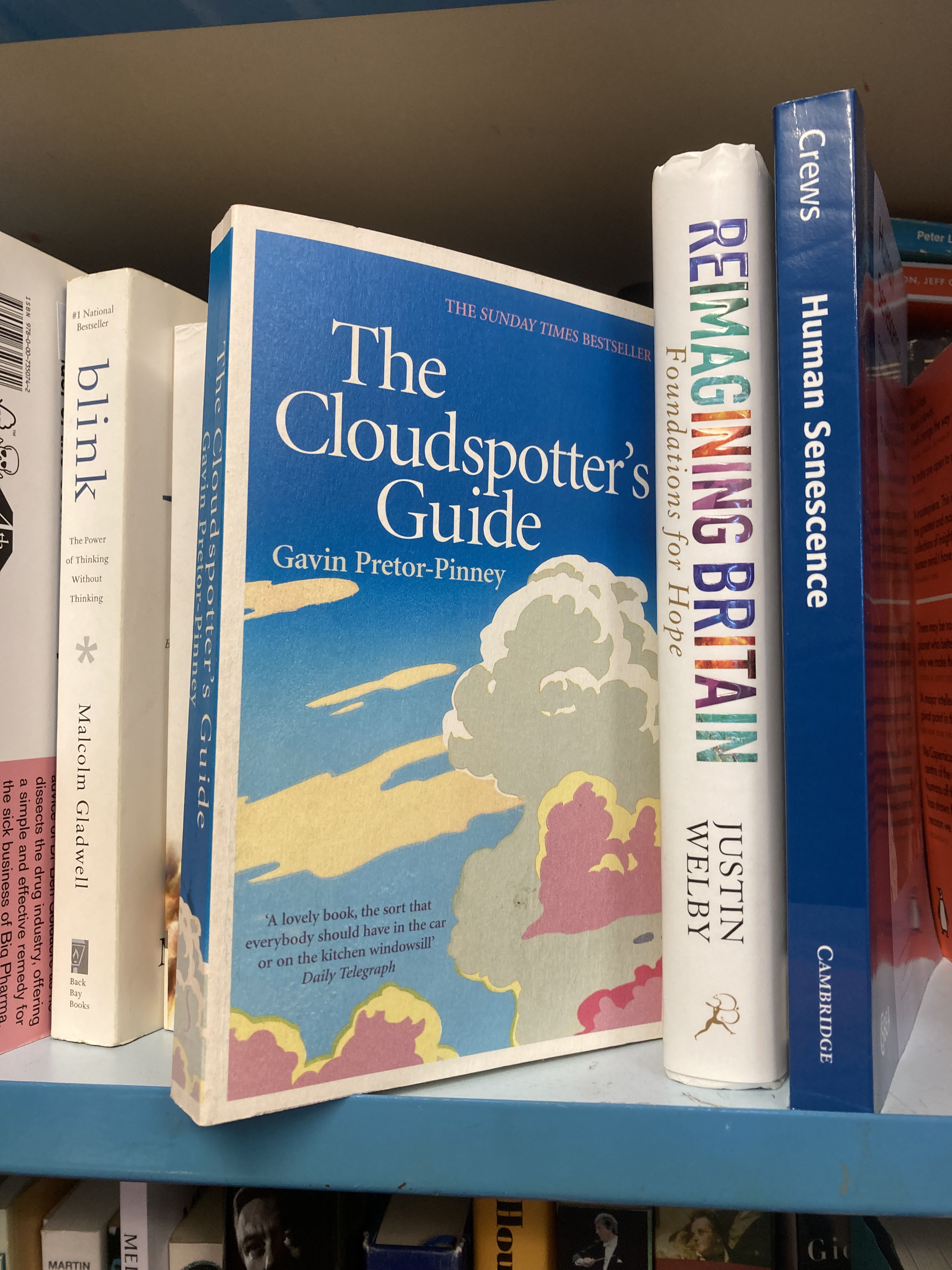
Someone came into the shop and asked for books on weather. 

He said his family had decided not only would they shop for Christmas gifts in charity shops, they had a theme – weather.

We we always, always have books on weather – clouds formations, climate change etc etc – but not this time.

Three of us scoured the shop upstairs and down, but nothing. 

Of course, after Christmas we have had lots of books which would fit the bill, but nothing at the time – sorry customer.

On the other hand, here is a good news story.

So, a couple came in, the same day, and asked for for an old  leather-covered bible. Not a request we get often.

And we often have one.

But not this time.

Apparently, their son had confirmed as a Christian as an adult and he loved second-hand stuff, shopping in charity shops etc.

And, they were not in a great hurry so I took their phone number, and said I would let them know if I found one.

One day, after the planning and work ( bearing in mind we have been doing this since August) and whoo-ha of Christmas, I had time to set out, clear out, rootle through the stash of ‘old and interesting’ books and found a bible dictionary which was not only leather bound, but presentation bound.

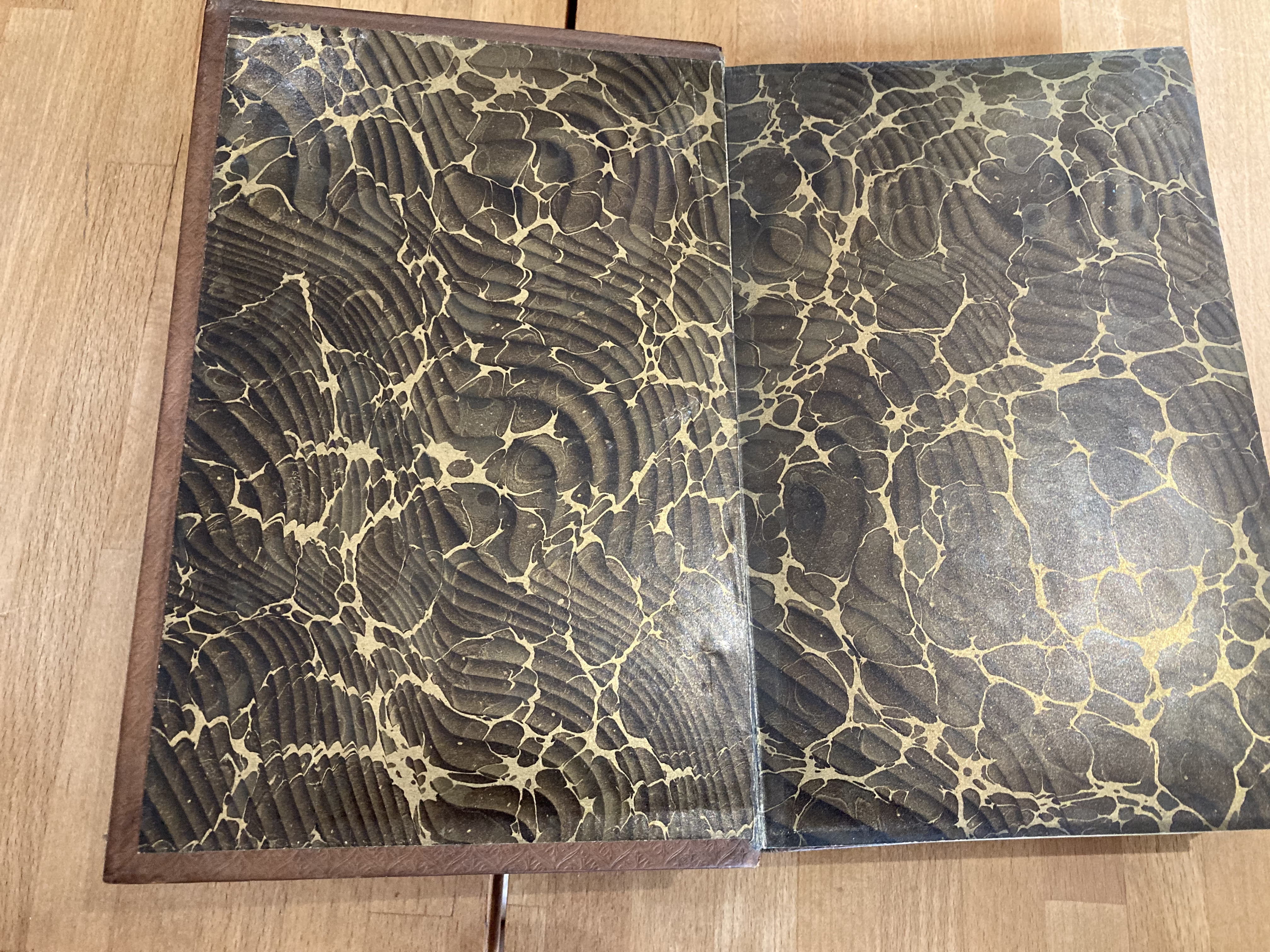
(That means, just in case you don’t know, it was bound especially to present to a student with a presentation certificate pasted inside. And it had marbled boards and page ends – no I don’t have a picture so you need to Google what that means if you are interested.)

And, sorry I did not take any photos.

It seemed to me to be a long shot of what the customers wanted ,but called them anyway saying they were under no pressure to buy, just a thought.

They turned up about an hour later, were delighted, paid twice what we had priced it at, and bought a coffee-table book (we had had for a very long time) on the most beautiful bibles in the world.

Later he sent me a text message saying how delighted they were and how much they had appreciated the ‘effort’ we had made to get what they wanted.

 As ever, there is something special about uniting a book with someone who is going to really appreciate it.

Next, serendipity and coincidence is more prosaic.

So, after Christmas I was thinking about that table to out out and I thought of cookery – what a surprise, my friends might say – and had a few old books and magazines relating to cookery which I thought might make a (slightly) interesting table.

I was upstairs sorting all this stuff out to fill a table when the volunteer downstairs let me know there had been a(another) donation.

When I abandoned my task and went downstairs, I found the donation included a copper kettle, a kitchen bowl, a set of cheese knives.

Sorted.

Finally, and thank you for keeping going this far, the end is nigh.

Sometimes I have a plan weeks in advance about table displays but sometimes I come in on a  Monday and wonder how I am going to make it work.

On one of these Mondays recently, I decided to put out books that were set in different countries.

Of course there were a few travel books, but also novels, history, etc etc. 

Now, there is nothing as useful as signalling your rather arcane theme than a prop and hey ho, someone, about twenty minutes later, donated a globe and some foreign coins. Thank you whoever you are.

And on the same day that it was announced Ronald Blythe had died at the age of 100 – most famously the author of Akenfield. Guess what I found stashed behind a pile of Jane Austen and John Betjamin…..

This is nearly the end.

Sometimes you have a donation which is not so much a delightful, serendipitous addition to your plan, as something you have to take a deep breath and think how on earth are we going to make this work.

A horse’s saddle.

Well, yes that was a bit of a surprise as a donation because it is not often we, as a book and music shop, get a saddle as a donation.

Apparently, someone brought it in and said her mother, a rider, had died and asked her daughter to give one each of her saddles to three charity shops in the town. (have to say, I have not seen saddles popping up all over town…)

So, instead of getting a bonus for a pre-planned display, we have had to build one around it. We have a lovely display of countryside and the saddle is front and centre.

God only knows what we do with it if it doesn’t sell – us volunteers, are so fed up of moving it out of the way in order to go to the loo.

And just as we thought we had sorted one large, in the way, unusual donation, we got a guitar.

One of our great volunteers was called in to tell us what it was worth. Some calling around and he came up with a price – £175 – a big deal for us.

So, my plans for the table were jettisoned smartly and here’s hoping it will sell before we have to drill holes in the wall and ‘erect’ a guitar holder.

Fingers crossed we have a guitar playing horse rider shopping in Petersfield this week…..

A Day Of Coins

Serendipity is part of the charm of working in the Oxfam bookshop. Usually it as about books but yesterday, it was about a remarkable you man, coins and stamps.

Now I don’t often work a Saturday afternoon but I have to say it is always interesting – a different demographic from a weekday, and busier – less time to do the titivating, tidying, sorting stuff that you can do Monday to Friday.

( As ever, a long-read warning but it is a heartening story so you might want to carry on at least for a bit.)

Anyway, there I am at the till with two Duke of Edinburgh Award young people doing their volunteering stints when in walks a young person of say 13 years old. ( I am surrounded by young people and it is making me feel old….)

The DofE young women are doing books, but he is not interested in books, he asks me if we have any pre-decimal coins, foreign coins and/or stamps.

Well, as it happens we did have a load of coins which a lovely volunteer ( at the other end of the age spectrum) had sorted into organza bags. 

Last year we had unearthed a stash shoved under a workbench in the shop and which had been there for some years – and we sold them in aforementioned bags.

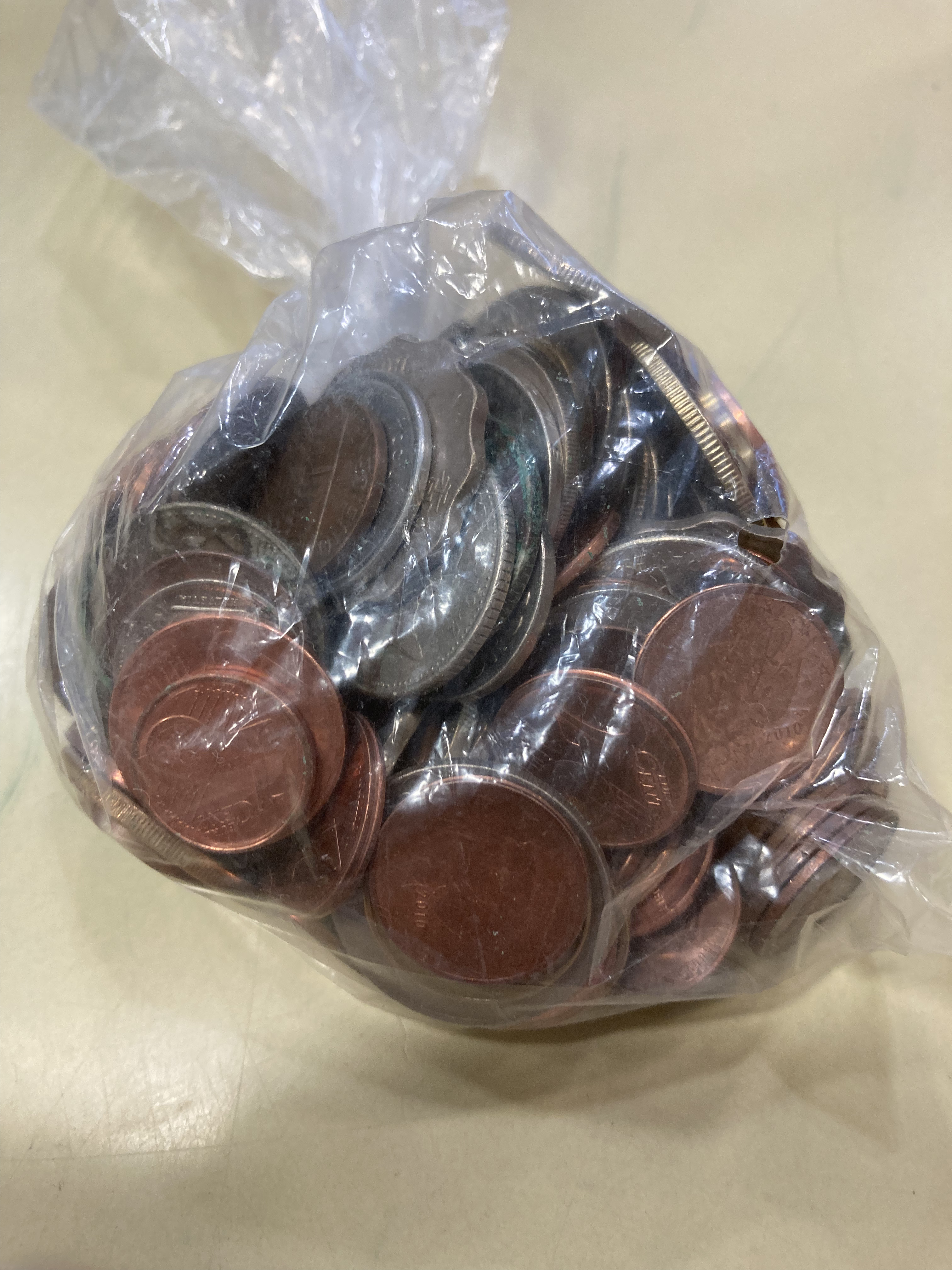
People bought them to put sixpences or threepences into their Christmas puddings, or bags of old pennies to ‘amaze’ their grandchildren, or foreign banknotes to play Monopoly with. We did well.

In case you need to see what the pences are:

So, she and I had decided to do the same this year and she waded through bags and bags and sorted them into pre-decimal British coins, foreign coins, silver coloured, brass coloured, etc etc. They were in a box upstairs.

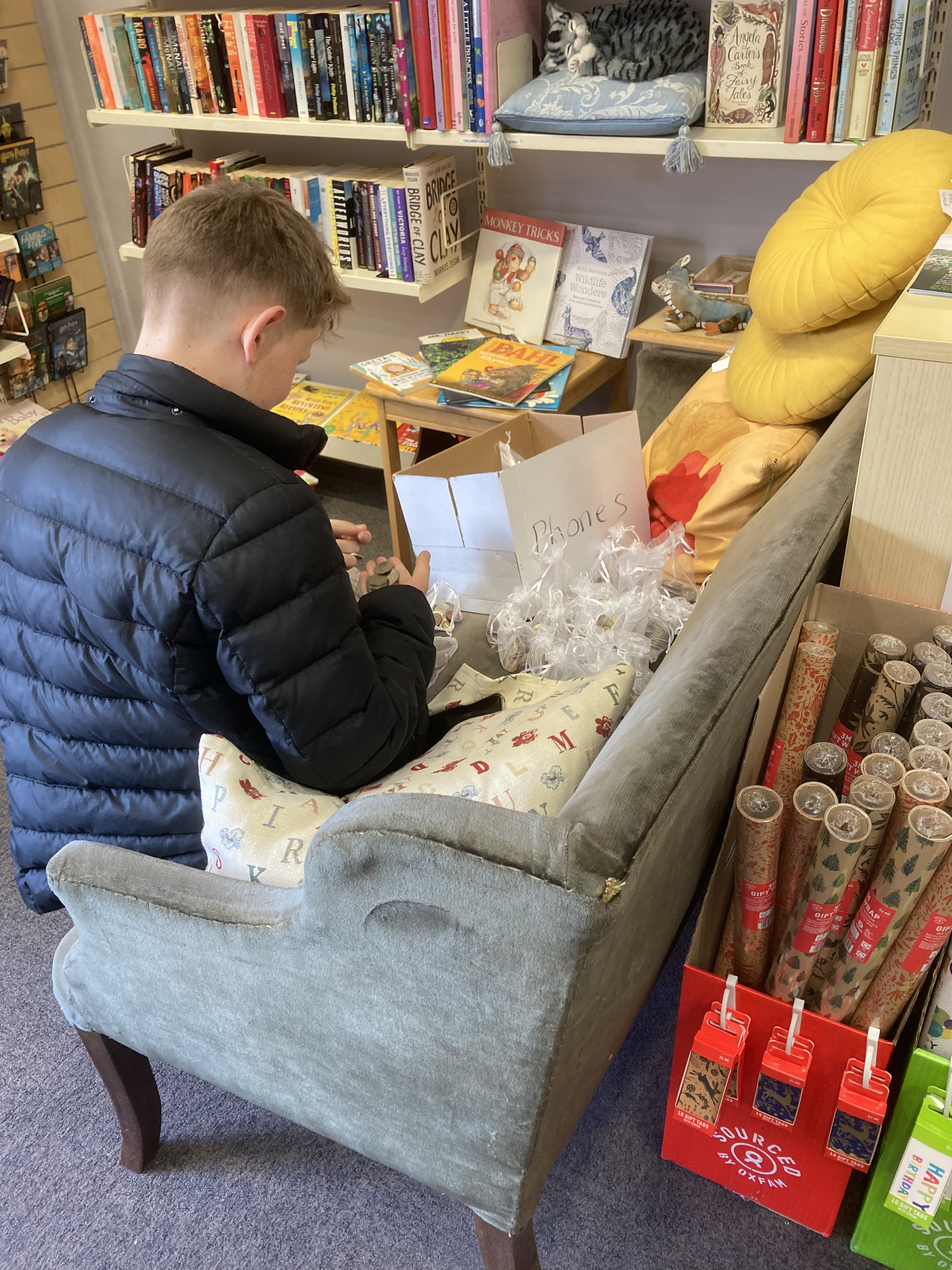
‘Well,’ I said to the young man I will call Tom, ‘ We do have some. Do you want to have a look?’

He did and spent more than an hour sitting on our shop sofa, riffling through and telling me – and indeed customers – about when silver sixpences were phased out (1947), what the print runs of Penny Red stamps meant in terms of value, pulling out the incredibly light ( probably made from Aluminium) coins from Romania and much more.

He told me/us that his grandfather was a coin and stamp dealers and left Tom his collection – now stored in a large container – which is now working through.

Some of the stamps are now at Gibbons, he has sold some of his own and his grandfather’s collection and used the first money to buy a dog – but, he admitted, his Mum does most of the dog walking and feeding. Well what a surprise.

Customers came and went and Tom carried on, still telling me stuff in between me taking money from book buyers.

At one point, there was him, me and just one customer who said, ‘ I have a bag of old coins and I have never know what to do with it. Could I bring it here and and if there is anything valuable, I am sure you will identify it and Oxfam can benefit?’

‘Yes,’ said Tom and I together.

So, he eventually left taking some stamps and coins to research, and coins he had bought.

‘Thank you so much for trusting me with these,’ he said.

‘Well, I have your phone number and I do trust you. And thank you for an interesting afternoon,’ I said.

‘I’ll be back,’ he said – and I am sure he will.

Book buyers kept me busy until almost closing time when a young woman came in and said,’ This is a long shot but do you take old and foreign coins?”

‘Yes, we do’ I said and she gave me the last donation of the day.

It was indeed a day of coins.

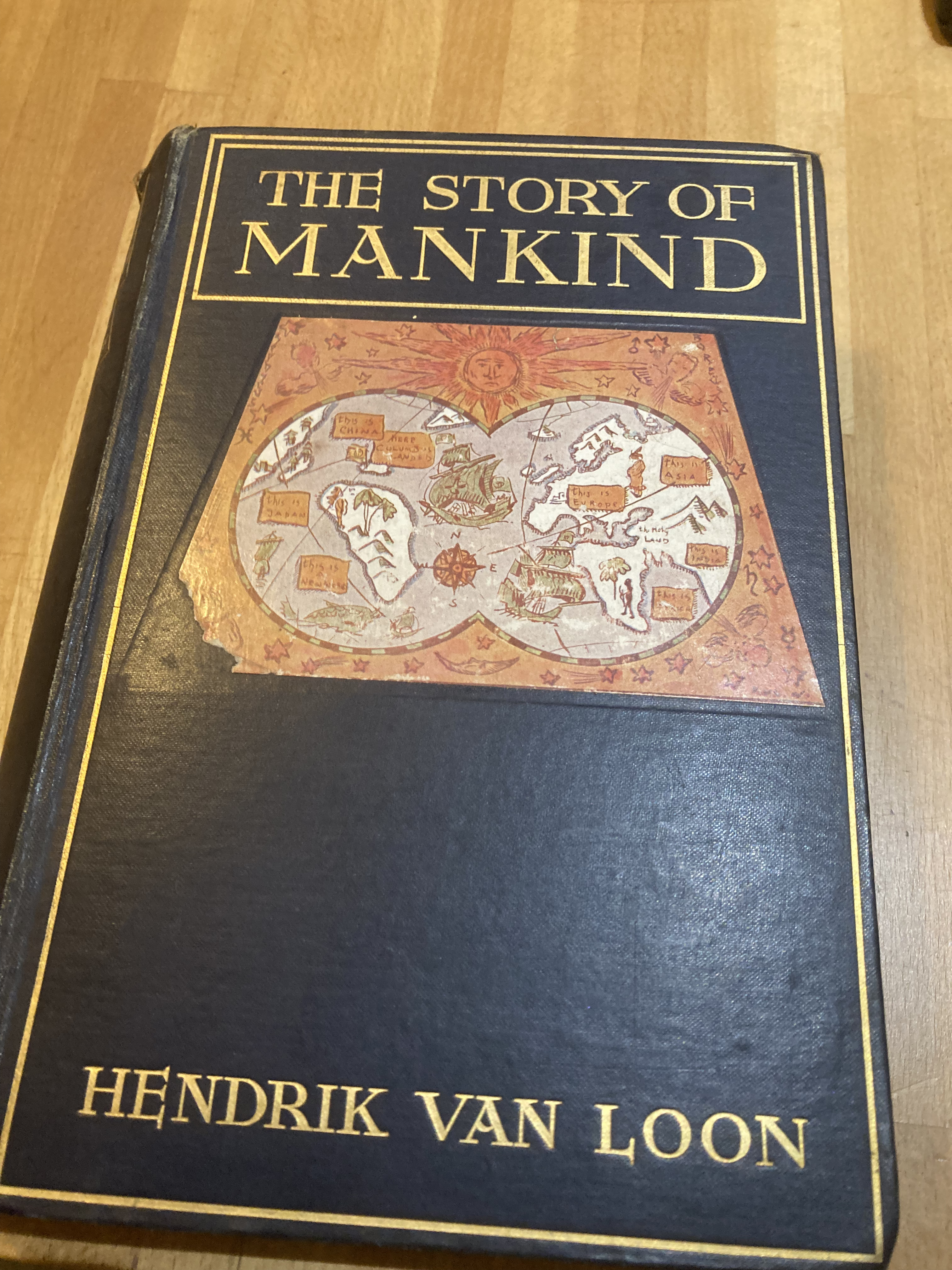
The Story of Mankind

Hendrik van Loon got sent to my house when I was languishing with Covid, bored, and couldn’t go into the Oxfam shop.

He arrived in a box with a collection of other books that I could ‘play around with.’ ( And more of the other books another day.)

And he is enchanting. Well, the book is, yet there are aspects to Hendrick’s life which have more question marks than enchantment – but more of that later.

Now, before you begin, I must warn you there is a long schlepp ahead of you. There are lots of images as well as words.

And I dedicate this blog to Mary and Bob – no they are not dead, off enjoying Irish music in the pubs of West Ireland – but they reminded me to tell some more Oxfam stories. Thank you to you both.

Just so you know:

(January 14, 1882 – March 11, 1944) Hendrick van Loon was a Dutch born historian, journalist, and children’s book author.

So, apparently this is a book he wrote for his children and ‘The Story of Mankind tells in brief chapters the history of Western civilisation, beginning with primitive man, covering the development of writing, art, and architecture, the rise of major religions, and the formation of the modern nation-state.’

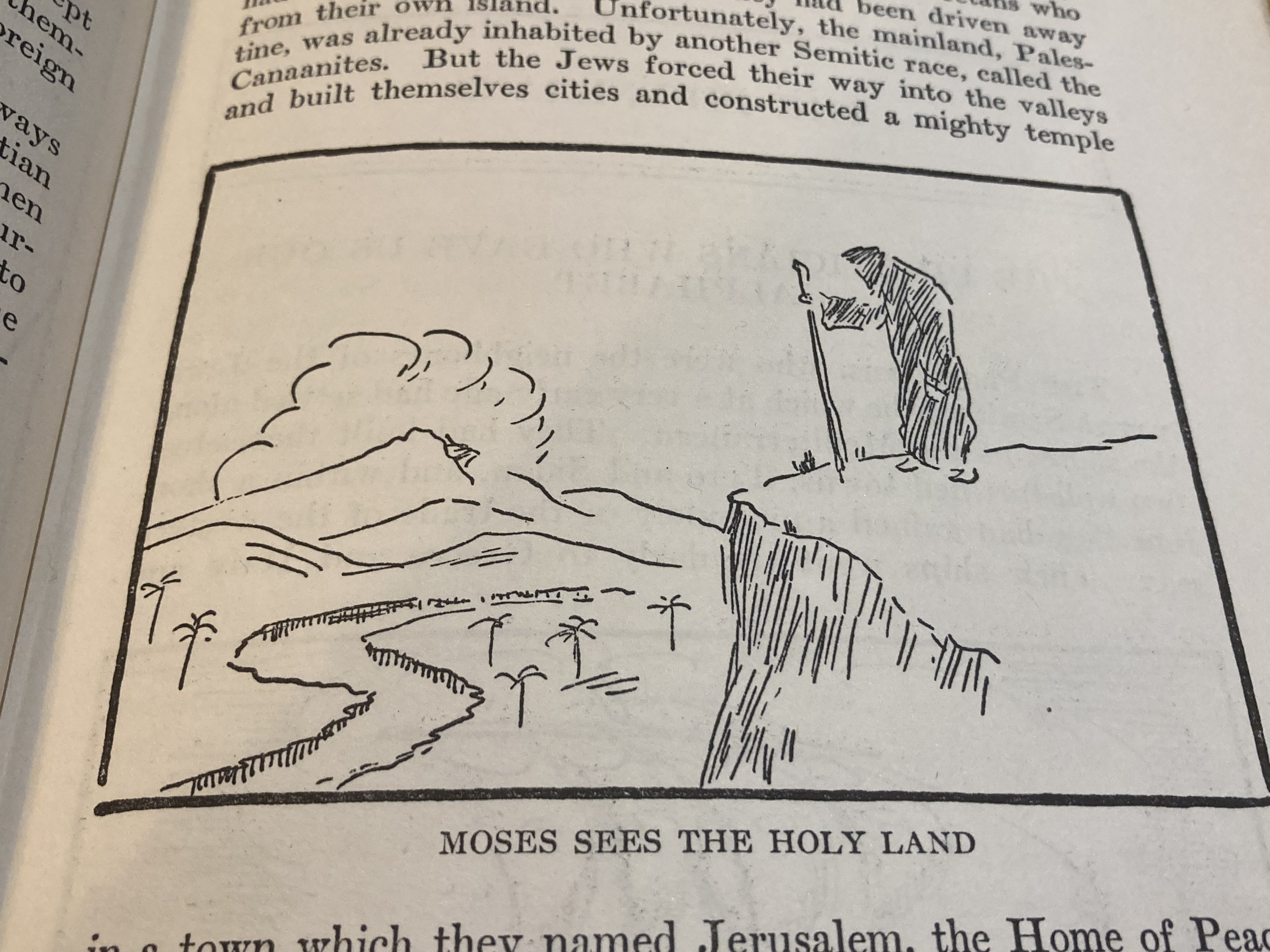
The chapter on Moses comes between the chapter on the Sumerians and the Phoenicians who

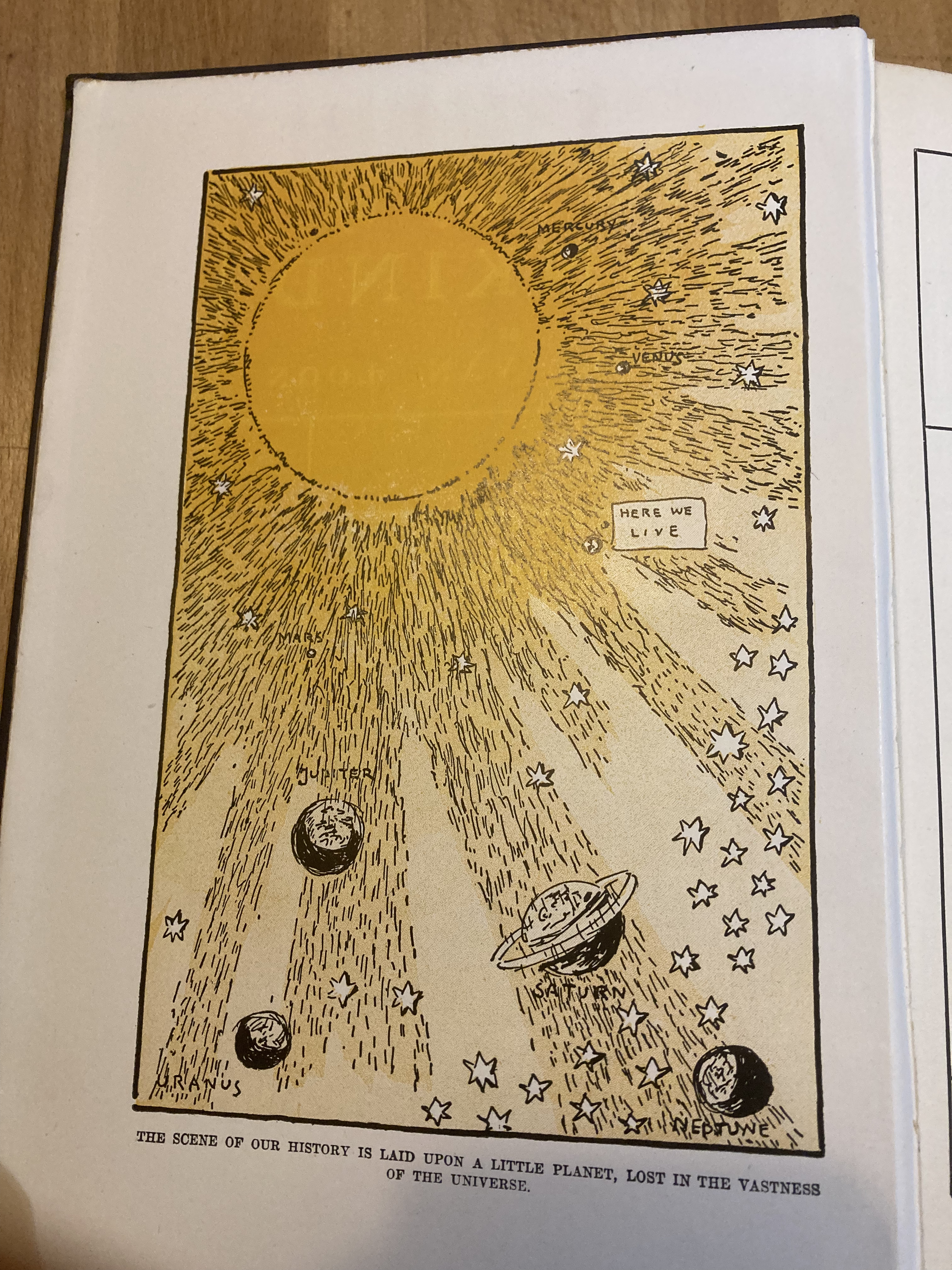
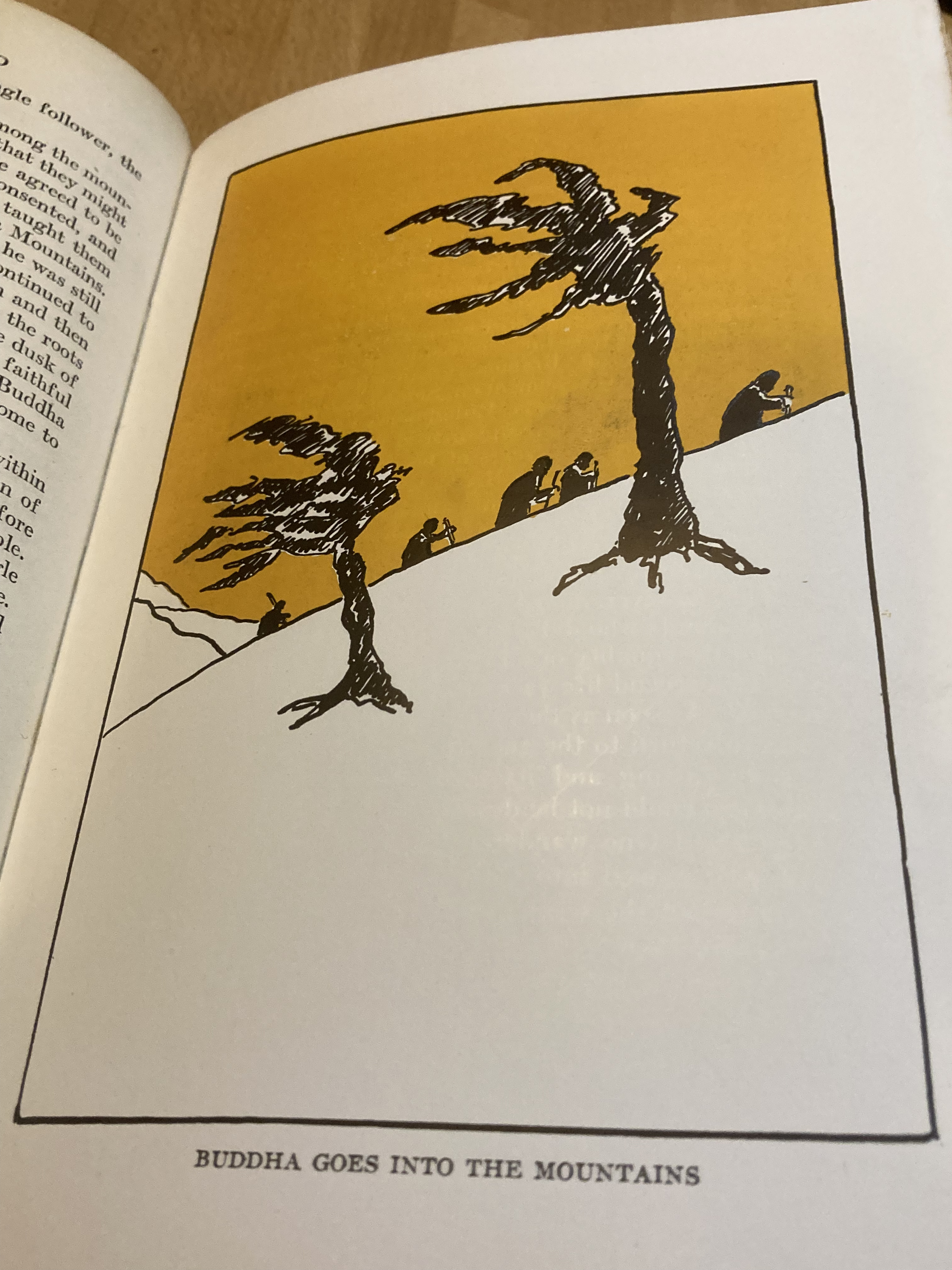
He not only wrote but also illustrated this book, and isn’t this great?

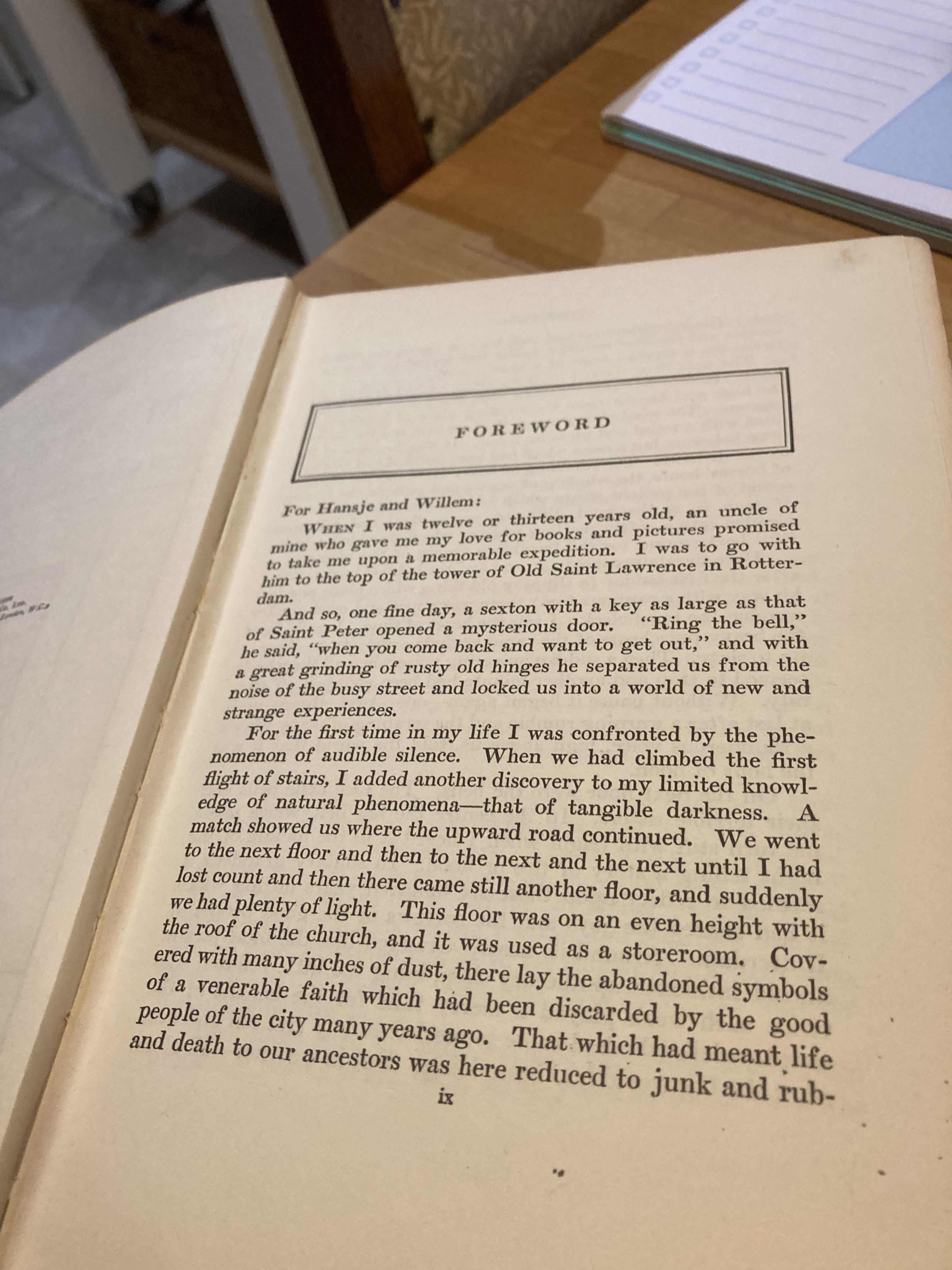
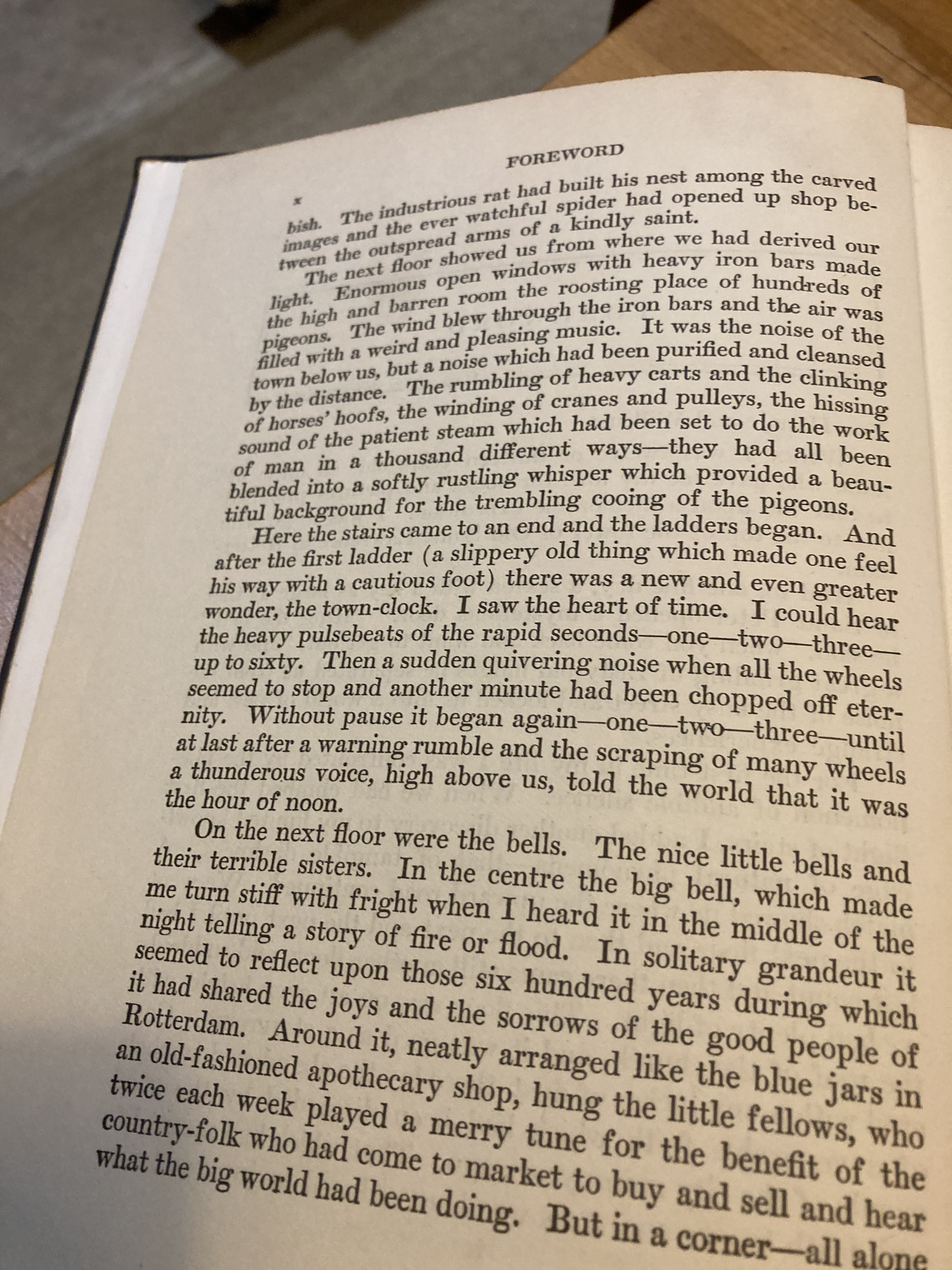
This is not a short book, so Hansje and Willem must have had to have a good few nights when their dad read it to them.

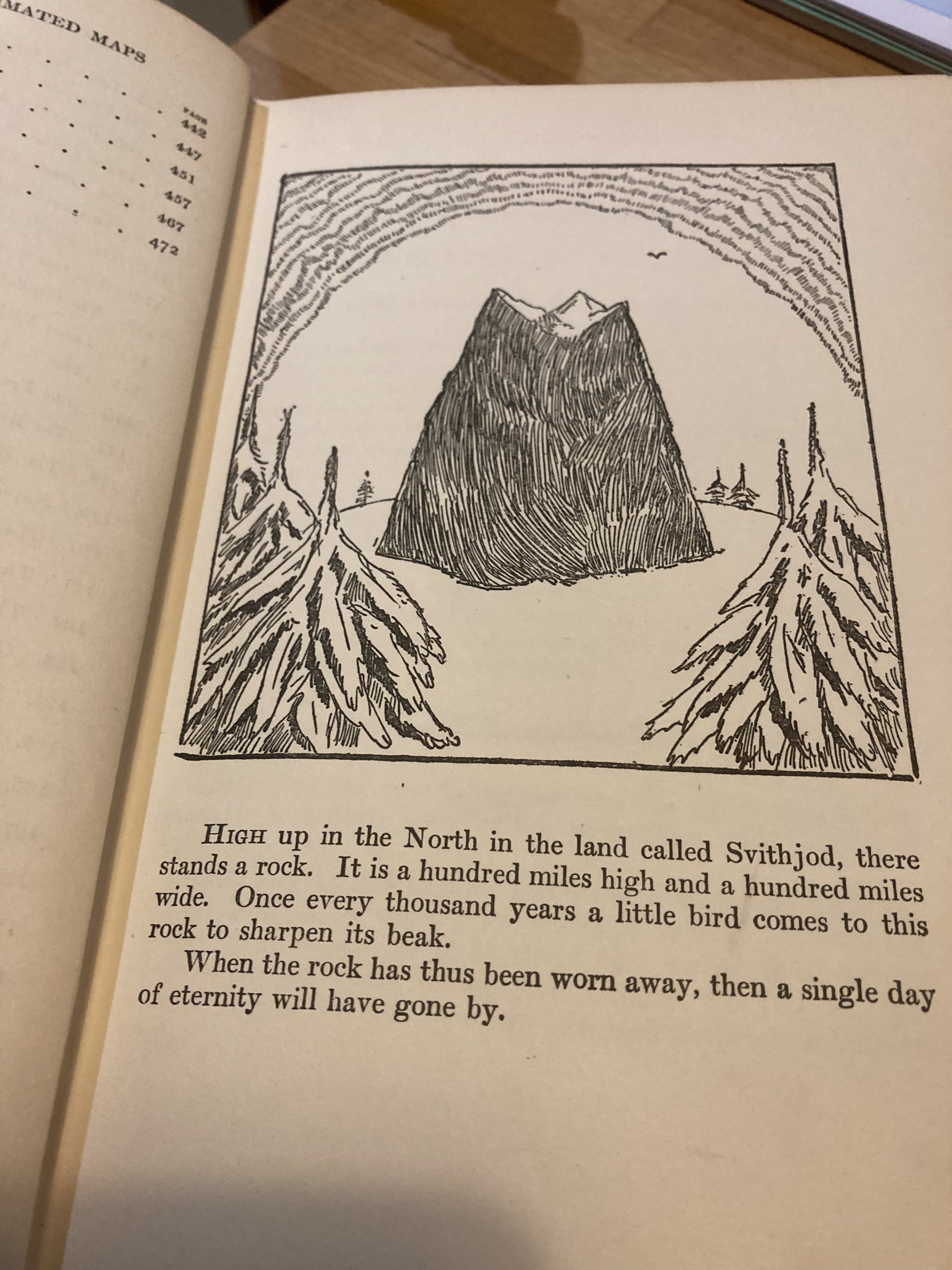
But if ever there was a book written to be read out loud, this is one of them. Tell me  when you read these starter pages, you can’t hear a Dad’s voice? 

Don’t worry I am not going to go through the whole book with you, even the most loyal of readers are not going to accept a commentary on nearly 500 pages from ‘The Setting of Stage’ to ‘The New World.’ 

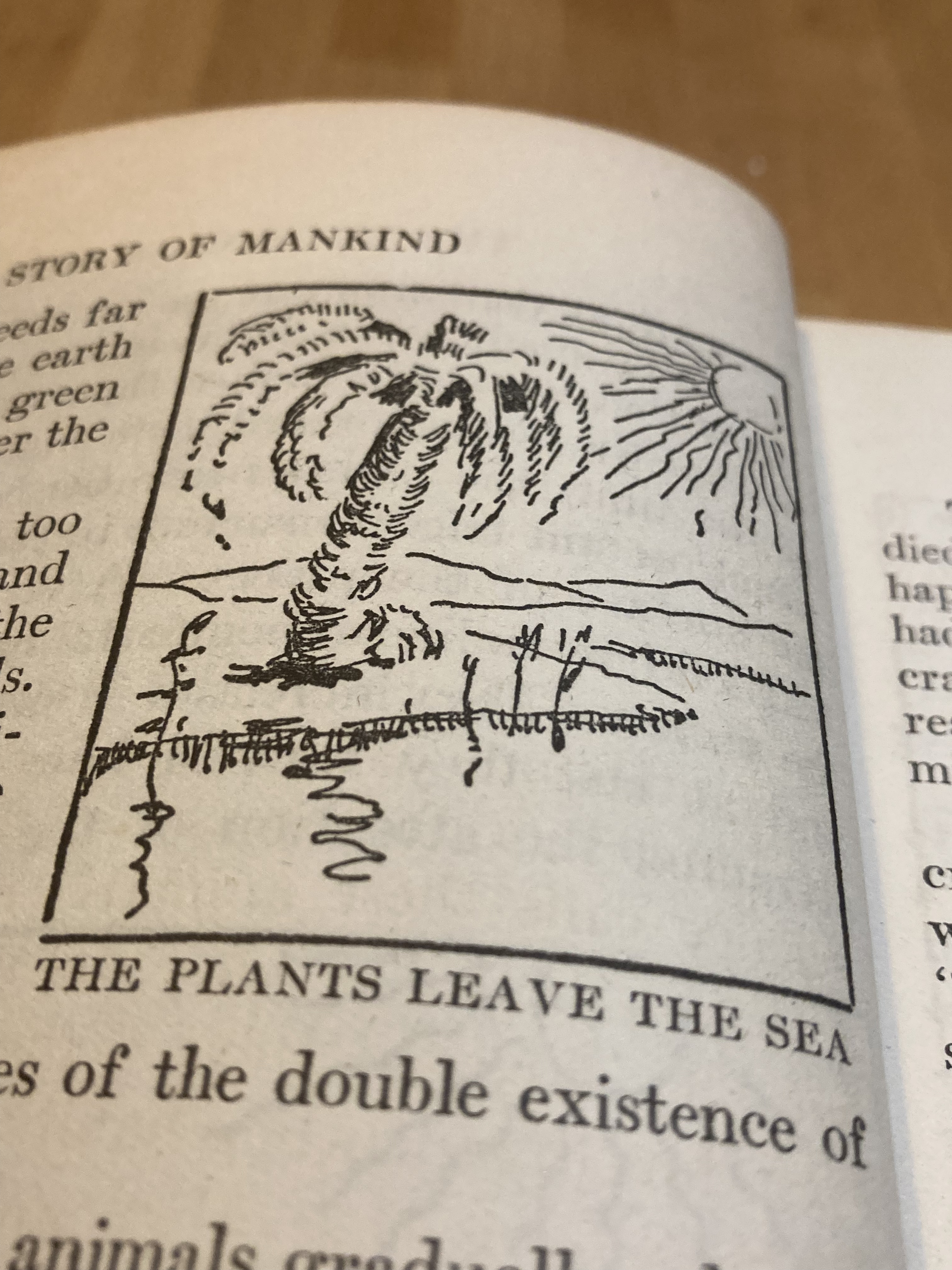
So, I am just going to give you some of the drawings with the occasional snippet of the words. 

Now that has to be a pre-historic marine-caterpillar dressed up as a palm tree – which is a bit of a stretch as the first movement of sea to land vegetation.

And it has guest appearances later in the story of civilisation:

Interestingly, there is little mention of dinosaurs – a paragraph or two. But I assume that it was Jurassic Park (1993 – yes that long ago) that lit the fire under (primarily) boys’ fascination with anything called something ending in ….saurus.

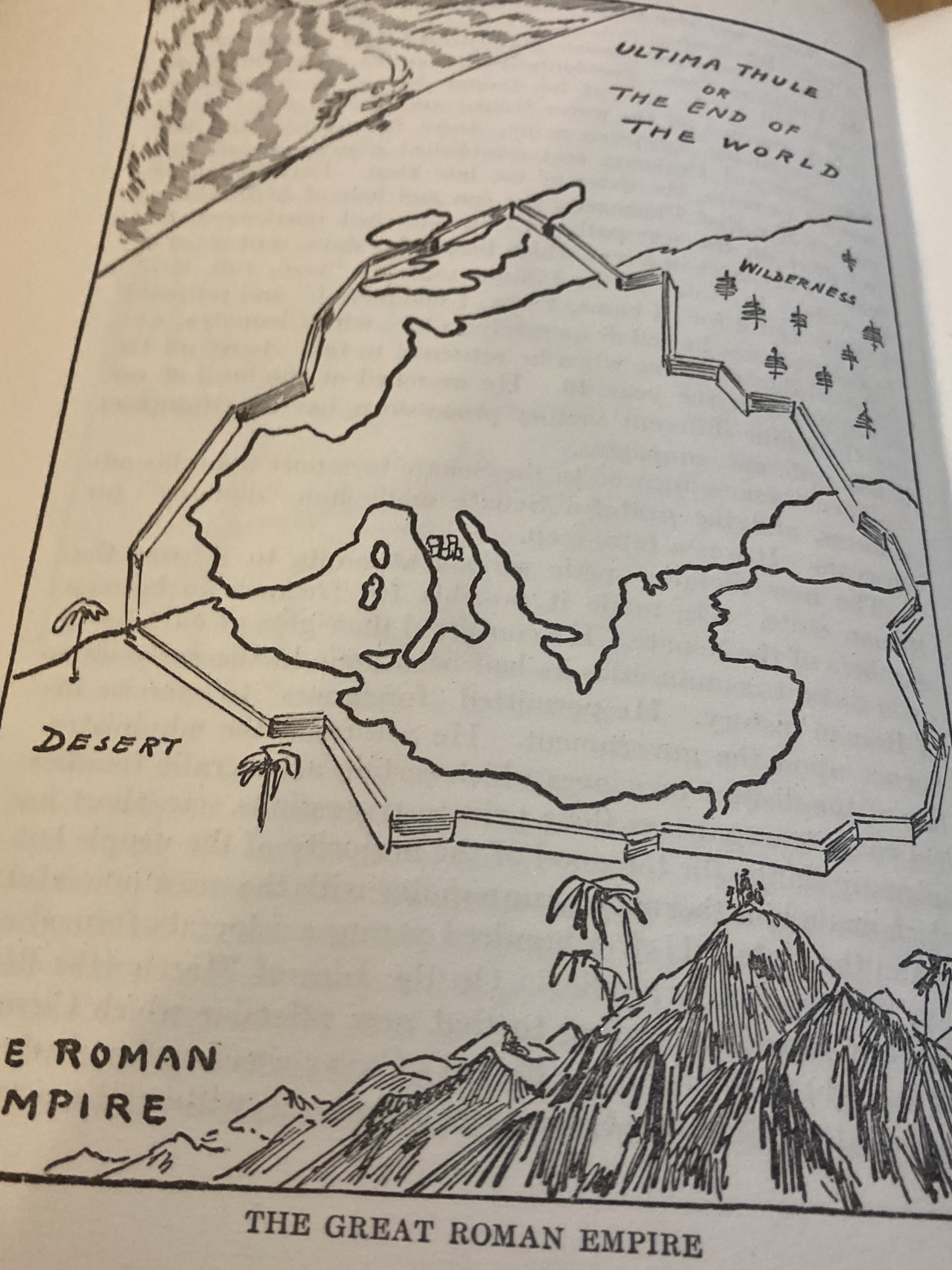
And there are maps which I am sure the Best Beloved, will study as he is writing his history book, meanwhile Jess has better things to do:

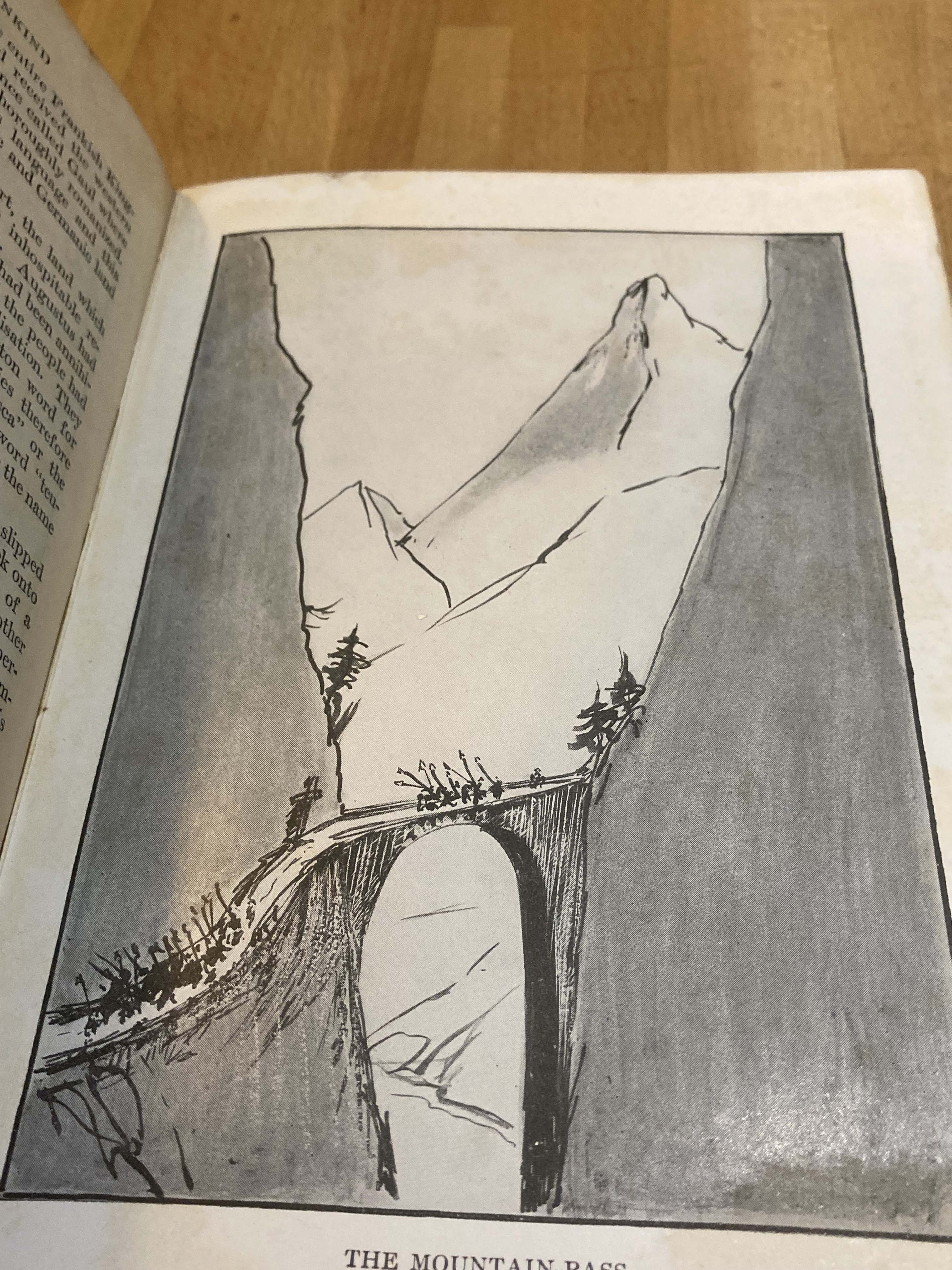
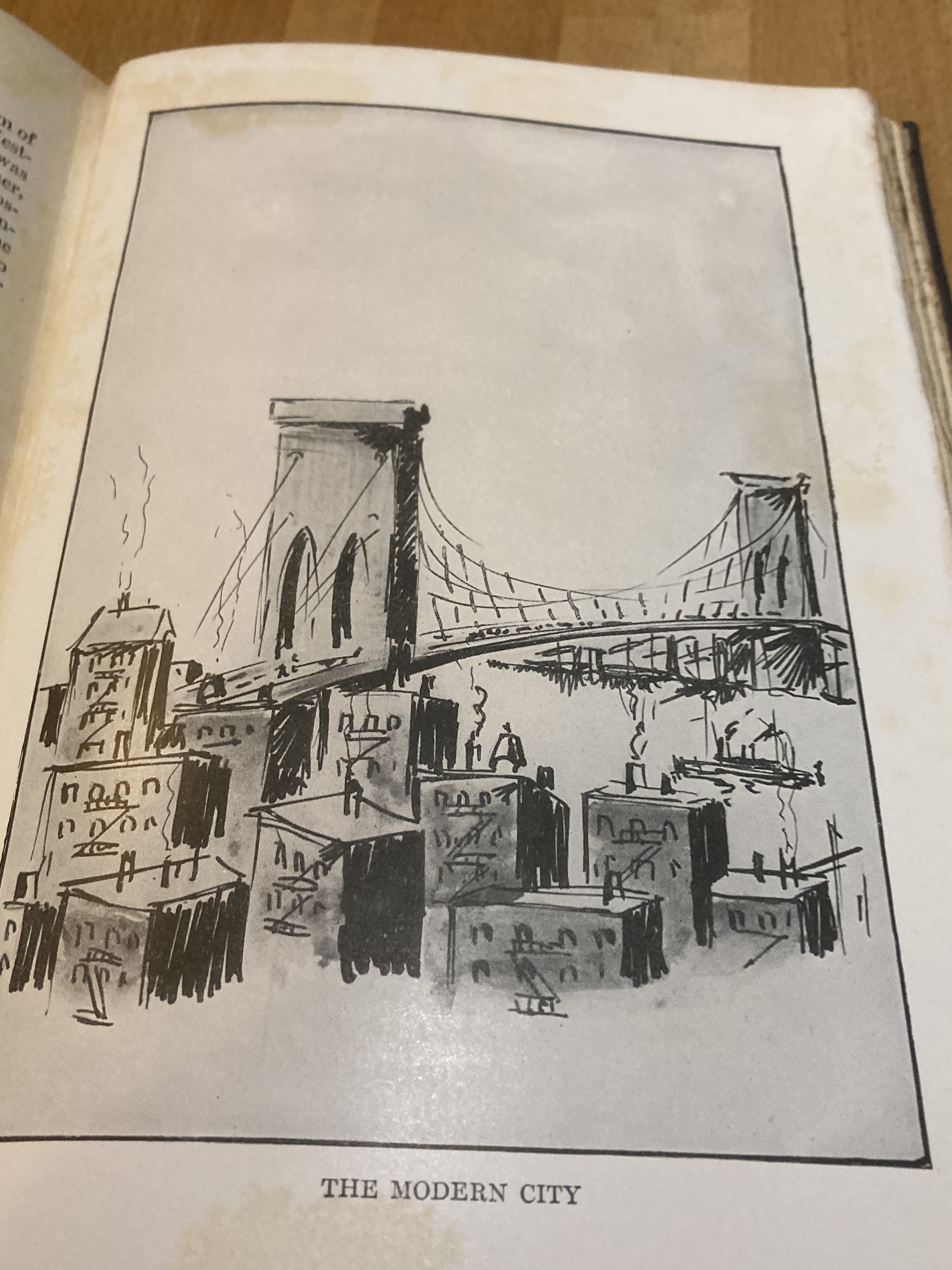
So, here are some of the illustrations which are nothing if not a snapshot of the subject:

and the BB would agree – blue sky and ancient monuments, what else would you need, well maybe a beach
Pretty sure this is the equivalent of a postcard….

Is it my imagination or are those trees walking quietly towards the Kremlin?

Yep that is a mountain pass

Now I am not sure of Hendrik’s views on all of the religions of the world though neither of these look altogether happy about their allotted lot:

Just mentioning the palm tree, and not entirely sure that is an authentic costume, just saying….
Moses not looking convinced

Just a quick note on Hendrik.

He wrote lots (and I mean lots) of books – check Wikipedia. 

Wikipedia also told me that Hendrik married an Eliza and had his two sons, then after leaving her ‘had two later marriages’ to another Eliza, and a Frances. Then he left Frances and went back to the second Eliza.  Keeping up?

That is quite a lot of marriage stuff to fit in between writing dozens of books on everything from The Rise of the Dutch Kingdom, followed ( inevitably) by The Fall of The Dutch Kingdom.

Multiplex man, or the Story of Survival through Invention, Life and Times ofPeter Stuyvesant (no, not the cigarette brand), and Man the Miracle Maker – all in 1928.

In case you were wondering, he was married to Frances in 1928 so either blissfully happy and creative, or hiding away in his writing room and keeping very distracted and busy.

And he had a look of what for him was the modern world:

I can’t claim I will be finding all Hendrik’s books and settling down to a decade of reading, but one I would have been interested in finding donated to the shop one day:

A World Divided is a World Lost, 1935. Could have been written in any of the last few years….

And he knew what he was talking about:

‘After having revisited Germany many times in the 1920s, he was banned from the country when the Nazis came to power. In the summer of 1938, during an extended visit to Scandinavia, van Loon met with refugees who had recently fled Nazi Germany and who gave him first-hand accounts of the terror that they had experienced.

His book Our Battle, Being One Man’s Answer to “My Battle” by Adolf Hitler (1938) earned him the respect of Franklin D Roosevelt, in whose 1940 presidential campaign he worked, calling on Americans to fight totalitarianism.’

But then I found this review and my enthusiasm has been a bit dented:

‘I was delighted to find this little booklet. Mr. Van Loon is one of my favourites. I was so excited. I wondered how he was going to deal with the title subject in such a short space – four chapters.

Well, he didn’t really. In typical Hendrik fashion he set the subject up in a simple but clever way. It took three chapters. I thought I might be going to get a proposal for tidying up the partisan-ness that we see in American government, for enjoying it and for making it work without the resorting to personal rancor, the utter refusal to listen or the telling of blatant lies. Didn’t happen! Chapter four waltzed off on to a different subject completely. I felt that the work presented in this pamphlet might have been intended as the beginning of another Van Loon book. Now that could have been fun.

Still, it is vintage Van Loon language and syntax. I love it for that. And for his illustrations!’

And this is a philosophical ending – thank you Hendrik, Bob and Mary.

A Day of Reuniting

If you want a good Oxfam story, this is one of my better ones. 

But dear reader, there is what we called as journalists, a long dropped intro.

Which means you have to wade through some stuff before you get to the nub of the story.

Here are a few things I have said before and all of them happened today:

1)If you wait long enough there will be every printed thing/book/pamphlet turn up in your Oxfam shop – there is something printed on every topic you could ever imagine.

2)There is a good home for some special books – places they belong.

3) It is a such a buzz to pick out something dusty and strange and make 2) happen and get some money for Oxfam, and make people happy.

Well, of course not every printed item turned up today, but at the bottom of a book of not very interesting books, something really unusual turned up. 

How it turned up in an Oxfam shop in Petersfield, I will never know and sometimes as a book sorter, I really wish I could hear the story of the donation. But we very rarely do – and I mean very rarely. 

After all, someone comes in with a few boxes of books and if we are lucky we can ask them to Gift Aid them ( if they do we get 25% extra from the government on every book we sell), and they are on their way. 

Often they are bringing in books from aged/dead/going-into-a-care-home parents and really haven’t looked at what there is.

Anyway, enough delay, let me tell you what I found:

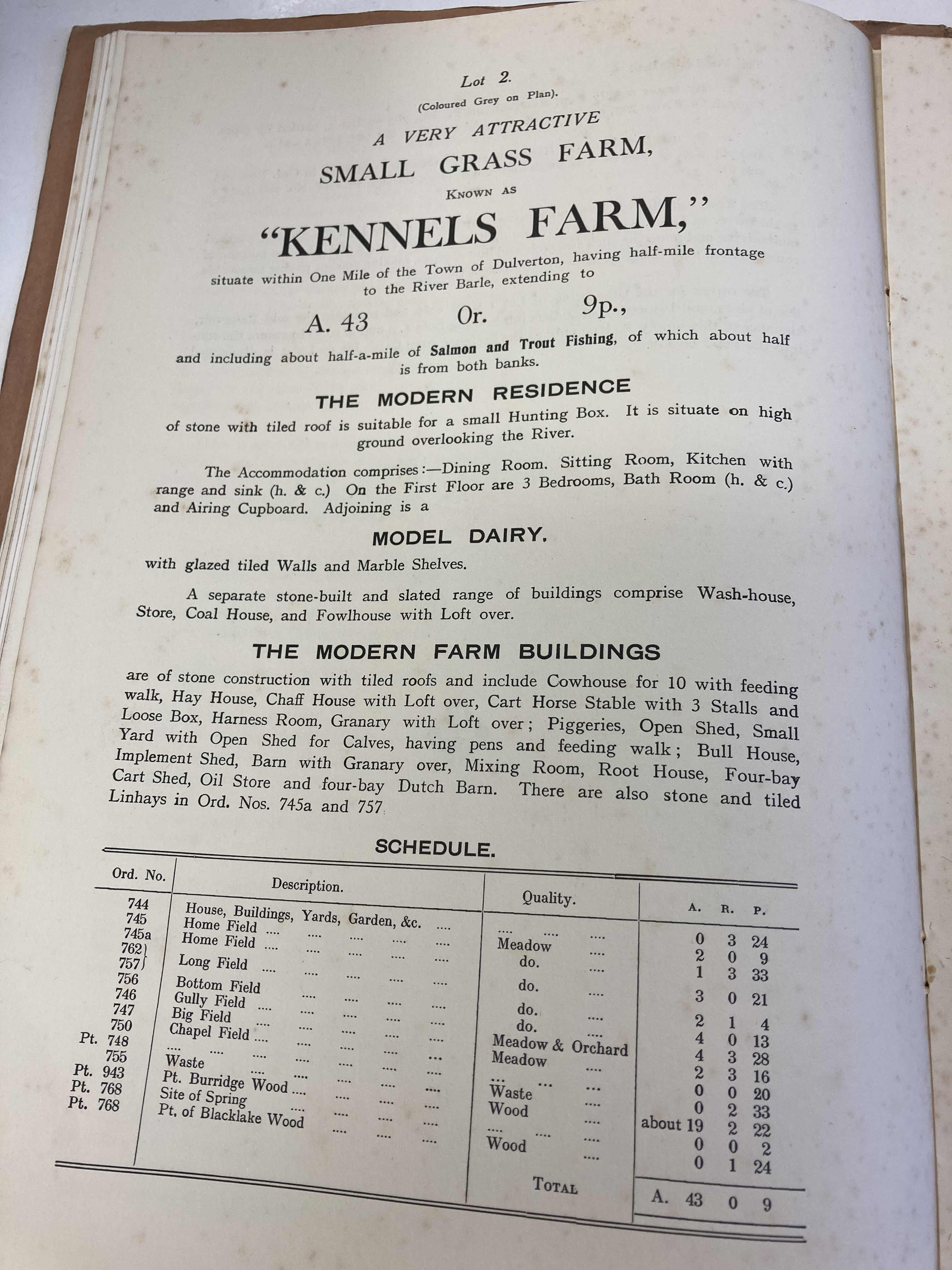
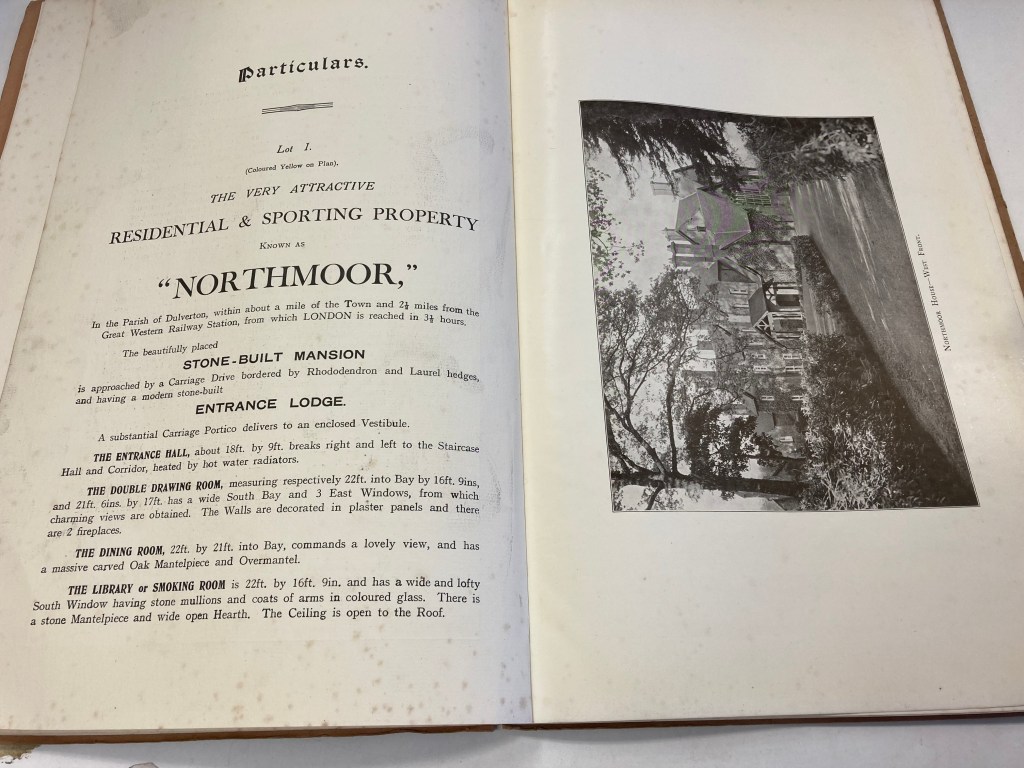
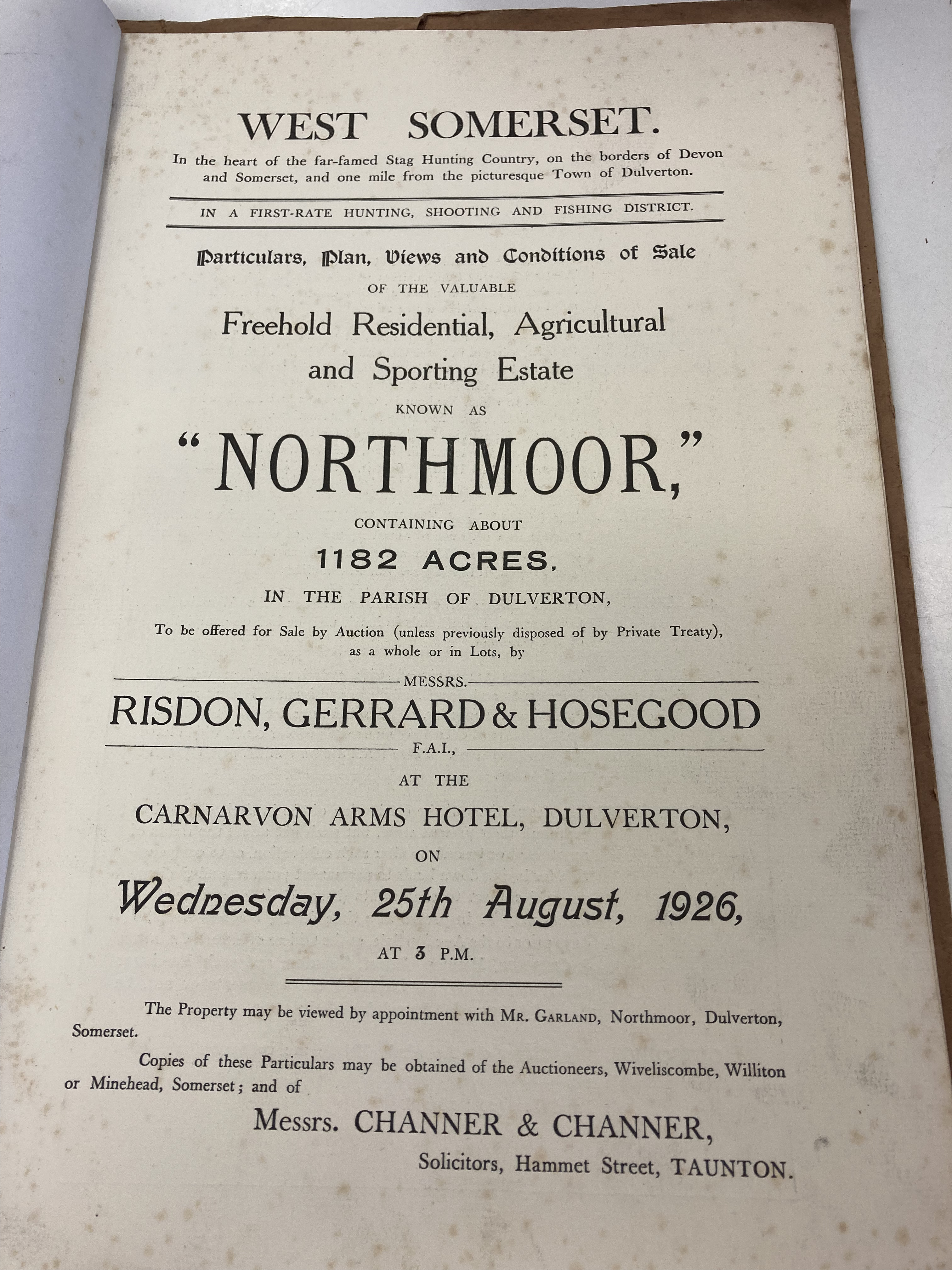
This is the particulars for a major estate sale in 1926.

Now, I couldn’t find another one for sale – which needless to say dear reader, means it is rare and a rather interesting read.

A bit of research, thanks Wikipedia, meant that I found out the estate was bought by Colonel Edward Clayton from the Wills family – indeed should that be ringing a vague bell, they were the founders of Imperial Tobacco Company and ‘in 1966 was the family with the largest number of millionaires in the British Isles, with 14 members having left fortunes in excess of one million pounds since 1910.’

In 1994 Edward’s son sold it on to Ralph and Suzanne Nicolson who now run the house as what looks like a very nice indeed holiday let. 

Clearly, a phone call needed to be made.

It turns out the family had tried to buy the a copy of the particulars but weren’t successful so they are said ‘Yes please’ to buying our donation.

Now, that is what I call a good day’s reuniting.

A Laugh In The Museum

Now there is no other way of putting this, I am about to show you quite a lot of holiday snaps so if that thought does not make you slightly breathless with anticipation, now is your chance to leave the room.

In case you are still with me, these are not (well maybe just one or two,) snaps of sun-kissed landscapes and wine dark sea – more of what made me laugh in Athens museums.

Don’t get me wrong, I love a museum and like very much looking at history and great works of art, but sometimes there is, intentional or not, amusing stuff.

See what I mean?

Now this is calling out for a better caption writer than me……

My best guess is the unseen censor is being told in no uncertain terms that it is well past six pm and no, music does not do the trick.

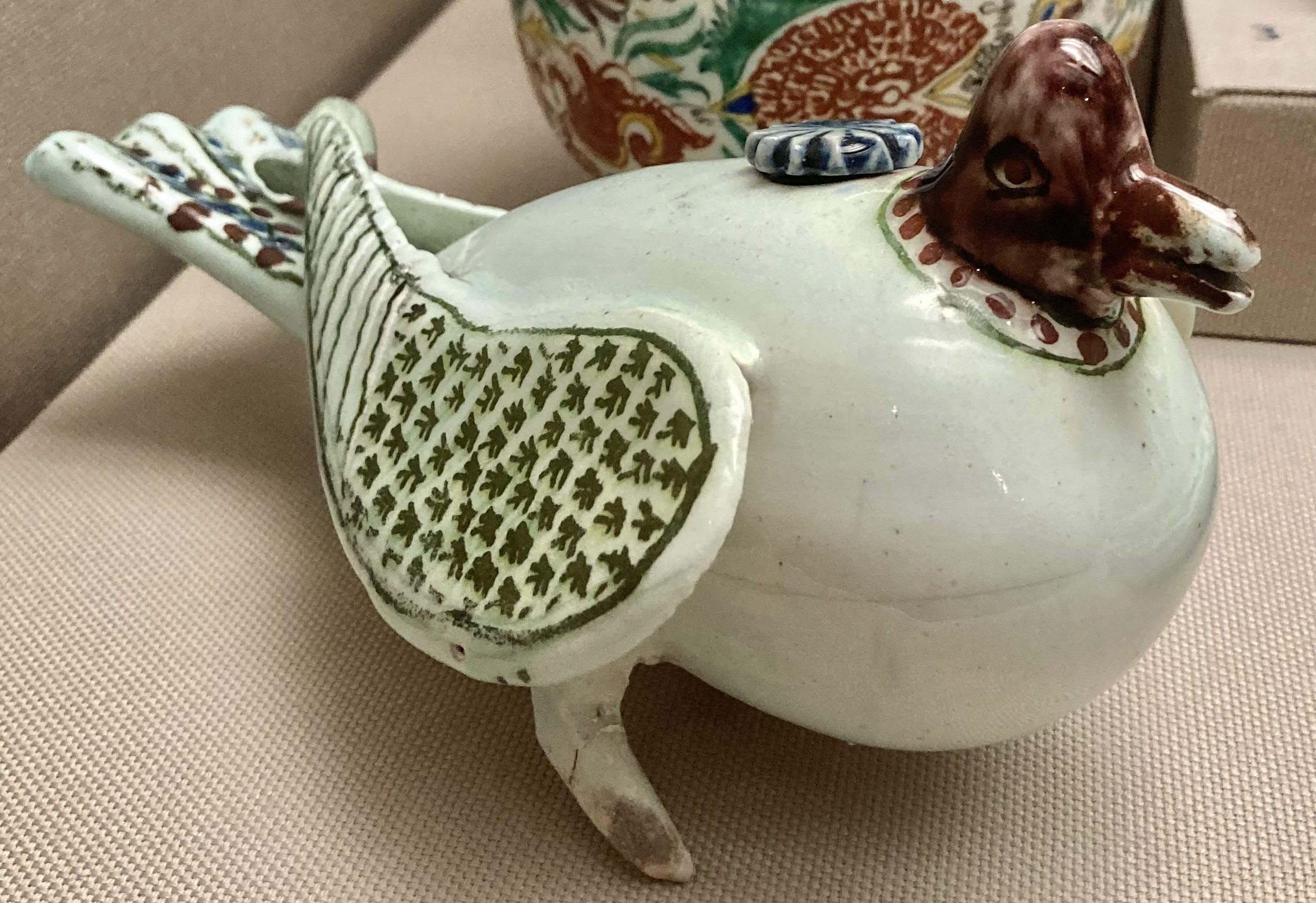
Now just because something is old, it may not mean that it is automatically a very good example of the potter’s art.

It may well have been found during the archeological dig of a rich person’s house, but hey who hasn’t kept something with no intrinsic artistic value but some sentimental attachment.

I rest my case

This made me laugh out loud which is not de rigeur in museums but really…..

I do realise that she may well have been a woman of a certain physique, but come on. Lechery is one thing, coy peeping of a nipple is another, but to distort her to fit round the dimensions of a chair……

Now, these are the images of Mohammed’s footprints which he left on the rock when he went to heaven in 621 for one night to talk to the prophets and Allah and brought back messages for the Muslim faithful.

Apparently.

All I can say is that apart from the slightly odd second toe being longer than the big toe, they look remarkably well conditioned feet providing a good basis for supporting a body.

My pilates teacher would be delighted, I thought but then on a whim I looked up what it meant to have a second, longer toe and guess what……

‘A Morton’s toe otherwise called Morton’s foot or Greek foot or Royal toe is characterized by a longer second toe. This is because the first metatarsal, behind the big toe, is short compared to the second metatarsal, next to it. The longer second metatarsal puts the joint at the base of the second toe (the second metatarsophalangeal or MTP joint) further forward. It is a type of brachymetatarsia.’

And, ‘It’s widely believed that a longer second toe is associated with being ill tempered and it’s recommended to keep one’s emotions in check.’

Who knew?

Meanwhile, Livy, a Roman writing about the appearance of Bacchanalia arriving from Greece offered ‘a scandalized and extremely colourful account of the Bacchanalia, with frenzied rites, sexually violent initiations of both sexes, all ages and all social classes; he represents the cult as a murderous instrument of conspiracy against the state. Livy claims that seven thousand cult leaders and followers were arrested, and that most were executed. Livy believed the Bacchanalia scandal to be one of several indications of Rome’s inexorable moral decay. Modern scholars take a skeptical approach to Livy’s allegations. (Wikipedia)

I love that last sentence.

Anyway, Bacchus and his followers are all over art – shedding their grape vines and overflowing cups around the place – and often there are satyrs.

So here’s hoping these are depictions of should-know-better satyrs and not young children with inattentive parents.

And finally, just because I can’t resist it….

Books & Covers

So, if you are still with me, lets’ go to Warren Hastings.

He who went through an impeachment trial brought on by Edmund Burke and whose biography appeared in our shop.

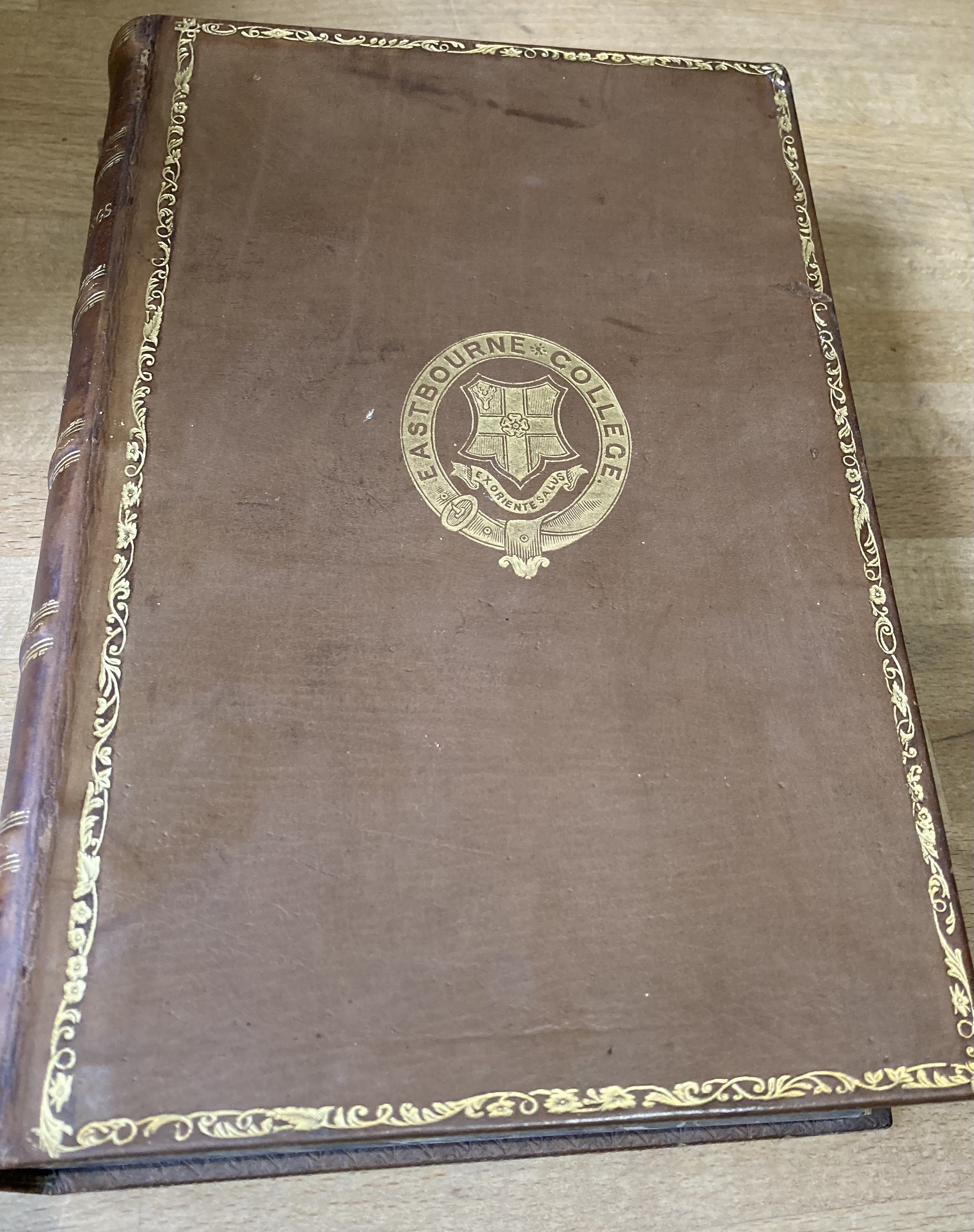
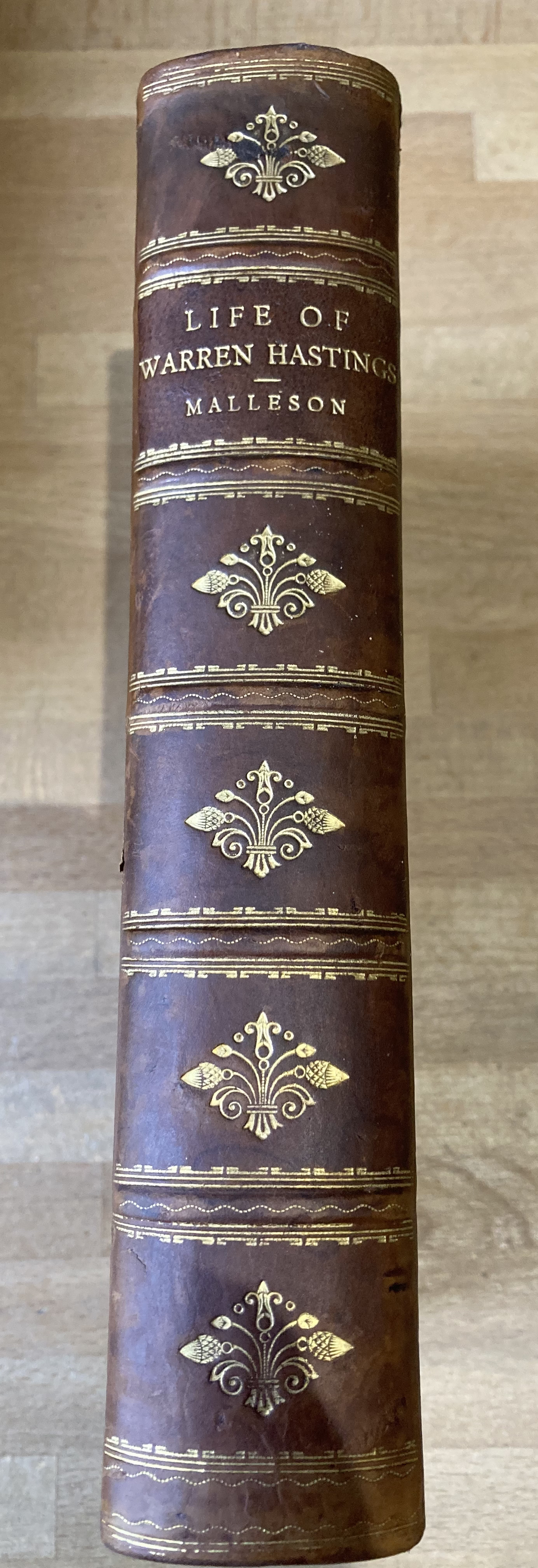
Malleson’s Life of Warren Hastings bound by the Relfe Brothers with a presentation binding but no presentation certificate.

If you want a translation of that paragraph let me tell you a bit more.

Usually with a binding like this, you would usually get a printed presentation certificate pasted inside with teacher handwriting saying something like ‘to George Robertson for excellent marks in history.’

Now, the Refle Brothers are really well known quality book-binders but can you find their story/history on Google? – well actually no.

No Wikipedia page – and yes I do give Jimmy Wales some money for all the use I make of his site.

So, if you look you can find books for sale with Relfe bidding and they are pricey, but you can’t find out anything about them – or at least, I haven’t yet.

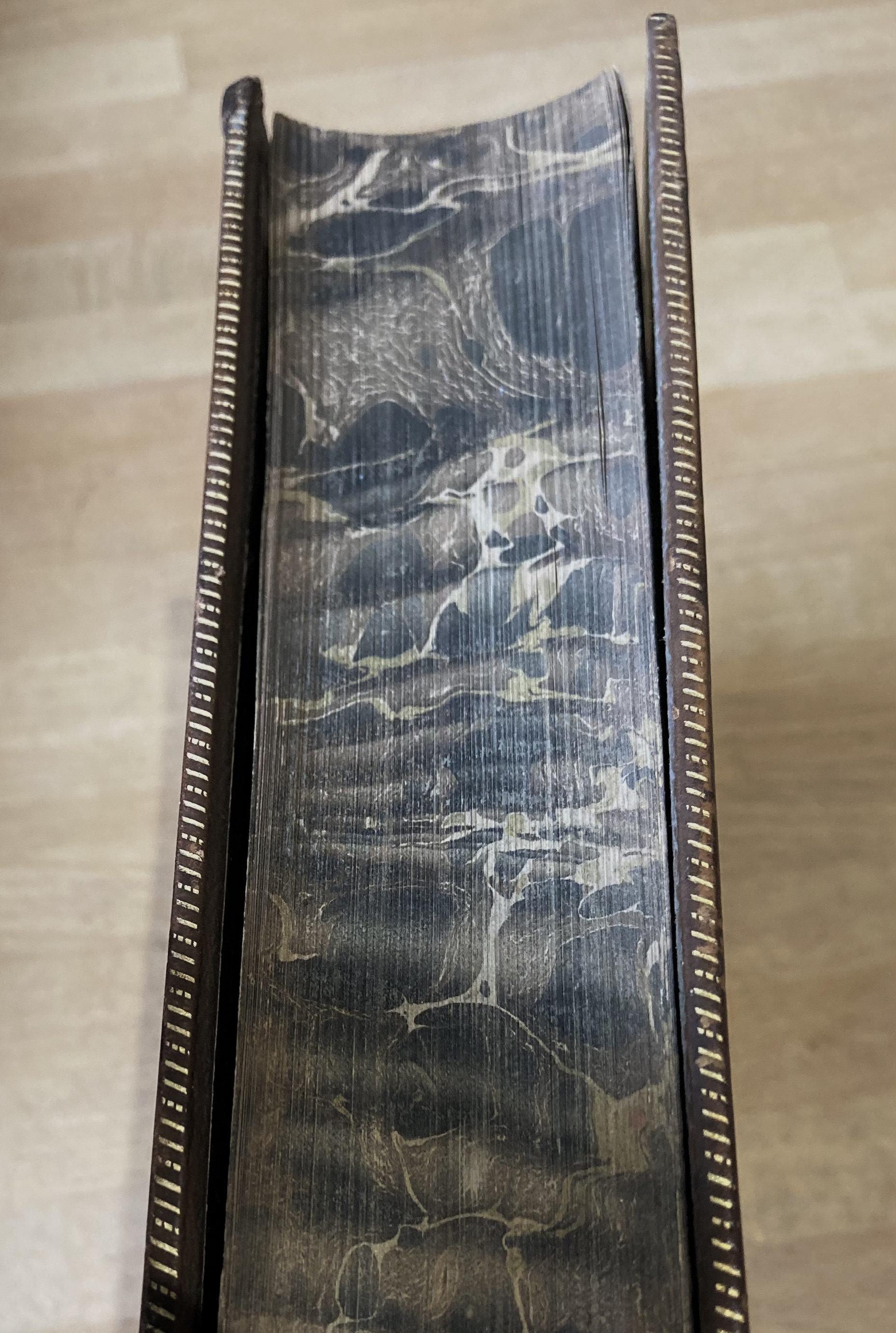
The page edges are marbled and I have flicked them to see if you do that a picture appears. If that was the case we would have a while lot more money to look forward to. 

So next time you see a book in a charity shop with marbled edges, just give them a flick and happily pay the money they are asking.

Now, you often get good bindings on really boring books and I am not sure that the boy ( usually) who got it was terribly excited about reading it.

Indeed the copy we have looks pretty much unread….

But see the hand-tooled gilt and the spine bands and the original marbled insides. Nice, very nice.

Now back to Warren Hastings.

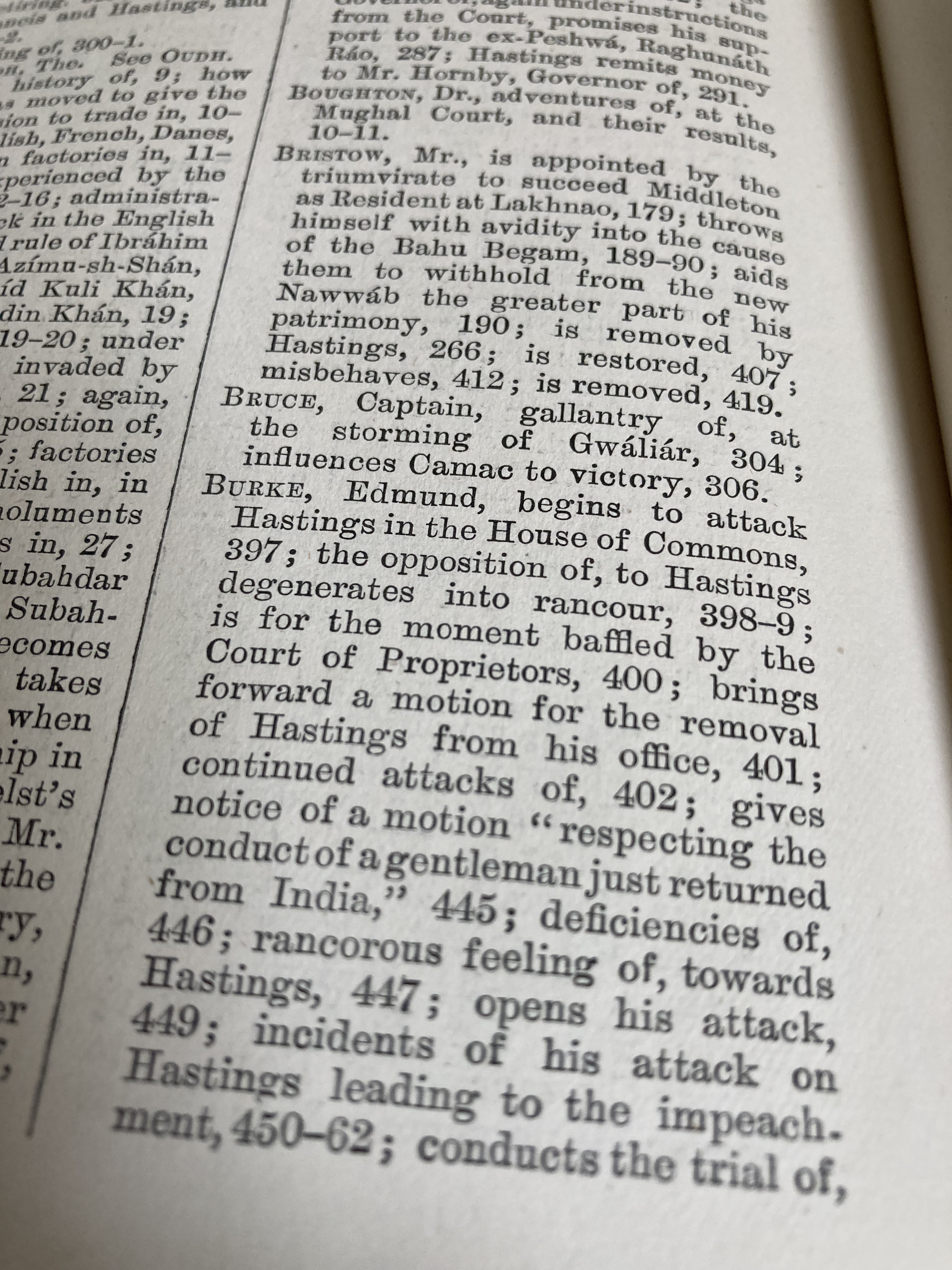
So Edmund Burke took two days to read the charges in Hastings’ impeachment. Mainly they were related to embezzlement, extortion and coercion.

The House of Commons sat for 148 days over seven years to hear this case.

In 1795 the House of Lords acquitted him and the East India Company, for whom Hastings worked, gave him a pension of £4,000 per year backdated to when he arrived back in England.

Hastings said the legal fees had pretty much bankrupted him but then he had lived in ‘considerable style’ in his London house throughout the trial……

And in 1788 he bought an estate in Gloucestershire for £54,000 had the house remodelled classical and Indian decoration, and gardens landscaped, and re-built its Norman church……not that living on lentils and no heating then. ( See also Rushi Sunak, again.)

Meanwhile, the East India Company was not just about trading.

Originally chartered as the “Governor and Company of Merchants of London Trading into the East-Indies”,the company rose to account for half of the world’s trade during the mid-1700s and early 1800s, particularly in basic commodities including cotton, silk, indigo dye, sugar, salt, spices, saltpetre, tea, and opium

The company also ruled the beginnings of the British Empire in India. (Wikipedia)

(Should you need to know more see my Best Beloved’s one-day-to-be-published history of Europe book.)

The EIC was either the beginnings of the glorious British Empire on which the sun never set, or the rapacious company implying all sorts of greedy, coercive, pseudo-rulers who imposed, stole, acted with impunity and had little interest in recognising they were not in charge – and indeed they became in charge.

I leave you to decide.

According to a site called History Reclaimed, ‘The impeachment of Warren Hastings was an act of imperial soul-searching unparalleled in history. Although Hastings was eventually acquitted, his trial was a warning to all future imperial proconsuls that they too could be called to account by the British Parliament. 

He was the first British Governor-General who launched India’s cultural renaissance way back in the 1780s.  Of all Britain’s imperial proconsuls, Warren Hastings was undoubtedly the most curious and learned about Indian culture and famously declared: “I love India a little more than my own country”.  

He became fluent in Bengali and had a good working knowledge of Urdu and Persian, the languages of the Mughal elite.  One of his most enlightened acts as Governor-General was to promote the founding of the Calcutta Asiatic Society in 1784.’

And, according to Wikipedia, ‘He and Robert Clive are credited with laying the foundation of the British Empire in India.

Getting a bit of an idea where Malleson is coming from.

Malleson was certainly on his side – a hagiography I would suggest but then with a Relfe binding, someone is going to buy this book because they have judged it by its cover.

A lot of time to research

This is about a book from 1796 which has arrived in Oxfam Petersfield in 2022.

And about a coincidence.

Be warned, there is a lot of this – I got a mild dose of Covid so was at home with time….

But at least this time there are some pictures.

Ignorance of the provenance of book is the lot of a charity bookshop. Indeed, I am not even clear which of our volunteers, put it aside for me to look at.

Anyway, we have it, and what an interesting book it is. (Value, you Antiques Roadshow aficionados, will come later.)

So this is a bound volume of three letters by Edmund Burke and for those of you who think who? Here is some info – actually, quite a lot of info.

https://en.wikipedia.org/wiki/Edmund_Burke#Later_life

And here are a couple of quotes which may chime:

‘The only thing necessary for the triumph of evil is for good men to do nothing.’

And:

‘Nobody made a greater mistake than he would did nothing because he could do only a little.’

Obviously, he was no feminist, but apparently he was anti-slavery.

He was also, depending on who you read, a founder of Conservatism and/or ‘a wet and a Eurosceptic’ according to the Beaconsfield Historical Society.

He wanted to be the Earl Of Beaconsfield and George III wanted him to be, but Burke’s son died so he couldn’t have a peerage. Life peers were only introduced in 1958 so if you didn’t have a male line to take it on, you didn’t get it.

What he did get was a handsome pension which was criticised by the Earls of Bedford and Lauderdale hence this:

His argument was that at least he had earned his pension by unstinting public service whereas the earls got their money by inheritance alone.

‘I was not, like his Grace of Bedford, swaddled, and rocked and dandled into a Legislator’

And he wrote in one of our letters, ‘Loose libels ought to be passed by silence and contempt.’ 

Meanwhile in a 1771 letter to the Duke of Richmond, Burke wrote that ‘persons in your station of life ought to have long views. You people of great families and hereditary trusts and fortunes are not like such as I am … we are but annual plants that perish with our season and leave no sort of trace behind.’

Oh yes, he had a good turn of phrase.

And according to Martin Greenberg, who also has a good turn of phrase:

In Letter to a Noble Lord (1796), Burke replied with a crushing force to two whippersnapper peers, obscenely rich enthusiasts of the philosophes and the French Revolution, who had attacked him for accepting a pension from the crown. He set his lifetime of accomplishments against the nothing of their juvenile efforts, his defense of their inherited rank and acres against their coquetting with a power whose universal ambition, if it were able to reach across the water, would have swept away all that they were and owned with a grin. Burke’s prose–sober-paced, weighty, powerful to the point of being overbearing–has always close behind its argumentation a reserve of poetic energy which now gleams, now flashes, and now, as in this letter, explodes in a fireworks of dazzling metaphors, a storm of epical-satirical language that tosses around the duke and earl, great galleons of the nobility, like little cockboats. ‘

Now I am not directly making any comparisons with current British politics but if you want to, be my guest.

Our book was published in 1796, the year before Burke died. 

Other things that were happening in 1796 include:

Jane Austen starts writing Pride and Prejudice, 

George Washington gave his farewell address warning against partisan politics ( that worked then), 

The British government began work on a 40 acre site at Norman Cross near Peterborough to become the world’s first prisoner of war camp,( who knew, and might need some more investigation)

At Christmas 1796, the French Navy nearly landed an army of 15,000 troops at Bantry Bay in Ireland. 

And Napoleon was appointed head of the French Army in Italy which was to have some significant ramifications….

Hence: 

Breathe easier, I am not going to give you a history of the Napoleonic Wars (though my Best Beloved can if you are interested.)

Burke wasn’t a fan of the French Revolution on the grounds because of its ‘origins and the class of people who were the driving force behind the Revolution’. 

Basically, he didn’t believe that the French urban working class, or the peasantry, could be trusted with legislative or political powers.

He had the view that only the ‘educated’ could be reliably left to run any country.

So, you can get the text of these letters online and you can buy them in the original but very rarely, infact, very, very rarely can you buy one from 1796 printed on such good quality paper – and in an original  binding. Most of them have lost their binding or were never bound at all – just get them out there, the printers must have said.

The paper is impressive. Very little foxing ( that’s the brown spots on the pages of old books) and it feels strong and thick and well cut, and well bound – impressive for such an old book.

We looked for a paper watermark but there wasn’t one. And I found out that this ‘book’ went into 11 editions in 1796. That is a lot of editions, and though the print run would have been the kind of print run were are used to, that is a lot of books.

And there are five raised gilt bands with gilt titling on the spine and gilt banding on the front and back boards.

Interestingly, at the bottom of each page there is the first word, or part of the word, of the next page. I have not seen this before, but maybe that is my ignorance.

It is also justified which means that the left and right margins are the same – and means that words are sometime broken up, or spaces are stretched to make the text fit the margins.

(That can make reading hard on the eye because different spacing seems disjointed. Our book, I have to say had a very good typesetter because it is easy to read.)

Is it about making sure the pages are in the right order? Possibly, but they are numbered.

Well, now you know a bit about how books are described online…..

And all that has been taught to me by someone who knows amore about books than I will ever do and who is the man who comes in ( when called up) and tells me what to look at, what to reasearch, what to learn…. and teaches me to expand what I know from the back of a postage stamp’s worth to, oh maybe a small postcard.

Waiting for the valuation? Well because it is bound and in great condition we are hoping for £275.

Maybe it will be sold asap or maybe it will take some time and be less than that – that’s the way it works.

Now, if you have got to the end of this and still have a memory of a mention of a coincidence….

So, Burke got his pension (I gather £2,500) in no small part for his work as Chairman of the Commons Select Committee on East India Company Affairs.

And he impeached Warren Hastings.

So when I went into the box of books that have been put aside for me to look at, under the Burke letters I found a handsome book – a biography of Warren Hastings….

I have no idea whether they were donated together or this is one of those coincidences that happen in the life of a bookshop when no providence can be found.

More of that next time.

And, we have another book from 1796, The History of America – perhaps more on that too.

Mushrooms and Beans – yes really

Well, there is a limited readership for this, I’m sure. If it is any temptation at all, there are some simple supper recipes involved – mind you only if you like beans, and indeed mushrooms and are not bothered about having food photos because there are none.

And, by the way, you are not wanting exact measurements and timings etc.

Hope I am not putting you off too much………

Otherwise, it will be back to Oxfam books next time.

So, I am a big fan of beans (and lentils) which apparently turns out to be a good thing as they are very good for you – and are cheap.

And, I am one of the very lucky people who doesn’t need to count the pennies.

( Me, and the Chancellor Rishi Sunak apparently. At least I am not making other people pay more than they can afford with no help from the Government whilst ensuring my multi-million pound lifestyle is protected. And has no idea that some families cannot afford for everyone to eat different breads…… Just saying.)

And, having listened to the BBC Food Programme ( an excellent listen) on beans I had a bit of a conversion. I had always bought tinned beans, now ( because I can afford it), I buy beans in a jar.

The taste is indeed much better and a whole lot easier than buying the dried beans, soaking them and cooking for quite a long time – before you even get to a sauce.

Mind you, I can see that coming on.

There are still some tins in the store cupboard and they will have to be used. And they’re OK, we’ve been eating them for years.

Meanwhile, I am stuck at home with a mild case of Covid and seem to spend my time doing some book research (see next blog) and, of course, cooking.

I asked my neighbour to add a couple of things to her food delivery order and one of those were some mushrooms.

Not the white button ones, though I can find ways of using them, but the large field ones – meaty without being meat – and very useful in the kitchen.

A while ago, I had some and made for us and the neighbours, mushrooms with tarragon and sherry. (Mmm you say ?- well hold on and I will tell you how to make them.)

I am of the view that it is very hard indeed to overcook a mushroom but recipes are always suggesting you can cook them in a matter of a few minutes. 

They are wrong. A bold statement I know, and one I have made before only to get messages which are the equivalent of a sharp intake of unbelieving breath.

But trust me. Don’t assume a mushroom meal is a quick meal. ( Perhaps a stir fry, I will concede, but really that is it. Not a step beyond.)

Anyway, my neighbour has a tendency to press the order button generously and now I find that I have a lot of mushrooms arriving this afternoon.

Part of the reason is the sherry and tarragon mushrooms I made for her and she liked quite a lot – so she added the big mushroom order.

So, here is what I did, – stuff:

Some nice mushrooms – remember mushrooms cook down to nothing (not quite the dramatic diminishing of fresh spinach when it is wilted, but not far off.) So, one container of supermarket mushrooms will feed two (ish).

Some chopped onion. I use half a small one for two of us.

Dried or fresh tarragon – to taste. Now fresh is lighter than dried, so up the quantity for fresh and be careful of the dried.

Garlic. Take a clove or two and if you want a stronger garlic flavour then chop it up. If you want a milder flavour crush them but keep them in one piece and fish them out before you serve it.

Some stock.

Dry sherry.

Chop the mushrooms to the size you want ( remembering they will shrink.) With the field mushrooms I do slices. Clearly, and you are not going to need this advice, the finer the slices, the quicker they cook.

Fry gently in a good amount of oil. Don’t stint but you are not deep-frying here. Don’t warm the pan and oil first, just put them all in.

Be prepared to wait and stir and check your emails, and stir……

Once they have got a good start in cooking, move to some hotter heat and add a lump of butter so that they brown a bit at the edges. It is worth it.

Once that happens go back to middling heat and add onions, once they have gone translucent, add the garlic.

Then some sherry – a generous slosh and you can always add more. I use some stock made from Marigold Bouillion. 

So we are planning on mushrooms in a sauce so not too much so that they are swimming lengths in too much liquid, but not so little that you can’t tell they are in a sauce. 

And some tarragon – if you are using fresh, save some back and chop very finely to scatter over the top of your finished mushrooms.

(This is not MasterChef so we are not talking amazing presentation just a little dash of poshness.)

Dried, I’d say a dessert spoonful, but we really like tarragon.

Cook, taste, and keep going until you are happy.

And again, you can always add more liquid(s) but it is hard to take it away so potter along adding as you fancy.

Meanwhile, back to the beans.

So, I had some frozen cauliflower and some (in a jar) butter beans.

Cook the cauliflower as per instructions or cook from fresh. Add some beans and whilst still hot, add some butter and finely chopped chives ( because I had them) and use a hand blender to make a puree or mash. ( Puree is best, I would suggest.)

Serve this under the mushrooms, and you have a very nice supper. As attested to by the neighbour and my Best Beloved.

Given that we have a shed load of mushrooms arriving that will be on the menu in the next few days.

And just before I go, a few more ideas because, as you can tell, I have not had much else to do whilst the plague keeps me at home….

Do the mushrooms as above but cook to be much drier and without the sherry and add in some chopped bacon/ham or not, if you don’t want meat.

Cook some pappardelle or any other long pasta you have.

Just before pasta is ready, add a large spoonful/ladle full of pasta cooking liquid and a few minutes later some creme fraiche to make a creamy consistency.

And, if you have any leftover puree/mash….

Make a sauce with (in my case)  tarragon and parsley.

Chop some onion, fry as per above and add herbs and a good slosh of white wine and some stock. 

This time you are looking for more liquid. 

When pretty much cooked add in a spoonful at a time of the left over puree to thicken the sauce and service with roast chicken thighs and some purple sprouting. Sauté potatoes if you are in the mood. 

Sauté potatoes = Par boil potatoes and fry in oil until crispy on the outside and soft in the middle.

More Maps

So finally an update on the maps – yes plural – but be warned there is a wince coming on. And a long read so, as ever, brace yourself.

Just a quick re-cap. 

In our unearthing of stuff the now-resigned manager had left stuffed under, in and around the behind-the-scenes parts of our shop, we found a lovely old map of Windsor and the 25 miles around.

We were very excited about this map and why not, it is a lovely old thing.

Anyway, as part of the shop’s lucky hinterland, I have been in touch with a man who has considerable expertise himself but as well as that, has his own hinterland of experts who can tell us what we have.

(We are lucky to have him and the occasional chat about what he has been collecting, things found in junk and charity shops, and what I have brought to him – are much appreciated.)

Brace yourselves, it is not always good news.

So, if you came across a map from the 1700s, printed and then hand-coloured with the local boundaries and the size of a smallish kitchen table, you might think you were on to a good thing.

But, apparently it was worth no more than £200. Our hinterland expert found someone in his hinterland and that man knew what he was talking about.

I thought a conversation with a local auctioneer might have be coming on, but decided to list it on Oxfam online first, just to see…

Meanwhile, more unearthing found us this.

Also from the 1700s but, according to our new and excellent expert, re-backed onto so later canvas.

Now a map of the Loire is unlikely to sell in the shop. We have relatively few customers who own a second home in the area.

I will list it on Oxfam online and see what happens.

Are you ready for the wince?

OK, so the lovely, hand coloured, printed as part of George III’s demand for accurate mileage between turnpikes, showing all sorts of interesting things including ” remarkable hills” Windsor map:

I did list it on Oxfam Online for £200.

And Oxfam decided to have (another) sale. Everything listed for more than three months got reduced. 50% and then 70% and so our beautiful map went to someone for just £75.

I was gutted.

Now I should have moved it out of the listings so that the sale would pass it by and that was something I failed to do – I would also have had a lot of books too to move – books don’t sell like clothes.

(Somehow, I thought that an old map, one as lovely as our’s would be exempt from the sale algorithm but that was me being distracted and not getting to check the comms about when the sale was sorted.

There were the 14 questions other volunteers had when I started the day, and the 20 things on my list of what to do that day, and the fact we needed milk for tea and coffee that I was making for us, so I went to get it, how to get an order for stationery when I don’t have a password to get into the system because I am a volunteer and not staff, the chat someone wants about the next few window displays, emptying the indoor bins and calling Biffa again about why they haven’t emptied the outside bins, someone texting me to say they can’t make their shift, who is going to cover Saturday afternoon……….. Excuses I know, but sometimes the urgent take over from the the important.)

Many books need to sit there quietly waiting for the collector of tractor books, or old maps, or special bindings, or the small publisher from the 19th century or or or…..

Of course, maybe we would never had sold it for £200 and yes, of course £75 all adds to Oxfam’s ability to help people for whom £75 is a vast amount.

I do know that, but I still think we might have got more.

Finally, on maps we have a map of Hampshire – yes Petersfield is in Hampshire – from 1821.

So, our expert got his experts to give us a valuation, and it is not much.

Think £30.

But, I am on a roll to recover from the Windsor map and I think there might be someone walking past the shop who might be willing to pay £75 for such a lovely thing.

We will try it and see.

But before I go, a bit about this map.

So, in 1821, Bournemouth didn’t exist according to this map, but according to Wikipedia:

‘Before it was founded in 1810 by Lewis Tregonwell, the area was a deserted heathland occasionally visited by fishermen and smugglers. Initially marketed as a health resort, the town received a boost when it appeared in Augustus Granville‘s 1841 book, The Spas of England.[1] Bournemouth’s growth accelerated with the arrival of the railway, and it became a town in 1870.’

They are both interesting men – worth a bit of a look.

And West Sussex where I live looks a bit like ‘There be dragons country.’

I have to say, that the dragons round here these days probably drive 4×4 and have swingy blonde ponytails but can breathe quite a lot of fire if you don’t give them room on country lanes and immediately move your Citroen Picasso into the ditch. Just saying.

Hundreds by the way are administrative divisions –

The origin of the division of counties into hundreds is described by the Oxford English Dictionary (OED) as “exceedingly obscure”. It may once have referred to an area of 100 hides. (In the early Anglo-Saxon period a hide was the amount of land farmed by and required to support a peasant family, but by the eleventh century in many areas it supported four families.[1]) Alternatively the hundred may have been an area originally settled by one “hundred” men at arms, or the area liable to provide one “hundred” men under arms.[2] (Note that in earlier times the number term “hundred” can itself be unclear, meaning the “short” hundred (100) or in some contexts the long hundred of 120.) Wikipedia.

And why on earth would Odiham (pronounced Odiam, in case you are planning a visit) be the point from which all distances were measured?

Odiham is the home of the Royal Air Force Chinook heavy lift helicopter fleet and I can attest to that because they fly over us – apparently learning how to go up and over the Downs as practice for some hills elsewhere.

Maybe also taking senior military types to golf, who knows…

But I gather that Odiham was equidistance from Winchester and Windsor.

Now, Winchester has a long history of power and clergy.

I have never been to that village but what a great address that would be. ‘Yes, itchings plural and no, I don’t know what the problem was.’

And well, Windsor, need I say more.

I’ll let you know if we get the £75.