As I have said many times before, there is drudgery about sorting through donated books – those from someone’s garage, a dead parents’ collection of national Trust house guides, dated cookery books, more books about every single allied aspect of WW2 than you can shake a stick at – and believe me, I do.
But there are treats, hidden gems, surprises, delights sometimes.
Out of a book, itself of no interest in itself, fell this.
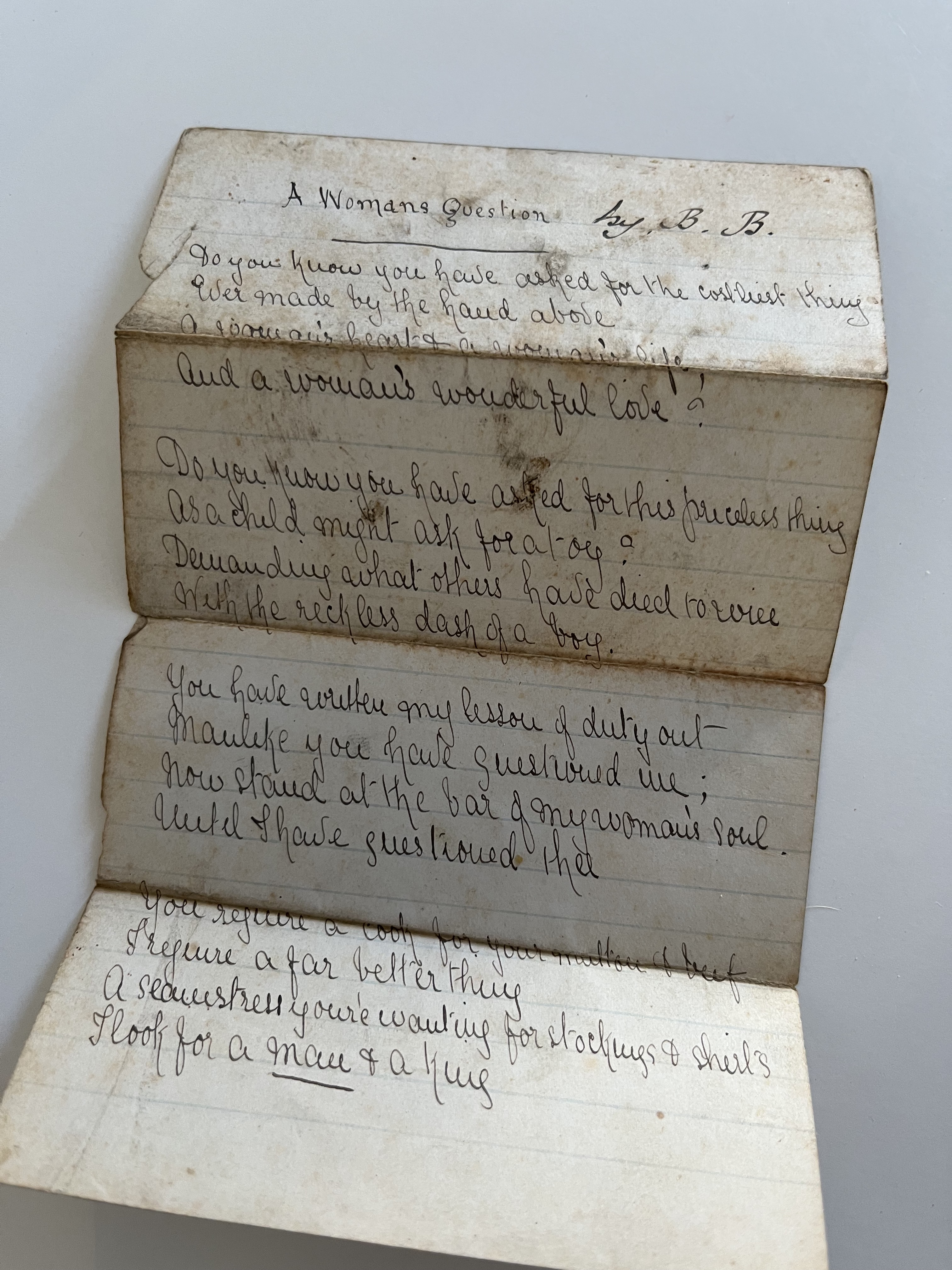
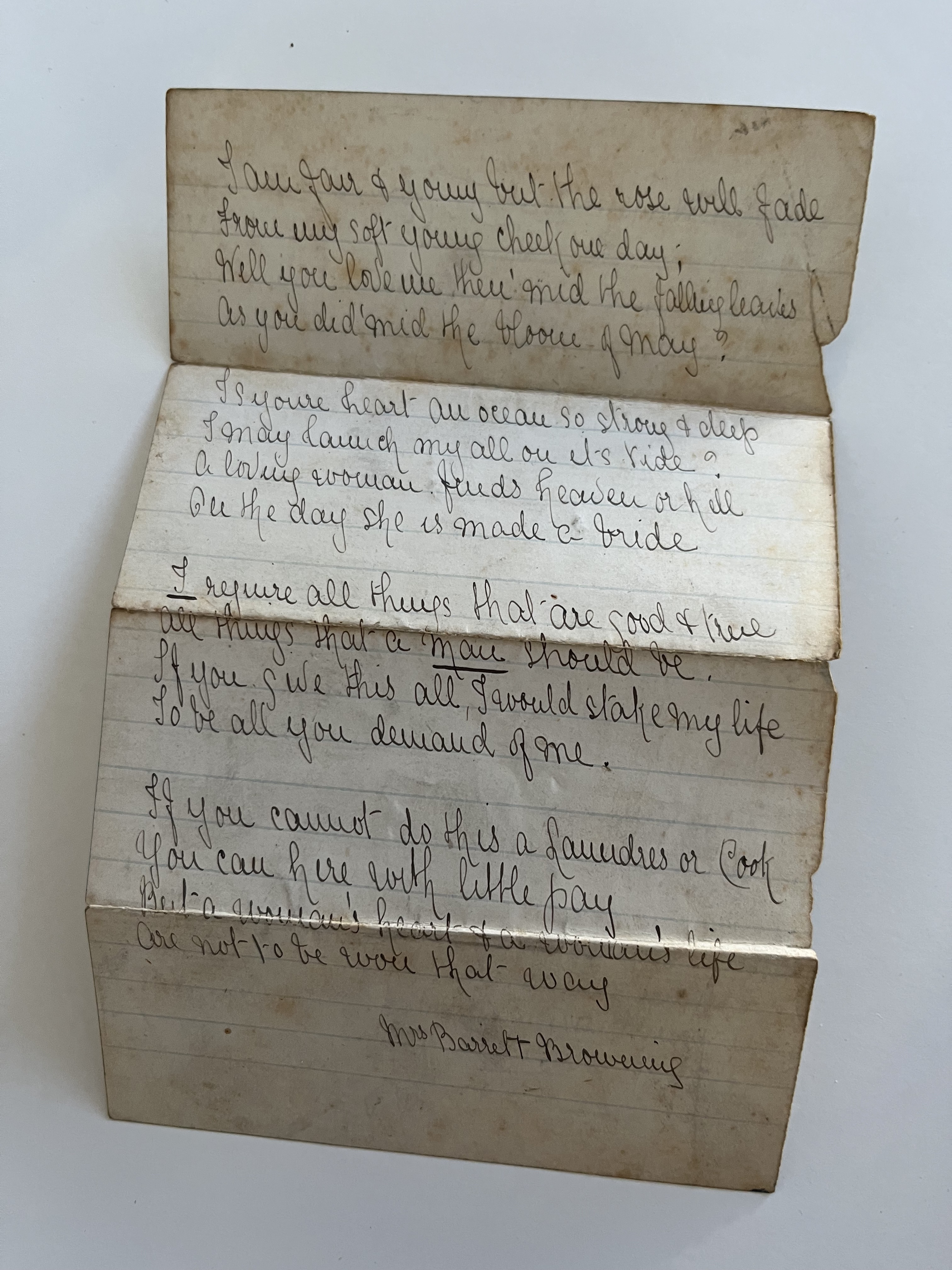
For about 30 seconds I thought we might have a real stunner on our hands, a sample of Elizabeth Barrett Browning’s handwritten poem.
Google immediately told me this was not her handwriting.
But it sent me down a rabbit hole or two and, should you have some time you don’t know what to do with, you are welcome to follow me.
So, having realised this was not in her hand, I assumed it was someone who had copied it out to keep, or in this case, as the book was dedicated in the same hand, to be given to someone special.
But no.
The poem is not written by BB, or even Mrs BB – not that I think she ever signed herself that.
It was written by Mary Torrens Lathrap 1838-1895.
According to Poem of the Week https://www.potw.org/archive/potw254.html
Lathrap, Mary T. The Poems and Written Addresses of Mary T. Lathrap. Julia R. Parish ed. The Woman’s Christian Temperance Union of Michigan, 1895.
As the book was compiled with the help of her husband and family, I am taking it as authoritative on the details of the poem, her name, and her life history. Such a statement may at first seem odd, but A Woman’s Answer to a Man’s Question has had a surprisingly rich history of being misattributed and miss-titled.
The most grevious error concerning the poem is replicated in Lawson (1927) where A Woman’s Question is credited to Elizabeth Barrett Browning. This error dates back to at least 1890 (J. Rose) where it seems that the poem was “generally attributed” to Browning under this title. It is unclear where these mistakes began.
Interestingly, at least to me, its title was originally:
A Woman’s Answer to a Man’s Question
(written in reply to a man’s poetic unfolding of what he conceived to be a woman’s duty)
In case you don’t want to squint over the original to decipher the handwriting, here is the poem so you can decide whether it is a good answer….
Do you know you have asked for the costliest thing
Ever made by the Hand above—
A woman’s heart and a woman’s life,
And a woman’s wonderful love?
Do you know you have asked for this priceless thing
As a child might ask for a toy;
Demanding what others have died to win,
With the reckless dash of a boy?
You have written my lesson of duty out,
Man-like you have questioned me—
Now stand at the bar of my woman’s soul,
Until I shall question thee.
You require your mutton shall always be hot,
Your socks and your shirts shall be whole.
I require your heart to be true as God’s stars,
And pure as heaven your soul.
You require a cook for your mutton and beef;
I require a far better thing—
A seamstress you’re wanting for stockings and shirts—
I look for a man and a king.
A king for a beautiful realm called home,
And a man that the Maker, God,
Shall look upon as He did the first,
And say, “It is very good.”
I am fair and young, but the rose will fade
From my soft, young cheek one day—
Will you love then, ‘mid the falling leaves,
As you did ‘mid the bloom of May?
Is your heart an ocean so strong and deep
I may launch my all on its tide?
A loving woman finds heaven or hell
On the day she is made a bride.
I require all things that are grand and true,
All things that a man should be;
If you give this all, I would stake my life
To be all you demand of me.
If you cannot do this, a laundress and cook
You can hire with little to pay;
But a woman’s heart and a woman’s life
Are not to be won that way.
I have to say that there are bits in that poem I do sort of get – if you want a wife who is a housekeeper, then get yourself a housekeeper…. just saying.
I have to say that Mary doesn’t sound like the kind of woman I’d be spending time with but each to her own…
Meanwhile, as they say and if you are still with me, Elizabeth Barrett Browning.
You probably know that she and Robert Browning started a correspondence which turned into a secret courtship as she was (rightly) convinced her father would disapprove.
They married secretly and moved to Italy for the rest of her life.
Mr Barrett disinherited Elizabeth as he did each of his children who married. Elizabeth had foreseen her father’s anger but had not anticipated her brothers’ rejection.[3] As Elizabeth had some money of her own, the couple were reasonably comfortable in Italy. The Brownings were well respected and even famous. Elizabeth grew stronger, and in 1849, at the age of 43, between four miscarriages, she gave birth to a son, Robert Wiedeman Barrett Browning, whom they called Pen. Their son later married, but had no legitimate children. Wikipedia
I do rather wonder why the father disinherited every child who married – not all the rage these days – just saying.
Anyway, you can read all about her in Wikipedia and many other places but there is one aspect of her life which is another rabbit hole for me.
I was brought up near Ledbury – a charming market town in Herefordshire.
You can, of course look it up but in the meantime think a lot of black and white buildings, a market hall built on stilts in which we hung around waiting for the school bus home – and indeed our (grammar) school which used to be the home of the Barclays Bank family, is now flats.
Think lots of interesting individual shops, some of which are indeed a bit precious, but also butchers, an ironmongers, a plethora of pubs, and a decent array of charity shopping options.
Yes, yes I am about to get to the point. Well, with a small rabbit hole to go into first.
Ledbury is the home of the UK’s foremost poetry festival and not just because of the connection with EBB.
There are long and deep associations with local poets and poetry in Ledbury including Elizabeth Barrett Browning, John Masefield, The Dymock Poets: Lascelles Abercrombie, Rupert Brooke, John Drinkwater, Robert Frost, Wilfrid Gibbon and Edward Thomas.The town sits at the foot of the Malvern Hills, the location of William Langland’s Piers Plowman. We celebrate being #LedburyPoetryTown.
( In a small burrow rather than rabbit hole, my first serious boyfriend was a great grandson of John Masefield – I am sure you are glad you know that.)
Right, brace up people.
Back to EBB and Ledbury.
So, in 1809, her father Edward Moulton-Barrett bought and extensively re-modelled a house called Hope End, just outside Ledbury and this is where Elizabeth and her many siblings lived for a few years.
It became ‘a new mansion of opulent Turkish design, which his wife described as something from the Arabian Nights entertainment’s, was built to a design and with a garden by John Claudius Loudon. It was built in the ‘Moorish Style’, with minarets. The interior’s brass balustrades, mahogany doors inlaid with mother-of-pearl, and finely carved fireplaces were eventually complemented by lavish landscaping: ponds, grottos, kiosks, an ice house, a hothouse, and a subterranean passage from house to gardens.
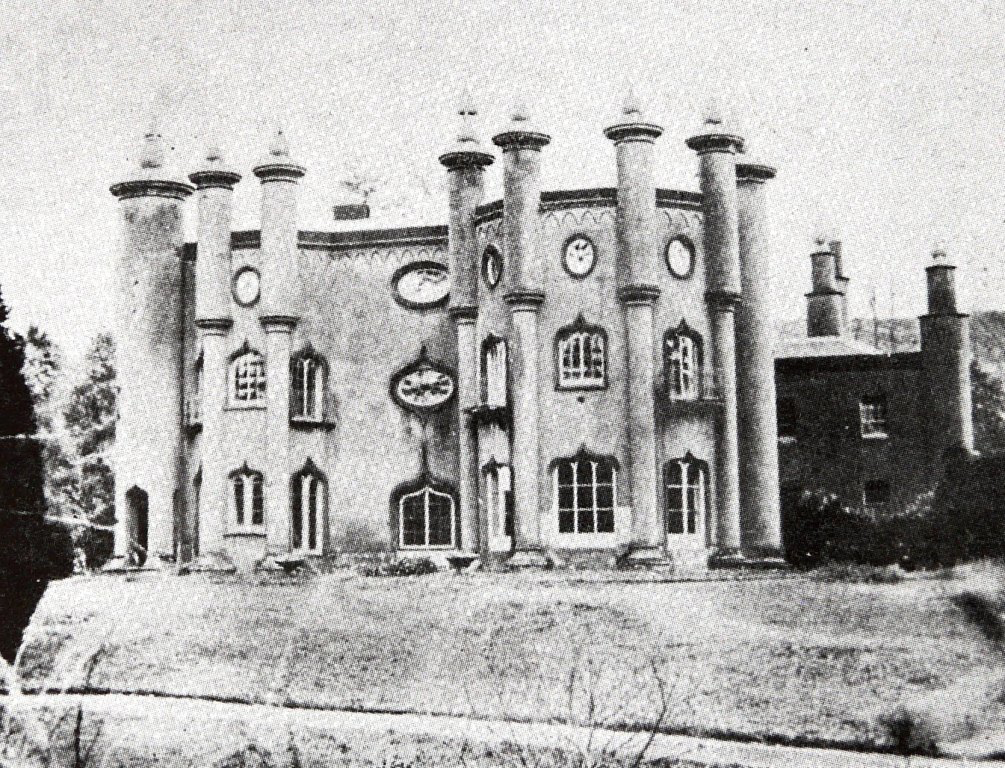
How did he afford this rather bizarre anomaly in the Herefordshire countryside?
Born in 1785 in Jamaica, Edward didn’t get on too well with his father Charles Moulton, but his hugely wealthy grandfather Edward Barrett needed an heir so had the name Barrett added to Moulton before he died. Edward Moulton Barrett and his brother then inherited their grandfather’s plantations and fortune.
Ah, that is how.
But it was not to last.
Not long after the huge expense of rebuilding Hope End, the African slaves took their rebellion in Jamaica up a notch, and many escaped from the plantations or flatly refused to work. Houses were burnt down and sugar cane was destroyed by the rebels, who also took control of many plantations. Of course in the end the rebellion was quashed, although it did help to accelerate the end of slavery, but the damage to plantation owners was immense and Edward lost a vast amount of his wealth. His mortgage was foreclosed and he was forced to sell Hope End shortly after the death of his wife.
Don’t feel too sorry for him – he still had property in London and ‘retired’ to Wimple Street.
If you want more information, and surely you do, go to herefordshirepast.co.uk and you can see the photos of the famous burning down of the house….
Well that is it.
What will I do with the written out poem?
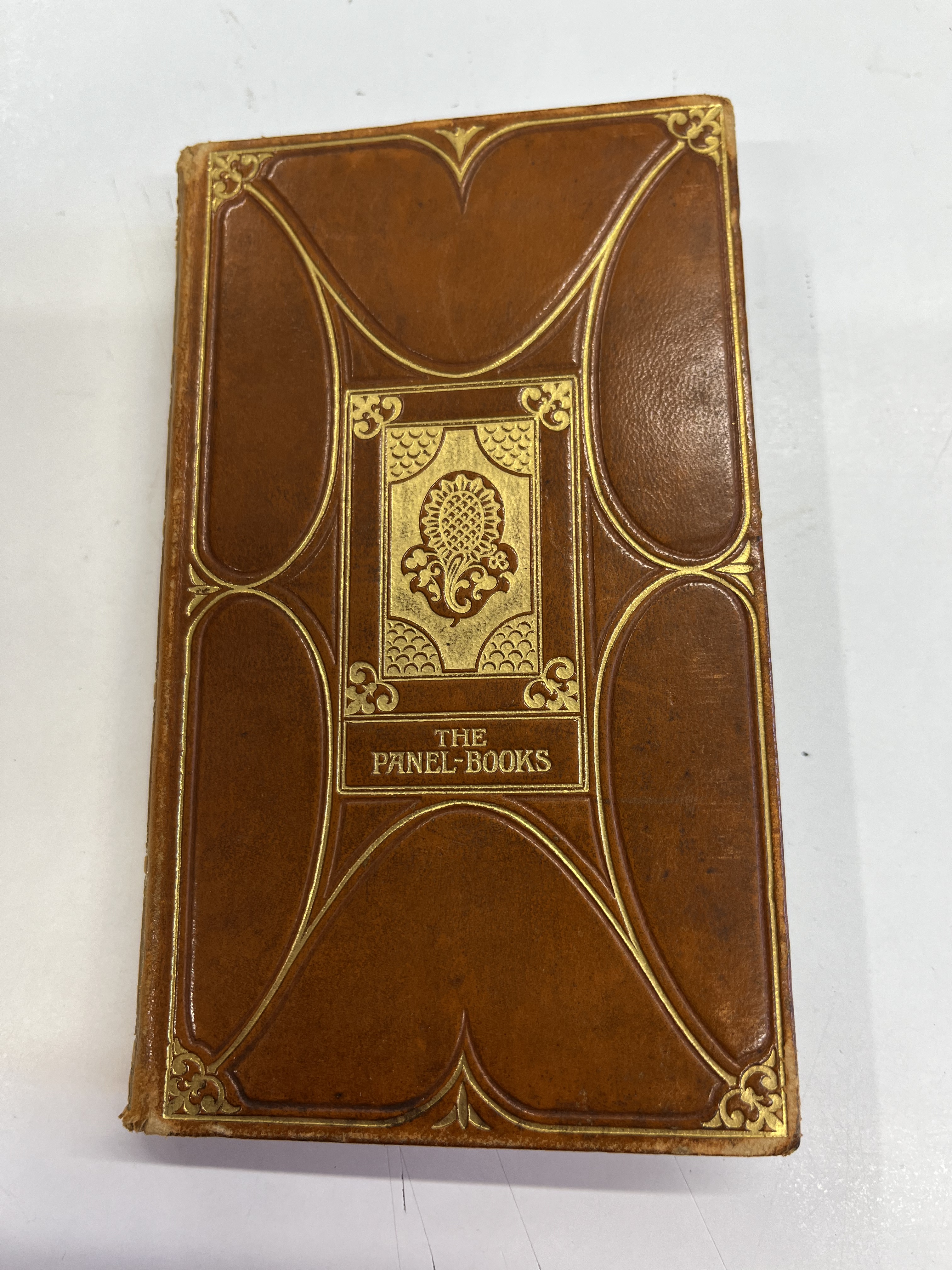
I have slipped it into a nice old book, put it on the Oxfam bookshop shelves and will wonder if the person who buys it will find the same rabbit holes I did.
 thereluctanthousewife